DD
MM
YYYY

PAGES

DD
MM
YYYY

spot_img

PAGES

Home Blog Page 7099

Which Microfinance Bank License Is Good For Nigerian Fintechs?

0
Microfinance bank Nigeria

If you check the microfinance bank licensing process in Nigeria, you will notice that it was written before the mobile internet era. It remains to be updated as I write. They have the unit, state and national licenses. According to The Vanguard, less than 1% of all the institutions have national licenses: “Less than one percent of Microfinance Banks, MfBs, licenced by the Central Bank of Nigeria, CBN, have national licence to operate in the country.” 

(1) Unit microfinance bank – with paid up capital of N20million,but without branches/ cash centres beside the main office.

(2) State microfinance bank – with paid up capital of N100million.To operate within the same state or the FCT subject to written approval by the CBN for each new branch/cash centre to be opened.

(3) National microfinance bank– with paid up capital of N2billion. Can operate all over the states or the FCT subject to written approval of the CBN for each new branch/cash centre.

Now, if you are a fintech startup which needs a microfinance bank license to support your operations on the web (like lending, saving, transfer, etc), which one would you go for?

Technically, a unit microfinance bank license may do, if the startup uses only the headquarters for its financing related operations. But doing that would create a big problem in the unbounded and unconstrained internet distribution system which enables that unit (microfinance bank) license holder to reach customers across Nigeria (the expected domain of the national license holders). Would doing that be out of compliance to the Central Bank of Nigeria? In the rule book, you have one physical office. Of course, internet has unbounded your distribution, making it possible to reach national clients.

The CBN, please update some of our regulations to remove ambiguity in our mobile internet era. While a unit license holder, operating on the web, can meet the physical domain requirement, the fact is that the risk is now at national license scale. Without fixing that, we can allow a systemic risk in the system.

This is what I suggest: The national license should be updated to National/Internet License making it clear that to operate on the web as the core distribution platform, any microfinance bank would require a national license.


Respond To People, Do Not Take Yourself Too Seriously

0
yourself too seriously

LinkedIn Summary: Humility brings accessibility. Accessibility opens doors to do great things. Business is about expansion and addition, work out ways to manage how to do that.

If you have a habit where you do not respond to emails, you do not answer phone calls, and yet you run a business, you are in trouble in Nigeria.

Being an entrepreneur means losing some of your personal rights to time! But where you want to hold the full rights, you need to go and look for a job in a bank, oil company, telecom or government. They have systems that make money and even if nothing happens, your paycheck is going to come. But if you open a shop, you will fail if you have that attitude.

Do not take yourself too seriously. It would be impossible to serve markets if you do not have the spirit to connect with people. Returning a client’s phone call and replying that email could unlock a great future. Learn to be nice to people – good things will come to you. 

The best audition happens when there is no prize. Audition always.


You know them – they never returned emails. They never return phone calls. They see everyone (but few) as forgotten. If you want to thrive, as an entrepreneur, do not be like them. Yes, there are people who just build relationships upwards and never bother to check what is happening downwards.

The fact is this: to become a good businessman or businesswoman you must develop a skill to make people feel good around you. You need to make customers feel appreciated. And you need to make everyone feel that way because today’s stranger may be customer or partner tomorrow. That is why people with skills to connect with humans typically make good business leaders.

Responding with “Noted” or “Thanks” or “Not possible” over ignoring people will not make us lesser humans. One of the things I tell close associates is that as you begin to find success, do not get trapped into thinking so much about yourself. By that, I mean, categorizing people. You stop picking calls. You stop responding to emails. And you stop endless excuses why no one can reach you in a week.

But that was that guy that had no start or end time. People liked the ability to reach you. Now, it is 8am-4pm as though that works for small companies. Being an entrepreneur means losing some of your personal rights to time! But where you want to hold the full rights, you need to go and look for a job in a bank, oil company, telecom or government. They have systems that make money and even if nothing happens, your paycheck is going to come. But if you open a shop, you will fail if you have that attitude.

Yes, if people call you twice and cannot reach you, they move on. If you check carefully, it is arrogance. Avoid it by all cost. Do not get trapped into the “alpha personality”. You might have hustled to find success, do not change that.

Humility brings accessibility. Accessibility opens doors to do great things. Business is about expansion and addition, work out ways to manage how to do that. Why it may not be possible to handle all calls, emails etc that come to you, delegating and shifting responsibilities make sense. But if you begin to make yourself so busy that no one can reach you, you are saying that you are too busy for new opportunities and partnerships.

But I never believe it is really about work. Most times, you are taking yourself too seriously. Possibly, you have a new title or you have added a new degree. Interestingly, those things do not matter when you are running your shop. People judge your business in the value they get and not the degrees you have. If they hire you and within 48 hours no one can reach you on emergency because you are busy, that would be the last contract.

Thank You Nigeria

1
Thank you Nigeria
Nigerian flag

Few hours ago, we received an email from one of the leading agencies in the Federal Ministry of Health that they would like to work with us on Medcera. Our Community Manager reached out asking what to do. Quickly, I told her the only response was Big Acceptance. Yes, we are honored that the agency reached out. But to avoid bureaucracy we would streamline the interface to make sure everyone gets value from the partnership. Our vision is to help fix a major friction in the healthcare system in Nigeria: disparate data resulting to poor patient outcomes.

Getting support from government in Nigeria is not very complicated if you understand Nigeria. Yes, our leaders are looking for help in some key areas. If you can help, they would come with support. I have made videos and wrote about this in my book – Africa’s Sankofa Innovation. Watch the videos, and read the piece. Ideally, government is majorly about policy; it is only through markets it can execute. If you position to attack those forgotten areas where they have real pains, they would call.

I can tell you that the focus has been qualifying partners over the last few days to support in Liberia, Namibia, Botswana, Ghana, Sierra Leone, Nigeria, etc [apply here]. They are coming and we are working with these businesses to strengthen execution models across markets. We have not even started government aspect of business development. I am happy they have noticed our vision: we welcome and ready to work together.

Thank You Nigeria, as always.


Africa’s Most Fearsome Fintech Competitor

0
opera crypto wallet. opera payment

I delivered a presentation to a South African client today via video. It is a fintech company, and I was tasked to offer the state of the fintech industry in Africa. Everything went fine (no tension) until I went into latent competitions of the near future. We examined them across different nexus. One is really fearsome.

Yes, one of the major latent future competitors is not really the fintechs getting licenses from the Reserve Bank and its agencies (like Central Bank in Nigeria and units). Rather, the biggest threat on the web payment is OPERA for the firm and most African fintech firms.

(USSD, mobile money and things like MPESA are not popular in South Africa. Typically, areas with pre-existing fairly mature infrastructure do not need such “leapfrogging” as what was available is just good enough for people to bother. That explains why no one would pay huge attention to MPESA in U.S., Germany and Canada.)

Opera’s strategy is brilliant for the firm, but it will put it in the crosshairs of many local companies. As more Africans use Opera, most local companies can experience erosion in their brands. Yet, it is also possible that Opera can move in the path of aggregation where it can make it easier to find leading payment, ecommerce and other partners through its browser. But no matter what happens, I do expect massive dislocation as Opera becomes a platform with commercial activities happening at the level of browser. It will be very interesting: Opera needs a business model to make money.

Opera is evolving as a web operating system in Africa. This company has a promise to automate out the need for most financial services to go beyond a browser. Why launch a web app for payment when that is available right in the browser? Yes, if your browser can enable you to make that payment, there is no need of visiting a fintech website to do so. And when you notice that Opera is really popular in Africa, you get the picture why this company can redesign the sector.

Across the continent, the trajectory is that Opera will build platforms with capabilities to abstract away most internet services at the level of its browser. My thinking is that Opera will increasingly make it easier for the bulk of its customer base to do more on its platform, thereby saving them more money in visiting the main Internet. Technically, your Internet can end in Opera because it will allow you do most things there. Simply, Opera is transmuting as an aggregator right at the browser level.

Because Opera is engineered to save you money when you browse, keeping you to its platforms makes a lot of sense. You do not have to visit websites where you spend too much mobile credit if you can get your news, games, financial services, etc delivered by Opera at the browser level [Opera technology minimizes the consumption of mobile credit]. It is investing $100 million in Africa to do just that.

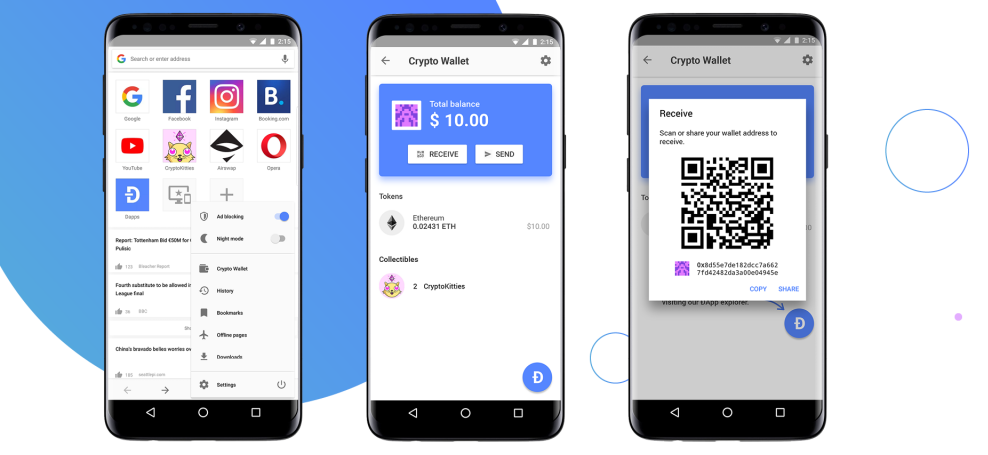
Now, the company wants to add crypto-wallet at the browser level, enabling the transition to Web 3.0 and web decentralization at scale. If it enables that, it may be winning Web 3.0 payment even before it begins in Africa. This is why this company is at the payment forefront even though most refer to it as a browser.

In a first for the company, Opera is launching new browser software that has a built-in cryptocurrency wallet.

The browser maker said Wednesday that its “new version of the Opera browser for Android… combines easy-to-use crypto wallet functionality with support for the Ethereum Web3 API.” The browser is currently in private beta, which the company is now inviting new users to join.

This means users no longer have to open a new web browser or download a separate extension to send, receive and pay in cryptocurrency – now they can do so directly from a toggle on their browsers on mobile Android devices.

It is an especially useful announcement for developers of decentralized web applications – more commonly known as dapps – given that the new browser functionality indicates users can now more easily interact with dapps being built on the ethereum network.

The Opera crypto wallet and general payment tool would be the grand-king of the consolidation of payment interfaces in Africa and could become ubiquitous that if you are not in it, you may be hidden in the “dark web” of African web payment. That is a threat to anyone doing fintech/payment in the continent.

Business Lessons From Croatia’s Football Call To Mission

0
Croatia team

Croatia is a very small country. It is a country of about 4.2 million people (think of Greater Ikeja in Lagos). Yet, it has booked a ticket to the Final of the World Cup. Its players and flag would grace almanacs across nations where football remains a religion and sports. What they have accomplished is mind-blowing. In the world of technology, it was like the young Google in late 1990s going after Yahoo on search. The difference here is that sports is an ephemeral endeavor with no gross margin. But make no mistake: there is nothing that endures in any generation like when legends make histories in sports. When I visited Greece for a conference, many knew Nigeria because of sports and specifically Nigeria’s 1994 World Cup squad.

The fascinating achievement of Croatia should teach us a big lesson in business: building and nurturing teams matter. Except Ivan Perišic (Inter) and Mario Mandžukic (Juventus), I did not know of any other player in the Croatian national squad before this competition. These men came to play, and with commitment and dedication, they have reached the zenith of their professions. The coaches brought them together and executed a mission.

From companies to nations, those that answer great missions typically shape everything. But sometimes they do pay severe personal penalties. At different levels, a Call to Mission requires extremely committed people. Even in your business, you must have that capacity to find and recruit people that can help you execute a great mission. You must prepare them. Equip them. And push them to come and get glory.

Go back to your business. Check how you can build a team with what you have. There may not be Ronaldo or Messi. But you have people. It works for nations across sectors and industries. America continues its mission of technological advancement. China is doing just that also. Croatia has shown that even in sports, a nation can pick 11 men from a population of 4.2 million to win at least a silver medal when some with excess of 100 million barely qualify. Simply, if people commit to something, they have a chance to achieve.

Croatia will play France on Sunday for the Gold; they would look good on the medal stage. They have done well and would possibly expand the number of countries that have won the World Cup. France had experienced that glory before; Croatia will want to complete this Mission. It would be good they do it, though I have predicted that France will win this.