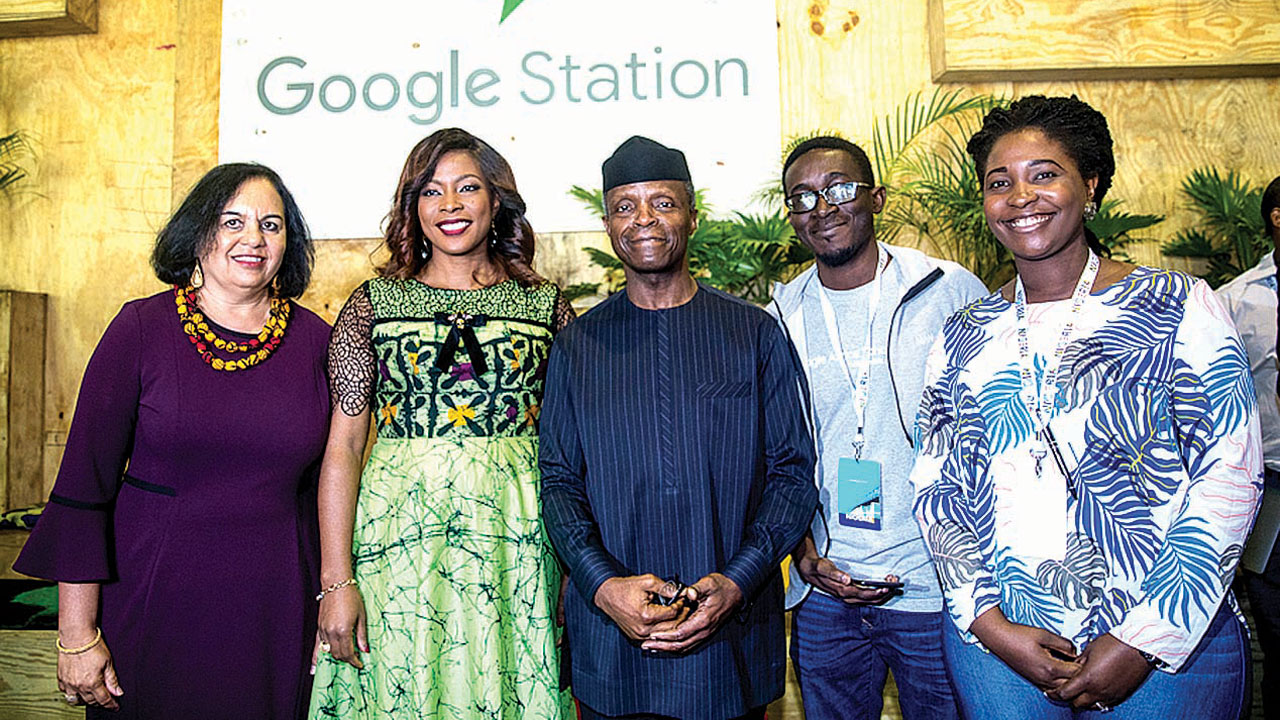
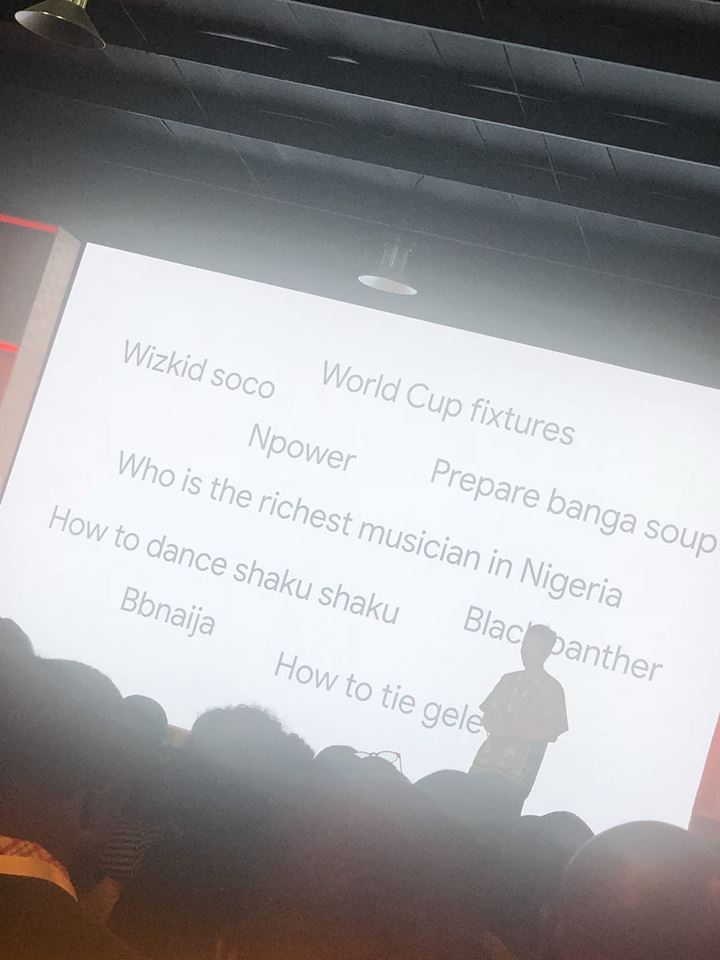
The Vice President of Nigeria, made this comment during a Google event in Nigeria. He noted that Africa’s fortunes will shape the world, and democratization of technology will be a quantum leap for Africa’s development. Google has launched an initiative to provide free internet access in Nigeria.
“This Century is Africa’s Century. Why? Because Africa will, for good or ill, play the defining role in global development. Africa’s fortunes will matter across all the trends shaping the world. I say for good or for ill because either scenario is possible. If Africa fails on these important development issues, because of our sheer size, the global impact will be catastrophic and if it succeeds the global impact will be incredible.”
“Technology has put great power into our hands, as individuals, but more importantly as co-creators and collaborators, to positively and dramatically change the course of human existence. With it, we can solve many of the problems that confront us.” – Prof Yemi Osinbajo, Vice President of Nigeria.
Just yesterday I revisited my model that by 2022 Nigeria would have immersive mobile connectivity that would enable new categories of web-based businesses at scale. I noted efforts which would catalyze that future. Today, Google launched Google Station in Nigeria to roll out public Wi-Fi in 200 locations.
The VP also presented a keynote which is shared below.
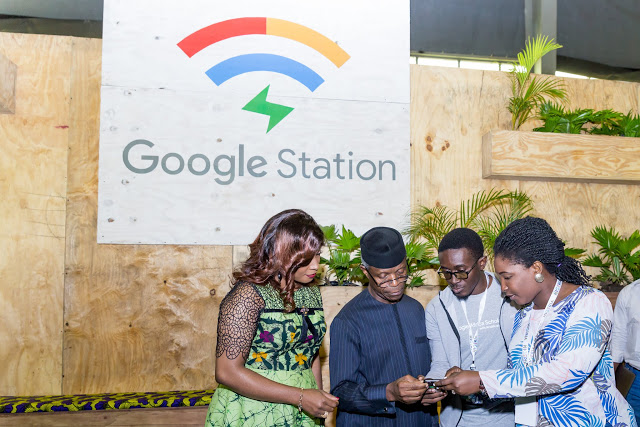
Keynote Address by his Excellency, Prof. Yemi Osinbajo, San, Gcon, Vice President, The Federal Republic of Nigeria, at The Google for Nigeria Event in Lagos, on Thursday, July 26, 2018
LAGOS, Nigeria, July 27, 2018/ — Keynote Address by his Excellency, Prof. Yemi Osinbajo, San, Gcon, Vice President, The Federal Republic of Nigeria, at The Google for Nigeria Event in Lagos, on Thursday, July 26, 2018:
PROTOCOLS
I am delighted to be to be here with you today at this year’s Google for Nigeria event. Just couple weeks back, it was a special pleasure to be welcomed to the Googleplex by Google CEO, Sundar Pichai and his great management team. We all have very warm memories of that visit, and I am truly grateful for your kindness and warm hospitality.
About three months ago, I spoke at an event at the Warwick University on the subject “The African Century.” The substance of that speech was that this Century is Africa’s Century. Why? Because Africa will, for good or ill, play the defining role in global development. Africa’s fortunes will matter across all the trends shaping the world. I say for good or for ill because either scenario is possible. If Africa fails on these important development issues, because of our sheer size, the global impact will be catastrophic and if it succeeds the global impact will be incredible.
In at least four important respects, Africa will hold the balance of world development. First is in world population (demography). Second is environment and climate change. Third is productivity. Fourth is social exclusion (or inclusion as the case may be) and its implications for global security.
Let’s take population, by 2035, Africa will have 1.2billion people. Nigeria is Africa most populous country; she will become the 4th most populous nation in the world. Over 50% of that number will be young persons under the age of 25. Today 60 percent of the unemployed in Africa are young people. If we do not change the trajectory of socio-economic development, we would have millions of jobless young people in the prime of their lives, and as we will see, largely illiterate and /or poorly trained. The workforce will be ill-equipped to man any industrial revolution or take advantage on scale of technology. The anger, disillusionment, and hopelessness of these young people will drive social unrest, compel more desperate migration northwards and present a fertile recruiting ground for extremist groups. If social conditions remain tenuous, even the well-educated will be tempted into migration and contribute further to the brain drain.
How about the environment and climate change? So, it is generally agreed that although Africa has contributed least to global warming, it is and will suffer most from its consequences. Indeed, we are already seeing extreme weather events such as flash floods, drought, and desertification.
So to cut a long story short, Africa is confronted with existential challenges, and there is simply no time to waste in resolving these problems. The answer that providence has given us is technology. The great purveyors of technology such as our hosts today Google, and their collaborators – 21st Century Technologies Limited and Backbone Connectivity Network (BCN), are not mere corporations in search of profit and some social good, they literarily hold the future of generations of humanity in their hands.
In Nigeria, we cannot train our nearly 200million young people by 2045, in classrooms alone. It is impossible! We must use the internet and even mobile telephony. We must connect our young people to knowledge and innovation all over the world. Co-creation efforts of innovators and inventors require broadband to be consummated.
So without connectivity, the development trajectory of our nation and continent is truncated. Today, it is also becoming increasingly clear that the availability of food and healthcare for the huge numbers of our people will depend on how democratized the technology becomes. We simply cannot provide enough food, drugs or vaccines in Africa without the availability of innovation in agriculture, and technology in farming and the production of drugs and vaccines. So democratizing Artificial Intelligence as we heard Marvin Chow, Google’s VP Product Marketing, describe in agriculture and the medical sciences, will change the human development story.
Indeed every step that is taken to democratize technology is a quantum leap in the African development story and a major contribution to Global stability and growth. This is why the launch of Google Station here in Nigeria, is an enormously significant event.
First, it means that Google and 21st Century, will be providing free WiFi access in several public spaces in Nigeria, more exciting is that several of our markets will benefit from this free internet access.
This partnership is particularly important to us, because we have in the past one year, in our energizing markets project, been providing solar power to markets and economic clusters across the country. We have done extensive work in Ariaria market in Aba, Sabongari in Kano, Gbagi market in Ibadan, Sura here in Lagos, and we are starting out in Iponri, and Balogun markets.
But the most profound implication is that internet access is becoming available to some of the poorest in society. What access to information, tools of education, business or commerce means is that gaps of inequality and exclusion are bridged. Jobs are created and in many important respects, there is a real chance of better quality of life for large numbers of our people.
Millions of Nigerians have personal stories of how the Internet has transformed their lives, their hustle, as today’s theme alludes to, in positive ways. And Juliet Ehimuan, Google’s Country Director Nigeria, has showed us, with stories of real people like Adaobi, how Google has featured prominently in many of these stories.
In 2016, working with the Office of the Senior Special Assistant to the President on SDGs, I launched the Google Digital Skills Training Programme with the target to train 400,000 Nigerians on basic Digital Skills, working with Google and local Nigerian Tech Training companies.
We have since surpassed those numbers and trained over a million Nigerians in basic digital skills in the last 24 months.
To scale up our support to private sector players in the technology space, I recently inaugurated the Technology and Creative Advisory Group, a subset of our National Industrial Policy and Competitiveness Advisory Council.
This group brings together, young private sector players in the technology and creative sectors and relevant government agencies, working jointly to formulate policies, programmes and projects for the Technology and Creative sectors of our economy.
Some private sector members of the Advisory Group and relevant government agencies like NITDA, NEPC and the Bank of Industry, went with me on the trip to Silicon Valley. Also on that trip, I met with the creative sector in Los Angeles and showcased Nigeria’s readiness and preparedness for investment, and the work we are doing with our Ease of Doing Business Secretariat, to provide an enabling environment for business in Nigeria, and which helped Nigeria rise 24 places on the World Bank’s Ease of Doing Business Index in 2017.
Through the GEM Project of the World Bank, the Federal Government has given out over $2million to 79 startups across the country. Apart from this, our National Social Investments Programme is working with the National Information Technology Development Agency (NITDA) to support the private sector to establish technology and innovation centers across the country.
We have established and launched these Innovation Hub projects across the nation. From the Ventures Platform in Abuja (Ventures Park), to the Marydel Hubs and the Edo State Government’s Edo Innovate project in Benin, Edo State, and the Humanitarian Innovation Center in collaboration with the North East Innovation Hub and the International Committee of the Red Cross (ICRC) in Yola, Adamawa State, we are committed to building an ecosystem to drive innovation.
The Federal Government is now investing in training 5,000 developers as part of our N-Power Tech program, just as we are catalyzing a whole new sector of animation production by training 3,000 young people with scriptwriting, storyboarding, voice acting, animation and post-production skills. Not only will we develop their skills, we are providing an initial support of the hardware and software tools that will help them function economically after they are trained. We also believe that starting earlier with our students helps to solve tomorrow’s challenges, today. The Federal Government is lending support to initiatives such as the Civic Lab’s Student Innovation Challenge, and the Campus Innovation Challenge by Union and CC Hub, Nigeria’s pioneer Tech Hub in Yaba, Lagos State, to discover and support student entrepreneurs in our tertiary institutions.
Next week, I will launch a Climate Innovation Center in partnership with the Enterprise Development Center at the Lagos Business School. This forms part of our ICT roadmap, in which the private sector is an important stakeholder.
The challenge remains connectivity, extending broadband reach, making data cheaper – National Broadband Policy. As a first[1] step, the Federal Government, through the Nigeria Communications Commission (NCC), has since licensed a number of Infrastructure Companies (Infracos), who will invest in rolling out broadband infrastructure across Nigeria.
I believe we can extend broadband reach significantly in a year or two. We will partner in whatever way we can with Google and Nigerian broadband providers like 21st Century Technologies Limited and Backbone Connectivity Network, to quickly achieve extensive broadband coverage.
Our goal is to create a data-driven digital economy; one that will lead the way not just in Africa, but globally as well. And I believe strongly that Nigeria is on the right path. We have the people, the talent, we have a government that sees the potential very clearly, and is showing the determination to unlock that potential.
Technology has put great power into our hands, as individuals, but more importantly as co-creators and collaborators, to positively and dramatically change the course of human existence. With it, we can solve many of the problems that confront us.
In addition, we can connect people, grow businesses, influence good governance, and create better lives, and a better country for ourselves and for the future.
Thank you
Like this:
Like Loading...