DD
MM
YYYY

PAGES

DD
MM
YYYY

spot_img

PAGES

Home Blog Page 7119

Mines Raises $13M to Escalate the Micro-lending Battle with Paylater and Others

0

Mines, a fintech startup re-inventing credit in emerging markets, has closed a Series A round of $13M led by The Rise Fund, a global fund managed by TPG Growth. Nigeria’s Bank of Industry also participated. Mines plans to use its investment for talent acquisition, continued growth in Africa, and expansion, to South America and South-East Asia. This is a huge warchest and Mines will use it to battle Paylater which recently crossed 1 million app downloads.

There are other players like Wema Bank’s ALAT and Piggybank.ng. These are competitors and also coopetitors and together these entities can pioneer a new sector that will make banking a sports for many Nigerians: something to cheer.

It is going to be a huge one – credit is credit no matter the form it came. Piggybank and Paylater are apps-driven while Mines runs on partnership- operating systems. You may not necessarily know Mines but some of the credits offered by some Nigerian telcos are powered by Mines.

This is a huge competition because if Mines meets the needs of customers (especially the not-so-affluent), those customers will not have anything to do with banks. Yet, the company works with banks. It has to as if it wants to make progress at scale where bigger credits can be extended to more affluent customers.

Mines provides a Credit-as-a-Service digital platform that enables institutions in emerging markets to offer credit products to their customers; no smartphone is required. Leveraging their own data sets, domestic institutions are able to serve loans to customers ignored by available credit systems and open up entirely new revenue opportunities.

“There are more than 3 billion adults globally without access to credit. Our vision is that every one of them will have instant access to credit in the next 10 years.” explains Ekechi Nwokah, Mines CEO. “We believe the best way to realize this vision is to partner with banks, retailers and mobile operators and power digital credit products tailored to their markets so they can create the customers of tomorrow, today.”

By mining high-volume data like phone records, bank records, and payment transactions in real-time, Mines can instantly assess credit risk in markets that lack robust credit bureau infrastructure. It then integrates its risk models with identity, origination, payments, loan lifecycle management, and customer service to form a holistic platform. The net result is a seamless user experience where partners’ customers can apply for and receive a loan in less than 60 seconds or make instant purchases with virtual or physical credit cards.

The company has hardened its proprietary technology in Nigeria where it has been used by over 1 million customers since launching in 2017. It is now the leading provider of consumer credit in the country, counting mobile operators 9mobile and Airtel, payment processors Interswitch and NIBSS, along with several banks amongst its partners. “What we have done differently is take Silicon Valley technology and built it into a product that is robust enough for emerging markets like Nigeria, Brazil, or Indonesia”, says Chief Scientist Kunle Olukotun. “We can extend credit to all types of customers, including customers without smartphones or even bank accounts as these are the people who need credit the most.”

As part of the financing, Yemi Lalude from TPG Growth and Willem Willemstein from Velocity Capital have joined Mines’ Board of Directors. Lalude says, “Mines combines world-class artificial intelligence and extensive use of data with a strong focus on local partnerships to build financial inclusion. We are excited to partner with them to drive financial access across the world.”

Mines started out as a research project on high performance artificial intelligence led by Olukotun, a professor of computer engineering at Stanford University. It came to life after a chance meeting with Nwokah, a computer scientist working on big data projects at Amazon Web Services, after which they teamed up to direct the technology towards solving the grand challenge of financial access. Both founders grew up in Africa and understand the challenges facing technology companies trying to solve problems in emerging markets without a deep respect for the complexities of local culture, knowing they need to take a different approach.

Photos/ MINES Executives l-r Adia Sowho, Ekechi Nwokah, Kunle Olukotun
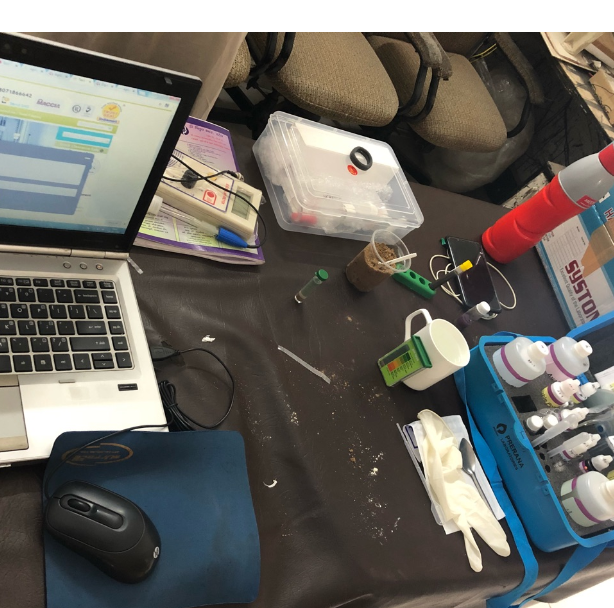
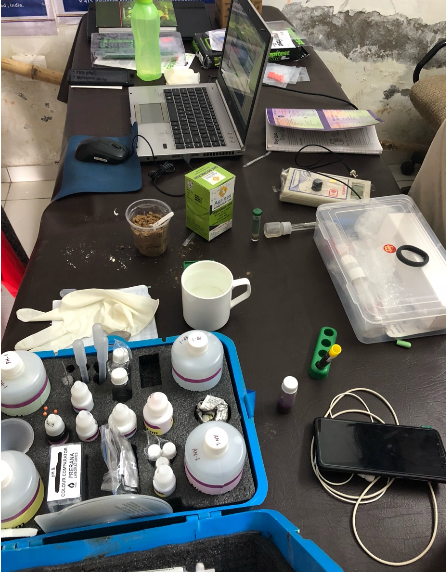
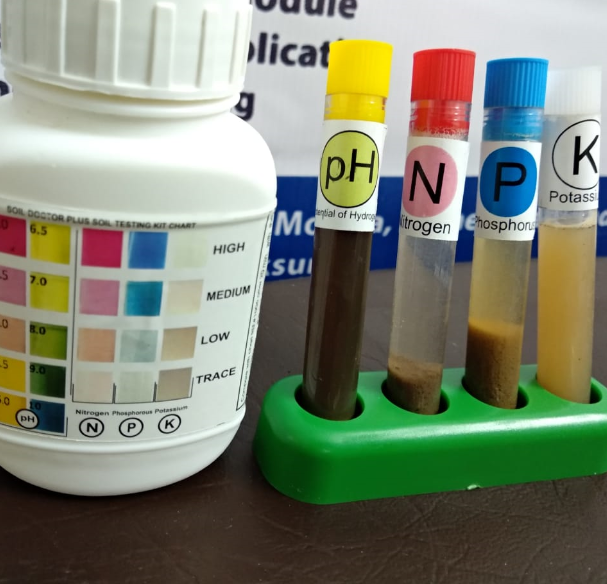
Photos from Zenvus Soil Nutrition Lab to Improve Crop Yield in Africa

0

By next year, Zenvus will begin supporting individual farmers. We made the first leap on that when we released the Zenvus Boundary which helps farmers in mapping the boundaries of their farms. At the moment, our focus has been governments and cooperatives largely because we need scale to serve customers.

Enjoy photos from Zenvus Soil Nutrition Lab where we are researching and building models on soil chemistry, computational algorithms and crop growths.

I am asking African governments to commission my firm to map all the farmlands in respective countries, archive the nutritional values, tag them to maps (via Zenvus Boundary) and make the data FREELY available. Yes, with that, farmers using their phones will have clarity on the state of the farmlands. It is a unfortunate that government sells the same fertilizer in Sokoto, Owerri and Ibadan (all in Nigeria) when the soils have different nutritional needs. Why waste nitrogen (in a fertilizer) in a farm with lots of urea if that saving can help support  more lands?

I think we can fix African agriculture. We just need resources to scale this thing really fast! If you have linkage to a state government, we have Zenvus Fusion to improve agriculture.

Zenvus Fusion is a service for governments and development organizations which is designed to help build Soil Fertility Geography in constituencies. It could be a state Soil Fertility Geography or even a National Soil Fertility Geography. We also support local governments.

Our product provides the data that makes it possible for farmers to understand the natures of the farmlands before they begin planting their crops. We do this by collecting many data samples to appropriately represent the soil fertility equivalence of that region or area.

The aggregated soil fertility data is made accessible to all stakeholders. The data is also GIS-tagged so that the exact locations of the soil are known. The Computational algorithm will use this data to make location-based recommendations on fertilizer applications across farming zones, and this will be delivered through mobile devices, to stakeholders that subscribe. Also, farmers can get predictive recommendations on the most economically viable crop to grow by feeding present crop prices, fertilizer cost, and population into the algorithm.

With this soil fertilizer geography, fertilizer production will become personalized and specifically engineered to mitigate deficiencies with deployment regions known pre-production. We welcome inquiries from governments, development organizations etc.

FIND THE PATH: Let’s Work on Your Business Mission This Aug & Sept

0
Fasmicro Consulting

We help startups, tech firms, banks, insurers, etc deepen their capabilities through advisory services and presentations focusing on innovations that enable growth. We’re home and will like to visit your company.  Connect with our team to schedule; fees apply. Let us work together to fix that market friction in West Africa. We have three core elements in our practice: Development of Business Roadmap & Strategy, Discovery Innovation Workshop, and Discovery Innovation Presentation.

FASMICRO Advisory deploys proprietary management concept, and execution strategies on its engagements and projects. Some of those concepts like CIPA (Content, Illustration, Practice and Application) have been shared in my works in Harvard Business Review. We pursue rigorous and analytical approach that is driven by facts. Our data-based strategy defines our business, and demonstrates our unalloyed commitment to execute projects with absolute commitment to quality.

Discover your path with us!


At Fasmicro Group, we do not recite numbers and tell you what you already know: we deliver unparalleled insights through uncommon perspectives shaped by our experiences as entrepreneurs and advisors in the markets. Our moments are unique because things we share with clients are shaped by our direct exposures to the markets. Fasmicro Advisory Services solutions are structured as follows:

  • Development of Business Roadmap & Strategy: A business plan is not enough to anchor business execution. A Roadmap Document is required especially in a sector which is in a state of flux [changing market, changing model, startup, competition, regulation, etc]. To avoid pursuing many windy paths or dead ends, a roadmap helps to encapsulate a profitable path to the vision with pillars and enablers necessary for success. Read more here.
    • We will conduct a review of the Firm’s current strategy, and identify the current gaps considering the business needs and market best practices and make recommendations to implement the strategic gaps with fit for purpose solutions in line with global best practices and local realities.
  • Discovery Innovation Workshop: To innovate is to set a new basis of competition in an economy, business sector or market. Typically, it results to disruption. This workshop will focus on innovation and growth because growth is the reward of innovation. Otherwise, that innovation is actually an invention. I will be the lead instructor with my supporting crew. The table below provides the workshop structure. We can adapt this workshop to two days.
Day 1 – Innovation Discovery Day 2- Innovation Exploration Day 3- Innovation Design and Applications
The State of Nigerian markets State of the Tech Nation address Becoming a Digital Innovator
Mapping internal & external trends Innovation Translation Filtering & modelling [Business & Functional Vision]
Digital Innovation frameworks Emerging Technologies Labs with Innovation Roadmap Brief
Business Challenges Teamwork / Disruptive thinking Takeoff Vision & Frontiers
Enablers and Creativity tools The Category-Kings Benchmarking [Local  & International] Innovation Execution
  • Discovery Innovation Presentation:This is a two-hour seminar where we will present what is happening in your market, customized for your company, and then offer insights on how you can plot your strategies to win. This goes beyond industry statistics and typical SWOT analysis. We work to help clients see their markets in new ways, providing roadmaps on how they can unlock opportunities. It is an intense talk, combining technology, finance, political economy and strategy. As technology redesigns markets, I break the implications in short, medium and long-terms.
    • Case: How can a (mall) real estate developer understand that ecommerce is a tangential threat since malls can be disrupted by digital commerce in future? My client now considers triple-play designs where malls can be converted into offices or homes, in case the moment comes.

Our services cover all industries, and we operate at the highest ethical level. If interested, email tekedia@fasmicro.com.

The Berlin Institute Recognizes Zenvus as “Good Practice”

0
Zenvus Good Practice

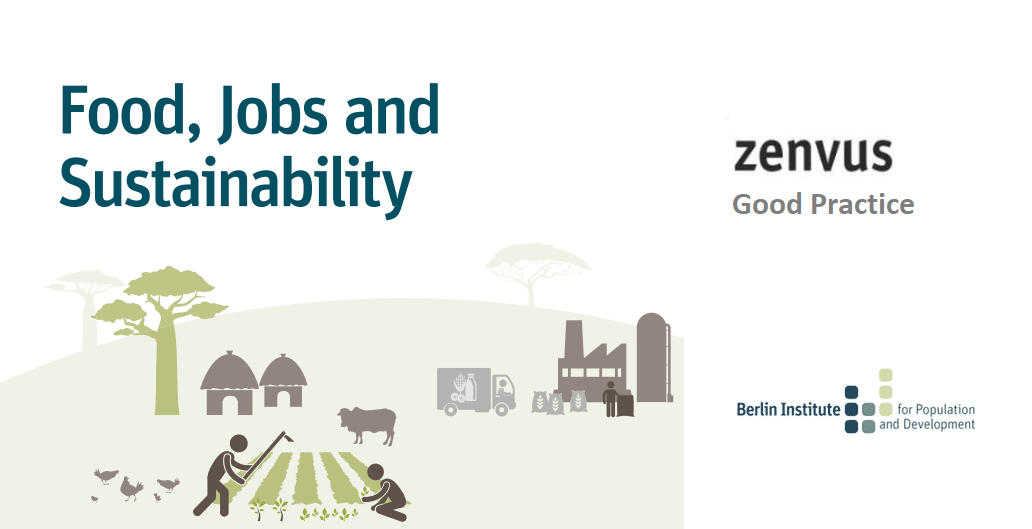
The Berlin Institute for Population and Development (Germany) has recognized Zenvus (plus yours truly) as Good Practice in a new publication titled Food, Jobs and Sustainability.

Sub-Saharan Africa has the lowest per capita income and the highest population growth of any region in the world. Only by promoting economic development and creating new perspectives for its peoples can the continent escape the dual trap of poverty and high numbers of children.

African agriculture, which is characterised mainly by smallholders, has a key role to play here. Although African farmers are currently unable to feed their own populations, they have the chance to benefit from European experiences and innovation and to avoid mistakes and undesirable developments.
To leapfrog, meaning to skip certain stages of technological development, in this case means: achieving higher yields by using resources intelligently and efficiently. If the countries of Africa succeed in linking farmers to markets, processing more raw materials in the places where they are grown and reinvesting the gains in added value, it will be possible for them to initiate the structural changes necessary in rural areas to turn agriculture into a driver of development.

Please download the research work here (PDF); Zenvus is on page 37.

Drones, AI, robotics and blockchains will change African agriculture – Akinwumi Adesina, AfDB President

0
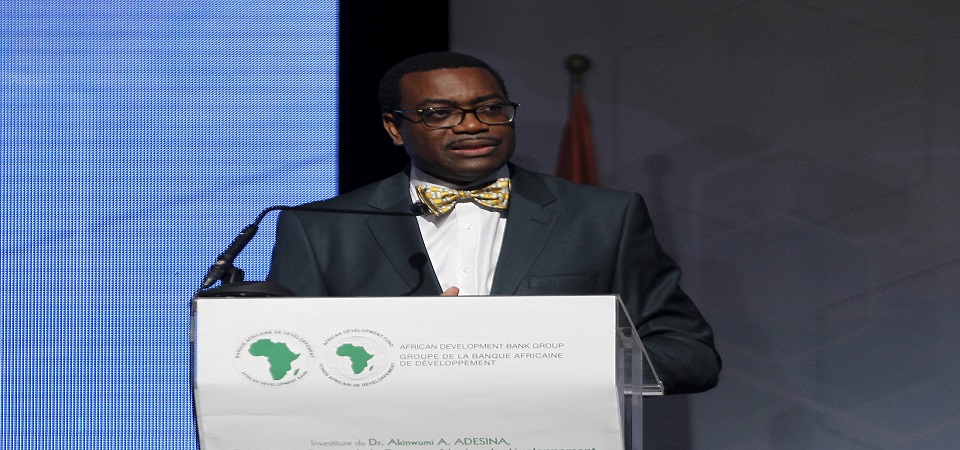
AfDB president Akinwumi Adesina
Akinwumi Adesina

The President of the African Development Bank Group, Akinwumi Adesina, has made an urgent call to give farmers across the continent new technologies with the potential to transform agricultural production. Adesina said the technology transfer was needed immediately and that evidence from countries like Nigeria demonstrated that technology plus strong government backing was already yielding positive results.

”Technologies to achieve Africa’s green revolution exist, but are mostly just sitting on the shelves. The challenge is a lack of supportive policies to ensure that they are scaled up to reach millions of farmers,” Adesina said during a keynote speech delivered at the 2018 Agricultural and Applied Economics Association (AAEA) Annual Meeting held in Washington, D.C August 5, 2018.

Adesina cited the case of Nigeria, where policy during his tenure as the country’s Minister of Agriculture, resulted in a rice production revolution in three years.

“All it took was sheer political will, supported by science, technology and pragmatic policies…Just like in the case of rice, the same can be said of a myriad of technologies, including high-yielding water efficient maize, high-yielding cassava varieties, animal and fisheries technologies,” Adesina said.

The African Development Bank is pointing the way to how this can be done, and is currently working with the World Bank, the Alliance for a Green Revolution in Africa (AGRA), and the Bill and Melinda Gates Foundation to mobilize US$ 1 billion to scale up agricultural technologies across Africa under a new initiative called Technologies for African Agricultural Transformation (TAAT).

TAAT is taking bold steps to bring down some of the barriers preventing farmers from accessing latest seed varieties and technologies to improve their productivity.

“With the rapid pace of growth of the use of drones, automated tractors, artificial intelligence, robotics and block chains, agriculture as we know it today will change,” the President said.  “It is more likely that the future farmers will be sitting in their homes with computer applications using drone to determine the size of their farms, monitor and guide the applications of farm inputs, and with driverless combine harvesters bringing in the harvest.”

Adesina used the opportunity to advocate for African universities to adapt their curriculum to enable technology-driven farmers and to focus on agribusiness entrepreneurship for young people, emphasizing the need to rise beyond theories to application.

Through its innovative Enable Youth initiative, the African Development Bank has in the past two years committed close to US$ 300 million to develop the next generation of agribusiness and commercial farmers for Africa.

Adesina stressed the Bank’s resolve to change the face of agriculture in Africa to unleash new sources of wealth.

AAEA President Scott Swinton said Adesina and the African Development Bank exemplify the use of economics that makes a difference in people’s lives.

“If applied economics is economics that make a difference, I think that there is no better example of someone who has used that than Akinwumi Adesina,” Swindon said.

Adesina told delegates at the 2018 conference attended by over 1,600 agricultural and applied economists from around the world: “There is no reason why Africa should be spending US$ 35 billion a year importing food. All it needs to do is to harness the available technologies with the right policies and rapidly raise agricultural productivity and incomes for farmers, and assure lower food prices for consumers.”

Adesina, who was the 2017 World Food Prize winner, is advocating for the creation of staple crops processing zones across Africa (SCPZs): vast areas within rural areas set aside and managed for agribusiness and food manufacturing industries and other agro-allied industries, enabled with right policies and infrastructure.

“I am convinced that just like industrial parks helped China, so will the SCPZs help to create new economic zones in rural areas that will help lift hundreds of millions out of poverty through the transformation of agriculture- the main source of their livelihoods- from a way of life into a viable profitable business that will unleash new sources of wealth,” he said.

The African Development Bank has already begun investing in the development of processing zones in a number of African countries, including Ethiopia, Togo, Democratic Republic of Congo, and Mozambique, with a plan to reach 15 countries in a few years.

To help Africa transform its agriculture, the Bank is investing US$ 24 billion over the next ten years to implement its Feed Africa Strategy.