DD
MM
YYYY

PAGES

DD
MM
YYYY

spot_img

PAGES

Home Blog Page 7122

Why Nigerian Diasporas refused to be “Billionaires”

0
Dr Ogbonnaya Onu
Dr Ogbonnaya Onu

Few weeks ago, China announced a new US$47.4 billion fund to stimulate innovation in the country’s semiconductor industry. At the moment, China consumes some 45% of the global supply of semiconductors, but only 10% are made by Chinese firms. The goal is to become self-sufficient on semiconductors even as export controls and other regulations, largely from U.S., hit the country.

The Chinese government has, in recent years, stepped up efforts to create a domestic semiconductor industry to help supply its massive electronics market, signaling its intention to spend $161 billion over 10 years to further that effort. China currently imports more than $100 billion worth of semiconductors every year.

The latest China Integrated Circuit Industry Investment Fund will follow a similar fund launched in 2014 that raised about $22 billion, according to the Wall Street Journal report.

Fast forward – many Chinese engineers and professionals, in U.S. and other Western countries, are planning to move back to China to partake in this $47.4 billion opportunity. It is indeed a huge fund and would seed a new generation of innovators and makers.

This is the lesson for Nigeria: you do not tell a man who lives in London [New York, Tokyo, etc] to carry his bag and return to Lagos, Uyo and Aba when you have no plan for him. The China’s model is what Nigeria can replicate if the nation really wants some of its citizens who are living abroad to return.

The Federal Government has called on Nigerians in the Diaspora to return home and seize the various economic opportunities to make billions of naira.

The Minister of Science and Technology, Ogbonnaya Onu, made the call at an investment forum organised in New York by his ministry for Nigerians in the U.S.

Mr. Onu explained that various investment opportunities currently existed and were waiting for them at home, challenging them to take it before they were given to foreigners.

The former governor of Abia from 1992 to 1993, informed the Diaspora Nigerians that various research products with opportunities to yield billions of naira, were waiting for them at home.

“We are asking you to come and be billionaires. That is what we are asking you, not millionaires. Come and make billions.

I will remain with my thesis that government must pick say $3 billion from the foreign reserves and fund SMEs in Nigeria (there is another one for VC tax incentives). The funding will be given as loans tied to BVN. Any person that does not pay can never access the financial system until the person repays. If we do this, we can create 3 million jobs within a year. Our immediate challenge is funding innovation and I am confident there are many small companies in Nigeria that would need that funding.

If we have this type of incentive, we will see many VC funds making Nigeria home to explore opportunities in Nigeria and continental Africa. That influx of capital will have many multiples of benefits to our economy, our people, and the Nigerian technology space. Most especially our tech firms will stay home.

Yes, we have a tax problem but the VC industry is not going to fix that for us since it is not one of the areas where we have been unable to appropriately collect taxes. There is no tax avoidance in the sector because none exists at the moment in the VC sector. The goal of this incentive is to explore how to deepen our capabilities to ensure that future companies are created in Nigeria. Our Vice President has been working on improving the business ecosystem in Nigeria; making it easier for startups to receive capital would go a long way. A new tax regime for investors, especially at the early stages, would be strategic for the nation.

If you make $3 billion available under a solid transparent and competitive system, many people will return to combine forces with those at home. As those from abroad bring the little exposures they have and those at home bring their knowledge of the challenges and markets, Nigeria would experience a virtuoso moment of innovation. But the constant “begging” of our diaspora to return when there is no plan for them, in the country, will not work.

Nigeria needs a roadmap to get its people working for the nation, and the bold vision of China needs to be replicated. Our venture industry is still at infancy which means government must do the lifting up just as China understands that semiconductor funding is not matured and anchoring the stimulation in Beijing. Today, Nigeria’s semiconductors could be food processing, textile, light manufacturing and more; we certainly do not need semiconductors at this time. But we need government to inject funding where it puts its mouth. And when that happens, the diasporas would hear the call, return and then make the billions even as they build the nation with their indigenous counterparts.


The Promise of the new Konga as an Ecosystem

0
new Konga

Many months ago, I wrote that Tecno, an African leading phone company, should invest on iROKOtv, the pioneer streaming video company, in order to have a platform since platforms have become very strategic in the consumer technology business.

iROKTOtv products are very popular in most markets Tecno operates. So this provides a natural ecosystem to help it drive further growth and lock customers in the video ecosystem.

We propose for Tecno to buy iROKOtv and use the product to deepen its capabilities in Africa and beyond. Our core idea is that Tecno needs to open a unit to be dubbed Tecno TVIt will be one place for anyone in Africa to access television, delivering unified TV experience. This ecosystem will meet the needs for TV shows, movies and broadcasting contents, across the continent. It will be TV and movie content-ready. Through the iROKOtv brand, it will close partnerships with leading local content providers.

[…]

Tecno will face real competitive challenges in coming years in Africa. Finding how to lock its present believers in a platform will be strategic. It has to do that as quickly as possible. iROTOtv provides a golden opportunity to make such “locks” happen. Tecno Mobile should buy iROKOtv and rebrand it Tecno TV, and rule the mobile device market in Africa, through service.

Tecno has been rumored to be building Tecno TV (they might have launched it; I am yet to use it). Interestingly, the opportunity may not be just for Tecno. If the Konga can build a royalty program on strong membership club [think of Amazon Prime] through clusters of its physical locations tied to its digital platform, we could see Konga well positioned in the market for multi-level partnerships.

Should that happen, Konga could also help iROKOtv, GoTv and DStv distribute their video contents by making subscriptions to those videos additional options on top of the regular club membership of Konga.

Sure – the major challenge remains the cost of bandwidth but there is nothing that stops someone bundling from an ecommerce platform to enjoy videos via kiosks which iROKOtv had created.

The Amazon Strategy

In U.S., premium cable channels like HBO and Showtime are garnering significant sales via Amazon, which sells the programming as additional options in its Prime video service. Over half of HBO subscriptions sold without a traditional cable systems and 72% of such Showtime subscriptions came from Amazon, Variety reports. Simply, Amazon has demonstrated that an ecommerce company can become an ecosystem for many other different types of businesses, charging “taxes” along the line.

Amazon has quietly become a major player in the subscription video sales business: Amazon Channels, the company’s platform for reselling subscription services like HBO and Showtime, now accounts for 55 percent of all a la carte direct-to-consumer video subscriptions, according to new data from The Diffusion Group (TDG).

53 percent of all consumers who don’t get HBO through their pay TV provider are purchasing it via Amazon channels, TDG estimated in a new report titled The Future of Direct-to-Consumer Video Services. Those numbers are apparently even higher for some of the other TV networks: 72 percent of Showtime subscribers get the network’s direct-to-consumer offering via Amazon Channels, and 70 percent of Starz a la carte subscribers receive it from Amazon.

The new Konga

If you look at the new Mission statement of Konga – “To create a trusted and vibrant retail ecosystem that facilitates trade across Africa” – you would not see any online or electronic thing in it. Simply, Konga wants to be an ecosystem for retail in Africa. And that retail does not mean only trousers, shoes and watches. It includes digital contents like books, videos and more. With Konga, iROKOtv will not need kiosks because Konga outlets could serve as service outlets. That is exactly the broad Vision of the new Konga which emphasized connectivity, growth and commerce, with no mention of “online” or “electronic”.

  1. To be a powerful force for the Economic Growth of Africa

  2. To connect Africans with each other and the rest of the world through Technology & Commerce

  3. To be a company that employees, customers & society are proud of and depend on

iROKOtv kiosk
A Konga-iROKOtv partnership will make these kiosks irrelevant as Konga stores could serve

All Together

Nigeria needs to invent multi- and cluster-subscription service where people can get more value for signing up for many things together.  The benefit is typically lower fee per service when services are bundled. Konga with its hybrid business model is possibly going to unify ecosystems, bringing digital and physical companies under one mammoth network, thereby helping customers to discover more value. This is why I am very bullish on the promise of the new Konga.

Four Magazines I Read

0
ndubuisi Ekekwe magazines
Copies of my magazines

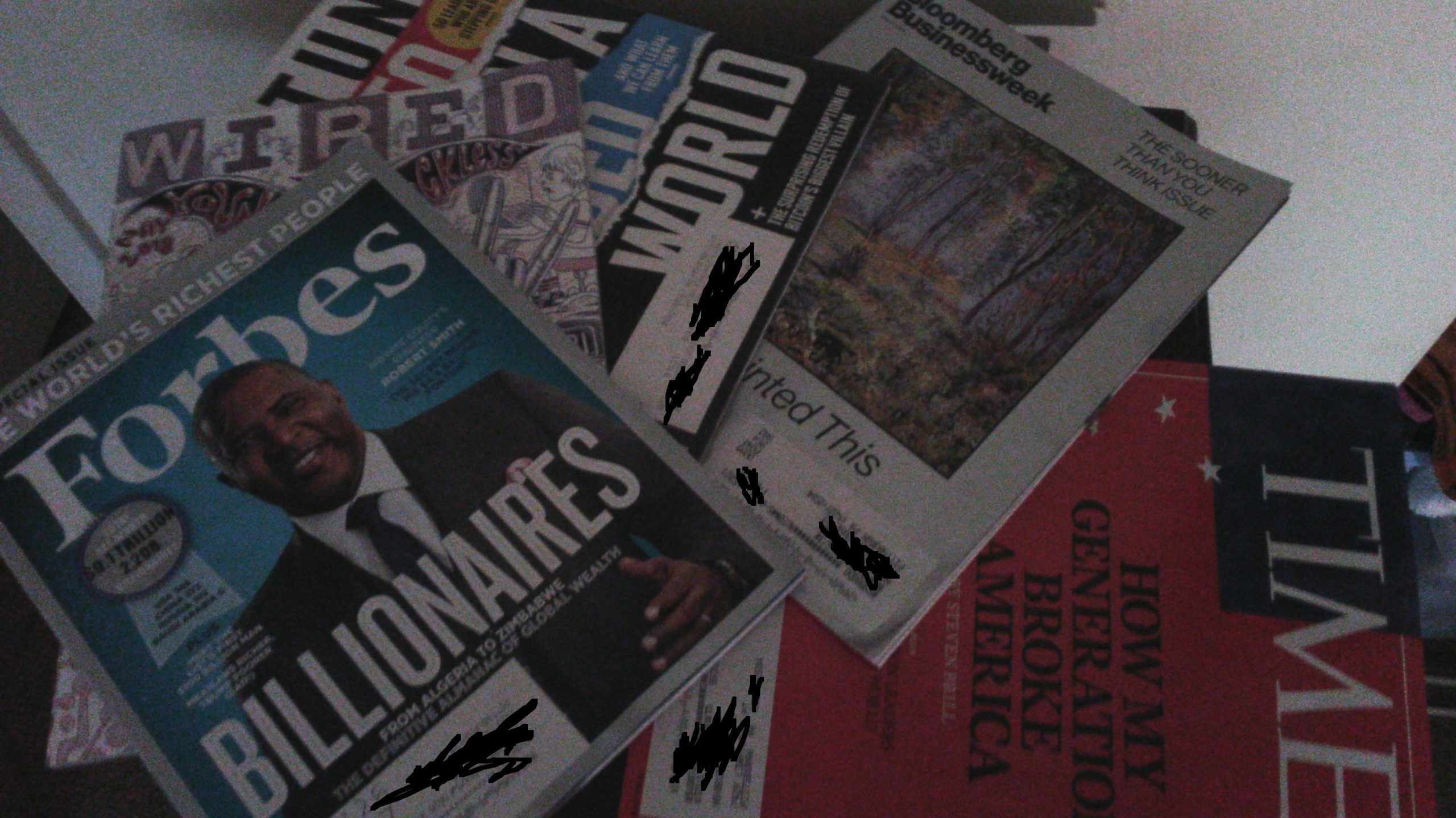
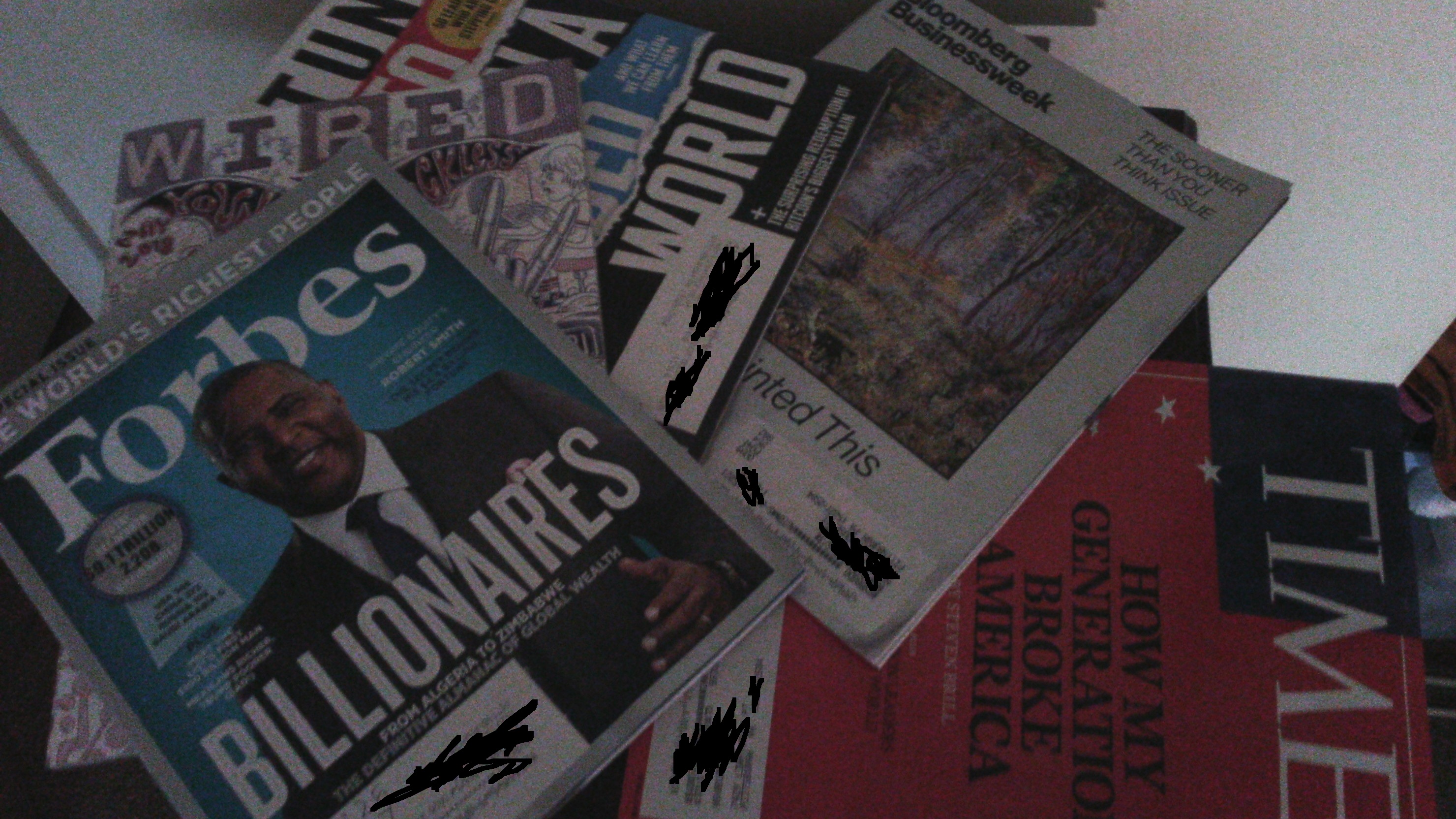
For years, I have subscribed to four magazines – Forbes, Fortune, The Economist and Businessweek (now Bloomberg Businessweek). I have occasionally added Time magazine which I do off and on.  The current subscription ends next month and I am not renewing – Time is becoming a discovery and adventure magazine which adds minimal value to me. I also have Wired but I merely skip the pages; their contents are not rigorous and analytical enough.

My best magazine is Forbes. It has the best people on covering entrepreneurial capitalism. The pages inspire me. Few weeks ago, I called them to thank them for putting a black man (software investing legend Robert Smith) on the cover of the 2018 edition of the Forbes Billionaires (I extended my subscription on that call). It was a huge change because for years, only black sportsmen rotate the covers for the few moments they put people of color.

ndubuisi Ekekwe magazines
Copies of my magazines

Coming behind Forbes is Bloomberg Businessweek. When Bloomberg bought Businessweek, the company expanded the coverage, making the contents more global. I have not missed a version for more than a decade and subscription runs into 2025. John Micklethwait, the former editor-in-chief of The Economist, has improved all aspects of Bloomberg News.

But The Economist, on a nice subject is peerless. But most times, it is hard to get something that addresses Africa, especially for the North American edition. One special report – A Cambrian Moment-  remains the best piece I have ever read on the The Economist. The full piece, typical of the seasonable The Economist’s Special Report, is iconic.

ABOUT 540M YEARS ago something amazing happened on planet Earth: life forms began to multiply, leading to what is known as the “Cambrian explosion”. Until then sponges and other simple creatures had the planet largely to themselves, but within a few million years the animal kingdom became much more varied.

This special report will argue that something similar is now happening in the virtual realm: an entrepreneurial explosion. Digital startups are bubbling up in an astonishing variety of services and products, penetrating every nook and cranny of the economy. They are reshaping entire industries and even changing the very notion of the firm. “Software is eating the world,” says Marc Andreessen, a Silicon Valley venture capitalist.

I really like business and I like to hold a copy of Fortune 500. It reminds me of the power of markets with margins, and the possibilities of human visions and their capabilities. I wish there is something closer to it for Nigeria and Africa in general. Such a magazine in Nigeria could have provided thesis on what works and what does not work as you digest revenues of leading companies chronologically arranged, year after year.

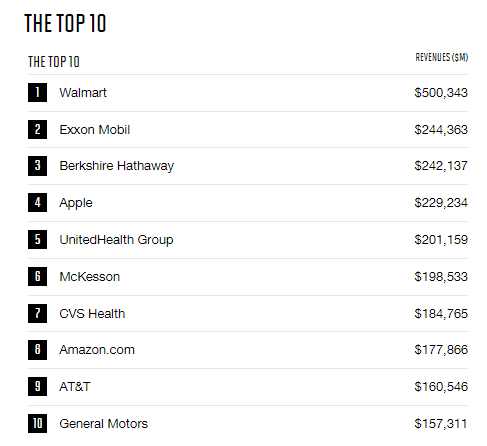
So, it was exciting, today, when I noticed that Fortune had unveiled the 64th edition of Fortune‘s Fortune 500 list of top U.S. companies. Walmart generates half a trillion dollars yearly on revenue and tops the list. Apple brings in $229 billion as the largest technology company (by revenue). Of course Apple commands the largest market cap at about $850 billion and also holds the title of the most profitable U.S. company at $48 billion.

Top 10 Fortune 500 (2018)

There are many things to look for in Fortune 500. For years, I always consider this: the threshold to make the list. For 2018, a company must have generated at least $5.4 billion on revenues to be in Fortune 500. That number is about 6% more than last year. Simply, that means there is growth for some of the biggest American companies. Fortune Global 500, a global version of Fortune 500, would likely mimic the same trajectory.

Forbes has its own list – the World’s Billionaire list (i.e. the World’s Richest People) and the Forbes 400, a list of America’s top 400 richest families.

When you look at these lists, you will marvel at the regenerative capabilities of the U.S. economy. As GE fades, Facebook blossoms; as barons exit, dropouts take their positions. As you read them, you get inspired that if you work harder and smarter, you could experience breakthrough at your level.

Certainly, it is a message of optimism, and it delivers energy that men and women could achieve. You celebrate men who became legends by being the best on something and the markets rewarded them. You aspire to emulate them, by working harder to find success at your level.

There is power on positive thinking, Norman Vincent Peale would write; Nigeria needs journalism that injects energy in the lives of people. I want to see annual ranking that chronicles entrepreneurial capitalism which can inspire young people to work hard and find success.

COMMENT FROM LINKEDIN

It’s not the size of GDP or amount of money in a country’s vaults that gives it the toga of developed or advanced economy. There are many stars that must align, you cannot decouple them or even attempt to leapfrog them.

Our journalism hasn’t gone beyond the primitive stage, because our education system is also within that bracket. The health sector is in identity crisis, after which we can attempt to discuss growth in that sector. Our banking sector isn’t advanced either, yes, many of them declare huge profits not because they are highly innovative or fantastic, but rather it’s part of a broken system, which oftentimes hands out greatest rewards to those who work least.

Our polical and democratic governance is suffering the same, not much progress has been made.

So, before our journalism must attend such height, many stars have to align, at the moment, that’s not the case.

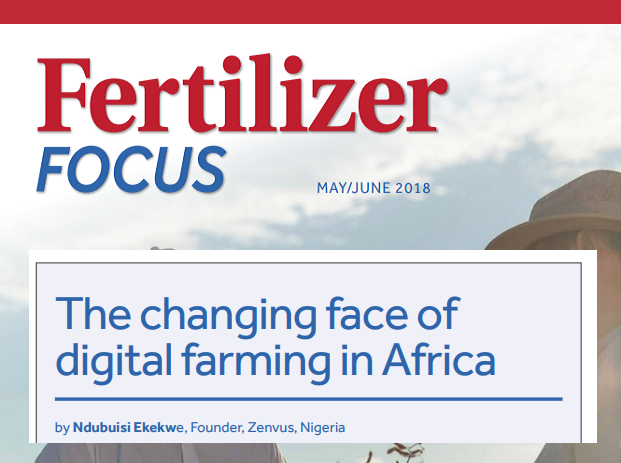
UK-Based Fertilizer Focus publishes my piece on Smart Crop Nutrition

0

Today, UK-based publisher, Fertilizer Focus, published an invited piece I had written on our work on smart crop nutrition. We are working to make fertilizer application data-driven, anchored on the real needs of crops, and correlated with the soil conditions. That work has brought the partnerships we have with fertilizer companies where we are working to help them engineer fertilizers so that farmers can save by systemically configuring fertilizer mix based on soil-crop needs.

In Ethiopia, earlier in the year, Argus Media, invited me to keynote a gathering of leading fertilizer companies in the world, including OCP, the world’s largest producer of phosphate. OCP had awarded us the 2017 “AgTech Startup of the Year”.

There is a fundamental redesign which must take place in the way fertilizers are designed and produced. Today, the same fertilizer sold in Uyo (Nigeria) is largely the same sold in Sokoto (Nigeria). That is not right because some parts of Uyo have urea which means the farmlands there do not need nitrogen at the same level as the soils in Sokoto. If the maker of the fertilizer has that information, it can re-engineer a minor production system where fertilizers shipped to Uyo would be cheaper because there may not be a need for too much nitrogen. Yes, you avoid wasting money blindly.

That cost reduction is saving to government which continues to subsidize most fertilizers used in Africa. Where government saves, the farmers would gain as the saving can be used to provide them with expanded farm inputs.

Using data from our sensors, we help farmers model the right mix of fertilizers in their farms. It is a very fascinating experience when we take guess work out of a very important industry.

Download the magazine here (PDF, page 43).


If you are a government or a cooperative and wants to work with Zenvus, please let us know.

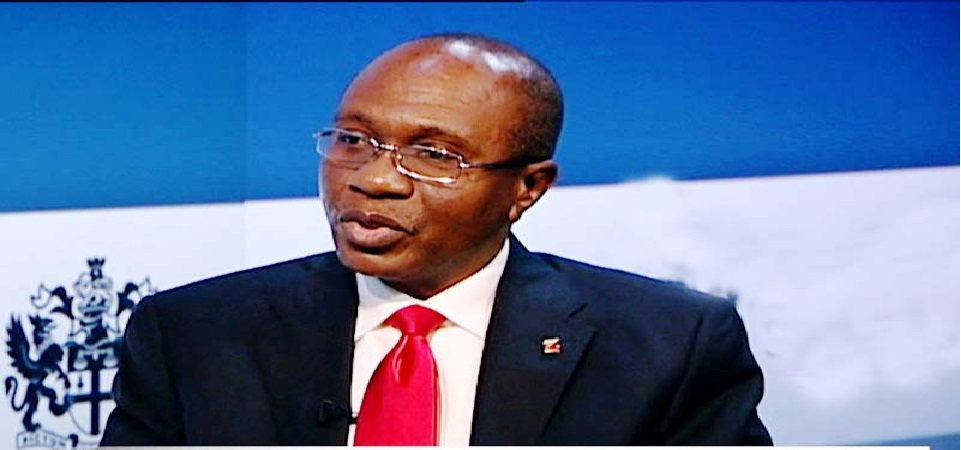
“In our industry, we have a common threat…Fintech, is real” – CBN Governor, Mr Godwin Emefiele

0
CBN Governorn, Godwin Emefiele

It is official – the Central Bank of Nigeria has clearly noted that fintech (financial technology) companies are indeed threats to Nigerian banks. The CBN Governor, Mr Godwin Emefiele, made the statement while delivering a goodwill message at the investiture of the Chartered Institute of Bankers of Nigeria (CIPN)’s 20th President and chairman of council in Lagos on Saturday.

The Governor, CBN, Mr. Godwin Emefiele, in his goodwill message at the investiture of the CIBN’s 20th President and chairman of council in Lagos on Saturday, said, “In our industry, we have a common threat. The enterprise management risk, particularly the threat posed by Fintech, is real.”

The message was delivered through the CBN Governor’s representative in the person of Dr. Okwu Nnana, the Deputy Governor in charge of the Economic Policy Directorate.

The participation of fintech is expected in the industry since it is evident that the opportunities are huge: “According to research done by The Fletcher School and Mastercard Center for Inclusive Growth, of the $301 billion of funds flow from consumers to businesses in Nigeria, 98 percent is still based on cash”. Simply, growth is ahead, and this market has not been completely won, at least on the digitization of payment front.

The Industry Redesign

There is no doubt that technology will play a significant role in future banking. Just as OTT solutions like WhatsApp and Skype have decimated revenues for telecom operators, we expect fintechs to affect the operations of banks. But these fintechs will include ICT utilities like Facebook and Google making the scenarios very consequentially.

This is the expected natural trajectory as the ICT utilities take over the lands. Once Facebook perfects the integration with MasterCard on Messenger, it would do same on Instagram and WhatsApp. Then, it would be opened to any financial institution that wants. MasterCard is a natural payment aggregator, agnostic of banking institutions. Facebook would be the platform while MasterCard would act as the “interface institution”[payment processing] and banks the hosts [the accounts]. The implication is that over time few would bother to notice the hosts, focusing more on the platforms [once you have set up an account and put your bank details, there is no need to even remember the bank again as the transactions would happen on Facebook while MasterCard handles the underneath processing with the banks].

The banks are doing what they have to do: with Facebook Corp, there is no other alternative – you either fall in line or you go extinct. This is going to be the future of banking in Nigeria. No one goes to a bank in China; most go to WeChat to do banking. Facebook has a plan for that in Nigeria. The plan is now under execution

Fintech (U.S.) Usage – UBS report (source, UBS)

All Together

The business of banking will remain with us. But the structure will certainly change. With the banks transmuting themselves into fintechs already, Nigerian customers would benefit. Yet, I do not see major competition against the banks over the next few years because they remain more capitalized and they also control most of the banking and financial system nodes. Yes, taking them out would be extremely challenging without direct access to those nodes.

Mr Godwin Emefiele has spoken and we do hope he would continue to allow innovation win without undue over-the-top regulation that would stymie the fintechs. The banks do not need help because they are already the premium fintech striking partnerships with Facebook and Mastercard. And if the indigenous fintechs evolve, the banks would also win as they would help in bringing more Nigerians into the banking sector.

Generally, it is good the CBN Governor has alerted his constituency on the threats; they need to take action because the challenges cannot be localized. The telcos slept into the OTT quagmire; CBN is shouting right now so that banks can see Facebook, Instagram and broad fintechs as threats. We hope they are listening.