DD
MM
YYYY

PAGES

DD
MM
YYYY

spot_img

PAGES

Home Blog Page 7250

Jumia Shoes, Konga Collections to Save Aba Shoe Industry

0

I am thinking that Jumia and Konga, two Nigerian ecommerce pioneers, can fix a major problem in Nigeria: the Aba shoe and leather business problems. (Besides Aba, we have similar issues in Kano and Oshogbo in other sectors.) For all the promises in Aba, Nigerian entrepreneurs are yet to unlock the latent opportunities therein. We do know that Aba has brilliant designers who are limited by their business visions, just as our farmers who remain keepers of ancestral traditions, over becoming businesspeople.

Both Jumia and Konga have invested so much on branding, and they are known in Nigeria. Each can pioneer a solid private label. So, I am hoping we will have things like Jumia Shoes and Konga Collections. They will have these businesses with pure elements of exclusivity in their respective portals.

Now that we are transitioning our economy, through diversification out of minerals and hydrocarbon, to a knowledge-based one, these ecommerce companies can play a critical role through commerce. Drawing my previous writings, these are ways they can create Jumia exclusive shoes on Jumia and Konga exclusive collections on Konga, and fix Aba shoe industry paralysis, using a pure aggregation construct:

  • Support some shoe designers and get them to produce under a unique label – Jumia Shoes and Konga Collections
  • Either will provide a shared infrastructure at scale to make it easier for makers and designers to have access to tools and equipment they need to design and make shoes
  • If either controls some of the brand rights, it will support the shoe makers to expand capacity in production. The firm will invest to boost capacity for the designers so that they can produce more shoes and leather materials
  • Either will help the shoe makers improve qualityso that the shoes can be sold internationally
  • Either will lead a pan-African structured advertising; the brand equity is there. Besides, Jumia, specifically, has deep experience in fashion through other entities in its parent Rocket Internet.

I am very confident that branding will unlock the opportunities in Aba, and the route to that will be having a differentiated label that brings some of the makers and players together. The fact is this: Jumia and Konga can give foreign shoe brands real heat in Nigeria if they build solid private brands by themselves through pure aggregation construct. They are not going to become makers, but they will set the standards, just as Uber does for drivers and Airbnb for homeowners, and the shoe makers will align.

In Praise of SMALL Data

0

In this video, I explain why you need to invest in SMALL data even as you expand your capacities on big data. The fusion of both will bring the great innovative moments in your company. While big data gives you the averages, the small data provides insights on the outliers which are usually ignored. Within those outliers are elements for disruption.

When data does not make sense, it does not mean that it has to be cleansed to fit into a big data analytic construct [we are guilt of cleaning data]; it simply means that the typical business model is not for it. Data does not lie, but cleansed data could hide truths. It averages lives and events, normalizing all moments that pass through it.

Yes, they swore, using data, that Africans could not afford mobile phone services, until an African son proved everyone wrong. The big data looked at growth and per capita income; the small data looked at the elemental culture that Africans like to talk, over writing. No wonder, except the Ethiopians, no other major culture invented any way of writing before colonialism.
That said: have a data New Year ahead.


Google Opens Wallet for CS Educators in Africa – Apply

0

Google has opened applications for the Computer Science educators funding program for 2018. It is open to school districts, schools, and other education nonprofits around Africa. This covers primary schools all the way to university levels. I know some schools you know may benefit.

Over the past 10 years, Google’s programme for the professional development (PD) of Computer Science (CS) educators (formerly known as CS4HS) has funded close to $13 million in grants supporting teacher PD in CS education globally. In Africa, 61 universities and nonprofits dedicated to growing the confidence and skillset of new and future CS educators have received grants that have impacted 5,000 educators from more than 15 countries.

We’re excited to announce our funding cycle is open to school districts, universities, and other education nonprofits around the world for the 2018-2019 school year. Historically, Google’s CS educator PD grants have aimed to help secondary school teachers gain confidence to integrate CS and computational thinking (CT) into their classrooms. To celebrate the tenth anniversary of CS PD funding, we’re excited to announce that the programme will expand to include applications from PD providers for primary school and pre-service teacher education in Africa for the 2018 grant year.

Apply Here.

Farmcrowdy’s $1M Seeded Agro-Aggregation Construct Business

0

If you are looking for a business model on how aggregation construct can help you, this is a real case study:  Farmcrowdy. Farmcrowdy is an agric-tech platform that gives Nigerians the opportunity to participate in agriculture by selecting the kind of farms they want to sponsor. Farmcrowdy uses the sponsor’s funds to secure the land, engage […]

This post is only available to members.

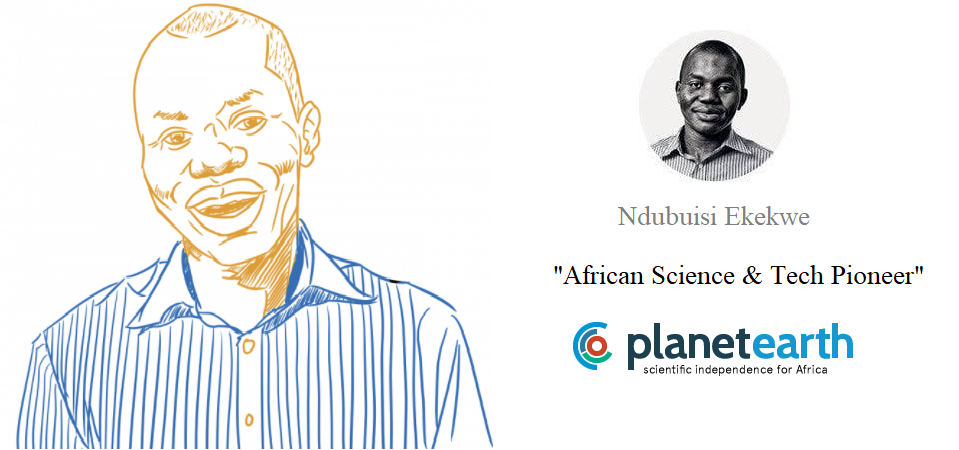
London-Based Planet Earth Institute Honors Ndubuisi Ekekwe as Tech “Pioneer”

2

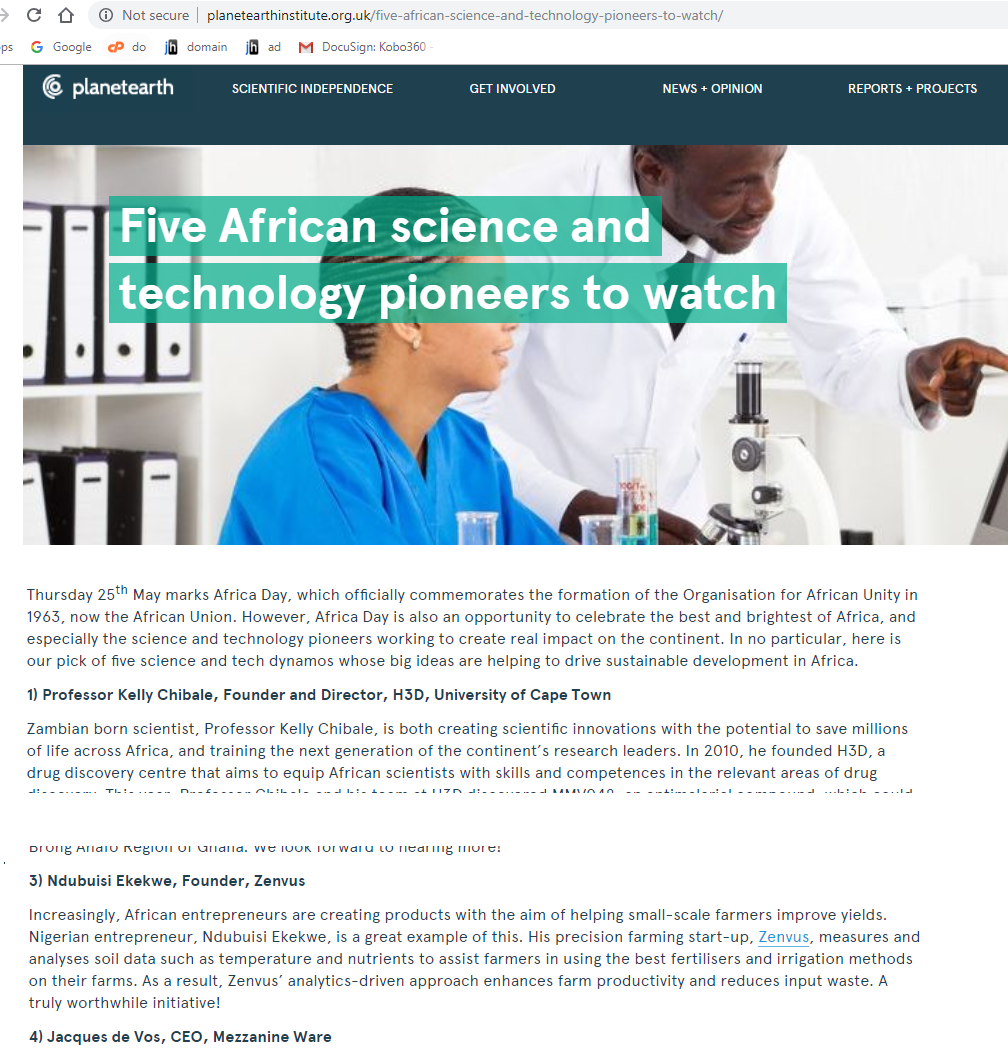
Yours truly was included as one of the “five African science and technology pioneers to watch” by London-based Planet Earth Institute, a non-profit chaired by a former Chief Secretary to the Treasury under ex-UK Prime Minister Rt Hon Tony Blair.

 Africa Day is also an opportunity to celebrate the best and brightest of Africa, and especially the science and technology pioneers working to create real impact on the continent. In no particular, here is our pick of five science and tech dynamos whose big ideas are helping to drive sustainable development in Africa.

The recipients are:

1) Professor Kelly Chibale, Founder and Director, H3D, University of Cape Town

2) Bernice Dapaah, Founder and CEO, Ghana Bamboo Bikes

3) Ndubuisi Ekekwe, Founder, Zenvus

4) Jacques de Vos, CEO, Mezzanine Ware

5) Marcel Steinberg, Founder and CEO, Clean Energy Africa, and Nazier Marthinus