DD
MM
YYYY

PAGES

DD
MM
YYYY

spot_img

PAGES

Home Blog Page 7276

Hacking Growth, Quantifying Scalable Advantage

1

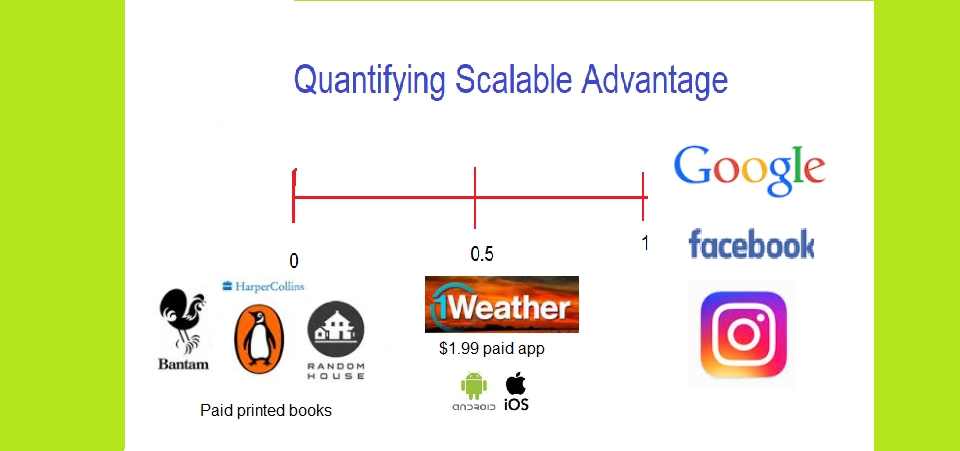
Any startup needs to model its scalable advantage (SA) to ascertain its capacity to scale and win in the market place. There are many factors which determine a company’s scalable advantage. Some are external like regulation, industry of operation and size of the market. Others are internal and they include marginal cost, supply pipeline, among others. In this video, I explain how to model that advantage by looking at the core transaction frictions between selling and buying. The more the business eliminates the friction, the more scalable it becomes.

But yet, scaling is not the whole story. You can scale traffic and make lesser money. I have called that diminishing abundance of internet where user growth does not correlate with more revenue. Wall Street Journal is largely subscription-based while many publishers have the freemium model. While the latter may have more readers (i.e. more traffic), WSJ may be making more money. So, scale must be put in context to make sense. And that is why you need to ascertain what matters for your business.

But no matter what it is, you have to test if you are closer to SA “0” or to SA “1”.

IOTransfer is the Best Way to Sync iOS Devices and PC

0

It happens all the time – we want to transfer data between our Apple devices like iPhone and iPad, and our PC. We do struggle because Apple products are built on iOS while PC runs on Windows. This is not just a problem for individuals, it affects companies and everyone.

I have had this problem myself and have been looking for a way to deal with it. The non-interoperability of these ecosystems are always issues. But now, there is a solution. A product called IOTransfer makes it possible to transfer iOS devices data and sync with Windows PC.

IOTransfer offers all-in-one iPhone/iPad photo transfer and management. Batch transfer photos and images between iPhone/iPad/PC with ease, saving your best memories of family, friends, and exiting moments during travelling. Import pictures from PC to iPhone/iPad to enrich your albums. Directly sync iPhone/iPad photos to multiple iDevices without iTunes or iCloud. Transfer your photos, your way!

The IOTransfer is an iOS software designed to manage the data on all of iOS devices in the easiest way possible. I downloaded, installed and have used over the last few days. It is super-great. Here are the key features you will like:

  • Easy Transfer

You can sync your data between iOS devices and backup them to your PC.

  • Easy Photo Manager – Retain Your Best Moments

IOTransfer manages photos between iPhone, iPad and PC. You can export and import contents  with one click. It is that simple.

  • Manage iPhone/iPad/iPod Music Portably

IOTransfer makes it extremely easy to transfer music between iOS devices and PC with just a simple click. Bulk transfer takes you less time to transfer, while more time to enjoy music on different devices. So you can access and share your favorite music with friends and family anytime. IOTransfer is also able to sync music downloaded on computer to iPhone/iPod/iPad without deleting the current music on your iOS devices. No more boundaries for you to enjoy music as the way you like.

IOTransfer in action

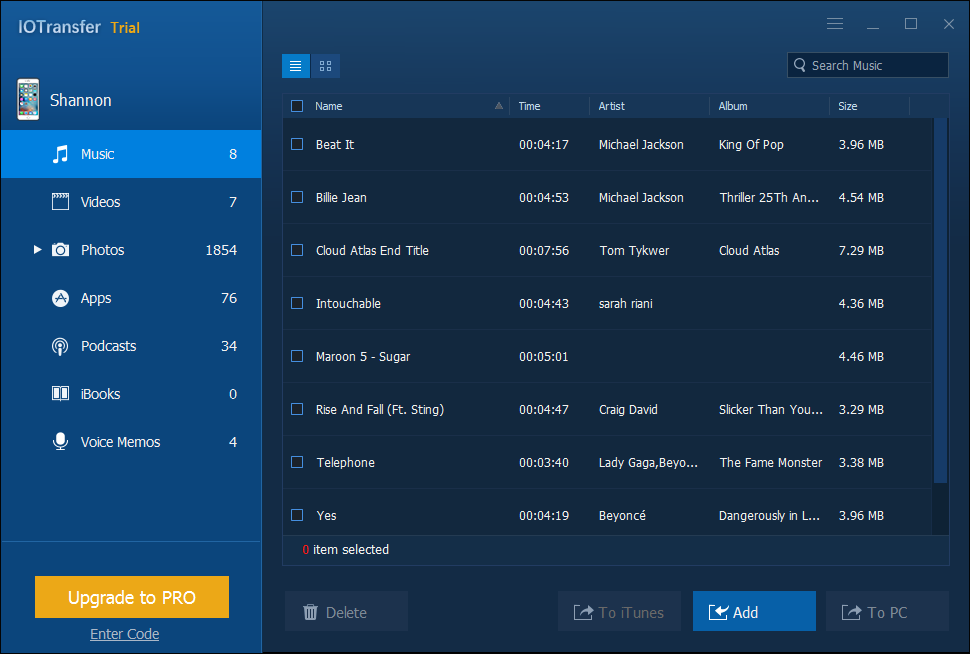
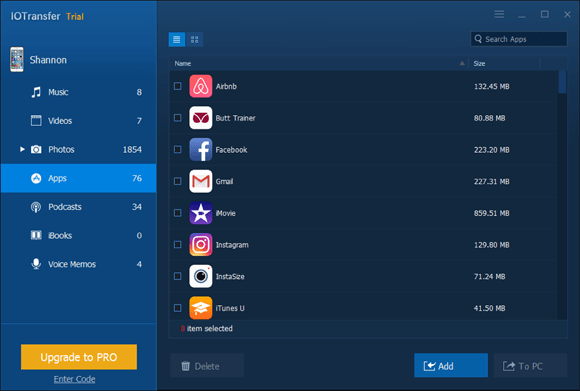
IOTransfer can be downloaded right from their website then installed on your PC with Windows 7 or above. Connect your iPhone, iPad or iPod when prompted, and allow access to your device by trusting the computer you are connected to. After a quick scan of your iDevice, items stored will be listed in categories like iTunes. Unlike iTunes, managing what is on your iPhone is simplified, with actions being more similar to the act of connecting to an external hard drive. Click on a category, for instance Music, and choose to sync to iTunes, PC or device. Items can be added, removed and synced either individually or in bulk. Even sync directly to iTunes without ever without actually dealing with iTunes, easily managing all music, videos, photos, apps, etc all from one application.

Like iTunes, IOTransfer can control all of the contents, but in a much easier to use format. IOTransfer essentially becomes your new iPhone manager, with the ability to not only move your data to and from a Windows PC, but between iOS devices as well.

IOTransfer doing its job between PC and iPad

Have an iPhone and iPad? Transfer between the two by connecting both devices to your PC and using IOTransfer’s content to device setting to export from one device to the other. It is direct access with an intuitive process. Just click what you want and put it where you want it. Moving photos in bulk is definitely my favorite feature overall as it clears up space on my phone much faster than the traditional method. My photos are backed up on my PC and precious storage on my phone is restored. Transfers also include backups, iBooks and even voice memos so nothing gets left behind.

Download IOTransfer right away here.

Thank You Mr. Governor for Donating The Generators

0

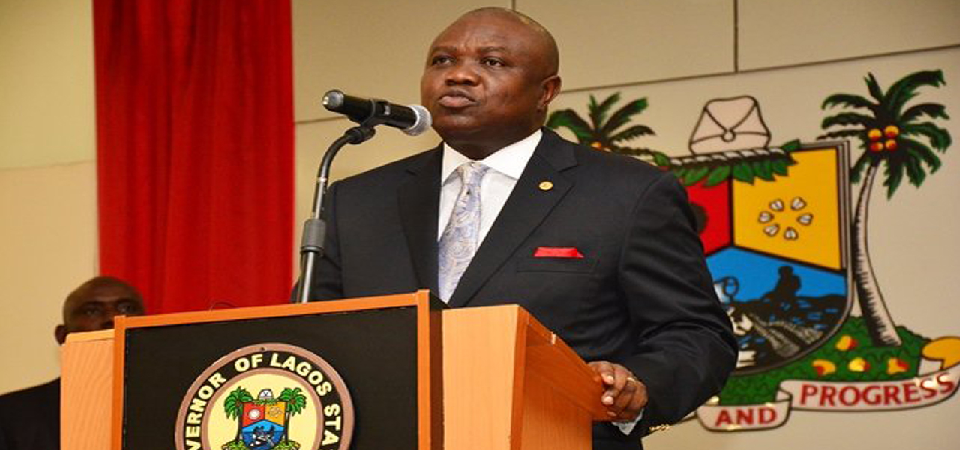
I admire Lagos State as it remains the best managed state in Nigeria. In many areas, Lagos is peerless. But it seems that the problem of Nigeria has also infected Lagos: Governor Ambode has donated 120 generators to the Police. I would have expected the governor to donate solar power systems over generators. Possibly, other states that look unto Lagos for vision will pick up better ideas. Unfortunately, another money to the generator mafia.

The Lagos State Governor, Akinwunmi Ambode, on Monday handed over 120 new 5KVA generating sets to the Lagos State Police Command to power all police formations across the state, with a pledge of continuous support to security agencies to ensure optimal performance.

[…]

Responding, the State’s Commissioner of Police, Imohimi Edgal thanked Governor Ambode for the gesture, saying that the generating sets could not have come at a better time. While assuring that the generating sets would be put to optimal use, Mr Edgal said that the facility would go a long way to ensuring that the divisional and area commands are well lit to enable them effectively enforce the laws of the land.

[…]

“Power is very essential. Our communication gadgets, especially phones need to be charged. You cannot function anywhere, you can’t take complaints, you can’t give directives to field officers when there is no power. These generating sets are very valuable to us,” Mr. Edgal said.

As noted in the press release, these generators will ensure that the Police do its work. You cannot fault the governor as he wants to keep the state safe. Running Police stations with generators is what Nigeria has become. A governor donates generators and calls a press conference for the world to see him giving generators to the Police. Yes, that is in Lagos, Nigeria’s Centre of Excellence, and it is 2017. Why not? The Police need to charge the phones and run their computers.

The Lagos generators (source: Bellanaija)

This is not to blame His Excellency. The problem of power is beyond his office. It was far easier as an opposition party. APC has shown that it is a child of PDP. They are all the same. All the micro-grids and small power cells are yet to come, at scale. During the election, the Vice President came to U.S. and gave a great talk on power. Some people questioned him on the feasibility of piping gases with trucks. The people that understood the business (I know nothing of it) were clear that it would be hard to make profits doing so. APC said it was possible. We are still waiting for light. It is very unfortunate.

But PDP would not have been better. They are all the same. They speak to get jobs and after that, no one cares. We will all forget, they reason, as we will continue to vote the same people back.  Forget their parties. Otherwise, any leader would have known that fixing power will put his face on the Nigerian currency. That is the biggest challenge in our economy today. Men come to work, to fix cars, but they turn to singers waiting for light to come. Women come to work, to braid hair, but quickly become prayer warriors to bring the light.

In the old Nigeria, a governor would have mandated the head of the distribution company to make sure that the power lines linking all the police stations have electricity. So magically everyone on the same lines with the Police will have light. But that was old Nigeria. It may not have been the best way of running a country. But today, the challenges are institutionalized. Even the Police cannot get light. And there is nothing they can do about it. The governor can only consult with the head of the distribution company, but cannot do much.

And you cannot blame the distribution company because it has its own grievances. So we are in a vicious circle that needs leadership for the issues to be resolved.

Nigerian government has to make good, and go back, and increase electricity tariff as agreed pre-privatization. The citizens do not have to pay this extra fee. Government can decide to write the discos cheques yearly. After all, it tricked the investors to invest based on the tariff. That the court struck and reversed the tariff is irrelevant. Investors did not sign any agreement with the court. That was the condition precedent and where it was voided, the discos have the rights not to deliver electricity. It makes no sense for them to be doing so losing money.

The problem is beyond distribution. The issue is that today’s tariff is so bad that it is better not distributing. Government knows that and that was why the tariff was raised to attract investors. But the court struck it out after they have invested. The investors will be naive to pump more money into a system like that.

Congratulations to both the Police and Lagos State. Now, the Police have the lights and can go ahead to do the work. The governor must be commended for this. The Police are not under his direct funding domain but he wants to see Lagos running. He is right to donate generators. But I wish he gave solar power systems. As a governor, and considering the structure of the Nigerian electricity sector, he has limited options to power 120 police stations, immediately. Indeed, generators are so beautiful; they power Africa’s largest economy.

Money Everywhere, But None for Nigerian Startups

2

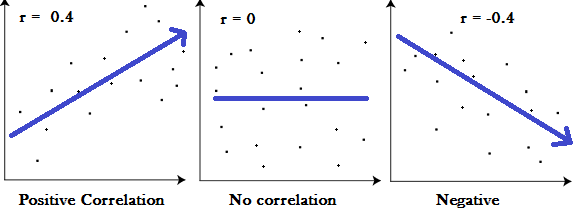
In mathematics and indeed any quantitative field, they have this thing they call Correlation. It gives you the phase of dependency between variables where the change of one variable determines how the other one adjusts.  The most common examples are linear relationships, with slopes.

Types of correlations

I have referred to correlation to help us explain what I have noticed in the startup ecosystem in Nigeria: our investors want the entrepreneurs to make huge returns, but at the same time, they do not want too much risk. That is a weak point and a very difficult scenario. When you want startups to return big, and at the same time you do not encourage them to take big risks with your money, it simply means the business relationship is on stasis. The usual concept in universal physics is that big force brings out big reaction: action and reaction are equal and opposite. Yes, small risks, small returns; big risks, big returns. That does not mean you cannot have deviations, but it makes sense to think within common occurrences in life.

The investors are good in giving a rule like this: do not lose my money no matter what you do. So, the key is preservation of the investment and making sure no money is lost. There is nothing wrong with that. Where I have issues is when you now add that the entrepreneur must come back with big returns. That is when the association breaks. Building startups does not follow negative correlation because there is a reward for the laborer. There is probably minimal risk producing candles in Nigeria as we are sure of continuous darkness for more years. If that is the business, be ready for the returns it can bring. But when you expect massive gains, that business may not be enough.

The entrepreneur cannot be timid on attacking opportunities and at the same time positioned to create immense value. There are investors that do not want to lose money like pension funds. And most times, they do not expect huge returns. But when a venture capital firm eliminates most of the key risks and expects huge returns, everything is broken.

Few years ago, some local investors were giving loans to entrepreneurs with options to convert to equities depending on the performance of the startups. They call it Convertible Note.

A convertible note is a form of short-term debt that converts into equity, typically in conjunction with a future financing round; in effect, the investor would be loaning money to a startup and instead of a return in the form of principal plus interest, the investor would receive equity in the company

The investors have the money and certainly could take equity, but somehow they like to offer loans to the startups. They always have the first option to determine if they want to convert to equity, in the future. This is the seed fund for the startups and the founders are beginning with loans which must be paid back. In some cases, the startups assets are used to secure the loans. For the founder, the mind is always on that loan. And every decision is influenced by that loan. To add salt to injury, the investors took board seats in the startups as “advisors”. I certainly believe the funds will not succeed in Nigeria because many brilliant entrepreneurs will not bother collecting money from such companies. Nigerian startup ecosystem is not optimized for such structures. It is either you want to take risk or not. And it makes sense to have confidence in the people you want to invest in their companies.

The Ecosystem

We are making progress in the country with regards to startups. Besides the challenge of unrealistic target, these are other issues to take note:

  • Entrepreneurs think local investors ask for more equity.  I always receive a specific type of email where people ask me if the equity percentage the investor wants for the money being invested is fair. Unfortunately, no one can answer that question for any founder. Though there are tools to help in the valuation of startups, nothing is science in them. Besides, I do not necessarily think that our local investors are greedy. Sometimes it has to do with basic understanding of the business. If you are taking money from someone with good understanding of your tech sector, it will be easier to have a good conversation on the valuation. But when that is not the case, that process becomes challenging. The key is doing a better job to explain the vision and hopefully both can arrive at a fair term to both. Both local and international investors want good returns. Yes, the motives are the same.
  • Giving away your company to popular people: Nigerians like big men in their teams. It is like having a very prominent man in your board will magically deliver huge revenue. Once you tell the world that this big man is the chairman of your board, revenue will fall like manna.  It is an illusion. The big man may not even have time for you. Yet, you have given away your company to him. Have confidence in yourself and let any person in your board earn that right, irrespective of his or her level in the society. Always remember that your customers make the decisions and most while spending their money do not care that much on the face of the man on the Board section. They want to be sure you can add value to their businesses or lives. Sure, bringing successful people in your Board is part of it. Nevertheless, I do hope you get the point.
  • Foreign funds are better: That seems to be a near universal conclusion by most founders. Yes, foreign funds connote that you are now global. Nigerian like everything foreign. So, all efforts to get that foreign funding become the business. That is a big mistake. There are high quality investors in Nigeria just as we have foreign investors. The problem is that many Nigerian rich people did not make money from technology. But helping them to understand what is going on will help them support your venture. But irrespective of the source, a good fund is nice. Go for it. But do not degrade local funds should they become available.
  • Raising capital is hard in Nigeria: There is no other way of making that point. While the funding round success is not the end, the difficulty makes it seem so. When you raise that capital, you must still have to execute the business plan. Do not be like some whose energies dissipate after the fund is raised. Yes, sometimes the strategy ends in getting that money.  There is no plan to run a company. It is common to see founders who are raising money and at the same time looking for jobs or applying for graduate programs. I found it hard to make sense of the thinking. You want people to give you money in a business you have not committed to build? Building a company is a battle and committing to it is the first phase of the preparation.

All Together

We will have a startup massive exit in Nigeria in the next 5-7 years and that will bring more attention to the ecosystem. U.S. based accelerator, Y Combinator, is already a believer as it has seen the innovation in the land. Our entrepreneurs are growing. From Facebook to Google, Nigeria is a strategic nation. We have the population and we like to spend. The moment will come.  There is no doubt on that. Yes, we need to make that happen and create many afro-unicorns so that more quality money will be activated both locally and internationally. When supply improves, great things will happen. Then suddenly, that money everywhere can flow to the shores of our startups.

What Traffic Light Teaches Us On Tech Regulations

0

Regulation kills innovation, they say. For most makers, the thinking is that when governments bring regulations, nothing of value happens, because entrepreneurs cannot break things fast, on the way to financial glory. So, in most startup communities, regulation is seen as a burden.

Few days ago, someone commented on a piece I wrote on the need for blockchain regulation as follows thus: “We must leave government out of blockchain because government will stop progress and slow things down. Even Bitcoin does not need regulation. The technology world will drive this without any government help”. This is typical because the narrative is that government uses regulations to put stumbling blocks on innovation.

Unfortunately, the perspectives from most startup communities are not right when it comes to regulation. When people think that regulation is bad, they miss the deal. While poor regulation is bad and does inhibit innovation, smart regulation unlocks value and accelerates innovation. The biggest limiting factor in the development of Bitcoin and by extension blockchain is lack of regulation in U.S., the world’s most important market. Without a clear regulation, there is a ceiling on the sector growth, because there is an uncertainty with legal ramifications.

Only a stupid person will invest another person’s money on these digital currencies without clear disclosures. The risk is huge. Clients may not bother during the happy days, but should things turn south, the trial lawyers will emerge from their hiding caves. With no law to fall back that you traded, for clients, on legally available products in the land, you will be on your own.

China has regulated initial coin offering – “an unregulated means by which funds are raised for a new cryptocurrency venture” – out. South Korea has done the same. For U.S., there is no regulation which means the regulation is weak. When you do not have a regulation on things people expect to be regulated, the community takes the default as confusion. When you have confusion, it is bad for innovation.

I commend the Nigerian government on its drone regulation. It was a brilliant moment in the nation. Without wasting time, they made it so clear that they were against civilian drone development. The registration requirements and the costs were evident government does not want drones to be flying around Nigerian cities. People moved on and that was it. Personally, they made a mistake on the draconian regulation. But yet, I was thrilled they moved fast making it. If anyone wants to change that, you have the courts or the Parliament. Simply, we have a clear regulation and can work to upgrade it. You cannot raise money for drone business now without a clear certainty on what the regulation says. That is far better than raising money with no clue of the possibilities in the future.

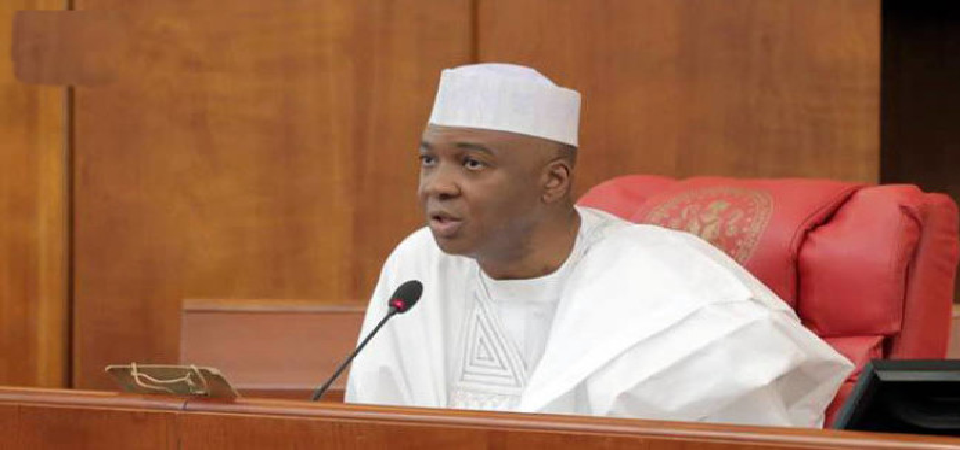
Yakubu Dogara, Nigeria’s Speaker of the House of Assembly

Traffic Light

Traffic light is so important in our transportation ecosystems. We see it as a very critical technology which makes our traffic challenges manageable. But there is one thing that makes traffic light very useful. That is the law behind it. Without the law that says that you cannot run a red light, the technology has no value. So, the value of the traffic light comes from the law that drives the transportation sector.

In Nigeria, people run red lights as they know the law is weak to punish them. The same traffic light which is highly feared in some parts of the world has lower respect, in some parts of Africa, where they are installed. You may be unable to drive for years in U.S. for running a red light. In Nigeria, it may be some fees. That is the difference.

The person that made traffic light produced a good technology. But without the law, it would be ignored. So, the strength of Bitcoin/blockchain may not necessarily be the engineering behind the duo but the law that will govern them. If it is smart, the society wins. If poor, the society loses knowing that society can win if a bad technology is banned. Making that call is left to experts because what seems exciting today can bring havoc in future, especially in finance.

All Together

So as we think about regulation, the focus should be making sure they are smart and timely. Working towards smart regulation is strategic. From cryptocurrency to medtech (medical technology), when governments put regulations, markets have certainties on the future. Regulation ratifies sectors and opens the flow of capital. Nigeria needs smart ones, and fast. Smart regulation does not necessarily mean approving all new technologies since some may be unhelpful to the society. But making that call on time, removing uncertainly, makes it possible for people to realign priorities and move on to other areas.