DD
MM
YYYY

PAGES

DD
MM
YYYY

spot_img

PAGES

Home Blog Page 7319

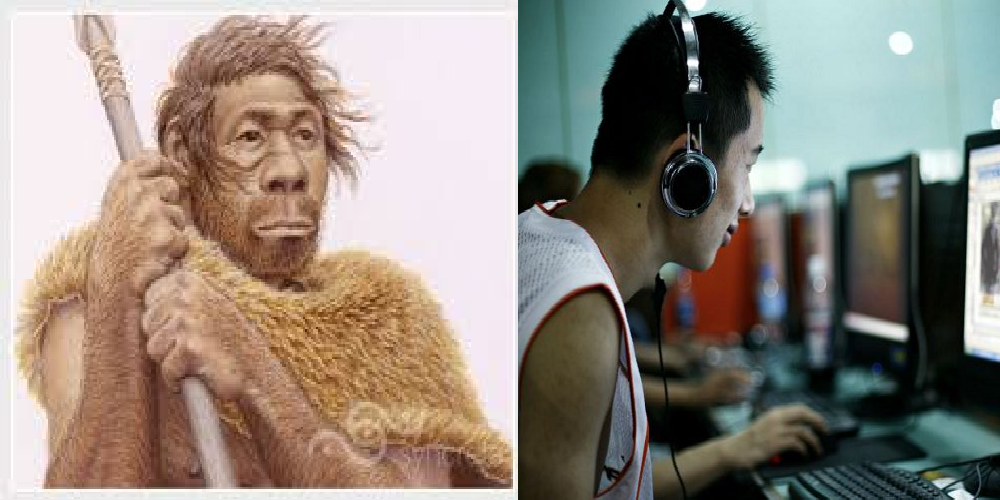
Lives Changed: From Homo Sapiens To Homo Netizens

0

We live in an era of unusual disruption of cultures, lives and businesses by technologies. As a little boy, I listened to folklore under the moonlight in my south eastern Nigerian village. The elders told the stories of justice, bravery, honor and humanity. There was no cellphone and there was no distraction. Life was under a predictable pattern, especially in the evenings when boys and girls would wait in turns to play under the moonlight, and receive moral education carefully orchestrated in the stories told by the elders. Every child belongs to the village and parents are nothing but stewards.

As we trekked miles to fetch water and firewood for the family cooking, we enjoyed the songs of the happy birds. We treasured the flowers and the gentle winds out of the thick rain forest near our stream. It was a life of great tranquility and we never had a suicide in the village. By norms and traditions, the fishes in our stream must not be fished. They were preserved and in most cases we played with them.

When it was time for school, we continued on that village tradition of brotherhood. The elders have mapped out lands in the village where people could go and plant fruit trees so that any villager, when hungry, could go there and eat. It was forbidden to sell anything from that land because it was designed to be a ‘strategic food reserve’. It worked; I planted an orange tree and my best friend gave the village a coconut tree.

But that was then. Many things have since changed, not just in my village, but around the world. Technology is disrupting all aspects of human existence and our lifestyles have changed. Industries are being demised and new ones are coming up with our lexicons constantly evolving to accommodate new tech-evolutions.

Lives Changed

Food preparation has been professionalized and families do not need to know how to cook. Technology and globalization have already changed family traditions.

As a boy, I heard of professional typists. These were specially trained pros who could churn out characters on typewriters at amazing speed. There are few of them today. There were shorthand experts; people that could write on special characters in order to capture statements as fast as they are spoken by their employers.

Many of these professions have since gone or are going. Technology is displacing their services. Computers make mastering of typing not a big deal since it does not cost anything to edit and delete when using word processing software. Compare that with erasing and changing stencils in a typewriter, you will appreciate the level of innovation that has taken place. A single mistake in a page could render the whole document useless; the typist has to start over, especially in quality documents, where erasure is not permitted. So the trade was to get people that could type with zero error, and at fast speed.

For those that are shorthand experts, video recorders with translation capability make it unnecessary to be writing when a politician or anyone is talking. Just record and soon print out the transcripts. Those experts are also fading. It is rare to see a journalist job that requires mastering of shorthand as Isaac Pitman invented it.

Have you noticed that the city of London could police the whole city through video cameras when in the old dull days, policemen might have been used? Those traffic policemen we used to see across many African cities are disappearing as most of the cities install traffic light systems. Those jobs or careers are being displayed by technology.

What of language interpreters? I recall a meeting in Kenya where someone was giving a speech in French and the interpreters were interpreting in English, Arabic and Portuguese. It worked out so well. But that career will soon die. If Apple or any of the Smartphone makers develop a good language translator in their gizmos, we may not need the interpreters, at least, in some gatherings.

Planning Careers of the Future

So, we have got a lot of challenges in career planning these days. Does it make sense to pursue this career considering how technology could change it in the future? How many ticket masters were displaced when airplane ticketing moved online? How will software affect journalism in the future? How is technology affecting parenting since technology is increasingly displacing our attention to our families? Those late night emails and constant trips to the phones at 10pm are all disruptions.

Planning for careers is not just focusing on what happens today or maybe in two years time. You must have a feel of where technology is going and then anticipate and stay ahead in your career. A business model to open physical bookshops may not be a good idea since most people rarely care to know the bookshop around their neighborhood these days. The first point is to order from eBay, Amazon or BN, if you are living in U.S. The local bookstore is model already endangered. The same goes with building cinema halls. Netflix, iROKOtv and others are our virtual cinema halls. They do not need physical locations; only that you  must join via an IP address.

The interesting thing about this technology disruption on careers is that it does not matter what your level of education is. It could be that your industry is booming but  has moved out of your locality. That brings the degree to which your field is outsourced. The easier your job can be automated by technology, the higher is the risk of technology displacement.

So when people discuss career planning, it is very imperative that you understand how technology and not just wages could play out in the future. If you specialize in a special type of engine design and from all trends, it is evident that that engine is going to be obsolete and you refuse to adapt and be retrained, you could be in trouble. Ask the expert photographers that made fortune washing and developing films in dark rooms. Those that failed to move to digital photography are only in history books.

All Together

Our world has been made better by technology because it improves our productivity and standard of living. However, it also carries a major challenge: disrupting careers and moving many jobs to museums. It is very important you stay ahead and see how new technologies could disrupt and displace your job. Never wait, plan ahead, and stay above technological innovation with new skills. In this age, as netizens, we must be learning constantly so that we can be ready for whatever comes. We already live in the web, so becoming Homo Netizens as Homo Sapiens may be one aspect of our adaptation. There is nothing you cannot learn from the web these days. That career resilience, disrupted by technology, can also be cushioned by technology. The web is an ocean with unbounded and unconstrained knowledge. You just have to make sure that you are swimming in the right direction with the waves.
Tekedia Programming Notice

0

Update: We have resumed programming.

As we prepare to publish my new book exclusively on Tekedia, we want to make sure we deliver the best service to readers. Consequently, Tekedia is moving to Amazon Web Services (AWS). AWS has the capacity to provide unrivaled experience to our readers.

I am an entrepreneur and I do all that is possible to deliver good experience to my customers. I sincerely appreciate that many come here daily to read my articles. We respect that and want to deliver value. I know the frustrations of seeing 500 errors which happen during peak periods. I personally apologize for that.

While we transition, I will not post any new content. Team took the last backup 9.30am Aba time today. They will be done in the next few days and programming will resume. But while we wait, Tekedia will remain fully available except that you may see some errors. Yes, the 500 error, largely related to traffic in the poor Hostgator service. We have tried many of these hosting services and have now decided to go AWS.

It is a natural choice because AWS hosts many of our other properties like Zenvus, Facyber, Milonics Engine, etc.

As always, I want to thank you all for sharing your time with us. We will be done over the weekend and programming will resume.

Regards,

Ndubuisi Ekekwe

Entrepreneur


Nigeria’s Alexa Opportunity

3

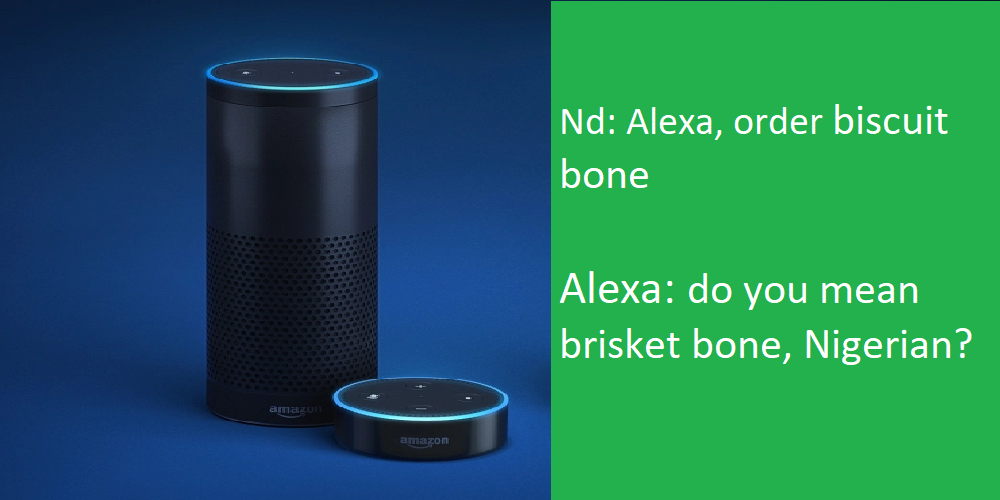
Amazon’s Alexa, an  intelligent personal assistant, discriminates. It struggles with my nice Nigerian accent. It gets so bad that most times I just give up.  Sure, it is not Alexa’s problem. It is also not my problem. But someone has to make it easy for me to participate in the voice-activated ecosystem.

My accent is truly Nigerian. I keep working to make sure I do not lose it. It gives me confidence and I like it when people ask me: Are you from Nigeria? I work on it making sure that I keep the vowels in the purest of way.

But since I got Echo/Alexa, that accent seems to be on its own.  I used to ask for “redy made” cloth instead of “already made” cloth, many years ago in primary school. I knew I ate many “biscuit bones” when I had in mind “brisket bones”. Coming with that background, I am making life harder for Alexa.

There is a huge problem. With virtually no participation from our region in this space, Paris, Silicon Valley, London will train for their voices. The Voice AI race may just forget the Nigerian accent. Everything we dream about voice AI could stall.  This is one of those areas where we can be left behind despite the huge opportunity voice offers to Nigeria.

We like to talk. We rarely enjoy writing. In short, without colonization, it is possible Igbo, Hausa and Yoruba would not be in written forms today. But now, Voice AI systems are coming to our domain (yes, talking), but our accent could hinder progress.

If you are dreaming, there is a business opportunity here. After all, the BBC has gone pidgin. Alexa needs to interpret that also. This is huge because in the next ten years, translators will be gone like typists and our phones will do translations synchronously. The question is this: Will Nigerians be part of that? Only our entrepreneurs can help, because that is not a Silicon Valley problem.

All Hail The GloCal Product Designers

4

In this contemporary time, the most dynamic and evolving human field is engineering or technology depending on your choice. Such an observation may seem at first to be a mere truism but closer considerations of its impacts in medicine, entertainment, energy and security will rapidly dispel any such dismissive judgment.

Engineering is transforming all fields. Future medicine looks as a field where robots will seamlessly help doctors and surgeons get patients back to work or home quicker and healthier. The future of global energy looks promising because engineers are breaking barriers daily in the quest to deliver affordable, efficient and clean sources of power.

From entertainment to security, nothing is spared. Today’s wars are technology wars fuelled by engineering geniuses acquired, advanced and processed over centuries. The bravery of a modern warlord is the engineering feat of someone who may never have to shoot. We are living in an era where discovery is not celebrated, not because they have become easier, but because they are happening regularly.

Engineering practice has changed so much and in a radical form from what it was a few decades ago. The global energy problem is engineering problem. The global health challenge is an engineering problem, and daily engineers are faced with burdens to solve major world problems. While the politicians enact the energy bills, the engineers make the energy practically available.

The bold and optimistic challenge to help engineer bio-grade artificial human organs is an assessment that managing what Nature gives us has limitations. Why not get a new artificial brain if the one that exists is not functioning because of disease?

The Challenges

But these advances pose serious ethical challenges which the engineers are not providing answers. In most cases, that is not their job; someone has to regulate them and put them on the path of keeping sanity on this earth.

But regulating these activities is unfortunately not easy. One technology could do well but could also be harmful. In this case, the problem is not the technology, but the application and usage. It is like saying because nuclear technology could kill en mass, it must be banned in hospitals where they are used in many critical treatments.

But for a moment, let us leave the technical aspect of engineering progress. I am already aware that many cotton farmers in Sudan could be out of jobs if some of the experiments on lab production of cotton in universities in US and European schools work out. We could be creating security crises where suddenly the commodity market is destroyed because nanotechnology has provided alternatives to rubber, cotton and hosts of other materials. People will be out of jobs and crises will start everywhere.

My concern is the disparity in engineering development between the developed and developing world. The rich nations are pushing the limits while the poor are not contributing much. It is not that they do not want to contribute, they want but the environment does not enable them. We lose their ideas and perspectives, unfortunately.

Can the future of engineering be structured such that these people can get on the pathway of creativity and innovation? Can the world and technical associations provide an effective system, where boys and girls in developing countries could help to solve the global engineering challenges? How can this be done? In short, how can companies begin to give people at the bottom of the pyramid opportunities to shape the products that are designed for them?

The same problem that has undermined our abilities to solve major poor people’s diseases is what is affecting the ability of the world to provide technology in ways that the poor people can use them. Exporting Smartphone to people that just need the simplest phone is not a great strategy.

Developing GloCal Mindset

The world needs a redesign: we need a new way in looking at things. It will be tough because there are many components to the engineering question. A drug company may prefer developing drugs for cancer over malaria because people that suffer malaria may not bring good revenue. Yes, those that engineer drugs consider business before the quest to save lives. But there could be a balance. Why not have a system where engineering goes global and local at the same time? They can solve the drug dilemma, with their global expertise, but localized at scale for each market.

Answering, understanding and managing emerging developments of meeting the needs of every customer (yes, the broad and specific needs), in the highly fragmented world market will define the future of engineering. It will show our readiness to solve the world’s problems. It will make engineering fresh before all global citizens. It is going gloCal- having a world global strategy, but acting local in each market or community. It means helping people solve local problems with global ideas.

If we begin to do that, we have the possibility of solving these problems. It is so shameful that in a world of so much knowledge, many are very poor and dying. We have solved the refrigeration problem in Boston, but in a small village in Ghana, the citizens have no light and refrigerators do not have any value there. So, can we say we have indeed solved how to preserve food?

The global food problem is an engineering problem. Even in Africa, they have enough during the harvesting season. But immediately that season is gone, many become hungry because they could not preserve the excess. So, you have a system where a man that threw away a basket of excess fresh tomatoes a month before is looking for a canned tomato for his family. What if he has preserved the fresh ones? We need solutions.

Now is the time to redefine what engineering research is. People at the bottom of the pyramid are not interested in nanotechnology and genome project. They just want simple ways to live and if entities can understand those challenges by providing simplicity through engineering, everyone can look at engineering future with optimism.

My African kinsmen care not if you can travel to Mars. You have not assisted them to preserve the mangoes they harvested to last longer and feed their families. So while the Mars race is on, they expect to find ways to store their excess food. If that happens, they can confidently look at the future of discovery and engineering with hope. A little support and devoting the engineering powers of the advanced nations to the “nonsense challenges” of the developing world could solve many problems.

There are engineering challenges across the developing nations and it is time we put resources to solve them instead of being obsessed with sending private ships to the moon. Engineering must be global and yet adaptable to local needs:- we need gloCal engineering for the future. Let engineers be engineers, irrespective of boundaries and make this world a better place. Until then, many will not understand why they matter. That process will help us make GloCal products. We have hailed legends that created products like iPhone and Tesla Motors. But always remember that in most places like Chad and Myanmar, the iPhone feat is just a cup of clean water. Right now, that clean water is not possible. And that is bad. The world will hail people that think global even as they help locals have solutions they need to live.


Tekedia Undergoing Maintenance for eBook Launch

0

Dear Reader,

As we prepare to launch the eBook and a section for exclusive articles next month, you may experience some errors as you use Tekedia. Please bear with us; we do not want to take the site offline, so team is coding live. We hope to finish this maintenance within the next 72 hours.

Thanks

Fasmcro Labs