The Asset Management Corporation of Nigeria (AMCON) has sold Keystone Bank Limited to Sigma Golf Nigeria Limited and Riverbank Investment Resources Limited. It hinted that the new owners were a consortium of local investors.
The corporation noted that the new beneficiaries emerged preferred bidder after the acquisition of the bank’s shares. The new development came after regulatory approvals from the Central Bank of Nigeria (CBN) and Securities and Exchange Commission (SEC).
AMCON, however, added that the completion of the transaction was now subject to the fulfillment of the conditions in the Sales and Purchase Agreement (SPA) executed between the bad debt company and the consortium.
The corporation said the process leading to the acquisition started with interest shown by 18 parties cutting across local and international investors. “The emergence of the Sigma Golf-Riverbank consortium resulted from a rigorous and competitive bidding process, which was coordinated for AMCON by Citibank Nigeria Limited, its affiliates and FBN Capital (Joint Financial Advisers) as well as Banwo & Ighodalo and Crosswrock Law (Joint Legal Advisers).”
After the inquest carried out by the Mallam Lamido Sanusi-led CBN in 2008, three of the 24 national banks that scaled the 2005 banking consolidation – Afribank Plc, Spring Bank Plc and Bank PHB failed a stress test.
These were, subsequently, nationalised by a special purpose vehicle that emerged in AMCON, imposing a new administration and rebranding them as Mainstreet Bank Limited, Enterprise Bank Limited and Keystone Bank Limited.
Keystone Bank was incorporated by the Nigeria Deposit Insurance Corporation (NDIC) on August 3, 2011, after the takeover, while AMCON eventually capitalised it before appointing a board and an executive management team to lead the financial institution.
Y Combinator is an American seed accelerator, started in March 2005. Fast Company has called YC “the world’s most powerful start-up incubator”. Fortune has called Y Combinator “a spawning ground for emerging tech giants. Y Combinator created a new model for funding early stage startups. Twice a year we invest in a large number of startups.
This March Winter 2017 Demo Day, the following Nigerian companies are pitching this week. WIFI.com.ng has just been profiled by Y Combinator.
Kudi.ai is a financial service provider focused on providing access to electronic banking and financial services by leveraging conversational interfaces, natural language processing and artificial intelligence to provider faster access, frictionless experience, and ultimately eliminate the need to download different financial or banking applications.
Aella Credit
Provides instant credit solutions that eliminates the hassle of standard loan applications and enables employee to borrow at competitive and fair rates through their employers. Individuals can download the application through Android devices. Benefits of the platform are offered to employees, companies, and investors.
BuyPower
Is a utility payment platform in Nigeria. Their website offers pre-paid electricity recharging service available for customers
Provides broadband internet using wi-fi to residential and small businesses. TIZETI (wifi.com.ng) has been deploying high speed internet access to estates, offices, multi-tenant building using next generation wi-Fi technology. They deploy internet to residential and business customers which allow customers get the full benefit of the internet with no data or time caps. They also offer VOIP and Video on Demand services.
Kangpe
Provides a platforms where doctors are able to give the best medical advice for symptoms, disease diagnosis, and treatment when you describe your health condition in a detailed manner.
Cisco, IBM, Apple and other U.S. companies are investing heavily in China. They see China as a very strategic market which they must not just sell things but also invest massive resources to tap local innovation.
For Apple, China remains its second-most important market outside the United States. The company continues to make big investments in the country despite political pressure to bring more of its manufacturing activities back to the United States. Apple CEO Tim Cook spoke in the World Development Forum in China last week.
Last, Apple said it would build two more research and development centers there in Shanghai and Suzhou. That makes four so far, at a cost of about $500 million.
IBM’s CEO Ginni Rometty was in Beijing Sunday, where she signed her company’s new partnership with a division of a huge local conglomerate, Wanda Group. This is IBM’s second big foray into China’s cloud services market, which is tightly controlled from a regulatory standpoint. Few details were disclosed about the new alliance, but IBM will share revenue with its new ally.
Apple and IBM are far from alone in their need to strengthen their friendships in China, ahead of possible changes to the U.S.-Chinese trade relationship. Cisco pledged $10 billion to the market back in 2015, so it also has plenty at stake.
Contrast that with Africa where these companies largely make any serious innovation investments. While IBM has a research unit in a university in Kenya, Cisco and Apple are largely nowhere in the R&D nexus in Africa.
Africa Policy
But you cannot blame these firms. African governments are always sales-driven as we see technology capabilities within the lens of buying and owing tech products. The creative aspect of it is not that common. So when we meet companies like IBM, Cisco and Apple, we are focusing on how many sales offices they will open. We rarely have policies that deliver incentives for them to invest.
It is also important that the challenges faced by local companies are the same these foreign companies will face. So if the local companies do not see value in risking capital on new investments, you should not blame the foreign ones for opening only sales offices in Africa.
It is easier to succeed in Africa selling imported things than making innovative products owing to trade policies.
In Future
Africa needs to have a redesign because what is happening now will not provide jobs for its citizens. If IBM, Cisco and other U.S. companies continue to invest in China, the result will be continuous Chinese dominance in global trade. Africa will miss the opportunity to provide employment for its citizens and that will be catastrophic for its long-term security.
A prescription medication is any medication that strictly requires a doctor’s prescription before a pharmacist can dispense it to you. Normally, a doctor will ask you several questions before prescribing a medication for, let’s say, hypertension or diabetes. Some of these questions include the drugs you are currently taking, whether you have reacted to any drugs before and which ones, including the one he or she is about to prescribe for you.
In addition to all your doctor tells you before prescribing any medication, Kangpe, a leading Nigerian healthTech startup, notes that you should endeavour to do the following before that medication enters your mouth:
1. Check the expiry date of the drug
It may sound irrelevant, but a lot of people don’t bother to check the expiry date of drugs before paying for them at the pharmacy. Taking an expired drug is harmful in any way you can imagine: such a drug has lost its potency to treat the condition you’re taking it for, meaning a waste of money, and it may even now cause a serious health problem for you.
Therefore, ensure you inspect the packs of the drugs you’re buying at any pharmacy before paying for them. If you can’t find the expiry date on the pack request for another one. For drugs that may be dispensed into a pill bottle or a sachet, ask the pharmacist about their expiry dates on the dispensing container. It is your fundamental human right to know the expiry date of any medication you’re buying. If you encounter resistance, just walk away and look for another pharmacy.
2. Check the possible side effects of the medication
Again, many people take this for granted. Whenever you purchase any prescription medication, ensure you go through the leaflet inside the pack. Don’t throw it away immediately. Look out for where all the possible side effects of the drugs are written and take note of them. While your doctor will definitely tell you the very common side effects of any medications he or she prescribes for you, there are less common ones that time may not permit him or her to inform you about. But they are written on that leaflet.
Going through the leaflet for these less common and often very dangerous side effects will enable you know and attribute any one of them to the drug at once if you experience any, thereby stopping the medication right away. And it will prevent you from wrongly blaming another thing for such a side effect while still taking the medication which could be very dangerous.
3. Read about the drug interactions
This precious information is also printed on the leaflet of any prescription medication you purchase. Drug interactions means other drugs and even foods and drinks that interact with the medications you’re taking in ways that make them either less effective or very harmful to your body. Hence, such drugs, foods and drinks should be avoided while on the particular medications prescribed for you.
If everything’s alright, it’s time to start budgeting for your treatment so that you can maintain consistency without financial strain. Patients suffering from gastrointestinal issues are often looking for Motegrity Coupon and Cost reduction options to stock up on their prescriptions without breaking the bank. These savings can make long-term care more manageable and reduce stress around affordability. With careful planning, patients can focus more on their health and less on financial concerns.
4. Read about the contraindications of the drugs.
On that same leaflet, you will find information on the contraindications of the medication. Contraindications of a drug are health conditions and situations in which such a drug should not be taken or a doctor should be consulted for guidance on taking them. For instance, someone with a liver or kidney disease is not supposed to take any medication whose common side effect is injury to any of these organs. When there are no alternatives as is the case for some first-line drugs for treating tuberculosis, such a person will take the drugs in dosages recommended by a doctor and will constantly be monitored for signs of injury to these organs.
Pregnancy, asthma, diarrhoea and so on are conditions (contraindications) that warrant certain drugs to be avoided or be taken under the strict guidance of a doctor. Your doctor will always ask you if you have any of these conditions that are contraindications before giving you a prescription. However, he or she may not ask you for all the possible conditions, and reading that leaflet can be a lifesaver.
Always endeavour to buy your prescription medications from a good pharmacy staffed with a registered pharmacy (they will always ask you for a doctor’s prescription before selling such medications to you)
This is courtesy of Kangpe Healthcare Services, a leading Nigerian healthTech startup.
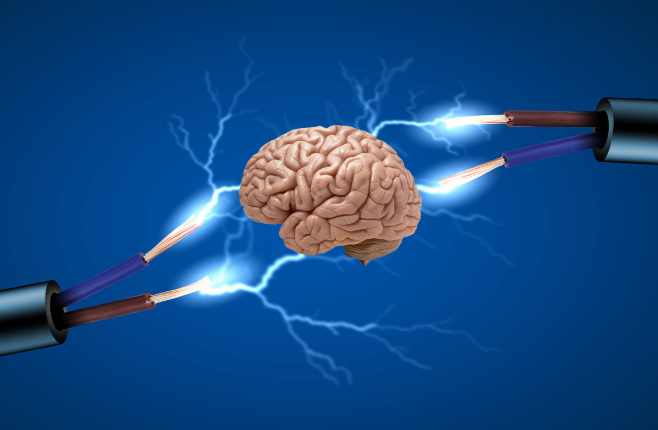
Electric dominance of the brain working is well confirmed and established by health and neural sciences. Electric signals within the brain not only govern/control the working of the human body, but according to recent medical studies, these signals with suitable electric brain stimulation techniques can be controlled to enhance the desired activities of the human body like motion, memory, health, peace and more. This article aims to bring to the reader such useful outcomes of electric brain stimulation, but with caution that such technology should be used under proper medical expert supervision.
Transcranial direct current stimulation
Electric brain stimulation in its current form may be relatively new, but humans have been tinkering with the brain for centuries. Electrical brain stimulation, also referred to as focal brain stimulation (FBS), is a form of electrotherapy. This technique is used in research and clinical neurobiology to stimulate a neuron or neural network in the brain through direct or indirect excitation of its cell membrane by using an electric current.
Electrical brain stimulation was first used in the first half of the 19th century by pioneering researchers such as Luigi Rolando (1773 – 1831) and Pierre Flourens (1794 – 1867), to study the brain localisation of function, following the discovery by Italian physician Luigi Galvani (1737 – 1798) that nerves and muscles were electrically excitable.
In the following century, the technique was improved upon by the invention of the stereotactic method by British neurosurgeon pioneer Victor Horsley (1857 – 1916) and by the development of chronic electrode implants by Swiss neurophysiologist Walter Rudolf Hess (1881 – 1973), José Delgado (1915 – 2011) and others, by using electrodes manufactured by straight insulated wires that could be inserted deep into the brain.
Two-photon excitation microscopy has shown that micro-stimulation activates neurons sparsely around the electrode even at low currents (as low as 10µA), up to distances as far as 4mm away. This happens without particularly selecting other neurons much nearer the electrode’s tip. This is due to activation of neurons being determined by whether these have axons or dendrites that pass within a radius of 15µm near the tip of the electrode. As current is increased, volume around the tip that activates neuron axons and dendrites increases and, with this, the number of neurons that are activated. Activation is most likely to be due to direct depolarisation rather than synaptic activation.
Techniques of electric brain stimulation
Medical experts and companies have developed a variety of non-invasive brain stimulation technologies such as cranial electrotherapy stimulation (CES), deep brain stimulation (DBS), transcranial direct current stimulation (tDCS), electroconvulsive therapy (ECT), functional electrical stimulation (FES), magnetic seizure therapy (MST), vagus nerve stimulation (VNS) and deep transcranial magnetic stimulation (deep TMS).
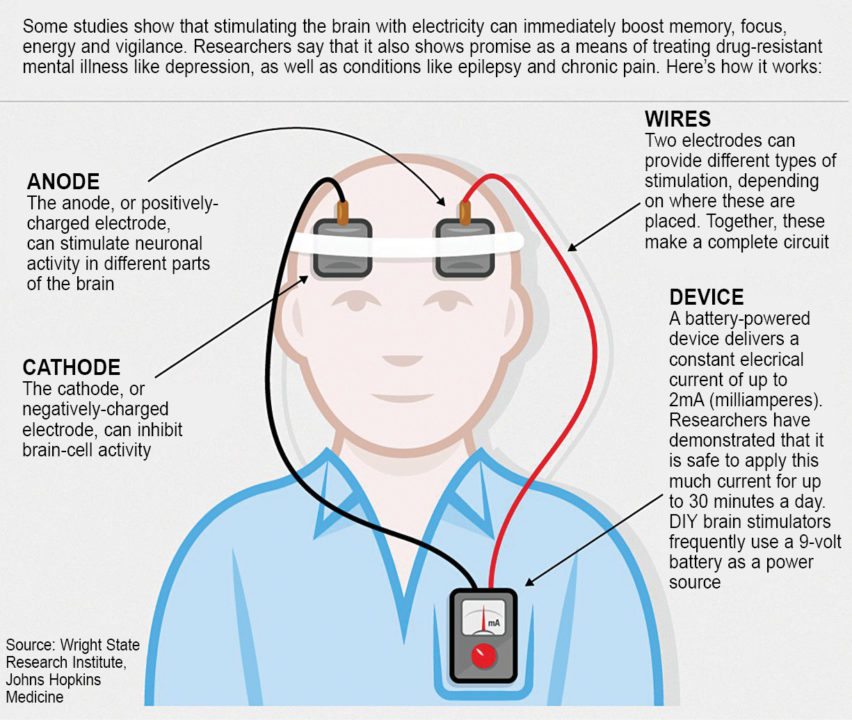
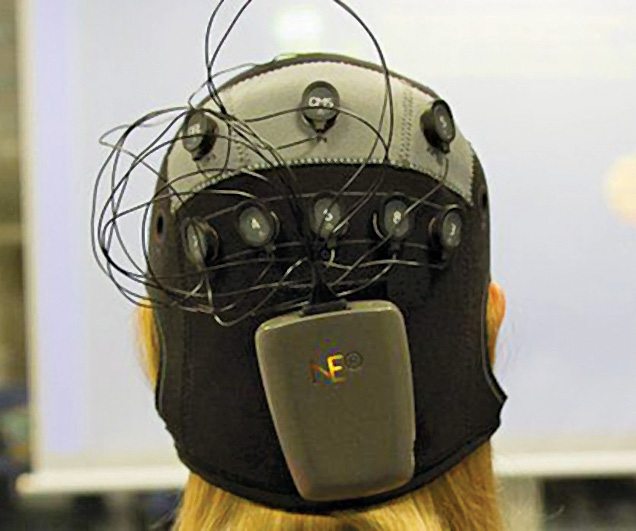
tDCS is getting loads of attention from early adopters who rave about its potential, and scientists who are trying to unravel what it can and cannot do. It is a non-invasive form of brain stimulation that involves passing a current between electrodes on the scalp. The technique is one of a number of technologies being tested to see if it can enhance cognitive functions such as boosting the performance of drone pilots or image analysts.
According to the experts, the current is set to about 2mA, which is about 1000 times less than the electrical current that flows through a typical iPad charger, and only about 1/50th of that current makes it through the skull to the brain. The stimulation is said to last for about ten minutes, and is aimed at the right inferior frontal cortex and the right anterior temporal lobe, which are brain areas thought to be important for learning.
A mild stinging sensation is felt where the electrode is attached to the head. This is thought to be a normal feeling, but if the sensation continues, it is better to turn off the connection and try to get a better connection.
Next, people notice a slight taste of metal in their mouth, a common side effect of tDCS, according to experts.
Although this is an experimental method, it is widely regarded as safe and does not appear to cause any short-term harm. The most common side effects of stimulation include tingling or skin irritation and seeing phosphenes (light rings or spots not produced by actual light). Other side effects include fatigue, headache and itching under the electrode. In rare cases, people experience nausea or insomnia.
Some studies have found impressive gains in performance from tDCS, while others suggest the technique has little effect. That has not stopped adventurous amateurs from testing home-made devices on themselves, though this is not recommended. Scientists are still investigating how tDCS works, but the reigning hypothesis is that it changes the excitability of a particular brain region. Depending on the direction of the current, stimulation could make neurons in a particular area of the brain more or less likely to fire.
Recent studies have focused on using tDCS to boost the performance of image analysts for the military. The study found that participants who received training and stimulation were about 25 per cent more accurate in identifying the objects than those without stimulation. Some studies claim to have found benefits in everything from mental arithmetic to memory; other studies have found no evidence of cognitive effects from a single session of tDCS.
Research on tDCS is not limited to seeking cognitive boosts. Many scientists are also investigating its efficacy in treating mental disorders such as traumatic brain injury and schizophrenia. However, there is no administrative approval for the use of the technique.
Similarly, TMS uses a magnetic coil to induce small electrical currents in the brain. In contrast to tDCS, TMS actually causes neurons to send signals or spike, and it has been approved for treating depression and migraines.
Effects of electric brain stimulation
Focused thinking, better memory, deeper sleep, relief from depression and reduced stress are some benefits of electronic stimulation for the mind and brain as mentioned in the literature on the Internet by companies dealing with the development of different types of the brain stimulation devices.
Electrical stimulation devices at Oxford University can have currents placed on various parts of the brain (Image courtesy: www.bbc.com)
Popular electric brain stimulation methods that are used to boost brainpower are detrimental to IQ scores. Using a weak electric current in an attempt to boost brainpower or treat conditions has become popular among scientists and do-it-yourselfers, but a new study shows that using the most common form of electric brain stimulation has a statistically significant detrimental effect on IQ scores.
Strong electric currents may cause a localised lesion in the nervous tissue instead of a functional reversible stimulation. This property has been used for neurosurgical procedures in a variety of treatments such as for Parkinson’s disease, focal epilepsy and psychosurgery.
Sometimes, the same electrode is used to probe the brain for finding defective functions, before passing the lessoning current (electro-coagulation).
A comprehensive review of the research on electrical stimulation of the brain gives a list of different acute impacts of stimulation depending on the brain region targeted. Following are some examples of the effects documented:
Sensory. Feelings of body tingling, swaying, movement, suffocation, burning, shock, warmth, paresthesia, feeling of falling, oscillopsia, dysesthesia, levitation, sounds, phosphenes, hallucinations, micropsia, diplopia and more
Motor. Eye movements, locomotion, speech arrest, automatisms, laughter, palilalia, chewing, urge to move, crying without feeling sad, etc
Autonomic. Blushing, mydriasis, change in blood pressure and breathing, apnea, nausea, tachycardia, sweating and the like
Emotional. Anxiety, mirth, feeling of unreality, fear, happiness, anger, sadness, transient acute depression and hypomania, among others
Cognitive. Acalculia, paraphasia, anomic aphasia, recalling memories, going into a trance, out-of-this-world experience, conduction aphasia, hemispatial neglect, reliving past experiences, agraphia, apraxia and so on.
Medical applications of electric brain stimulation
Electrical stimulation of the brain is a relatively new technique used to treat chronic pain and tremors associated with Parkinson’s disease. It is administered by passing an electrical current through an electrode implanted in the brain. While implantation of electrodes in the brain is used to treat or diagnose several disorders, the term electric brain stimulation is limited to the treatment of tremors and as a pain-management tool for patients suffering from back problems and other chronic injuries and illnesses.
An electric brain stimulation tremor-control device used in treating people suffering from Parkinson’s may interfere with or be affected by cardiac pacemakers and other medical equipment. As a result, patients with other implanted medical equipment may not be good candidates for the therapy. Electrical stimulation of the brain, or deep brain stimulation, is effective in treating tremors in up to 88 per cent of Parkinson’s disease patients.
An electrode is implanted into the thalamus (part of the brain) of the patient and is attached to an electric pulse generator via an extension wire. The pulse generator is implanted into the patient’s pectoral, or chest area, and the extension wire is tunneled under the skin. The pulse generator sends out intermittent electrical stimulation to the electrode in the thalamus, which inhibits or partially relieves the tremor. The generator can be turned on and off with a magnet, and needs to be replaced every three to five years.
Similar methods have been used to treat chronic pain that responded unfavourably to conventional therapies. A remote transmitter allowed these patients to trigger electric stimulation to relieve their symptoms on an as-needed basis. Patients with failed back syndrome, trigeminal neuropathy (pertaining to the fifth cranial nerve) and peripheral neuropathy fared well for pain control with this treatment, while patients with spinal cord injury and postherpetic neuralagia (pain along the nerves following herpes) did poorly.
Implantation of electrodes into the brain carries risks of hemorrhage, infarction, infection and cerebral edema. These complications could cause irreversible neurological damage. Patients with an implanted electric brain stimulation tremor-control device may experience headaches, disequilibrium (disturbance of the sense of balance), burning or tingling of skin or partial paralysis.
Warning over electrical brain stimulation
Preliminary research on the effects of tDCS has spurred a host of scientists (and amateurs) to explore the possibility of improving cognitive function, increasing reaction times and treating mental illnesses through carefully-applied electrodes.
Research has shown that by delivering electricity to the right part of the brain, we can change the threshold of neurons that transmit information in our brain and, by doing that, we can improve cognitive abilities in different types of psychological functions. The idea is to make the neurons more likely to fire.
Preliminary research suggests that electrical stimulation can improve attention as well as have a positive impact on people with cognitive impairments and depression. Research has also highlighted that electrical brain stimulation could have favourable effects on humans, but some companies are selling such devices online, leading to calls to regulate the technology. If used in the wrong way, these devices could be harmful.
We need to know how long to stimulate, at what time to stimulate and what intensity to use. Electrical stimulation is used in a controlled environment for no more than ten minutes at a time and only on participants who have passed strict medical checks. Scientists are, after all, applying electrodes to the brain, which they say could have some unintended results. For example, different brain regions than those intended might be affected and, in some instances, stimulation could impair rather than improve function if the polarity of the stimulation is reversed.
What is even more worrisome is that people are increasingly making DIY brain stimulation kits themselves. This puts the technology in the realms of clever teenagers.
Another concern is that the science behind these devices is not ready for the commercial market, and companies are jumping on the hype of research that is not quite ready for the world. Any device with medical claims that it is meant to affect the biological function should be appropriately regulated.
Suggestions of increased attention and alleviation of certain medical conditions mean that interest in electrical stimulation is bound to increase, but if the research continues to show promising results, it is clear that electric brain stimulation will need to be treated with some caution.
by By Dr. S.S. Verma – Dr. S.S. Verma is a professor at Department of Physics, Sant Longowal Institute of Engineering and Technology, Sangrur, Punjab