DD
MM
YYYY

PAGES

DD
MM
YYYY

spot_img

PAGES

Home Blog Page 7431

What is Big Data? Beyond the “Three Vs”, The Additional “Four Vs”

0

The world generates data at an astonishing rate—about 2.5 quintillion bytes each day. Big data is huge and it is an emerging fascinating area.

But what is big data? That’s a good question. There seems to be as many definitions for big data as there are businesses, nonprofit organizations, government agencies, and individuals who want to benefit from it.

One popular interpretation of big data refers to extremely large data sets. A 2011 McKinsey study defined big data as “datasets whose size is beyond the ability of typical database software tools to capture, store, manage, and analyze.” Some have defined big data as an amount of data that exceeds a petabyte—one million gigabytes.

Another definition for big data is the exponential increase and availability of data in our world.

This data comes from myriad sources: smartphones and social media posts; sensors, such as traffic signals and utility meters; point-of-sale terminals; consumer wearables such as fit meters; electronic health records; and on and on.

Buried deep within this data are immense opportunities for organizations that have the talent and technology to transform their vast stores of data into actionable insight, improved decision making, and competitive advantage.

By harnessing the power of big data, healthcare systems can identify at-risk patients and intervene sooner. Police departments can predict crime and stop it before it starts. Retailers can better forecast inventory to optimize supply-chain efficiency. The possibilities are endless.

But to fulfill this promise, organizations need qualified professionals with the skills to extract meaning from the mountains of data—and these elusive data scientists are in short supply.

The “Three Vs” of big data

In 2001, industry analyst Doug Laney defined the “Three Vs” of big data:

  1. Volume

    The unprecedented explosion of data means that 90 percent of all the world’s data has been created in the past two years. The global digital universe now exceeds 2.7 zettabytes, and volume is expected to double every two years. Today, the challenge with data volume is not so much storage as it is how to identify relevant data within gigantic data sets and make good use of it.

  2. Velocity

    Data is generated at an ever-accelerating pace. Every minute, 571 new websites are created. Email users send 204,166,667 messages. Google receives more than two million search queries. The challenge for data scientists is to find ways to collect, process, and make use of huge amounts of data as it comes in.

  3. Variety

    Data comes in different forms. Structured data is that which can be organized neatly within the columns of a database. This type of data is relatively easy to enter, store, query, and analyze. Unstructured data is more difficult to sort and extract value from. Examples of unstructured data include emails, social media posts, word-processing documents; audio, video and photo files; web pages, and more.

Beyond the big three Vs

More recently, big-data practitioners and thought leaders have proposed additional Vs:

  • Veracity

    This refers to the quality of the collected data. If source data is not correct, analyses will be worthless. As the world moves toward automated decision-making, where computers make choices instead of humans, it becomes imperative that organizations be able to trust the quality of the data.
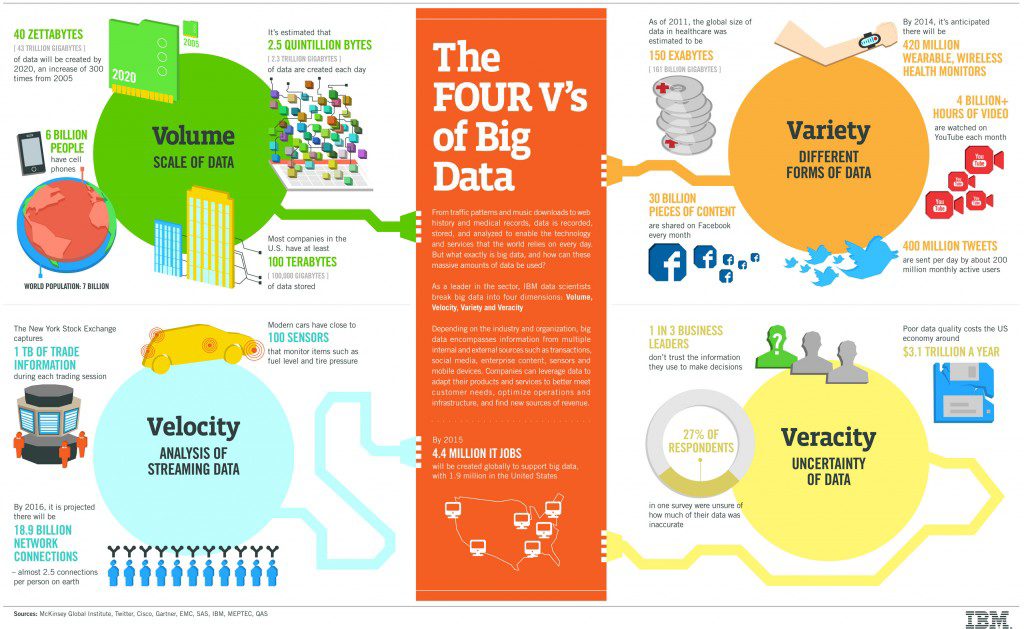


    IBM data scientists break big data into four dimensions: volume, variety, velocity and veracity. This infographic explains and gives examples of each.
  • Variability

    Data’s meaning is constantly changing. For example, language processing by computers is exceedingly difficult because words often have several meanings. Data scientists must account for this variability by creating sophisticated programs that understand context and meaning.

  • Visualization

    Data must be understandable to nontechnical stakeholders and decision makers. Visualization is the creation of complex graphs that tell the data scientist’s story, transforming the data into information, information into insight, insight into knowledge, and knowledge into advantage.

  • Value

    How can organizations make use of big data to improve decision-making? A McKinsey articleabout the potential impact of big data on health care in the U.S. suggested that big-data initiatives “could account for $300 billion to $450 billion in reduced health-care spending, or 12 to 17 percent of the $2.6 trillion baseline in US health-care costs.” The secrets hidden within big data can be a goldmine of opportunity and savings.

Bringing it all together

No matter how many Vs you prefer in your big data, one thing is sure: Big data is here, and it’s only getting bigger. Every organization needs to understand what big data means to them and what it can help them do. The possibilities really are endless.


{Image Credit and sources)
Microchip pioneers smart, connected and secure solutions with hardware cryptography-enabled microcontroller

0

Security threats are increasing exponentially in terms of frequency, targeted devices, malignancy and costs of attacks. In today’s vast interconnected world, the need to provide greater security within a customer’s product or system is becoming a standard requirement.

To stay one step ahead of the criminal element and prevent theft of software/hardware, intellectual property and data, or communications services, customers today are designing their products with an eye on providing robust, connected and secure systems.

We are in the golden age of IoT and security is increasingly moving to hardware. not just software.Microchip has unveiled a new product – CEC1702. The CEC1702 full-featured microcontroller streamlines security implementation for an increasingly connected world

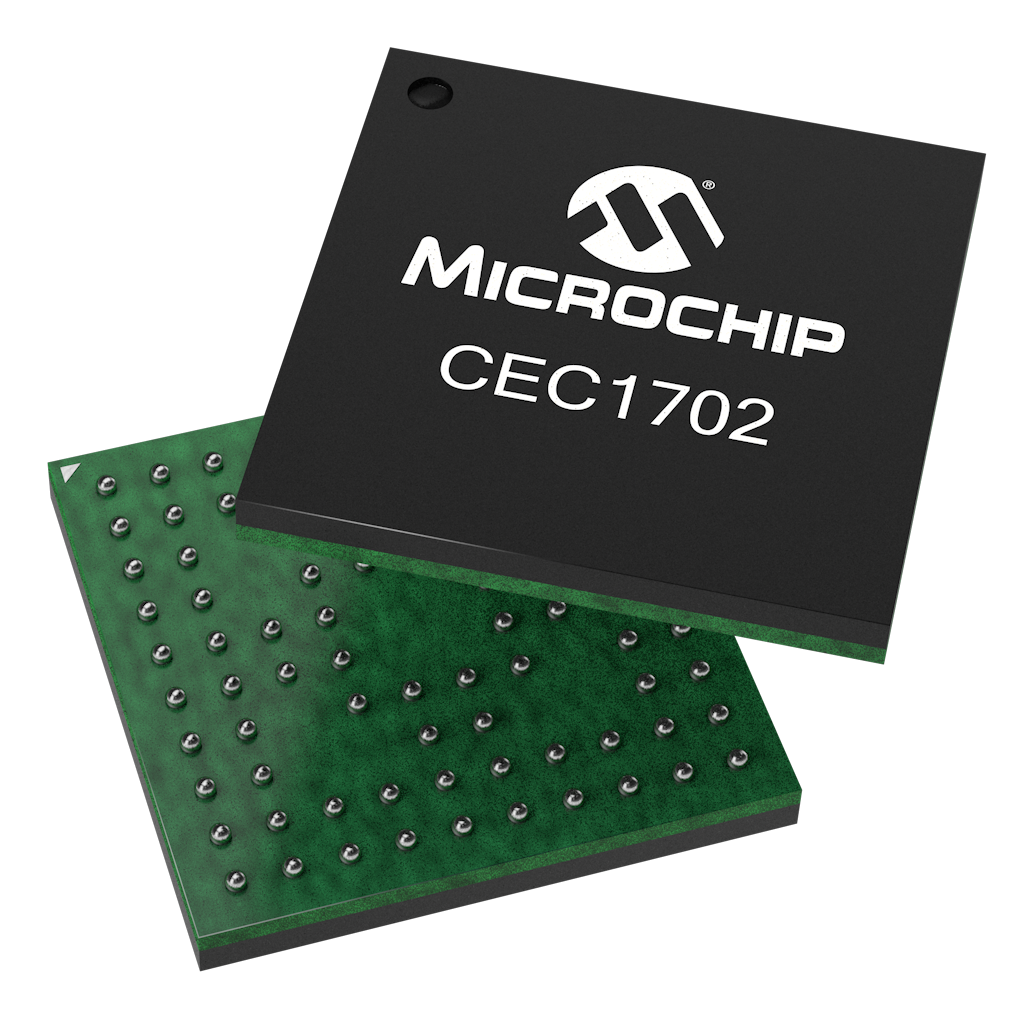
Microchip CEC1702

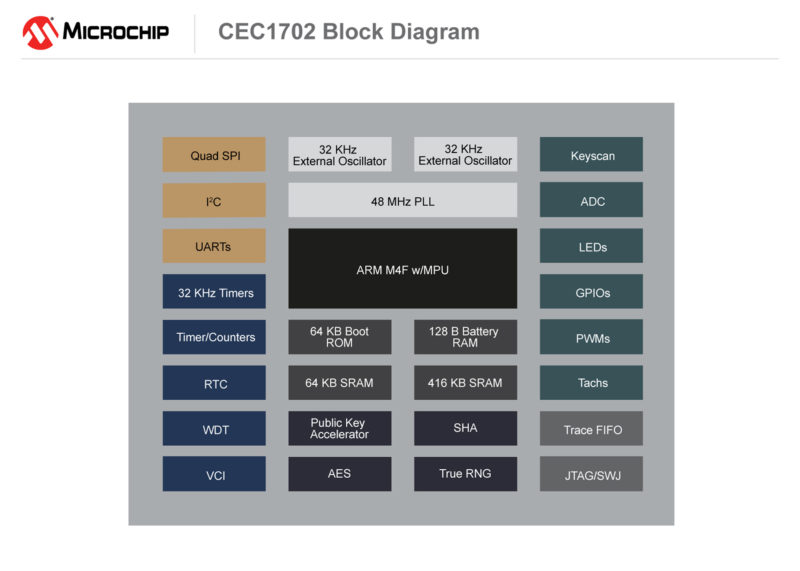
The CEC1702 hardware cryptography-enabled microcontroller is now available from Microchip Technology Inc., a leading provider of microcontroller, mixed-signal, analog and Flash-IP solutions. The CEC1702 addresses the increasing need for security measures, such as secure boot, driven by the continual growth of Internet of Things (IoT) applications.

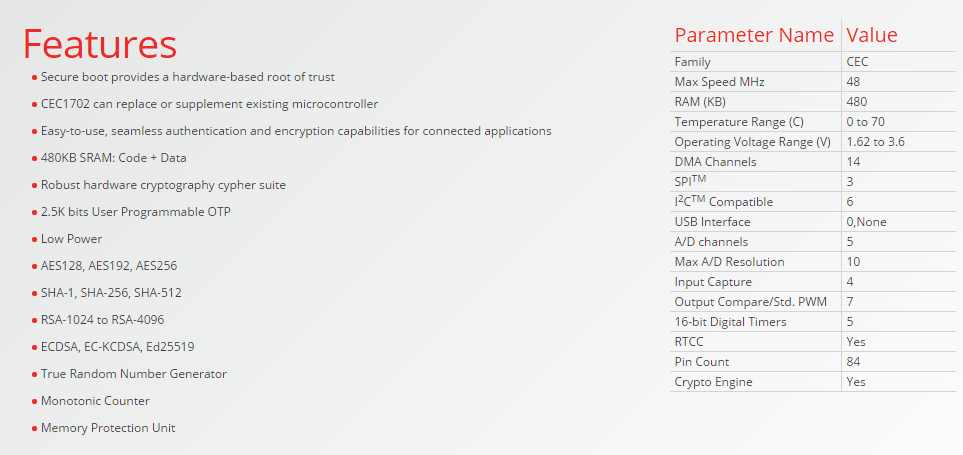
The CEC1702 is a full-featured ARM Cortex-M4-based microcontroller with a complete hardware cryptography-enabled solution in a single package. This low-power but powerful, programmable 32-bit microcontroller offers easy-to-use encryption, authentication, private and public key capabilities and allows customer programming flexibility to minimise customer risk.

The CEC1702 also provides significant performance improvements when compared to firmware-based solutions. The device’s hardware cryptographic cipher suite reduces compute time by orders of magnitude over software solutions, and, as an example, provides 20x-50x performance improvement for PKE acceleration as well as 100x improvement for encryption/decryption. This robust hardware-based feature set results in applications that can run security measures quickly, effectively and with significantly lower cost and power consumption.

Protecting system integrity has never been more important. Whether it’s being used as a security coprocessor or a standalone microcontroller, the CEC1702 delivers a multi-dimensional defense against attacks, including:

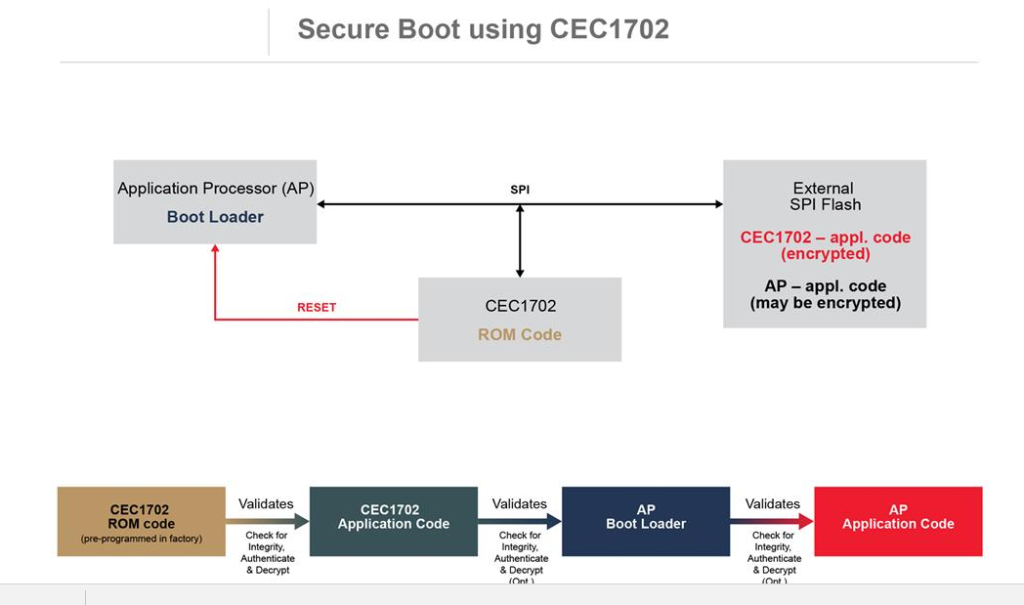
  • Pre-boot authentication of system firmware: Providing an immutable identity and a root of trust to ensure that the firmware is untouched and hasn’t been corrupted
  • Firmware update authentication: Verifying that the firmware update has not been corrupted and is from a trusted source
  • Authentication of system critical commands: Attesting that any system-critical command is from a known source with authorisation to make the given change, preventing potentially devastating actions
  • Protection of secrets with encryption: Safeguarding code and data to prevent theft or malicious activities

Boot Code Security

“The acceleration of the Internet of Things has brought higher visibility to the security considerations of new designs,” said, Ian Harris, vice president of Microchip’s computing products group. “One of the hardest challenges to solve in a connected system is the ability to ensure that the boot code has not been comprised. The CEC1702 eliminates this issue by making it easy for designers to verify pre-boot authentication and then provide firmware updated from known, trusted resources.”

Fasmicro Training

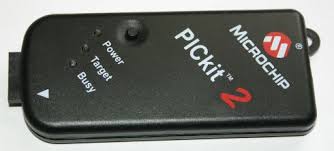
In West Africa, Fasmicro is an authorized training partner of Microchip. You can buy CEC1702 from Fasmicro. Also, Fasmicro  has stock of PICKit2 and PICkit3 and ship to any part of Nigeria.

Embedded Cybersecurity Training

First Atlantic Cybersecurity Institute (Facyber) offers embedded cybersecurity training covering technology among other areas. Interested learners can take advantage of the online program.


Senate President Saraki’s Bulletproof Range Rover Documents Seized By Nigerian Customs

0

This is why you cannot believe anything a Nigerian politician tells you – most of the guys are really not working for the country.

It has emerged that the ongoing scrutiny of the Nigerian Customs Service leadership by the Senate stemmed from the seizure of the Senate President, Bukola Saraki’s bulletproof Range Rover Sports Utility Vehicle (SUV).

According to Sahara Reporters, Customs officers in Lagos had on January 11, 2017, intercepted and impounded the SUV, which they claimed belongs to Saraki, over unpaid customs duty.

The Vehicle, with chassis number “SALGV3TF3EA190243, is said to be valued for N298 million, which means that customs duty of N74 million should have been paid on it.

It was reported that upon interception, the driver of the SUV confirmed Saraki owns it.

Here are the documents which we have aggregated in pdf.


The most innovative global agtech startups that must excite farmers

0

Agricultural tech, or agtech for short, has gradually become a fascinating  hot trend across the globe. It is the engine which is transforming farming. With readily available computational systems made possibly by embedded systems and cheap processing systems which can be rented in the cloud, agtech is blossoming. The era of smart farming is one driven by agtech  which is still a growing industry.

The following agtech companies are the most innovative right now in the word.

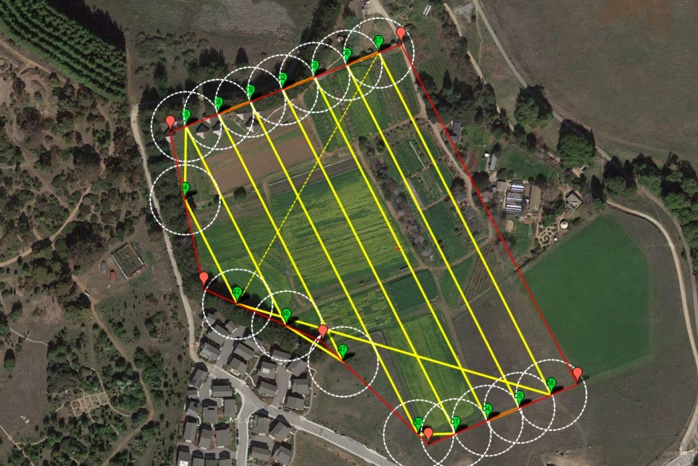
Resson is an aerial image analytics company that uses computer vision and machine learning techniques to detect and classify in-season biotic and abiotic stressors such as plant disease, insect damage or water shortage. The Resson Agricultural Management & Analytics System (RAMAS) takes in imagery from multiple platforms, including ground-based cameras and UAVs, to perform these analyses, moving beyond NDVI. It detects and localizes anomalies allowing growers to follow individual plant growth and make in-season course corrections.

Zenvus is an intelligent solution for farms that uses proprietary electronics sensors to collect soil data like moisture, nutrients, pH etc and send them to a cloud server via GSM, satellite or Wifi. Algorithms in the server analyze the data and advice farmers on farming. As the crops grow, the system deploys special cameras to build vegetative health for drought stress, pest and diseases. The data generated is aggregated, annonymized and subscribed for agro-lending, agro-insurance, commodity trading to banks, insurers and investors.

PrecisionHawk recently partnered with A&L Canada, the agronomy lab, to integrate A&L’s ground sampling data with PrecisionHawk’s drone imagery. PrecisionHawk is an information delivery company that combines unmanned aerial systems, remote sensing technologies and advanced data analytics to improve business operations and day-to-day decision making. PrecisionHawk brings value to an emerging market by offering an end-to-end solution for aerial data gathering, processing and analysis to provide actionable information across a wide range of data-intensive civilian industries.

Mavrx, which first based its insights on aerial imagery from planes, recently added a drone scout feature to its app to create specific drone flight maps for farmers to assess potential problems areas identified with its ultra high-resolution imagery from planes. The idea is to help farmers locate fields where yield is at risk efficiently to eliminate the burden of drone-based image processing. Mavrx is on a mission to collect and organize the earth’s physical data. Their job is to connect the world of agriculture with the world of big data—driving improvements in crop productivity and land management.

IntelinAir is also using machine learning to analyze aerial imagery as a service, although it acquires this imagery through third parties. IntelinAir, Inc., is an aerial imagery analytics company focused on agriculture that delivers actionable intelligence to help farmers make data-driven decisions to improve operational efficiency, yields, and ultimately their profitability. IntelinAir combines the power of aerial imagery analytics through traditional computer vision and modern deep learning methodologies, agronomic science and user-friendly interface (mobile) technologies to deliver near real-time decision support to farmers. The company’s flagship solution AG-MRI™ is a field health monitoring and early-warning system that enables farmers to manage their operations proactively and with confidence. The company, founded in 2015, has dual headquarters in San Jose, Calif., and Champaign, Ill.

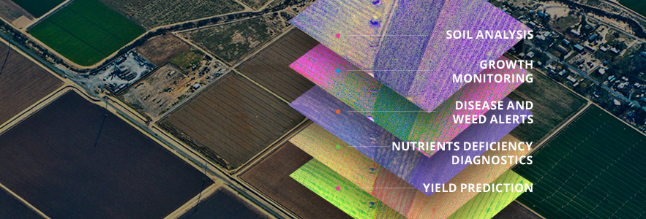
Hummingbird is a drone-enabled data and imagery analytics company leveraging machine learning and crop science. The UK-based startup offers 10 flights per growing season to detect weeds and disease at key times during the growing season to help farmers decide what and how much input to apply. It promises a 24-hour turnaround after each flight. It also offers yield prediction. Hummingbird is drone-agnostic, but mostly uses senseFly and Parrot drones and sensors. The startup layers satellite imagery and soil maps over the drone imagery as well as combine harvester reading for yield maps.

SlantRange is a drone sensor manufacturer and imagery analytics provider using computer vision. It recently announced a new multispectral sensor called the 3p. One of the main benefits of the 3p is its on-board image processing and in-field analytics capabilities, which can give farmers instant insights in the field, without the need for cellular connectivity and cloud connection.

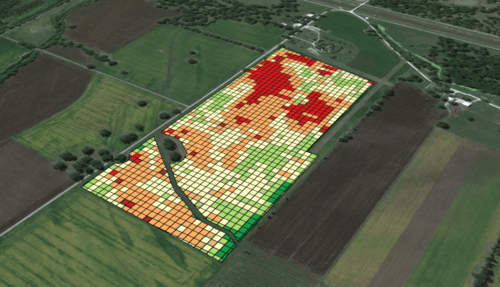
Agribotix, which was founded in Colorado in 2013 as one of agriculture’s first drone startups, produces NDVI maps for its clients including Jamie Dumalski, a Canadian farm operator who manages 35k acres of peas, lentils, canola, wheat, barley, and soy for a farmland investment group in Saskatchewan. Agribotix is a drone-enabled software company that provides advanced imaging and analysis for precision agriculture. It offers Agribotix Hornet Drone, a rugged low-cost drone airframe purpose-built for operational use on the farm; and Agribotix Infrared and Thermal Sensors, which are thermal cameras that collect images over fields of interest. It also offers Agribotix Image Processing Services, a software solution that delivers easily viewable georeferenced aerial images.

CropX is an ag-analytics company that has developed the world’s most advanced adaptive irrigation service, which automatically optimizes irrigation, thereby delivering dramatic crop yield increase and water and energy cost savings to farms.

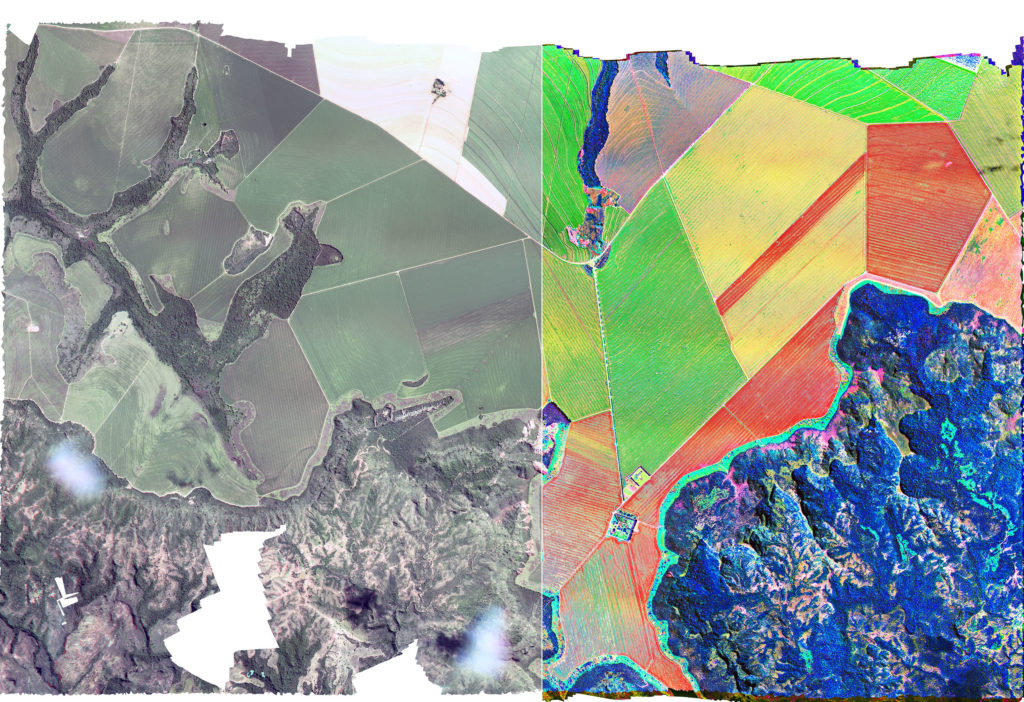
Gamaya, is a drone sensor and analytics platform. It differentiates itself by manufacturing hyperspectral sensors; the majority of drone imagery companies use multispectral images. The novel design can show over 40 bands of light instead of just the four — red, green, blue, infrared — provided by multispectral cameras. By capturing over 40 bands of light instead of just four, hyperspectral can detect specific physiological traits within the plant, argues the startup. The sensor is Gamaya’s enabling technology, however, and it says its main intellectual property is in its analysis of this hyperspectral imagery using artificial intelligence to produce information about the plant’s physiology. 

Sentera – Sentera’s forward-thinking team of engineers have seamlessly blended elegant design concepts with deep customer understanding to produce advanced, lightweight and customizable drone, sensor, interpretive software and data management solutions. Sentera brings meaning and organization to data and images.

DroneDeploy – DroneDeploy is a provider of cloud-control software solutions for drones which include automated flight safety checks, workflows, and real-time mapping and data processing. The company has partnered with leading drone manufacturers like DJI to provide its software to end users in a variety of industries, including agriculture, real estate, mining, construction and many other commercial and consumer arenas. DroneDeploy is compatible with any drone.

Nigerians banks gave big loans to Etisalat, yet local startups cannot get funding supports

0

The story of how Etisalat Nigeria is owing nearly every major bank in Nigeria is a very unfortunate one. This is a country where banks prefer to finance trade over long-term investments. And when they want to invest in technology, they prefer a “well-funded” empire in Etisalat.

Can any Nigerian company receive that type of support? Not possible. The reality is that Etisalat Nigeria may not worth much when compared to the loans it has received and the parent company can just forget its Nigerian subsidiary. In other words, do not expect anyone to pump money into Nigeria to help pay the banks.

The Loan Crises

Despite last week’s intervention by the Nigerian Communications Commission (NCC) and the Central Bank of Nigeria (CBN), banks in the country have opposed a proposal by Etisalat Nigeria to convert part of a $1.2 billion loan from dollars to naira and want the Abu Dhabi telecoms group, Etisalat and its other shareholders to recapitalise it instead.

A banker conversant with the negotiations told Reuters that the seven-year syndicated loan, on which Etisalat Nigeria missed a payment, has a dollar portion of $235 million, which the telecoms operator wants to convert to naira to overcome hard currency shortages on Nigeria’s interbank market.

The UAE’s Etisalat own 45 per cent of Etisalat Nigeria, while Abu Dhabi’s Mubadala owns 40 per cent of the company, which was due to meet its lenders on Thursday for debt talks mediated by the central bank and the telecoms regulator.

However, the 13 banks that syndicated the loan for Etisalat postponed Thursday’s meeting to address the $1.2 billion the telecoms company owes the banks.

The Nigerian problem

Nigeria has been running short of dollars as a result of lower global prices for oil, its major export. Its economy entered a recession last year for the first time in 25 years.

Most of the 13 lenders involved in the Etisalat Nigeria loan had raised dollars abroad to participate, meaning that further naira weakness would see them receive fewer dollars.
The naira has lost half of its value since the loan, which matures in 2020, was made. Interest is due monthly and the next principal payment is due in May, the source said.

Etisalat, which generates 3.7 per cent of its revenues from the Nigerian business, has questioned the rationale of investing more in it and may sell its stake, sources say.

Etisalat had written down the value of Etisalat Nigeria last year to $50 million due to naira weakness, Moody’s said in a note, adding that the default at the affiliate company did not affect the parent’s credit profile.
Meanwhile, Fidelity Bank Plc’s investor relations team on Thursday revealed that its exposure to Etisalat Nigeria was about N17.5 billion ($56 million).

Rounding Up

Etisalat owes GTBank N42 billion and Access Bank N40 billion, while its exposure to other banks was yet to be disclosed.

Etisalat Nigeria has over 20 million subscribers, according to Nigeria’s telecom regulator, making it the country’s number four mobile operator with a 14 per cent market share.

South Africa’s MTN has 47 per cent, Globacom 20 per cent and Airtel – a subsidiary of India’s Bharti Airtel – 19 per cent.

When you write about Nigerian economy, you have this feeling that Nigerians do not like themselves. If things are right, Etisalat should not be in the forefront of this type of support. But the banks are always smarter – they had banked that Etisalat parent company will bail them out, if things go really bad.

But the game has changed because the parent company has no interest in a recession-ridden country called Nigeria. The question now is who will bail the banks by buying Etisalat Nigeria?