DD
MM
YYYY

PAGES

DD
MM
YYYY

spot_img

PAGES

Home Blog Page 7432

Sectors and Top Destinations of Fortune 500 Investments in Africa [with Infographics]

0

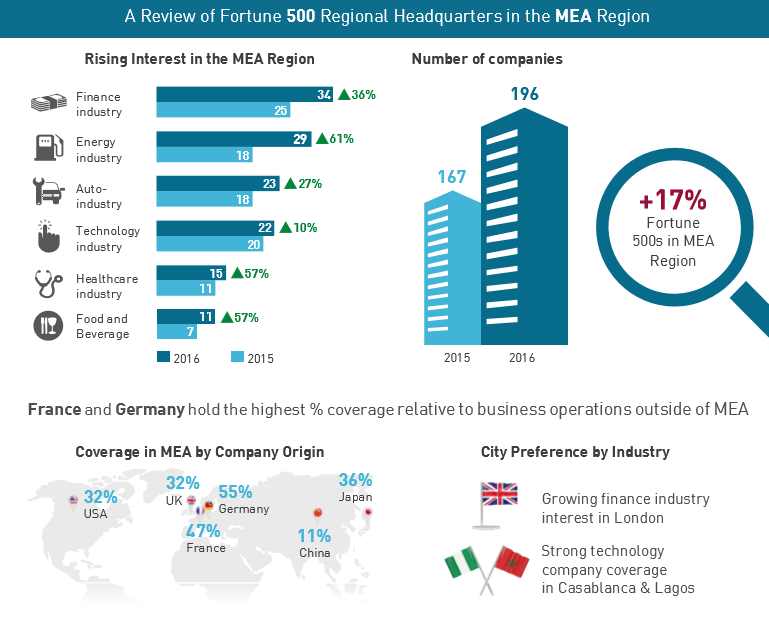
The Middle East Africa (MEA) region has become increasingly important for the majority of global Fortune 500 countries, according to a new report released by Infomineo, a global business research company specialising in Africa and the Middle East.

The report focuses on multinationals looking at entering, or already present, in the Middle East and Africa region. Overall, there was a 17% increase in the number of companies in MEA in 2016 compared to 2015, with Johannesburg being the leading destination for Africa.

Location Choice

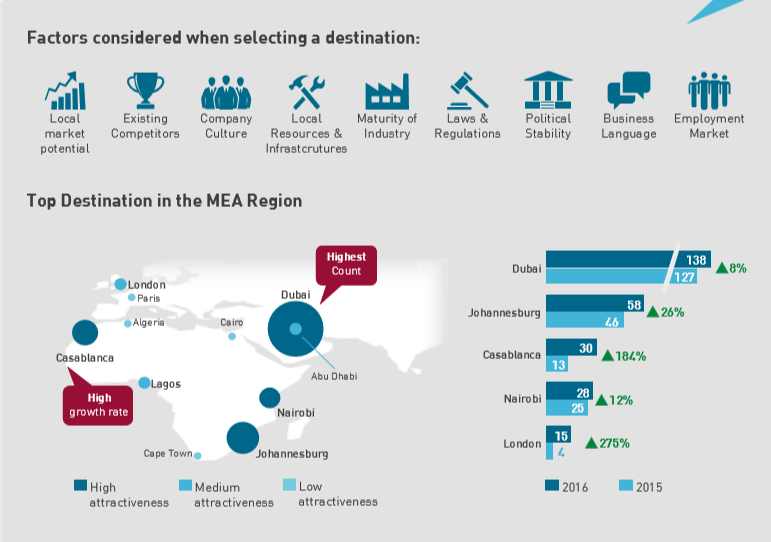
In 2016, 196 Fortune 500 companies had established a dedicated regional headquarters in the MEA region. In the Middle-East, Dubai is the most popular choice with 138 companies establishing a dedicated entity in the city.

There has also been a marked uptick in companies deciding to cover MEA from outside of the region – 38 companies up from 22 have established a regional headquarters in areas such as London, Brussels and Paris.

The leading destinations on the Fortune 500 list include Dubai, Johannesburg, Casablanca, Nairobi, Lagos, and Cairo. Egypt remains behind the leaders due to political instability, however, it has seen a 250% increase in Fortune 500 investment since 2015. Germany and France are leading in terms of coverage rate while China has the lowest presence in the region.

Industry Type

Industry type plays a pivotal role in the selection of city and country. Financial services are more likely to base MEA coverage from London, while technology companies are more inclined towards Casablanca or Lagos. The latter city is also the premier location for organisations looking to manage their operations across Western Africa with 12 Fortune 500 companies already established in the region.

Automotive and Healthcare tend to have a presence in both Africa and the Middle East, while Technology is more inclined to having a presence from the outside.

Nairobi, in Kenya, is the leading destination for the FMCG companies and tends to be the top choice for organisations looking to service Eastern Africa. Dubai and Johannesburg are the most popular hubs overall, but both Casablanca and Nairobi are rapidly gaining traction and international awareness. Casablanca has the highest growth rate overall, while Dubai has the highest count. The same can be said for London, which has tripled its number of regional HQs in the region, acting as an MEA hub. Given the geographical proximity and the talent pool present in the city, it could be that London is playing the role of a first step into the MEA region, especially for Japanese and North American companies.

Other Factors

There are numerous factors which impact on the organisation’s selection of a specific city. These include the local market potential, maturity of the industry, existing competitors, political stability and the quality of the employment market, among others. Determining the attractiveness of a location along these clear lines assures the Fortune 500 companies of a stable and profitable investment and significantly mitigates risk. The most attractive cities are Dubai, Johannesburg, Casablanca and Nairobi, and at the lower end of the spectrum, Cairo, Paris, Algiers and Cape Town.

What’s Next for Global AgTech

0

Twenty-sixteen was a year of contrasts for the agriculture technology startup market and paves the way for the sector’s next generation of technologies in 2017.

Last month, we published the 2016 AgTech Investing Report, detailing $3.23 billion in investment across 580 deals. That’s a 30% decline in funding dollars from 2015’s record-breaking $4.6 billion, but a 10% climb in deal activity year-over-year.

The decline follows the wider global venture capital markets, where funding fell 10%, and even more if you discount some extreme outliers, such as the late stage financings of Uber ($5.6 billion), Didi Chuxing ($7.3 billion), and Ant Financial ($4.5 billion).

But the growth in the number of agtech deals, driven by a 77% increase in seed stage investment, bucks the global trend where deal activity fell 24% and early stage activity saw the greatest proportionate decline.

The growth in seed stage activity can be attributed in part to the increasing number of early stage resources available to agtech entrepreneurs. From accelerators to incubators to venture development organizations, at least 33 organizations globally cropped up in 2016 to support entrepreneurs looking to disrupt the food and agriculture industry.

While this support of early stage agtech businesses is encouraging, it also opens up a question about how this second wave of agtech innovation will find investment backing at the later stages, particularly in light of the 43% decline in Series A funding to agtech startups in 2016.

How the Industry Supports Agtech

By our count, there are 14 active, agtech-focused venture capital funds today with $850 million under management, and eight more currently raising funding. Even in such a small group, they are spread across the US, Canada, France, Holland, Israel, India and China. There are also a growing number of corporate venture funds in the food and agriculture industry, dedicated to supporting new innovation.

Syngenta was the first to launch a corporate venturing arm back in 2006, and Monsanto joined in 2011 with Monsanto Growth Ventures (MGV). MGV and Syngenta Ventures are by far the most active, but their peers BASF, DuPont, and Bayer have started agtech investing initiatives too. There are some also newer initiatives from smaller agribusinesses such as The Andersons, which launched Maumee Ventures in 2015, and ag retail firm Wilbur-Ellis which launched Cavallo Ventures in 2016. More recently there’s been more corporate venture activity among the food companies, and in 2016 Kellogg’s, Campbell’s Soup, Tyson Foods, and Danone announced new investment initiatives with eighteen94 Capital, Acre Venture Partners, Tyson New Ventures, and Danone Manifesto Ventures respectively. We expect more to come in 2017 including a fund from Archer Daniels Midland.

While participation from the agtech VCs remained relatively constant in 2016, and we saw growth in the corporate venture space, these investors still provide a very small portion of the sector’s overall investment needs. This means the industry needs to rely on general tech investors to fill the gaps in funding, and they played a key role in getting the first generation of agtech startups off the ground.

The First Wave of VC-backed Agtech Startups

The five most active investors in 2014 were Khosla, Cultivian, Y Combinator, Andreessen Horowitz, and KPCB. They invested mostly in precision ag and sensing, alternative proteins, and food e-commerce. That year, Conservis, Granular, aWhere, Semios all raised Series A deals, while FarmLink, AirWare, FarmLogs, and Farmers Edge raised Series B. Beyond Meat, Hampton Creek, and Impossible Foods raised Series B, C and A rounds respectively. Instacart raised a whopping $220 million Series C from three of the above VCs, and Blue Apron raised a $50 million Series C. There were also some noteworthy deals in the indoor agriculture, waste technology, and biotech sectors, but mostly from lesser known tech VCs.

Investment activity from some of these mainstream investors declined in 2016; Khosla made just three compared to 9 in 2014, for example. The pullback from these funds doesn’t mean agtech is out of favor with them, but reflects the fact that fund priorities ebb and flow along with innovation and industry development.

The industry is sorely lacking in exits, therefore exit data to provide VC funds with performance metrics for agtech and encourage further investment in the sector. There is also the possibility that some technologies will take longer than expected to gain the traction tech investors expect, which could create a lull in investor activity as they wait to see results. If lacking traction results in a down round, that could wipe out many early investors from the space altogether.

Cause for Optimism

We are optimistic that the second wave of agtech will bring more general tech investors into the fray on the back of a faster growth trajectory. Our conversations with some of the top VCs in Silicon Valley indicate that they’re eager for these new opportunities and many with a strong thesis recognize the cyclicality.

Many of the first wave of agtech startups had to build a full-stack solution just to deliver an MVP (minimum viable product) to their customers: hardware, operating systems, software applications, and communication systems. This second wave will build on an existing foundation and ecosystem, however. We expect that these startups will have more rapid growth and experience quicker adoption by farmers and customers because they can focus on building products that deliver value to their end customer rather than enabling technologies. One example is in the drone technology space, which now has an ecosystem of specialized companies innovating around the basic technology. First there were drones manufacturers like DJI, which manufactured UAV hardware technology and placed a generic camera on it to collect data. Next came DroneDeploy, an operating system designed to help drone pilots operate and offer some basic analytics of the imagery. Today we have Gamaya, which has built a hyperspectral camera to attach to drones for increased resolution, and IntelinAir, which is using machine learning to analyze third party drone imagery through an application. Expect to see similar ecosystems building around other agtech subsectors, and crossover technologies coming to the sector from other industries too.

Growing Awareness

There’s a growing awareness among consumers, investors, industry, and entrepreneurs, that the entire food chain needs to be overhauled. It’s not just meeting the food requirements of a growing global population that’s concerning investors and entrepreneurs; the food chain is largely inefficient and opaque, beset by safety issues and lacking in traceability; consumer eating trends and regulations are rapidly changing with indications that much of the existing food industry can’t keep up; agriculture’s environmental footprint is unsustainable and increasingly unpopular; and rising labor costs are cutting into razor thin margins.

Agribusinesses understand that they need to pay more attention to innovation and indicated in a survey we conducted with Boston Consulting Group that they would invest more resources on new technologies to revolutionize their industry. It’s likely many of them are currently preoccupied with the ongoing mega-mergers of Bayer and Monsanto, Chem China and Syngenta, and Dow and DuPont. But they also need guidance; the majority of those surveyed indicated uncertainty in how to approach investing in innovation.

We can also expect corporates from other industries to start participating in agtech. In December, precision ag startup Farmers Edge raised funding from Fairfax Media, the investment company of billionaire Prem Watsa, due to potential synergies with its insurance business, and recently South African media company Naspers invested in FarmLogs.

New venture investors are also yielding from all corners of the globe. US startups accounted for 48% in 2016, down from 58% in 2015, and 90% in 2014, as we saw Chinese investors make some large bets in the sector, and activity in other Western markets like Canada and the UK grew. There are growing ecosystems of agtech startups across our network in New Zealand, Australia, Latin America, Singapore, and Europe, all with accelerators, conferences, and startup competitions cropping up to support them.

Technological developments will also drive investment. 2016 saw particular growth in funding for agriculture biotechnology startups with post-GMO technologies exploiting the microbiome and gene-editing. Food waste reutilization also drove ag biotech investment. Novel Farming Systems that are producing insects, microbes, and indoor crops, gathered pace with the promise of providing sustainable food, ingredients, and animal feed alternatives.

And the data support our optimism. While funding dollars declined in 2016, the number of investors remained steady with 670 participating compared to 672 in 2015 when funding reached $4.6 billion.

There will be challenges, and the agribusinesses need to step up to those challenges; start acquiring more companies and making more venture investments. But, with an industry that represents 10% of global GDP and accounts for only 3% of venture investment, there can only be one long-term direction for investment in agtech startups.

(For more insights on agtech funding in 2016, you can download the full report here.)

by Louisa Burwood-Taylor – Head of Media & Research AgFunder – dedicated to funding the next food & agriculture revolution.

How to Encourage the Adoption of Agtech Innovation in India

0

Editor’s Note: Hemendra Mathur is agribusiness investment lead and venture partner at Bharat Innovations Fund, a new $150 million early stage fund with a focus on agtech, cleantech, health-tech and enterprise-tech ventures. Mathur previously worked at SEAF India Investment Advisors and Yes Bank. 


An estimated 450 million¹ of the population in India depends on farming for their livelihood. Agriculture in India makes for an interesting study with the farmer at the epicenter.

An interesting phenomenon of Indian agriculture is that it’s increasingly feminized with more women working in the fields while menfolk migrate to urban areas seeking alternate employment. Despite the increasing contribution of women to farming, few women have titles to the agricultural land in their name.

Landholdings are small and getting smaller. The average size of farmland holdings in India is also falling on account of the division of landholdings among siblings in each generation. Average holdings are currently around 1.2 hectares (3 miles) and widely expected to drop to one hectare or less. In fact, nearly 50% of Indian farmers have land holdings of less than half a hectare.

The Indian farmer has subsistence income and is heavily in debt. The average monthly income of the Indian farmer is a mere Rs6,400 ($100). An estimated 50% share of the income is from farming and animal husbandry (mostly cattle) while non-farming activities account for the rest. This income barely meets household expenses and leaves little for savings or investment in new farming techniques. Indian farmers on average have loans of over Rs47,000 ($700). Unsurprisingly, over 50% of Indian farmers are in debt, and a mere 10% have crop insurance cover.

Farming is not the preferred option to earn a living. Most Indian farmers inherited the farm from their ancestors. A significant one-third of farmers, according to various farmer surveys, are willing to quit farming if presented with alternate employment.

In this scenario, understandably, the farmer has limited ownerships of farming assets such as machinery. The penetration of tractors in India remains well below 10% — by comparison, the adoption of mobile telephones has surpassed 50% — and most small and marginal farmers lease land from larger farmers.

The Indian farmer requires assistance on several fronts including policy reform, infrastructure development, institutional financing and, more importantly, innovation to address some of their key challenges.

How Will Innovation Benefit Indian Farmers? Will Farmers Pay for Innovations?

Agtech innovations can increase farmer incomes by improving the efficiency of farm operations, reducing costs, and de-risking farming considerably in the following ways:

  1. Improved productivity and diversification of farming activities.
  2. Optimizing the cost of applying inputs such as seeds, fertilizers, agrochemicals, mechanization.
  3. Improving supply chain efficiency and reducing the cost of borrowings.
  4. De-risking Indian agriculture by developing innovative crop insurance solutions and reducing supply-demand mismatch which causes price volatility.

Five agtech innovations that have the potential to collectively and comprehensively achieve the above are:

  1. Farming-as-a-service to make cost variable and make farming affordable to the majority of small and marginal farmers.
  2. Big data intervention through real-time capturing and synthesis of data to aid farmers in better decision making.
  3. Market linkages for the sale of farm produce to facilitate disintermediation and aggregation of farm produce so farmers reap a higher share of the end-consumer price.
  4. Fintech platforms to aid institution financing to reduce the cost of borrowing for farmers.
  5. Diversification to increase the sources of income for farmers.

Figure 1: Role of Agtech Innovation Mapped with Farmer Needs

Screen Shot 2017-03-16 at 12.12.02

Each innovation in Figure 1 addresses at least three pain-points for Indian farmers. Indian farmers have time and again demonstrated an eagerness to set aside convention and adopt new practices, as demonstrated by the following three key developments in Indian agriculture in the past decade.

  1. Small and marginal farmers are taking horticulture to new growth levels – in 2016 they produced approximately 290 million tons compared to less than 150 million tons in 2006. They are doing this as it fetches higher/additional income and is less working capital-intensive.
  2. Many farmers are using new equipment like a rotavator, a machine that breaks up the soil for planting, laser land levelers, solar-powered irrigation pumps. Those that cannot buy the equipment are renting it, even using social media for bookings!
  3. Growth in the cattle, poultry, and aquaculture feed markets in the past decade – they now have a combined size of $ 18-20 billion. This is a clear indicator that animal husbandry has been adopted to diversify income sources, improve the working capital situation (refer Figure 2) and allow for non-farming income from alternative sources in drought years.

Figure 2: Schematic of a Farmer’s Working Capital Requirement During the Year

Screen Shot 2017-03-16 at 12.26.48

As demonstrated in Figure 2, in the case of food grains, farmers enjoy liquidity only twice a year – at harvest time of Rabi (April-May) and Kharif crops (October-November) respectively. Horticultural crops (read vegetables) offer more frequent liquidity due to the short lifespan of those crops. Animal husbandry (read dairy) offers the best liquidity of all because surplus milk is sold for cash daily with winter months yielding better than summer due to the availability of better fodder resulting in higher milk output. Both horticulture and animal husbandry have demonstrated significant easing of working capital requirements for farmers and this has promoted the higher adoption rate of these farming activities.

Given the cash-strapped financial status of the farmer, the cost of the innovation will need to be financed by other constituents in the supply chain. The likely buyers of agtech innovations who stand to gain from it, and are therefore willing to finance the costs, are mapped in Figure 3.

Figure 3: Likely Buyers of Agtech Innovations in India

Screen Shot 2017-03-16 at 12.22.19

Farmers have demonstrated willingness to pay for innovations that have immediate tangible benefits; be it hiring of implements or farm produce aggregation for a better price and higher income through diversification.

This also implies that entrepreneurs working on agtech innovations must prepare themselves for sales through a B2B business model for the initial period of sustenance.

Four Recommendations to Facilitate the Adoption of New Innovations by Farmers

    1. Rural Incubation Centre: The Government of India entrepreneurship fostering initiative, Atal Innovation Mission, provides grants of up to Rs100 million ($1.5 million) to each center, but should give preference to incubator centers set up in rural areas and targeting agriculture innovation.
    2. Rural Entrepreneurship: Agriculture alone cannot provide a sustainable living for India’s teeming rural youth. Rural youth will not be tempted to migrate to urban areas for employment if they are provided with entrepreneurship opportunities in the villages. These opportunities can center around services that are in high demand such as aggregation, farm produce storage, soil scanning, implement rentals and cattle feed centers.
    3. Village Data Hubs: Farming decisions are taken based on previous years’ data but the availability of real-time and accurate current year data is limited. Institutionalizing farmer advisory services through village data hubs will help capture real-time data from in-field interventions such as drones, sensors, IoT and satellite images, with access of this on smart phones which are today affordable. Innovations should drive real-time capturing and analysis of the data and the disaggregation of data at the farm level.
    4. Village Adoption by Research Institutions: Simple mechanisms to transfer technology from research institutions and agricultural universities to farmers; and incentives for institutions to adopt clusters of villages to facilitate “faculty-researcher-student-farmer” interaction, will provide much-needed support to the farming community. The village adoption program of National Institute of Food Technology, Entrepreneurship and Management (NIFTEM) in India, trained farmers in some food technology innovations, for

In conclusion, there needs to be a concentrated effort from investors and innovators to develop and deploy innovation to make farming an aspirational profession in India.

As Will Rodgers wisely said, “The farmer has to be an optimist, or s(he) wouldn’t still be a farmer.”


¹The population in India is an estimated 1,326,801,576. Of the over 167 million rural households in India, approx. 90 million households are engaged in farming. The average farming family has five members, thereby near 450 million people directly dependent on farming.

African entrepreneurs in the age of data revolution and personalization of everything

0

Technology is redesigning industrial sectors and transforming people, nations and governments. As we continue to experience innovations in A.I, machine learning and overall computational models, new business models and processes will emerge. Personalization is going to become the business model standard of the 21st century.
Emerging technologies will bring the individual to the epicenter of solution development and spur design and development of more and more customized and need-based products and services. This will allow ‘on demand’ and personalized access at affordable prices and empower the individual to have a say in solution development and the governance of his or her data.
Fintech startups have been leading the way, leveraging data backed insights to develop customized financial products and serve financially excluded populations. However, the potential is much larger for disrupting the way companies, governments and donors design and deliver solutions and engage with the BoP consumers.

How we design solutions: From customization to precision

Today there are 15 billion connected devices worldwide, generating massive amounts of data about people using them. About 725 million people in Africa are projected to subscribe to mobile services by 2020. The resulting explosion of data will fuel deeper insights informing customized solutions, leveraging emerging technologies. Blockchain and AI enabled smart contracts will enable personalization of nearly everything across the product life cycle. Mobile phones will serve as a medium for registering and serving about 400 million people in Africa who today lack any official form of identification.

East-Africa based Tala, for example, is a data science and mobile technology company which is already gathering information about a customer from over 10,000 data points to form a financial identity with a credit score within five seconds. Precision medicine is beginning to target an individual’s personalized needs using a combination of genomics, Big Data and predictive analytics. Going forward, this will also inform more targeted public healthcare approaches and allow greater precision in disease surveillance.

How we deliver solutions: Accessibility and affordability for all

New insights will allow further segmentation of BoP markets, driving more informed and personalized marketing, pricing, delivery and financing strategies for improving access. The healthcare sector, for example, will see a transition towards personalized delivery, increasing access and affordability. While telemedicine and mobile health services have already facilitated ‘on demand’ medical advice, emerging technologies will drive a new wave of personalization. Wearables will provide people with data and tools to make better health decisions and also be accountable for their decisions.

Big Data in combination with predictive analysis and newer forms of remote diagnostics will shift health and disease management from being reactive to preventive, reducing costs for patients and healthcare providers alike. Similarly, IoT and Big Data will encourage insurance providers to rethink their business models and client interaction. For example, sensor enabled real time feedback and predictive analysis of consumer behavior can shift property and casualty insurance from a ‘reimbursement’ model to a ‘prevention and loss control’ model.

How we engage with the individual: Enhanced accountability and empowerment

Personalized and decentralized solutions will drive redistribution of power, accountability and decision making to the individual. Personal data encryption and decentralized data management will redefine the way data is shared and hence, what data is being used for solution development.

MedRec and IBM Watson Health are examples of innovators who are working on creating Blockchain enabled data management system for health records and strengthening a patient’s ability to manage and own his or her data. Empowerment of the individual will also extend to production itself. Currently CAD files for 3D Printing is restricted in use owing to issues around intellectual property (IP) and design theft. Blockchain can overcome these issues via smart contracts and trigger exponential use of 3D Printing.

Cases

  • Health providers are able to prevent more than USD210.7 million in healthcare fraud in one year using predictive analytics (Source: mapr.com)
  • Market for personal 3D printers increased 33% in 2015 (Source: 3Dprint.com)
  • Worldwide Wearables Market increased 67.2% in Q1 of 2016 (Source: IDC)
  • Personalized medicine market will be worth over USD149 billion by 2020 (Source: Marketwatch.com)

Rounding Up

It is here – the era where everything can be personalized. As internet penetrates across Africa, this will be easier across different industrial sectors. Entrepreneurs must understand this design and be “open” as they architect products and services. Products of the 21st century will be personalized.

Full Text of Nasir El-Rufai Memo to President Buhari – “Immediate and Medium Term Imperatives for President Muhammadu Buhari – September 22, 2016”

4

Governor Nasir El-Rufai of Kaduna State,  in September 2016, sent a memo to President Muhammadu Buhari arguing that their party, the All Progressives Congress (APC) has made the situation in Nigeria worse than it met it by failing to be proactive in taking key decisions in a timely manner, SaharaReporters has learned.

In April 2015, I sent a short memorandum to you, Sir – then as president-elect. We never discussed the memo in detail and I am not even sure you got to read it bearing in mind the levels of human traffic visiting you in those heady days. I crave the indulgence of Mr. President to please read the memo (attached herewith as Annex II) and see how like every aspect of life, the memo was sometimes presciently accurate and at the same time off-target! It is on the basis of that message, and my commitment to write anytime I feel compelled that matters of urgent national importance confront you, that I address this with greatest respect and humility.

Read the full text here (PDF).

Here are major excerpts from El-Rufai memo to President Buhari:

1. It is 1984 for you all over again— only far worse…You must therefore put forward some organizing principles around which your administration would be designed that will enable Nigerians identify and adopt as a unifying vision for the next decade or so.

2. [These principles] should be national unity, social discipline, personal sacrifice and the constant signaling of hope for a better tomorrow.

3. You must through your words, your personal example and the selection of the team around you, unite our nation by creating a sense of inclusion that gives people of proven honesty, competence and commitment, roles in your government. The mistake of the outgoing regime of creating a strong appearance of an Ijaw enclave, or the Katsina-Kano cabal of Yar’adua, must be deliberately avoided.

4. A key requirement of setting the right tone and direction of your government is to choose the right people early to constitute your core team that will work in the State House…The quality and caliber of the personal staff you appoint, along with a handful of key executive positions will either reinforce the tone and direction of your government or contradict it…It is important that these persons are carefully selected with emphasis on integrity, competence, capacity and chemistry to work well with the President.

5. It is not difficult to reverse these negative trends and change the narrative to one of a nation with a growing, efficient and well-managed national infrastructure. All the plans and strategies are there. What is needed is political will, technocratic capacity and focus, which you, Mr. President must ensure are present here and now.

6. …We must therefore take advantage of our large internal market, natural endowments and comparative advantages in agriculture, minerals and human resources to be self-sufficient in food and fuels within your first term of office. It is neither impossible nor unduly difficult to achieve both goals.

7. The danger of this current state of affairs is that we are inadvertently creating successive generations of poorer, barely educated, unskilled, hopeless and angry children of the poor, side by side with increasingly richer, privately educated, skilled and optimistic children of the privileged. It is a demographic and social time bomb waiting to explode as the poor and hopeless youths are easy recruits of insurgents, violent politicians and criminals. Only you, Mr. President will appreciate this danger and do something about it with the urgency it deserves.

8. Government performance depends on political legitimacy and administrative capacity. It results from sound political vision, courage and the will of the President and other appointed and elected officials, supported by the administrative capacity of the public service…You have the vision, courage and will, Mr. President. The jury is still out whether your most senior appointed officials share these qualities, and this must change for the better, Sir.

9. Our public service today is too expensive, aging, outdated and inadequately skilled to discharge its mandate of providing administrative support to the political leadership. The nearly 600 MDAs at the federal level (and smaller number of counterparts at subnational levels) consume nearly 90% of our national revenues. This is why the FGN borrows over 100% of its capital budget! This is neither fair nor just.
There is a perception that your ministers, some of whom are competent and willing to make real contributions, have no clear mandate, instructions and access to you. Ministers are constitutional creations Mr. President and it is an aberration that they are expected to report to the Chief of Staff on policy matters.

10. Mr. President, there is an emerging view in the media that you are neither leading the party nor the administration and those neither elected nor accountable appear to be in charge, and therefore the country is adrift. It is the view of many informed citizens that while you are actively fighting corruption, the institutional weaknesses that enabled it to thrive under Jonathan, and the persons that participated in it, and oiled the system are still very much in charge, and many are around you.