DD
MM
YYYY

PAGES

DD
MM
YYYY

spot_img

PAGES

Home Blog Page 89

Top 3 Coins to Buy as Smart Investors Brace for Market Volatility

0

As market volatility returns, seasoned crypto investors prepare for one of the year’s greatest rotations.  With inflation data fluctuating and institutional liquidity shifting, traders are seeking assets with asymmetric upside, projects that can withstand turmoil and multiply rapidly when sentiment turns bullish.  Little Pepe (LILPEPE), Book of Meme (BOME), and BONK are solid investments for the next market cycle. These tokens have different cultural significance, liquidity, and upside catalysts, but Little Pepe has the appropriate narrative, infrastructure, and presale momentum.

Little Pepe (LILPEPE): Layer-2 Power and Whale Accumulation Drive Birth of a Meme Titan

Little Pepe (LILPEPE) is more than a meme; it’s a movement. Now in Stage 13 of its presale at $0.0022, LILPEPE has raised over $27.49 million, representing more than 16.66 billion tokens sold to early believers and retail speculators alike. That’s 95.99% of the current allocation, a staggering figure that speaks to momentum and demand. What sets LILPEPE apart from earlier meme projects is its foundation as a Layer 2 EVM-compatible blockchain designed specifically for memecoin scalability. Built for speed, micro-fees, and fair trading environments, the Little Pepe chain will act as a secure launchpad for new meme tokens and DApps, complete with sniper bot protection, 0% buy/sell tax, and a CertiK audit score of 95.49%. Adding fire is the viral $777,000 community giveaway, fully backed by the project’s treasury, including 10 winners receiving $77,000 each once the presale ends. Meanwhile, a 15 ETH Mega Giveaway is driving whales to compete for top buyer rankings, further pushing presale participation and visibility. Analysts view LILPEPE as one of the few emerging meme coins likely to outperform during and after market volatility, with projections of a 3,500% to 5,000% upside once CEX listings commence.

Book of Meme (BOME): The Comeback Contender for High-Volatility Traders

Built around a decentralized on-chain meme library concept, BOME provides collectors and traders with a hybrid meme experience that seamlessly blends nostalgia and virality. Market analysts argue that if BOME can reclaim momentum, it could supply 10x–20x returns, especially as its multi-chain integration and branding efforts gain traction. For investors who follow technical patterns, BOME’s consolidation and volume resurgence signal a potential breakout. The project’s community commitment, demonstrated by a steady increase in holders, also makes it one of the stronger entries in the high-risk, high-reward class.

Bonk (BONK): Solana’s Meme Coin Engine Still Has Room to Run

Trading at around $0.00001953 with a market capitalization of just under $1.5 billion, BONK has solidified its position as the leading meme coin on Solana and one of the most liquid memes in the space. As Solana returns to favor among institutions and developers, BONK has benefited from increased network activity, rising DEX volume, and the spillover effect of NFT liquidity returning to meme coins. Analysts expect a potential 10x run to $0.00030–$0.00040 if Solana continues its current revival. What gives BONK an edge during volatility is its established liquidity and listing base — offering traders a safe, high-momentum asset that’s likely to react aggressively during both panic sell-offs and breakout rallies.

Conclusion

Smart money thrives in volatility. While others panic, strategic investors position themselves in projects carrying the strongest blend of story, infrastructure, and upside catalysts. Little Pepe (LILPEPE), Book of Meme (BOME), and BONK form a trio of meme-driven plays with serious potential to outperform as the market enters its next phase. Little Pepe leads the pack, not only due to its presale size, audit score, marketing power, and Layer-2 innovation, but because it has built the kind of structural and narrative confidence that early-stage meme giants like SHIB and PEPE did before going parabolic. If crypto’s next wave arrives soon, these three tokens may prove to be the cornerstone of a high-return strategy, and for early LILPEPE buyers, this presale could be the moment they look back on with a 50x smile.


For more information about Little Pepe (LILPEPE) visit the links below:

Website: https://littlepepe.com

Whitepaper: https://littlepepe.com/whitepaper.pdf

Telegram: https://t.me/littlepepetoken

Twitter/X: https://x.com/littlepepetoken

$777k Giveaway: https://littlepepe.com/777k-giveaway/

OpenAI Eyes One of the World’s Largest Subscription Bases at 220m by 2030

0

OpenAI is making one of the boldest bets in the global tech industry, projecting that at least 220 million of ChatGPT’s weekly users will eventually buy a subscription, according to The Information, which cited a person familiar with the company’s internal forecasts.

The projection assumes ChatGPT will reach about 2.6 billion weekly users by 2030. If that happens, roughly 8.5% of them—around 220 million people—would convert into paying subscribers. That places OpenAI’s subscription ambitions on the same scale as the world’s largest digital services, a group that includes global streaming platforms and top-tier enterprise software giants.

As of July, about 35 million people—roughly 5% of ChatGPT’s weekly active base—were paying for the “Plus’’ or “Pro’’ subscription tiers, priced at $20 and $200 per month. The gulf between that figure and the company’s 2030 target shows the size of the leap OpenAI expects as it rolls out more powerful models, business tools, and commercial-grade features.

But even with the explosive rise in users, OpenAI’s finances remain tight. The company has attracted tens of billions of dollars in investment from backers, including Microsoft, pushing its private valuation to around $500 billion—a level rivals needed decades to reach. Yet the company is still running at a loss as it competes in a field where model training costs run into billions of dollars, and day-to-day operations require huge amounts of computing power.

The company’s annualized revenue run rate is expected to reach about $20 billion by year-end, according to sources who spoke to Reuters. But losses continue to grow at nearly the same pace. Earlier reporting from The Information said OpenAI generated around $4.3 billion in revenue during the first half of 2025—about 16% higher than it earned in all of 2024—while burning $2.5 billion over the same period. Much of that money went into research, training newer models, and maintaining the enormous infrastructure needed to keep ChatGPT running for hundreds of millions of users.

This financial structure has created a paradox for the world’s most famous AI startup: record-breaking valuation and influence, yet thin revenue and persistent losses.

That is why OpenAI is placing so much hope on subscriptions. The company is counting on paid users to eventually offset its massive operating costs and help it break even. The internal forecast of 220 million subscribers reflects that strategic push. A successful transition to a subscription-driven model would give OpenAI a predictable cash stream that could finally match its spending on GPUs, data centers, and model development.

The company is also trying to widen its revenue sources. It expects around 20% of future earnings to come from new products outside the traditional chatbot format. This week, OpenAI introduced a personal shopping assistant inside ChatGPT, a move that could open the door to advertising partnerships or commission-based retail revenue.

Even so, the company’s financial path remains steep. Training frontier models now costs billions of dollars per cycle, and competition from Google, Anthropic, Meta, and others is further driving up the price of the high-end chips needed to stay ahead.

Against this backdrop, OpenAI is now leaning into the idea that the global appetite for AI will keep rising—and that millions of users will eventually pay to take part in what the company views as the next major shift in personal computing.

Bitcoin Surges Past $90,000 Amid Rising Whale Deposits and Massive Exchange Outflows

0

Bitcoin has climbed above the $90,000 mark once again, even as market data reveals contrasting signals from whales and institutional players.

The latest figures from CryptoQuant show that large deposits to exchanges now account for 45% of all BTC inflows, with one day registering over 7,000 BTC in whale deposits. These movements mirror levels last seen in late October, sparking renewed concerns about sustained selling pressure among major investors.

At the time of reporting, Bitcoin trades at $91,382, marking a 3.12% increase in the past 24 hours. Despite the short-term rally, the world’s leading crypto asset remains 30% below its all-time high of $126,080 reached on October 6, 2025. The current rebound follows a significant correction last week that briefly pushed BTC down to $80,000, erasing most of the gains accumulated earlier in the year.

Adding to the mixed market signals, an unprecedented withdrawal of 1.8 million BTC from exchanges occurred overnight. This massive outflow has fueled speculation about institutional accumulation or strategic repositioning, creating uncertainty about whether whales are preparing to dump or hoard.

Historically, increasing inflows suggest that investors are gearing up to sell, while rising outflows tend to indicate accumulation and reduced selling pressure. The steady rise in large deposits transactions of 100 BTC or more suggests that whales may be restructuring portfolios or planning major liquidations. This trend has contributed to elevated volatility across the market. In the past 24 hours alone, over $337 million worth of leveraged trades were liquidated, wiping out more than 112,000 trading accounts.

Short traders took the hardest hit, with $233 million in liquidations, compared with $104 million from long positions. One of the largest single liquidations occurred on Hyperliquid, totaling $8.61 million in BTC-USD. Bitcoin and Ethereum accounted for the bulk of liquidations, recording $119 million and $73.34 million respectively—evidence of the heavy leverage traders continue to employ, despite sharp market fluctuations.

Analysts at CryptoQuant caution that continued selling pressure from large holders could trigger another downturn. If bulls maintain control, however, Bitcoin faces immediate resistance near the $91,500 level. Further resistance lies at $92,000, followed by $92,500. A decisive close above $92,500 could push the price to $93,750 and potentially toward $94,500. Additional hurdles for buyers stand at $95,000 and $95,500.

On the downside, failure to break above $92,000 may lead to renewed decline. Immediate support rests at $89,750, followed by stronger levels at $88,500 and $88,000. A deeper drop could drive BTC toward $86,500, with the primary support sitting at $85,000. A break below this threshold could accelerate losses in the near term.

As whales continue to shift massive amounts of Bitcoin, the market remains divided on whether the current rebound marks the beginning of renewed momentum—or the calm before another downturn.

Outlook

Bitcoin’s current position above $90,000 places the market at a critical juncture, with the next major move likely to be determined by whale behavior, exchange flows, and traders’ reaction to recent volatility. Although the price has recovered from last week’s sharp correction to $80,000, the rise in large deposits to exchanges suggests that selling pressure from major holders is still a significant concern.

Overall, the market remains highly sensitive to whale activity and leveraged trading positions. With institutional movements also playing a larger role, highlighted by the recent withdrawal of 1.8 million BTC from exchanges, Bitcoin is poised for heightened volatility. Whether the current rebound evolves into a sustained uptrend or gives way to another downturn will depend on how these competing forces unfold in the coming days.

“The Big Short” Michael Burry Doubles Down on Nvidia and Palantir Short Bets

0

Michael Burry, the contrarian investor immortalized in The Big Short for predicting the 2008 housing collapse, has escalated his war against the artificial intelligence sector.

In a scathing new critique published Tuesday, Burry revealed he is actively betting against both Nvidia and Palantir, while dismissing a recent defense from the world’s most valuable chipmaker as “disingenuous” and ridden with logical fallacies.

Writing on his newly launched Substack in a post titled “Unicorns and Cockroaches: Blessed Fraud,” Burry dismantled a memo Nvidia reportedly sent to Wall Street analysts. The document, intended to refute Burry’s earlier skepticism, was characterized by the investor as a collection of “straw man” arguments that failed to address his core thesis regarding the sustainability of the AI infrastructure build-out.

The “Straw Man” Exchange

The conflict centers on a memo Nvidia circulated to sell-side analysts—first reported by Barron’s—which attempted to debunk Burry’s bearish claims regarding stock-based compensation, buybacks, and depreciation cycles.

Burry expressed disbelief at the quality of the rebuttal, stating it “almost reads like a hoax.” He specifically took aim at Nvidia’s defense regarding the depreciation of its own property, plant, and equipment (PP&E). Burry clarified that his criticism was never about Nvidia’s internal accounting, as the company is a “fabless” chip designer with minimal capital expenditures.

“No one cares about Nvidia’s own depreciation,” Burry wrote. “One straw man burnt.”

Instead, Burry’s primary concern lies with the “hyperscalers”—tech giants like Microsoft, Amazon, and Meta—who are purchasing Nvidia’s chips. Burry argues these companies are artificially boosting short-term profits by depreciating these assets over five to six years. However, given the rapid pace of innovation, Burry warns these chips could become functionally obsolete between 2026 and 2028, paving the way for massive future writedowns.

“The hyperscalers have been systematically increasing the useful lives of chips and servers… as they invest hundreds of billions of dollars in graphics chips with accelerating planned obsolescence,” Burry noted.

To bolster his argument, Burry pointed to a recent admission by Microsoft CEO Satya Nadella. In an interview, Nadella revealed he had slowed data center construction earlier this year to avoid overbuilding infrastructure for a single generation of chips, acknowledging that future generations would require different power and cooling specifications.

Nvidia’s Defense: Utilization and Buybacks

Nvidia’s memo, however, paints a different picture of the hardware lifecycle. The company argues that its customers depreciate GPUs over four to six years based on “real-world longevity and utilization patterns.” Nvidia cited its A100 chips, released in 2020, noting they continue to run at high utilization rates and retain significant economic value well beyond the two-to-three-year window critics like Burry have suggested.

The memo also addressed financial engineering accusations. Nvidia clarified that it has repurchased $91 billion in shares since 2018, countering Burry’s figure of $112.5 billion by suggesting the investor incorrectly included taxes related to Restricted Stock Units (RSUs).

“Employee equity grants should not be conflated with the performance of the repurchase program,” the memo stated. It further rejected claims of “circular financing”—the idea that Nvidia pumps up revenue by investing in startups that then buy its chips—stating such investments represent a negligible fraction of its revenue.

The Palantir Feud

Beyond Nvidia, Burry confirmed he continues to hold put options against data analytics firm Palantir, another darling of the AI rally.

The disclosure follows a public spat with Palantir CEO Alex Karp, who earlier this month called Burry’s bets “batshit crazy” during a televised interview. Burry retorted on X (formerly Twitter) that he wasn’t surprised Karp “couldn’t crack a simple 13F,” referencing the regulatory filings that disclose hedge fund holdings.

Palantir shares have skyrocketed 26-fold since the start of 2023, valuing the company at approximately $390 billion—nearly 90 times its projected annual revenue of $4.4 billion. Burry’s bets against Palantir and Nvidia, which had a combined notional value of $1.1 billion in earlier filings, actually cost his fund, Scion Asset Management, only around $10 million each, according to his latest post.

Burry’s renewed offensive comes at a fragile moment for the AI trade. Nvidia shares have slumped 14% from their November 3 high as investors increasingly question whether the trillions of dollars in anticipated infrastructure spending will yield proportionate returns.

“I am looking forward because I see problems that are relevant to investors today,” Burry wrote, hinting that his comments have struck a nerve deeper than he anticipated. “I have been drawn into something much bigger than me.”

U.S. Air Force Awards Boeing $2.47bn Contract for 15 Additional KC-46A Tankers

0

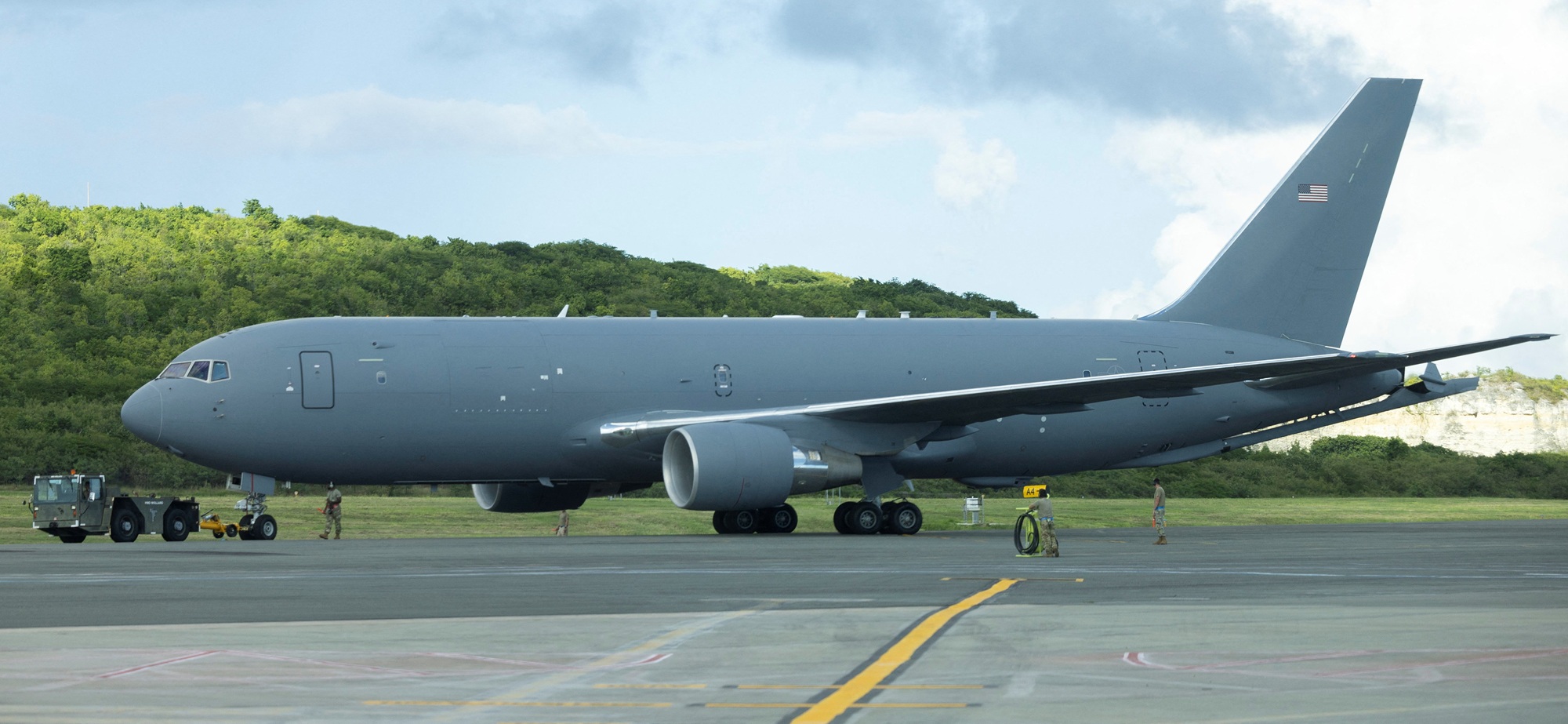
On Tuesday, the U.S. Air Force awarded Boeing a $2.47 billion contract to deliver 15 additional KC-46A Pegasus aerial refueling tankers.

This follows a nearly identical deal in 2024 for the same number of aircraft, then priced at $2.38 billion, signaling steady Pentagon demand even as Boeing grapples with ongoing global headwinds. The KC-46A programme, long criticized for defects ranging from foreign-object debris to supplier-quality issues, has now delivered 98 tankers to the Air Force since 2019, putting Boeing in a stronger position to reclaim confidence from military and international customers alike.

But this contract win reflects only part of a larger story: Boeing’s gradual, and far from complete, decoupling from the economic fallout of the U.S.–China trade war, which once threatened to undermine its global commercial business and exhaust its cash reserves.

Over the past year, Boeing found itself at the center of escalating trade tensions between Washington and Beijing. As U.S. tariffs soared to as much as 145 percent on Chinese imports, China retaliated with steep levies (125 percent) on U.S.-made goods, including commercial aircraft. To protect its airlines from skyrocketing costs, Chinese authorities directed carriers to suspend deliveries of Boeing jets and related parts.

As part of the impact, several jets, including 737 MAX airliners already painted in Chinese-carrier liveries, were flown back to Boeing’s Seattle factories from China’s Zhoushan completion facility.

The shift effectively shut Boeing out of one of the fastest-growing aviation markets in the world at a time when China was projected to account for roughly a fifth of global aircraft demand.

Equally damaging was the effect on Boeing’s supply chain. Building modern commercial aircraft depends on a vast network of global suppliers, many of them outside the United States. With trade barriers raised, Boeing faced doubled costs on parts and increased difficulty sourcing components — a blow to both margins and production timelines.

As orders collapsed and aircraft slated for Chinese carriers piled up unsold, Boeing’s finances creaked. Deferred deliveries translated into inventory carrying costs, stalled revenue recognition (since buyers pay only on delivery), and increased pressure on cash flow.

Some analysts estimated that losses tied to delayed or cancelled China deliveries could reach a billion-plus dollars in 2025 alone.

For a company that relied for decades on China as a key growth engine, sometimes delivering a quarter of its commercial jets there, the disruption threatened not just a temporary revenue drop, but a structural setback.

Faced with shrinking demand from China and elevated costs, Boeing adopted a deliberate pivot — expanding its reliance on international customers outside China, focusing on military contracts, and working hard to stabilize operations and cash flow.

CEO Kelly Ortberg recently said that Boeing is “not going to continue to build airplanes for customers who will not take them.”

Instead, the company has directed much of its 2025 production capacity — especially 737 MAX jets — toward other global buyers rather than waiting for China’s market to reopen fully.

This reallocation appears to be paying off. In Q1 2025, Boeing reported a much narrower loss than feared, $31 million compared with the prior year’s much larger deficit, alongside revenue of $19.5 billion, boosted by strong delivery numbers. Its cash burn, once a key concern, also reportedly shrank significantly.

Moreover, orders and deliveries for military aircraft — which are less sensitive to trade politics and airlines’ cost pressures — have become more prominent in Boeing’s mix. The new KC-46A tanker order is one of several recent defense deals that help offset losses from stalled commercial deliveries.

In effect, Boeing is trying to reshape itself from a company tethered to cyclical airline demand in a few markets into a more balanced aerospace exporter with both commercial and defense streams — better insulated from trade-war shocks.

Why the KC-46A Deal Matters — Symbolism and Strategy

The $2.47 billion contract for 15 KC-46A Pegasus tankers doesn’t just represent revenue. It is a signal that Boeing remains a trusted partner for the U.S. military even as it navigates one of the most turbulent commercial periods in its history. The fact that the new contract comes at a similar price point to last year’s underlines stability in U.S. defense procurement even as global geopolitical and trade pressures swirl.

This provides a dual benefit for Boeing. First, it brings in predictable, high-margin revenue at a time when commercial market demand remains uncertain. Second, it reinforces Boeing’s standing in Washington and among allied nations — a critical asset if the company hopes to leverage future international defense sales or offset commercial volatility with long-term defense contracts.

Seen against the backdrop of China’s delivery freeze and supply-chain disruption, the tanker deal underscores how Boeing is leaning on its diversification strategy — balancing commercial uncertainty with defense demand.

Still a Long Road With Risks

But while Boeing’s recent performance offers hope, challenges linger. The trade war with China is not definitively resolved; tariffs remain high, and Beijing’s airlines may continue to favor European or domestic manufacturers over American ones.

Global supply-chain costs remain elevated, particularly for aircraft such as the 787 Dreamliner that rely heavily on imported components.

For the commercial business to fully rebound, Boeing must not only offload planes originally destined for China, but also win new orders in other regions — a task complicated by reputational issues, competition (especially from Airbus), and rising global economic uncertainty.

Still, the KC-46A contract — and Boeing’s broader pivot — suggests the company is no longer relying on China alone. That shift may prove essential if Boeing hopes to emerge from the trade-war disruption not just stable, but structurally more resilient.