

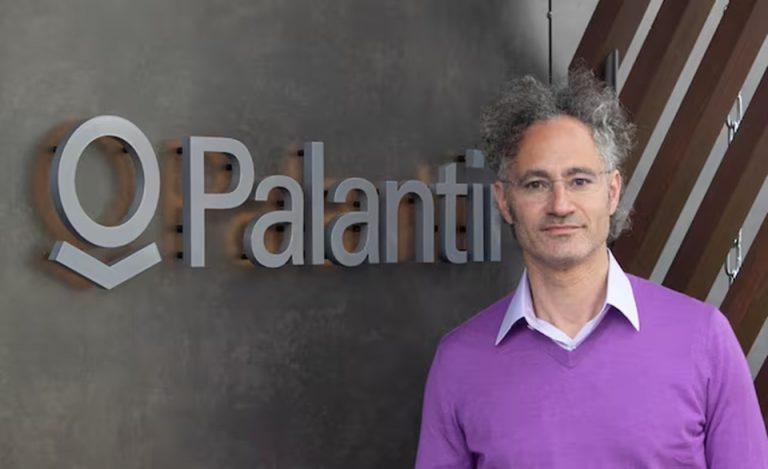
Palantir Technologies CEO Alex Karp is once again making headlines—not for new software or contracts, but for his increasingly grandiose public statements about his company’s role in America’s future.
In a series of recent media appearances, Karp positioned Palantir not merely as a data analytics firm but as a vital force sustaining U.S. economic growth and national security in the artificial intelligence era.
During an interview on The Axios Show, Karp was asked by host Mike Allen the question that many still struggle to answer: “What the hell is Palantir?” His reply was sweeping.
Register for Tekedia Mini-MBA edition 20 (June 8 – Sept 5, 2026).
Register for Tekedia AI in Business Masterclass.
Join Tekedia Capital Syndicate and co-invest in great global startups.
Register for Tekedia AI Lab.
“We are growing the GDP of the U.S. We are the part of the GDP of the AI economy where things are useful,” he said.
The statement, while vague, echoes similar remarks he made earlier on CNBC’s Squawk Box, where he linked Palantir’s success directly to America’s AI-driven economic expansion.
Karp indicates that he sees Palantir as indispensable to the nation’s progress. “Most of the GDP growth in this country is because of AI,” he told CNBC, adding that investors should back his company as part of that broader transformation.

His tone has mirrored that of other tech leaders who have begun portraying their firms as defenders of Western values against authoritarian rivals.
On CNBC, Karp described Palantir as “one of the greatest businesses in the world” performing “a noble task.” Later, on Axios, he used less formal phrasing—calling it “the most baller, interesting company on the planet,” with a “baller product” and “baller culture.”
In his letter to investors following Palantir’s third-quarter earnings, Karp struck a more serious note, invoking W.B. Yeats’ The Second Coming: “Things fall apart; the center cannot hold.” He adapted it to his worldview, writing, “Today, America is the center, and it must hold.” He went on to argue that “it is and was a mistake to casually proclaim the equality of all cultures and cultural values”—a statement that drew attention for its political undertone coming from a technology executive.

Karp’s rhetoric also reflects a worldview where technology, geopolitics, and patriotism intertwine. When pressed by Allen to discuss potential risks of AI, Karp minimized concerns, saying: “It could go wrong in lots of ways, but again, there I would say we need to absorb a lot of risk there because it’s either going to go right and wrong for us or it’s going to go right and wrong for China.”
Even when asked again to clarify how AI could harm ordinary people, Karp stayed on message. “We are going to be the dominant player, or China is going to be the dominant player,” he said. “There will just be very different rules depending on who wins. You will have far fewer rights if America’s not in the lead.”
That argument—that surveillance, automation, and data control are acceptable trade-offs in the name of national leadership—has become a recurring theme in Karp’s public remarks. It also reflects the dual identity of Palantir itself: a company that works with governments on intelligence and security projects while selling its software to corporations for commercial use.
Karp’s attempt to lighten the discussion occasionally turns strange. When talking about public concerns over surveillance, he joked that most people fear technology might “take away my right to go have a hot dog with a coworker I’m flirting with while being married.” Later, he added that much of the anxiety about AI-driven monitoring comes from “people worried about being caught shagging too many people on the side.”
When the discussion finally turned to existential threats from AI, Karp defined the main risk as “social instability,” warning that it could trigger “pretty crazy populist movements that obviously make no sense, like the government is going to run grocery stores.”
His framing underscores a worldview where state regulation or social backlash—not corporate power—poses the real danger. In Karp’s version of the future, the safeguard against chaos is deeper integration of AI across society, led by companies like his.
Karp believes Palantir’s mission has grown far beyond building software. It’s about preserving America’s dominance in a technological arms race, he believes, that defines the century. Whether his rhetoric inspires confidence or concern, it reinforces one thing: Alex Karp sees Palantir not just as a company, but as a cornerstone of the modern American experiment.