

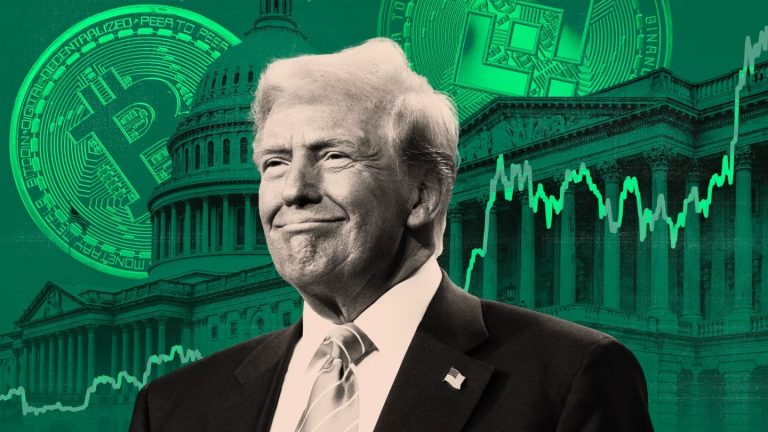
Recent financial disclosures tied to President Donald Trump have once again highlighted the growing convergence between politics, traditional finance, and the cryptocurrency industry. Among the most notable revelations in the latest filing were first-quarter purchases connected to major crypto-linked firms including Coinbase, Strategy, and MARA Holdings.
The disclosure has sparked renewed debate over how deeply digital assets have become embedded in mainstream investment portfolios and political circles ahead of the 2026 election cycle. The purchases are particularly significant because they reflect exposure not merely to speculative crypto tokens, but to publicly traded companies that have become central pillars of the broader digital asset ecosystem.
Each company represents a different layer of the crypto economy. Coinbase stands as one of the world’s largest regulated cryptocurrency exchanges, Strategy has become synonymous with corporate Bitcoin accumulation, and MARA remains one of the most recognizable Bitcoin mining firms in the United States.
The inclusion of these firms in Trump-related disclosures underscores how cryptocurrency has evolved from a fringe technological experiment into an institutional asset class that now intersects with political influence, regulatory policy, and Wall Street capital flows. Just a few years ago, political leaders often approached Bitcoin and crypto with skepticism or outright hostility.
Register for the next Tekedia Mini-MBA.
Register for Tekedia AI in Business Masterclass.
Join Tekedia Capital Syndicate and co-invest in great global startups.
Today, however, exposure to crypto-related equities is increasingly viewed as a strategic financial and ideological position. Coinbase has emerged as a major beneficiary of this transformation. As regulatory clarity in the United States gradually improves, especially with legislative efforts surrounding market structure and stablecoin frameworks, investors have increasingly turned to Coinbase as a proxy for broader crypto adoption.
The exchange benefits from rising trading activity, expanding institutional participation, and the continued growth of Bitcoin ETFs. For politically connected investors, Coinbase also represents a bet that the United States will ultimately embrace regulated digital asset innovation rather than suppress it.
Strategy, meanwhile, has become almost inseparable from Bitcoin itself. Under the leadership of Executive Chairman Michael Saylor, the company transformed from a traditional software business into the world’s largest corporate holder of Bitcoin. Strategy’s stock performance has increasingly mirrored Bitcoin price movements, making it a leveraged institutional vehicle for investors seeking exposure to the asset without directly holding tokens.
The company’s aggressive debt-financed Bitcoin accumulation strategy has attracted both admiration and criticism, but it has undeniably positioned Strategy at the center of the crypto-financial conversation. MARA represents another important dimension of the digital asset economy: infrastructure. Bitcoin miners occupy a foundational role within blockchain networks, validating transactions and securing decentralized systems.

MARA’s inclusion in the disclosure signals confidence not only in Bitcoin’s future price appreciation but also in the long-term sustainability of mining operations within the United States. As geopolitical tensions and energy policy debates reshape global mining dynamics, American mining firms like MARA are increasingly viewed as strategic assets within the digital economy. The broader political implications of the disclosure are equally important.
Trump has undergone a notable evolution in his public stance toward cryptocurrency. During his earlier presidency, he expressed skepticism toward Bitcoin and digital currencies. More recently, however, Trump-aligned political messaging has become significantly more crypto-friendly, emphasizing financial innovation, economic competitiveness, and opposition to excessive regulatory crackdowns.
This shift mirrors broader Republican outreach toward the crypto industry, which has become an increasingly influential donor and voter bloc. The timing of these disclosures also matters. Cryptocurrency markets have experienced renewed momentum in 2026 amid institutional inflows, ETF expansion, and growing integration between traditional finance and blockchain infrastructure.

Political figures and major investors alike are increasingly positioning themselves to benefit from what many believe could be the next major phase of digital asset adoption.
The appearance of Coinbase, Strategy, and MARA in Trump’s latest financial disclosure illustrates more than simple portfolio diversification. It reflects the normalization of crypto-related investments within elite financial and political circles. What was once considered speculative and unconventional is now becoming deeply woven into mainstream capital markets and policy discussions.
As digital assets continue to reshape global finance, disclosures like these offer a glimpse into how influential figures are preparing for a future where cryptocurrency is no longer an alternative system operating on the margins, but a central component of modern economic power.