

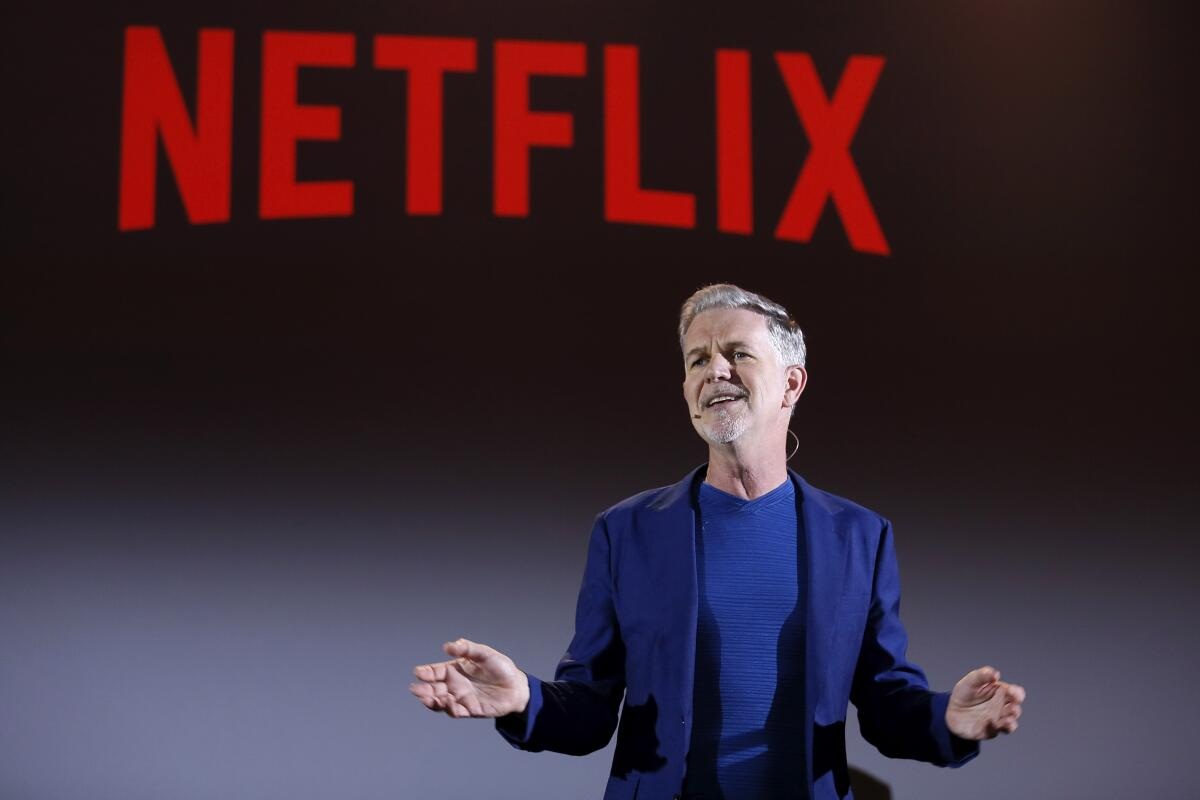
Reed Hastings, the co-founder who transformed Netflix from a humble DVD-by-mail service into the world’s dominant streaming entertainment powerhouse, will depart the company’s board in June and will not seek reelection.
Netflix disclosed the move Thursday alongside its first-quarter earnings, describing it as part of Hastings’ shift toward philanthropy and other personal pursuits.
Hastings served as CEO until 2023 and later as executive chairman. The company praised his foundational role in building a culture of innovation, integrity, and high performance.
Register for the next Tekedia Mini-MBA.
Register for Tekedia AI in Business Masterclass.
Join Tekedia Capital Syndicate and co-invest in great global startups.
“His vision and leadership pioneered how the world is entertained,” Netflix said in its shareholder letter, “and his legacy and impact are not only felt by all of us at Netflix, but by audiences around the world.”
In his own words in the letter, Hastings reflected on his contributions, saying: “My real contribution at Netflix wasn’t a single decision. It was a focus on member joy, building a culture that others could inherit and improve, and building a company that could be both beloved by members and wildly successful for generations to come.”
He gave warm credit to his successors, co-CEOs Greg Peters and Ted Sarandos, noting their “commitment to Netflix’s greatness is so strong that I can now focus on new things.”

Peters responded that “Reed will always be Netflix’s founder and biggest champion,” while Sarandos highlighted Hastings’ “selfless, disciplined leadership style” that continues to guide the current team.
Hastings’ post-Netflix plans include deepening his philanthropic work. He has already donated $1.1 billion to the Silicon Valley Community Foundation and helped establish the Hastings Initiative for AI and Humanity at Bowdoin College. He has also poured energy into developing Powder Mountain, a ski resort in Utah. Forbes currently estimates his net worth at around $5.8 billion.
The announcement came as Netflix delivered solid first-quarter results but offered guidance that left investors wanting more. Revenue climbed 16% to $12.25 billion, narrowly beating consensus estimates around $12.2 billion. Operating income reached $3.96 billion, roughly in line with expectations, while earnings per share hit $1.23—well above forecasts, helped by a $2.8 billion breakup fee collected after the company walked away from its pursuit of Warner Bros. Discovery’s streaming and studio assets.

Yet the stock dropped more than 9% in after-hours trading. Wall Street had grown wary during Netflix’s brief courtship of Warner Bros. Discovery, with shares losing roughly a third of their value at one point amid doubts about the deal. After Netflix pulled out, the stock rebounded more than 40% from its late-February low.
The current reaction suggests investors were hoping for stronger forward momentum, particularly on subscriber growth, advertising, and content strategy in a maturing streaming landscape.
This marks the end of the “post-Warner Bros. honeymoon” period. Netflix now returns to proving it can sustain double-digit growth without a major acquisition to accelerate its scale. The company continues to benefit from its massive global audience, approaching a billion people when counting paid members and viewers, while pushing into advertising and live events.
Hastings leaves behind a company far different from the one he co-founded in 1997. What began as a scrappy disruptor of Blockbuster has become a cultural force that reshaped how billions consume television and film. His emphasis on data-driven decisions, fearless content investment, and a culture that prized freedom and responsibility helped Netflix survive the shift from physical media to streaming—and then thrive as competition intensified.
For the streaming giant, the transition feels orderly. Peters and Sarandos have been running day-to-day operations for years, and the board change represents the final step in a long-planned succession. Still, losing the founder’s institutional memory and quiet influence leaves a void, even if the company insists the culture he built will endure.
Hastings’ exit comes at a moment when Netflix appears stable but no longer invincible. The advertising tier is growing, password-sharing crackdowns have stabilized the subscriber base, and international expansion continues. Yet challenges remain: rising content costs, fragmentation across rival platforms, and the constant need to keep “member joy” at the center of every decision.
As Hastings steps back, he does so with the satisfaction of knowing Netflix changed entertainment forever—and, in his own words, changed his life in countless ways. One of his favorite memories, he said, was January 2016, when the service became available to “nearly the entire planet.” That global reach, once a bold ambition, is now an everyday reality.