

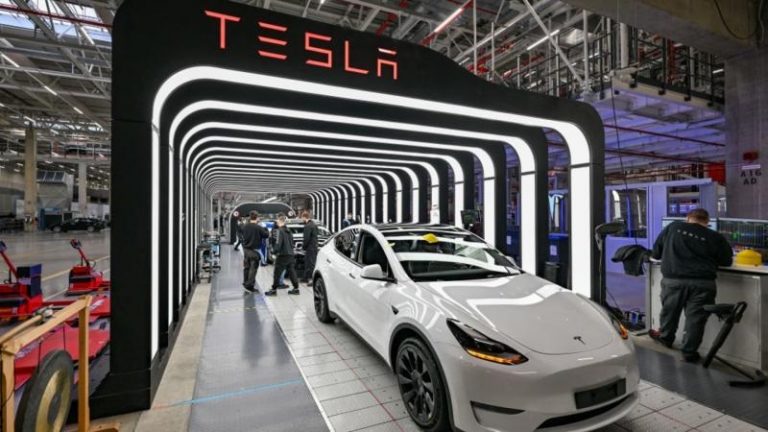
Tesla, once the undisputed leader in electric vehicles (EVs), is now struggling with slowing sales, growing competition, and an increasingly hostile policy environment under President Donald Trump.
The company’s latest earnings report, released amid a market shaken by Chinese advancements in artificial intelligence (AI), highlights a steep decline in profits and underwhelming revenue growth.
This is coming amid the Trump administration’s aggressive move to roll back environmental regulations, a shift that could further erode Tesla’s competitive edge and stifle its future growth.
Register for Tekedia Mini-MBA edition 20 (June 8 – Sept 5, 2026).
Register for Tekedia AI in Business Masterclass.
Join Tekedia Capital Syndicate and co-invest in great global startups.
Register for Tekedia AI Lab.
Tesla’s fourth-quarter earnings for 2024 painted a grim picture of the company’s financial health. The automaker reported a 70% drop in net income, earning $2.3 billion in profit compared to the $7.1 billion recorded in the same quarter the previous year.
Revenue grew slightly to $25.7 billion, representing a 1.9% increase year over year, but it still fell significantly short of Wall Street’s expectations, which had predicted $27.26 billion in revenue. For the full year, Tesla earned $97.7 billion in revenue, reflecting a 6% decline from 2023.
Tesla’s revenue shortfall was not the only troubling indicator. The company relied heavily on the sale of regulatory credits—a revenue stream that is now under direct threat. In the fourth quarter alone, Tesla sold $692 million in regulatory credits to other automakers, accounting for nearly a quarter of its profits.

Over the full year, credit sales reached nearly $2.8 billion. However, Trump’s administration has made it clear that it plans to dismantle California’s emissions program, which has allowed Tesla to profit from selling credits to competitors who fail to meet strict emission standards. Without these credits, Tesla’s already thinning margins could suffer even more.
However, Tesla is pressing forward with plans to expand its vehicle lineup. The company reiterated its intention to release a more affordable EV later this year, though skepticism remains high after Tesla abandoned its previously planned $25,000 “Model 2” vehicle. Investor backlash forced Musk to recommit to the initiative, but Tesla has yet to confirm whether the upcoming model will be a completely new vehicle or simply a cheaper version of the Model 3.
Tesla’s current lineup is aging rapidly, particularly in China, where domestic automakers like BYD are introducing cheaper, technologically superior EVs at an unprecedented pace. Even with the introduction of a refreshed Model Y, Tesla is struggling to keep up in its most important market.

The Cybertruck, Tesla’s most controversial vehicle, remains an unproven product in the market. The company has projected that it will soon become eligible for the $7,500 federal EV tax credit, a factor that could make it more appealing to potential buyers. However, Trump’s administration has already signaled plans to eliminate the federal EV tax credit, which would further dampen demand for Tesla’s vehicles.
In its shareholder letter, Tesla acknowledged ongoing efforts to develop its fully autonomous driving technology. The company reported that Tesla drivers have now cumulatively driven over 3 billion miles on Full Self-Driving (Supervised) and claimed that its AI training capacity increased by over 400% in 2024.
Tesla remains on track to introduce an unsupervised FSD option for customers and its upcoming robotaxi service, with a planned launch later this year in select U.S. locations. However, regulatory pushback—particularly under an administration that appears skeptical of EVs and autonomous driving—could hinder Tesla’s ability to scale these technologies.
Musk’s Influence in the Trump Administration and Its Consequences for Tesla
While Tesla struggles in the market, Musk himself has been consolidating political influence within the Trump administration, positioning himself as a key figure in shaping the country’s economic and energy policies. Musk, who now serves as chief cost-cutter for the Trump administration, has installed several former Tesla executives in key government positions and has been overseeing a massive purge of federal workers. Reports indicate that Musk is even sleeping at the Department of Government Efficiency headquarters in Washington, D.C., echoing his past habit of sleeping on the floor of Tesla’s factories during production crises.
But despite his growing influence, Musk may struggle to shield Tesla from the broader policy shifts that are poised to disrupt the EV industry. Shortly after taking office, President Trump signed an executive order revoking California’s right to enforce its own emissions standards, a move that could kill the market for regulatory credits that Tesla has relied on for billions in revenue.
Additionally, Trump’s pick for Secretary of Transportation, Sean Duffy, wasted no time in reversing policies that had been designed to encourage the adoption of EVs. Within hours of being sworn in, Duffy issued a memo ordering an immediate review of fuel economy standards, with a focus on rolling back the tougher regulations put in place under the Biden administration. In his memo, Duffy explicitly stated that stricter emissions rules had “needlessly driven up the cost of a car” and accused the previous administration of pushing a “radical Green New Deal agenda.”
Beyond fuel standards, the General Services Administration (GSA) has issued another major blow to the EV industry by banning the federal government from purchasing electric vehicles. This move directly contradicts a 2021 executive order issued by former President Joe Biden, which had aimed to transition all federal vehicle acquisitions to zero-emission models by 2032. The GSA’s reversal eliminates a major source of institutional demand for Tesla’s EVs, further complicating the company’s outlook.
With Tesla’s stock already struggling to recover from disappointing sales figures, the Trump administration’s rollback of pro-EV policies threatens to exacerbate the company’s struggles. Analysts have warned that these policy shifts—combined with intensifying competition from Chinese EV makers—could erode Tesla’s dominance in the sector and significantly slow its growth in the coming years.
Although Musk has managed to cultivate strong ties within the Trump administration, Tesla remains highly vulnerable to policy risks. The company is now in a race against time to accelerate the launch of a more affordable EV, expand its manufacturing footprint, and solidify its leadership in autonomous driving technology before Trump’s anti-green agenda fully takes effect.
Analysts note that if Tesla fails to adapt, it may struggle to maintain its leadership in the global EV market. And with a political climate that appears increasingly hostile to electric vehicles, Musk’s vision of an all-electric future may be in jeopardy.