

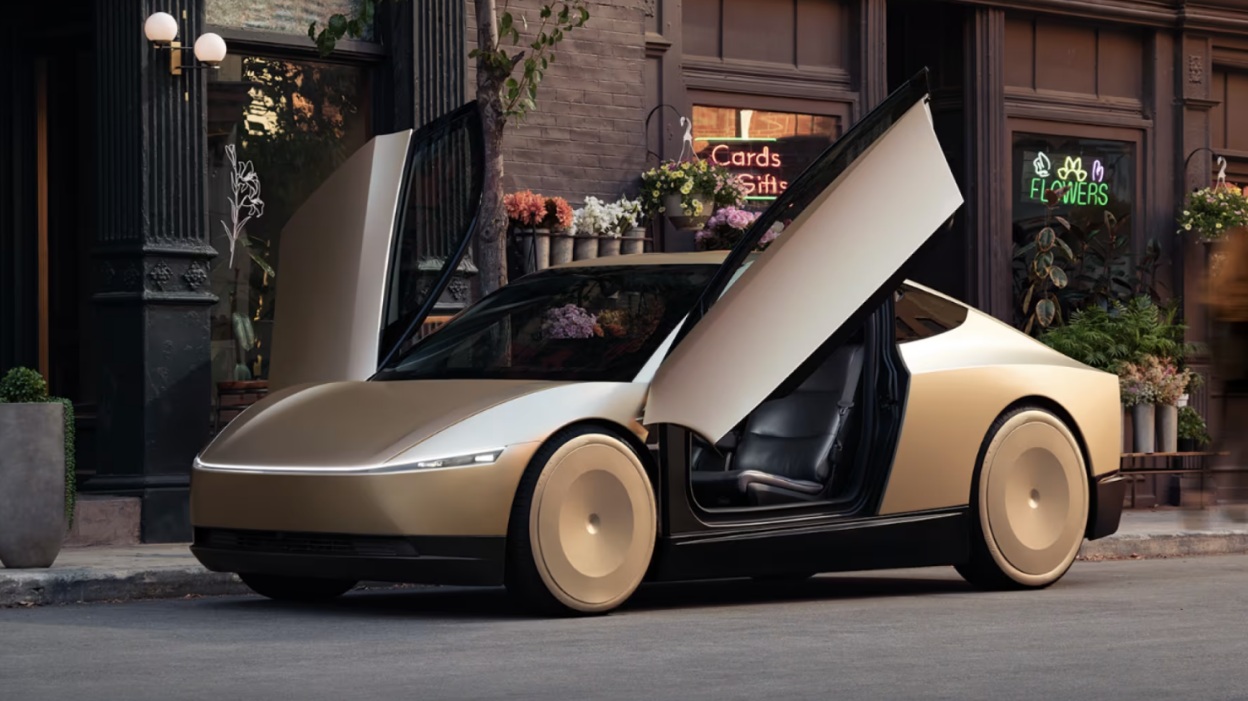
Tesla is rapidly increasing the number of its driverless Cybercabs authorized for commercial service in Texas, but the pace of expansion remains modest compared with the scale of Elon Musk’s ambitions for the robotaxi business.
In the month since Tesla unveiled its Cybercab service in Austin, the number of its bronze two-seat vehicles authorized for commercial use in Texas has nearly quadrupled, rising from 45 at the Sept. 3 launch to 169 as of Friday, according to public records from the Texas Department of Motor Vehicles. The increase shows that Tesla is steadily building out the fleet, but it also highlights the distance the company still has to cover if autonomous ride-hailing is to become a meaningful new growth engine.
The Cybercab is an unusually stripped-down vehicle. It has no steering wheel, pedals, rear or side-view mirrors, or outside door handles, and relies on Tesla’s camera-based autonomous driving technology and sensors. For paying passengers, however, the novelty has come with a range of practical problems.
Register for the next Tekedia Mini-MBA.
Register for Tekedia AI in Business Masterclass.
Join Tekedia Capital Syndicate and co-invest in great global startups.
Passengers have posted videos and comments describing lengthy waits, vehicles arriving at incorrect pickup or drop-off locations, and difficulties involving the cars’ butterfly doors and trunks. Those problems matter because Tesla is attempting to turn autonomous driving from a technology demonstration into a commercially reliable transportation service.
The company needs that transition to happen at a time when its core automotive business is under increasing pressure. Tesla’s vehicle sales have remained sluggish, while its automotive revenue has declined for consecutive years as Chinese electric-vehicle manufacturers such as BYD and Xiaomi compete with more affordable and innovative models.
Tesla shares were down 18% this year before Friday’s delivery report, making it the only megacap technology stock to have failed to generate a positive return for investors. Better-than-expected third-quarter vehicle deliveries subsequently lifted the stock almost 5%, but deliveries still fell about 2% from a year earlier. That makes the robotaxi operation more important to Tesla’s broader investment narrative. Musk has repeatedly positioned autonomous vehicles as a major source of future growth, but investors now have to assess not only whether Tesla can make its vehicles autonomous, but whether it can operate a large, dependable commercial network.

Waymo’s Head Start Raises The Bar
Tesla is not entering an empty market. Alphabet’s Waymo has spent years developing commercial autonomous ride-hailing and has established a considerable operating lead.
Waymo is now operating in 15 U.S. markets, with another 15 on the horizon, according to the company’s website. It has also announced planned international launches in London, Tokyo and Munich. In Texas alone, 1,154 autonomous vehicles were authorized for commercial use as of Friday, including 359 of its newer Ojai models, which feature a low step and sliding doors.
Waymo says it is conducting more than 500,000 paid rides each week and has completed 270 million fully autonomous miles of commercial driving domestically. Its U.S. commercial operations currently include more than 4,000 driverless vehicles.

Tesla’s Texas robotaxi fleet is considerably smaller. In addition to the 169 Cybercabs, its fleet includes 420 Model Y vehicles equipped with Tesla automated-driving systems that are not yet available to individual car buyers.
Austin is currently the only city where Tesla operates the Cybercab as part of its driverless ride-hailing service. The city has become an important testing ground for autonomous vehicles because of relatively lax state regulations and its large technology community. Amazon’s Zoox is also testing there.
The difference between the companies goes beyond the number of autonomous vehicles on the road. It is the maturity of the underlying service. Tesla is still refining basic elements of the passenger experience while Waymo has already built a network capable of handling hundreds of thousands of paid journeys every week.
Ethan McKanna, a 20-year-old Austin resident, former Tesla intern and computer science student at Texas A&M University, has taken rides in every type of autonomous vehicle available to public riders in the city. He has also created RobotaxiTracker.com, which uses machine learning to analyze data from traffic cameras and other public records to track autonomous services in U.S. cities.
McKanna, according to CNBC, said he has taken about 30 Cybercab rides and has used Waymo since the latter launched in Austin in 2024. He likes the Cybercab’s private cabin, massive screen, media controls and apps, describing the driving experience as “very smooth.”
But the service around the vehicle remains less mature.
The “pick up, drop-off experience,” he said, was not yet refined, while the outward-opening butterfly doors were “less convenient” than conventional or sliding doors. Early demand also produced significant waiting times.
“There was so much demand that wait times were often like 45 minutes plus,” McKanna said. He added that waiting times have fallen in recent weeks as demand has become more “equalized.”
Waymo, meanwhile, benefits from having operated commercially for longer.
“Waymo’s been doing commercial operations for longer, so they’re just more mature with 24/7 service, better support, things like that,” McKanna said. He noted that Waymo itself experienced problems in its early Austin operations, including “harsh braking” issues.
For Tesla, the challenge is turning the Cybercab from an impressive autonomous vehicle into a transportation system that passengers can rely on repeatedly.
Expansion Brings Technical and Regulatory Risks
Scaling that system beyond Austin could expose Tesla to another layer of difficulty: regulators.
The National Highway Traffic Safety Administration initiated an audit query following the Cybercab launch to determine whether the vehicles comply with federal safety standards. NHTSA initially asked Tesla to respond by Sept. 30 to a long list of safety questions, although Tesla obtained an extension, according to an agency spokesperson.
The regulatory scrutiny comes as Tesla continues to confront the difficult edge cases that autonomous vehicles encounter outside controlled demonstrations.
One of the latest involves something far smaller than a conventional road hazard. Musk said Saturday that Tesla was extending its Austin robotaxi operating hours from 10 p.m. to 11 p.m., while also identifying nighttime visibility as a problem the company is trying to solve.
“The main thing we’re trying to solve is making sure that we don’t run over pets when they’re hard to see at night,” Musk wrote in an X post. “Literally trying to avoid grey kittens on grey tarmac in the dark.”
The issue underpins the difficulty of autonomous driving: a system capable of handling ordinary traffic still has to respond correctly to rare, unpredictable situations. Cats and dogs can move suddenly into the roadway, creating a different challenge from the predictable flow of vehicles and pedestrians.
Tesla says its Cybercabs use “camera vision and sensors” to navigate. Its vehicle manuals acknowledge that low or limited light, including unlit or poorly lit roads at night, can limit a camera’s ability to provide accurate visual information.
Musk has argued that AI-assisted image processing can improve nighttime performance. Responding to a comment on his X post, he said: “Visual spectrum cameras can see very well in the dark when AI is doing the photon count analysis.”
But the issue is already attracting regulatory attention. NHTSA is investigating Tesla’s camera system for full self-driving vehicles and whether it can adequately identify road hazards under less-than-ideal visibility conditions.
Waymo takes a different technical approach, using LiDAR, which relies on laser beams to scan the surrounding environment. That technology is not without its own challenges. Late last year, a Waymo vehicle struck and killed a 9-year-old tabby cat named KitKat, prompting an outpouring of tributes from residents in the neighborhood.
Tesla has also encountered an animal-related incident in its Austin robotaxi operation. In September 2025, a Tesla Model Y operating as part of the service struck a dog that ran into the street. Tesla reported the incident to NHTSA, saying the dog ran away from the vehicle and appeared to be uninjured.
These incidents are a reminder that the robotaxi race is not merely a contest over fleet size or city launches. Each additional vehicle and each additional hour of operation increases the number of real-world situations autonomous systems must handle safely.
That is challenging for Tesla because Musk’s ambitions require scale. The Cybercab fleet has grown substantially in a short period, but the company is still operating in a single city with a relatively small number of purpose-built vehicles, while Waymo is already operating thousands of autonomous vehicles commercially across the United States.
Therefore, Tesla faces a difficult sequencing problem. Analysts, including some Tesla bulls, believe the EV giant needs to expand quickly enough to demonstrate that robotaxis can become a significant business, while improving reliability and satisfying regulators before expansion exposes shortcomings at a much larger scale.