

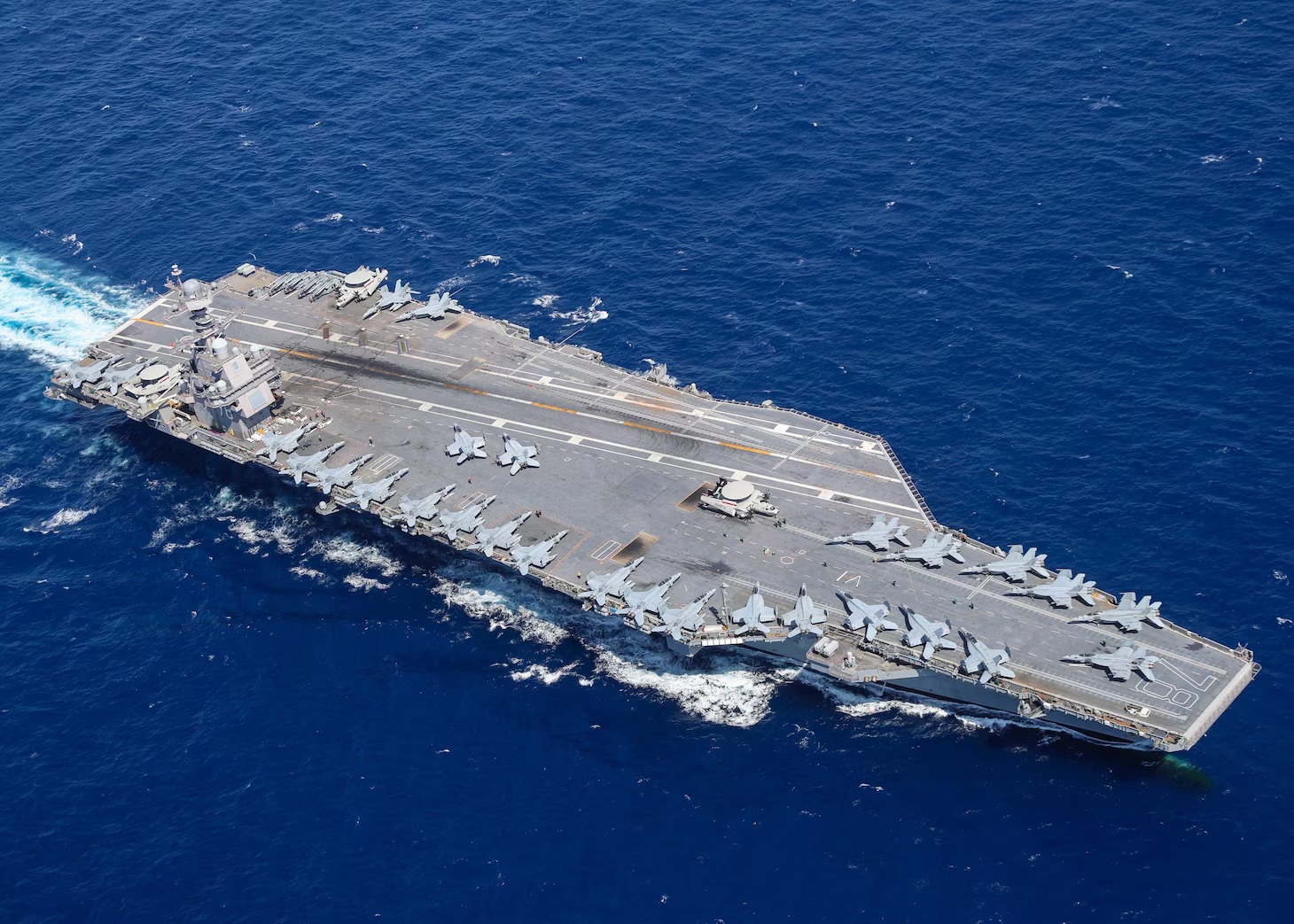
The United States has deployed the USS Gerald R. Ford—the world’s largest warship and aircraft carrier—toward the Middle East amid escalating tensions with Iran. This is part of a significant military buildup under the Trump administration, aimed at pressuring Iran over its nuclear program, ballistic missiles, and regional activities.
The USS Gerald R. Ford, accompanied by its strike group including destroyers like the USS Mahan, recently transited the Strait of Gibraltar and entered the Mediterranean Sea. It’s en route to join the USS Abraham Lincoln carrier strike group, already positioned in the Arabian Sea/Persian Gulf area near Iran.
This dual-carrier presence—rare and indicative of high readiness—includes dozens of additional warships, fighter jets (F-22s, F-35s, F-15s), aerial refueling tankers, submarines, and air defenses. The deployment follows stalled or challenging indirect talks in Geneva and upcoming in Oman, where the US demands “zero enrichment” and limits on missiles/proxies, while Iran rejects key terms.
President Trump has publicly warned Iran has “10 to 15 days at most” to reach a “meaningful” deal, or face consequences, with some reports suggesting a decision on action could come soon.Regarding the odds of a US strike by March 15, 2026, at 50%—this aligns closely with current assessments from prediction markets, sources, and analysts.
Register for Tekedia Mini-MBA edition 20 (June 8 – Sept 5, 2026).
Register for Tekedia AI in Business Masterclass.
Join Tekedia Capital Syndicate and co-invest in great global startups.
Register for Tekedia AI Lab.
Polymarket and similar platforms have shown probabilities around 50-60% for strikes by late March climbing to ~57% for end of March in recent data, with shorter-term odds lower but rising. Insider reports from Axios, citing Trump advisers put chances of “kinetic action” in the coming weeks as high as 90% in some views, though others describe preparations for a potential multi-week campaign if talks fail.
Experts note the buildup (largest since 2003 Iraq invasion levels) signals serious preparation rather than mere posturing, but a full-scale war remains uncertain due to risks like Iranian retaliation (missiles, proxies, Strait of Hormuz disruption), oil price spikes, and broader escalation involving Russia/China.
No strike has occurred as of February 20, 2026, and diplomacy continues. However, the window Trump referenced points to early-to-mid March as a critical period. Tensions are very high, with both sides signaling readiness—Iran conducting joint drills with Russia and fortifying sites—making de-escalation or limited action possible outcomes.

This creates a rare dual-carrier presence alongside the USS Abraham Lincoln in or near the Arabian Sea/Persian Gulf area, backed by extensive supporting assets (destroyers, submarines, F-35s/F-22s, tankers, AWACS, and more).
This buildup is the largest U.S. military concentration in the Middle East since the 2003 Iraq invasion, explicitly tied to pressuring Iran over its nuclear program, ballistic missiles, regional proxies, and enrichment activities.
Two carrier strike groups provide overwhelming airpower, precision strikes on nuclear sites, missile facilities, or command structures. The Ford’s advanced electromagnetic catapults and stealth aircraft integration make it ideal for high-intensity operations. Positioning near Israel adds flexibility for joint U.S.-Israeli actions.

This signals credible threat to Iran, but also heightens miscalculation chances. Iran could respond with asymmetric tactics: missile/drone barrages on U.S. bases/ships, proxy attacks (Houthis, Hezbollah, Iraqi militias), or attempts to close the Strait of Hormuz disrupting ~20% of global oil flow.
Russian and Chinese naval presence/exercises in the Gulf could complicate U.S. operations, potentially leading to multi-power entanglement. President Trump’s public warnings (Iran has “10 to 15 days at most” for a “meaningful deal,” or face “really bad things”) frame this as coercive diplomacy. Indirect talks demand zero enrichment and missile limits—terms Iran rejects outright.
Failure risks kinetic action; success unlikely given stances could de-escalate. The buildup serves as leverage, but prolonged stalemate increases strike probability if Trump perceives no progress. Any strike or Hormuz disruption could spike prices dramatically potentially $100+/barrel short-term, fueling inflation and global recession fears.
Gulf states (Saudi Arabia, UAE) might face Iranian retaliation; Europe/Asia could see energy shocks. Allies like the UK (Typhoons deployed) provide limited support, but full war would strain coalitions.
Prediction markets likePolymarket show rising but varied odds: 30-35% for early March dates by March 5, climbing toward ~50%+ by mid-to-late March in some contracts e.g., end-of-March around 49-62% in recent data, with high volume in millions wagered.
Shorter windows by March 1 hover lower (29-30%), reflecting buildup timelines—the Ford may not fully arrive/position for weeks. Analyst views split: Some see 50%+ for limited strikes if talks collapse; others note risks (Iranian retaliation, oil chaos, no invasion intent) make full-scale war less likely.
No strike has occurred yet; diplomacy persists amid pessimism. The situation is highly fluid—Trump’s decision window (potentially days to weeks) aligns with the March 15 timeframe, but de-escalation remains possible if Iran concedes or external factors.