

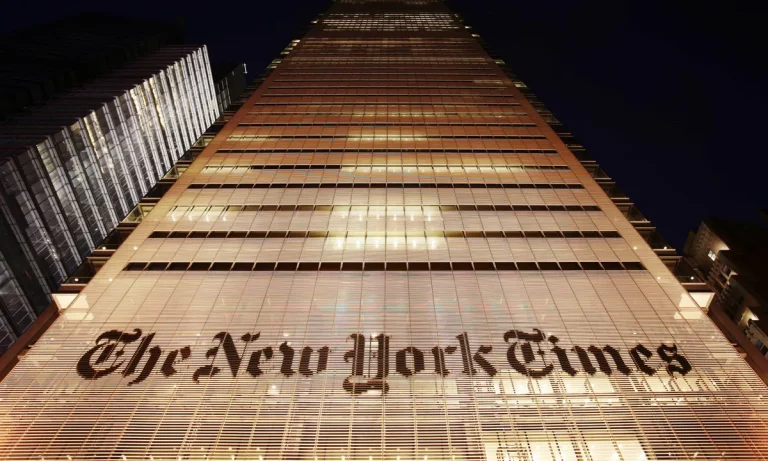
President Donald Trump filed a $15 billion defamation lawsuit against The New York Times, four of its reporters, and Penguin Random House in a Florida federal court on September 16, 2025.
The lawsuit alleges that the newspaper’s coverage, including a book titled “Lucky Loser: How Donald Trump Squandered His Father’s Fortune and Created the Illusion of Success” by Times reporters Susanne Craig and Russ Buettner, along with related articles, intentionally damaged Trump’s reputation and business interests, specifically citing harm to the $TRUMP cryptocurrency token.
The complaint claims that the Times’ reporting, which questioned Trump’s business history and linked the $TRUMP token to Chinese crypto mogul Justin Sun, contributed to an 88% decline in the token’s value, from a peak of $73.43 to around $8.50, reducing its market capitalization to $1.7 billion.
Trump’s legal team argues that the coverage was malicious, aimed at undermining his 2024 presidential campaign and causing economic loss to his media company, Trump Media & Technology Group. The lawsuit also references the Times’ endorsement of Kamala Harris as evidence of bias, calling the outlet a “mouthpiece” for the Democratic Party.
Register for Tekedia Mini-MBA edition 20 (June 8 – Sept 5, 2026).
Register for Tekedia AI in Business Masterclass.
Join Tekedia Capital Syndicate and co-invest in great global startups.
Register for Tekedia AI Lab.
The New York Times and Penguin Random House have dismissed the lawsuit as meritless, asserting it is an attempt to stifle independent journalism. Legal experts note that Trump, as a public figure, faces a high bar to prove defamation, requiring evidence of “actual malice” under the New York Times v. Sullivan precedent, meaning the defendants knowingly published false information or acted with reckless disregard for the truth.
Critics, including First Amendment scholars, argue the lawsuit is more about political posturing than legal merit, pointing to Trump’s pattern of suing media outlets like The Wall Street Journal, ABC News, and CBS, some of which settled for multimillion-dollar sums.
The $TRUMP token, launched in January 2025, saw an initial valuation surge to $73 billion before crashing. Despite the token’s decline, Trump’s overall wealth has reportedly increased due to other crypto ventures, including the World Liberty Financial platform.

The lawsuit’s claims about the token’s losses remain contentious, as the cited reporting predates the token’s launch, raising questions about causation. As a public figure, Trump must prove “actual malice” under the New York Times v. Sullivan (1964) standard, meaning the Times knowingly published false information or acted with reckless disregard for the truth.
This is a challenging threshold, and legal experts suggest the lawsuit may struggle to succeed, given the Times’ reporting appears to rely on documented claims about Trump’s business history and the $TRUMP token’s ties to Justin Sun.
A successful lawsuit could embolden public figures to pursue defamation claims against media outlets, potentially chilling investigative journalism. Conversely, a dismissal could reinforce protections for press freedom under the First Amendment.
Filed in Florida, the case may face scrutiny over venue, as the Times is based in New York. Trump’s choice of Florida, where he resides, could be seen as forum-shopping for a favorable court, potentially complicating proceedings.

The case could further erode public trust in mainstream media among Trump supporters, deepening political divides. It may also fuel debates about media bias, as Trump’s legal team leverages the Times’ political stances to argue malice.
If Trump wins the lawsuit could signal a broader push to reform defamation laws, making it easier to sue media outlets. Trump has previously advocated for loosening libel standards, which could reshape press protections.
The lawsuit claims the Times’ reporting caused an 88% drop in the $TRUMP token’s value, from $73.43 to $8.50, slashing its market cap to $1.7 billion. However, the token’s volatility, tied to speculative crypto markets and external factors like Justin Sun’s involvement, may undermine causation claims. A prolonged legal battle could further depress investor confidence in the token.
The lawsuit highlights Trump’s growing stake in cryptocurrency through Trump Media & Technology Group and World Liberty Financial. Negative publicity could harm these ventures, though Trump’s overall wealth reportedly benefits from other crypto successes.
Defending the lawsuit will impose significant legal costs on the Times and Penguin Random House, potentially straining resources even if they prevail. This could deter smaller outlets from critical reporting on powerful figures.
Media and Journalism Implications
The lawsuit’s $15 billion demand, even if unlikely to succeed, may intimidate journalists and publishers covering Trump or other high-profile figures, particularly on sensitive topics like financial dealings or crypto ventures.
The case amplifies Trump’s narrative of a “fake news” media, potentially undermining the credibility of investigative reporting. The Times’ robust defense, however, could reinforce the importance of journalistic independence.
The token’s dramatic rise and fall, coupled with the lawsuit’s claims, may attract attention from regulators like the SEC, especially given questions about its valuation and market manipulation risks in the crypto sector.
The case tests the balance between free speech and defamation law. A ruling in Trump’s favor could narrow press freedoms, while a victory for the Times would uphold robust protections for critical reporting.
The case underscores the growing intersection of cryptocurrency and politics, as public figures like Trump leverage digital assets for financial and political gain, raising questions about transparency and accountability.
The lawsuit is less likely to succeed on legal merits but carries significant symbolic weight. It serves as a political tool for Trump to galvanize supporters, pressure media outlets, and draw attention to his crypto ventures.
For the Times and Penguin Random House, it represents a costly but winnable fight to defend journalistic integrity. The outcome could influence defamation law, media practices, and the volatile crypto market.