

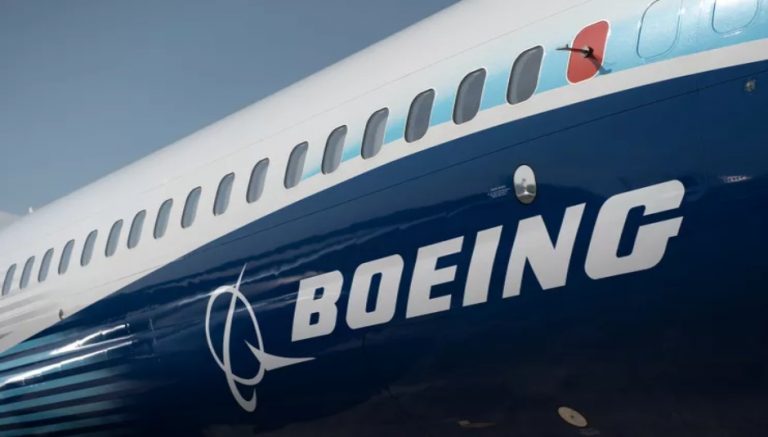
President Donald Trump announced on Friday that China has committed to purchasing 200 Boeing aircraft, with the potential to expand the order to as many as 750 planes.
The deal will deliver a significant commercial and political victory for the U.S. planemaker after nearly a decade of limited access to the world’s second-largest aviation market.
“The deal includes approximately 200 planes and a promise of up to 750 if they do a good job,” Trump told reporters.
Register for the next Tekedia Mini-MBA.
Register for Tekedia AI in Business Masterclass.
Join Tekedia Capital Syndicate and co-invest in great global startups.
The aircraft will be powered by GE Aerospace engines. While full specifications on the mix of narrowbody and widebody jets were not immediately released, the scale of the potential order would rank among the largest in aviation history.
The announcement, made during Trump’s high-profile visit to Beijing, was accompanied by senior executives from Boeing and GE Aerospace, underscoring the importance both sides placed on the outcome.
A Long-Awaited Return for Boeing
The deal represents Boeing’s most substantial opening in China since trade tensions and regulatory issues effectively sidelined the American manufacturer. Airbus has aggressively captured market share in recent years, building a strong backlog with Chinese carriers, while Boeing faced headwinds from the 737 MAX crisis, production bottlenecks, and geopolitical friction.

The order provides critical momentum at a challenging time for Boeing. The company has been grappling with safety scrutiny, supply chain issues, and labor tensions. Securing a large Chinese commitment not only boosts its order book but also signals improving relations that could stabilize future deliveries.
From China’s perspective, the purchase addresses pressing capacity needs. Its domestic champion, COMAC, has struggled to scale production of the C919 narrowbody jet, falling well short of targets due to technical, certification, and supply chain limitations. The Boeing order allows China’s three major state-owned carriers to continue expanding their fleets to meet robust domestic and international travel demand.
Aviation consultancy IBA estimated the firm’s 200-aircraft portion at approximately $17–19 billion, assuming a heavy weighting toward 737 MAX jets. If widebody aircraft make up a larger share, the value could climb toward $25 billion. Should China ultimately exercise options up to 750 planes, the total deal could exceed $60–70 billion, potentially becoming the largest commercial aircraft order ever placed.

The agreement offers tangible benefits on both sides of the Pacific. In the U.S., it supports hundreds of thousands of jobs across Boeing’s extensive supply chain, spanning manufacturing hubs in Washington state, South Carolina, and dozens of supplier states. For China, it provides reliable access to proven, high-efficiency aircraft while its own industry matures.
Political Win Amid Trade Tensions
For President Trump, the deal delivers a visible trade success story at a time when his broader tariff strategy has yet to significantly reduce the U.S. trade deficit with China. It also sets the stage for potential follow-on orders during Xi Jinping’s planned reciprocal visit to Washington in September.
However, analysts caution that China has a pattern of bundling new orders with previously announced backlog aircraft when announcing major packages tied to diplomatic summits. The exact split between new business and existing commitments remains unclear.
Despite the optimism, significant risks remain. Chinese aviation expert Li Hanming highlighted deep-seated concerns over long-term support.
“The reason China isn’t buying is very simple: no one wants to buy something without guaranteed after-sales maintenance and support. Last May, the U.S. was still threatening export restrictions on parts. If they impose parts embargoes like that, who would still dare to buy Boeing?” Li said.
There is also concern that geopolitical volatility could still disrupt the deal. Past experience shows that U.S.-China tensions can quickly lead to regulatory delays, certification hurdles, or delivery pauses. Boeing will need to navigate these risks carefully to convert the memorandum into firm, executable contracts.
Market reaction was muted. Boeing shares fell about 2.6% on Friday after dropping nearly 4% the day before, as the initial 200-plane figure came in below some analysts’ expectations of 500+ narrowbodies plus widebodies.
This potential mega-order highlights commercial aviation’s enduring role as a key pillar of U.S.-China economic engagement. Even amid fierce competition in technology, semiconductors, and military affairs, both nations recognize the mutual benefits of stable cooperation in civil aerospace.
Success in China remains vital for Boeing and GE Aerospace’s long-term growth. For Beijing, balancing its “self-reliance” goals with pragmatic purchases of Western aircraft allows it to sustain rapid aviation expansion while COMAC continues its long development journey.