

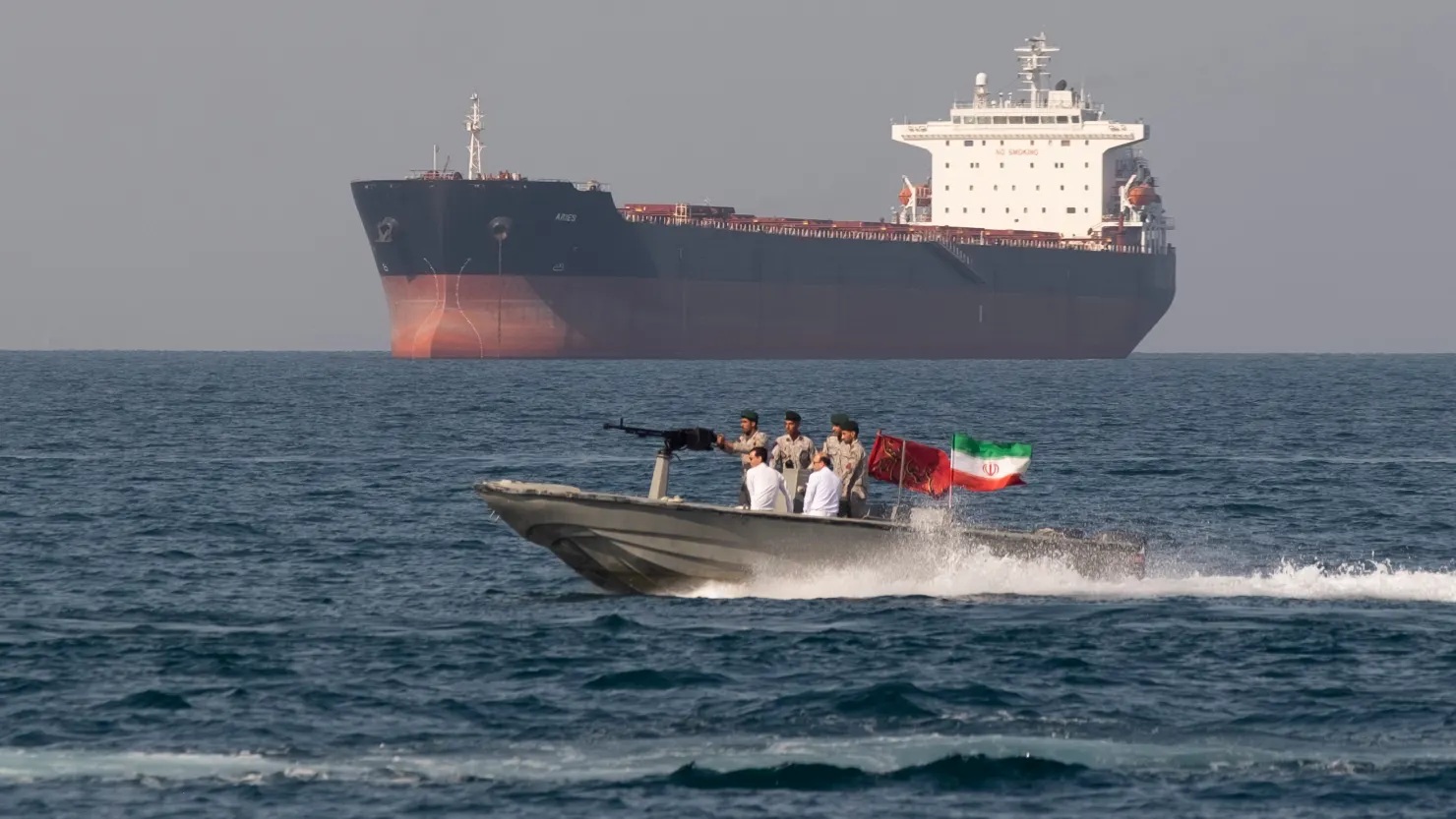
President Donald Trump responded to the collapse of weekend peace negotiations with Iran by ordering an immediate U.S. naval blockade of the Strait of Hormuz, the narrow waterway that carries roughly one-fifth of the world’s daily oil supply.
In a Truth Social post on Sunday, Trump declared: “Effective immediately, the United States Navy, the Finest in the World, will begin the process of BLOCKADING any and all Ships trying to enter, or leave, the Strait of Hormuz.”
He blamed Iran for the impasse, noting that Tehran had failed to guarantee unrestricted passage.
Register for the next Tekedia Mini-MBA.
Register for Tekedia AI in Business Masterclass.
Join Tekedia Capital Syndicate and co-invest in great global startups.
“At some point, we will reach an ‘ALL BEING ALLOWED TO GO IN, ALL BEING ALLOWED TO GO OUT’ basis, but Iran has not allowed that to happen by merely saying, ‘There may be a mine out there somewhere,’ that nobody knows about but them.”
Trump further directed the Navy to target vessels that paid tolls to Iran: “I have also instructed our Navy to seek and interdict every vessel in International Waters that has paid a toll to Iran. No one who pays an illegal toll will have safe passage on the high seas.”
He issued a blunt warning to any resistance, explaining that the U.S. will destroy the mines the Iranians laid in the Straits.

“Any Iranian who fires at us, or at peaceful vessels, will be BLOWN TO HELL! Iran knows, better than anyone, how to END this situation which has already devastated their Country,” he said.
The president argued the blockade would prevent Iran from profiting from transit fees while the rest of the world bore the cost of disrupted shipping. He added that other nations would join the effort, though he named none.
The announcement followed marathon talks in Pakistan led by Vice President JD Vance, which ended without agreement.

Vance said early Sunday: “We go back to the United States having not come to an agreement. We’ve made very clear what our red lines are, what things we’re willing to accommodate them on and what things we’re not willing to accommodate them on.”
The central sticking point, Vance explained, was Iran’s refusal to provide an “affirmative commitment” that it would not pursue a nuclear weapon or acquire the materials needed for a nuclear deterrent.
Trump had announced a conditional two-week ceasefire on April 7 in hopes of halting the fighting that erupted on February 28 and reopening the strait. Yet traffic has remained tightly restricted, keeping energy prices elevated and supply chains strained.
Trump’s blockade introduces a dangerous new dimension to the conflict. By explicitly targeting ships that paid Iranian tolls, the U.S. is not only confronting Tehran but also indirectly challenging its major customers — most notably China, which relies heavily on Iranian oil.
Beijing has already lost Venezuelan supply this year; a sustained disruption through Hormuz could force it to scramble for alternatives, heightening tensions between Washington and Beijing at a time when trade frictions are already high. The move risks drawing China more directly into the crisis, either diplomatically or through efforts to secure alternative shipping routes, further complicating an already volatile geopolitical landscape.
Markets reacted swiftly and sharply. Oil prices surged, with West Texas Intermediate climbing above $104 per barrel and Brent nearing $103.
Veteran economist Peter Schiff, chief economist at Euro Pacific, said the development will shoot oil prices further up.
“The talks designed to open the Strait of Hormuz will result in the strait being closed tighter than ever. Trump announced the U.S. Navy will blockade the strait to make sure that those ships paying Iran’s tolls for safe passage can’t get through either. Get ready for $150 oil,” he said.
The escalation comes as finance ministers and central bankers gathered in Washington last week, confronting the third major global economic shock in recent years after the COVID-19 pandemic and Russia’s 2022 invasion of Ukraine. Both the IMF and World Bank have downgraded growth forecasts and raised inflation projections, warning that emerging markets and developing economies will suffer most from higher energy costs and supply disruptions.
The World Bank now sees growth in those economies slowing to 3.65% in 2026, and potentially as low as 2.6% in a prolonged conflict, while inflation could climb to 4.9% or even 6.7%. The IMF warns that persistent disruption could push another 45 million people into acute food insecurity by interrupting fertilizer shipments.
With public debt at record levels in many countries, officials face a delicate balancing act: cushioning the blow of higher prices without igniting broader inflation or derailing job creation for the 1.2 billion young people expected to enter the workforce in developing nations by 2035. The G20, chaired by the U.S., is further hobbled by the exclusion of South Africa, limiting its ability to coordinate an effective response.
Trump’s decisive action has transformed the regional standoff into a broader test of economic resilience and international relations. By tightening the noose on Hormuz, the administration aims to pressure Iran into concessions, but the immediate result is higher energy costs, strained alliances, and fresh friction with China.