

U.S. President Donald Trump has stated that Washington should have demanded a larger ownership stake in Intel Corporation, underscoring how central the once-struggling chipmaker has become to America’s industrial and artificial intelligence ambitions.
Speaking in an interview with Fortune published Monday, Trump revisited last year’s landmark government intervention that resulted in the U.S. taking a 9.9% stake in Intel, a move widely viewed as one of the most aggressive state-backed efforts to revive a strategic American technology company in decades.
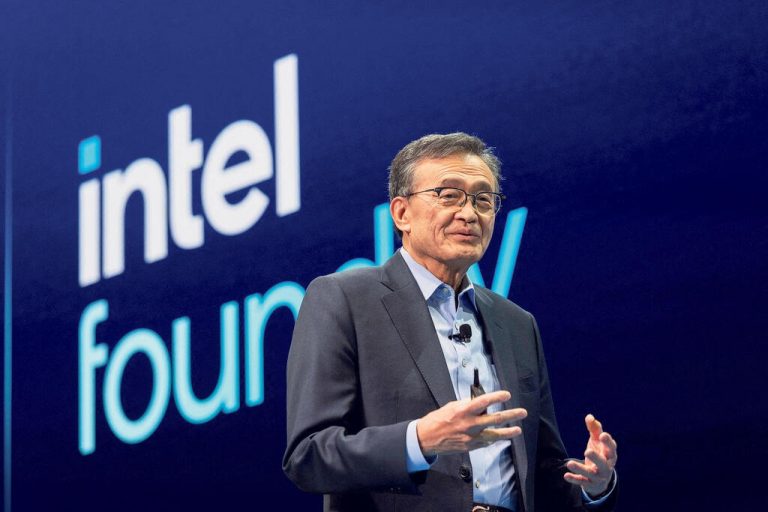
Describing his discussions with Intel Chief Executive Lip-Bu Tan, Trump said he demanded “10% ownership for free” during negotiations tied to federal support for the semiconductor giant.
Register for the next Tekedia Mini-MBA.
Register for Tekedia AI in Business Masterclass.
Join Tekedia Capital Syndicate and co-invest in great global startups.
According to Trump, Tan immediately agreed.
“S—, I should have asked for more,” Trump said.
The remarks come amid the increasingly interventionist posture of the U.S. government toward the semiconductor industry as Washington intensifies efforts to secure domestic chip manufacturing capacity and reduce dependence on Asia for critical technologies.

Intel’s revival has become politically symbolic for the Trump administration, which has framed semiconductor manufacturing as both an economic and national security priority amid intensifying technological rivalry with China.
Rebuilding America’s chip industry
The government stake emerged from a sweeping rescue and industrial support package announced last year after Intel suffered years of manufacturing setbacks, market share losses, and declining investor confidence.
Under the arrangement disclosed in August by U.S. Commerce Secretary Howard Lutnick, approximately $5.7 billion in unpaid CHIPS Act grants awarded to Intel were converted into equity, alongside an additional $3.2 billion from separate federal awards. The transaction gave Washington a 9.9% ownership position in the company, an unprecedented level of direct government participation in a major U.S. semiconductor manufacturer.

At the time, Intel was under mounting pressure after falling behind rivals in advanced chip manufacturing, particularly Taiwan Semiconductor Manufacturing Company and NVIDIA Corporation.
But the company’s fortunes have shifted dramatically over the past nine months.
Intel’s shares have surged more than 300% since the government-backed restructuring, fueled by renewed investor confidence, resurgent demand for its central processing units, and growing expectations that CPUs will play a larger role in powering next-generation AI systems.
April marked Intel’s strongest month in its 55-year history on the Nasdaq, with the stock more than doubling during the month alone.
The rally tagged along a broader AI infrastructure market boom.
For much of the generative AI boom, investor attention centered overwhelmingly on graphics processing units, or GPUs, dominated by Nvidia. But mounting computational demands are now driving renewed focus on CPUs, particularly for handling data orchestration, memory management, and increasingly complex AI workloads.
Bank of America has projected that the CPU market could more than double by 2030.
Meanwhile, Nvidia executives acknowledged earlier this year that “CPUs are becoming the bottleneck” in scaling AI systems. Lip-Bu Tan reinforced that narrative during Intel’s April earnings call.
“The CPU is reinserting itself as the indispensable foundation of the AI era,” Tan said, adding that demand for Intel’s data-center CPUs was exceeding supply.
AI rivalry and geopolitical overtones
Trump used the interview to argue that earlier protectionist policies could have fundamentally altered the global semiconductor industry.
He claimed Intel would now be “the biggest company in the world” if the United States had imposed stronger tariffs earlier against imported chips.
“Intel would have all that business now, and there would be no Taiwan,” Trump said, referring to TSMC, the world’s dominant contract chipmaker.
The comment reflects longstanding frustration within sections of Washington over the migration of advanced semiconductor manufacturing capacity from the United States to Asia over the past three decades. TSMC currently commands a market value of roughly $1.84 trillion, dwarfing Intel’s approximately $547 billion valuation despite the latter’s recent rebound.
The comparison has become politically potent because TSMC sits at the center of global semiconductor supply chains while operating from Taiwan, an island Beijing claims as its territory and one increasingly viewed as a major geopolitical flashpoint.
The Trump administration has made semiconductor reshoring a core pillar of its economic and national security strategy, arguing that dependence on foreign chip production leaves the United States vulnerable during periods of geopolitical instability.
The administration’s industrial policy push has accelerated alongside broader efforts to contain China’s technological rise through export restrictions, investment controls, and tighter oversight of advanced AI technologies.
Trump also used the interview to claim the United States remained significantly ahead of China in artificial intelligence development.
“We’re beating them by a lot,” he said. “It’s important that we win.”
The remarks come as competition between Washington and Beijing increasingly extends beyond trade into advanced semiconductors, AI infrastructure, and computational capacity.
Intel’s turnaround has also begun attracting major strategic customers.
Earlier this month, reports emerged that Apple Inc. and Intel had reached a preliminary agreement for Intel to manufacture certain chips for Apple devices, a potentially significant validation of Intel’s foundry ambitions. Separately, Elon Musk said in April that he intended to rely on Intel’s future chips for his proposed $119 billion Terafab AI infrastructure project.
Those developments suggest Intel’s recovery is no longer viewed simply as a corporate turnaround story. Increasingly, it is becoming intertwined with Washington’s broader effort to rebuild domestic semiconductor manufacturing capacity and secure America’s position in the global AI race.