

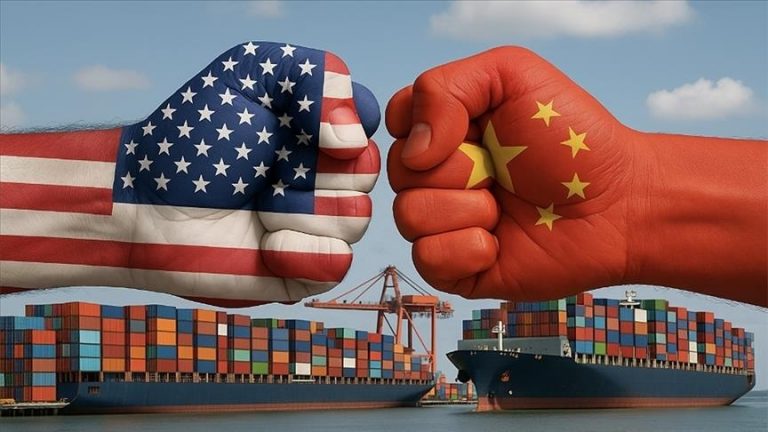
The Trump administration is preparing to impose a new 7.5% tariff on Chinese goods over allegations of excess manufacturing capacity, a move that would raise the effective U.S. tariff burden on Chinese imports to about 20% ahead of a planned September meeting between President Donald Trump and Chinese President Xi Jinping.
Bloomberg reported, citing people familiar with the matter, that the proposal would allow Washington to revive part of Trump’s broader protectionist trade agenda while keeping additional duties on Chinese goods within a ceiling that Beijing has previously indicated it could accept under the current U.S.-China trade truce.
The exact rate has not been finalized, however, and the administration could still change the structure or timing of the measure. One option under consideration is to announce a higher tariff and suspend part of it, leaving an effective additional duty of 7.5%, according to one person familiar with the discussions.
Register for the next Tekedia Mini-MBA.
Register for Tekedia AI in Business Masterclass.
Join Tekedia Capital Syndicate and co-invest in great global startups.
The proposed action would come at a sensitive moment in U.S.-China relations. Trump and Xi are expected to meet in Washington on September 24, while the current one-year trade truce between the world’s two largest economies is due to expire on November 10.
The two governments are also negotiating an extension of the agreement, making the proposed tariff a potentially important bargaining tool ahead of the summit.
The key issue for Beijing is whether Washington will respect the tariff ceiling discussed during previous negotiations. China has previously said the U.S. agreed to limit additional tariffs on Chinese exports to 20%.

“We hope that the US will honor its commitments, ensuring that regardless of the reasons given for imposing or replacing tariffs on China in the future, US tariffs on China will not exceed the levels outlined in the Kuala Lumpur trade consultations,” China’s Ministry of Commerce said in May.
The proposed 7.5% measure is tied to a U.S. investigation into excess manufacturing capacity in China and other major trading partners.
The Trump administration launched the Section 301 investigation in March, targeting more than a dozen economies over concerns that government support and industrial policies have resulted in excess production that can flood international markets with subsidized goods.

The issue has become bold in the U.S.-China trade relationship as Chinese manufacturers expand production in sectors ranging from electric vehicles and batteries to solar equipment, steel and other industrial goods.
Washington states that China’s excess capacity can weaken U.S. manufacturers by allowing Chinese companies to sell goods at prices that American producers struggle to match.
The investigation is also part of a broader effort by the Trump administration to construct a new legal foundation for tariffs after the Supreme Court struck down Trump’s earlier global levies imposed under the International Emergency Economic Powers Act.
The ruling forced the administration to search for alternative legal mechanisms to maintain many of its trade restrictions.
Section 301 of the Trade Act of 1974 gives the U.S. Trade Representative authority, under presidential direction, to impose tariffs or other measures in response to foreign trade practices that Washington determines are discriminatory or inconsistent with U.S. rights under international trade agreements.
The administration is now using investigations into issues such as forced labor and industrial overcapacity as the basis for new tariffs.
Washington imposed a 12.5% tariff on Chinese goods in July, citing China’s efforts to address forced labor concerns. Beijing criticized the measure but did not immediately retaliate, instead pointing to the 20% ceiling it said had been agreed during earlier negotiations.
The potential new tariff would therefore take the effective second-term tariff burden on Chinese imports back toward that level. That would represent a significant distinction in Trump’s approach to China compared with his treatment of some traditional U.S. allies.
While Washington has so far sought to preserve its tariff truce with Beijing, the administration has imposed a 50% tariff on billions of dollars of Canadian goods and has raised the possibility of abandoning the North American trade agreement negotiated during Trump’s first term.
The potential tariff also comes as Washington attempts to use trade policy to address what it sees as a structural imbalance in global manufacturing.
China’s enormous industrial base has made it a dominant supplier in several strategic industries. The United States and its allies see that capacity not only as an economic challenge but as a national security concern, especially in sectors considered important to the energy transition, advanced manufacturing and technology.
The legal basis for the new tariffs could nevertheless become another source of uncertainty.
A coalition of 25 states, including New York, California and Illinois, filed a lawsuit earlier this month at the U.S. Court of International Trade challenging the administration’s use of Section 301. The states argue that Trump is improperly using the forced-labour rationale to recreate tariffs that were struck down by the Supreme Court. Small businesses have also brought legal challenges against the administration’s tariff programme.
The White House has maintained that the Section 301 tariffs are legally valid and supported by previous court decisions.
The administration has not confirmed the proposed China tariff. A White House official said any tariff announcements would come directly from the administration and dismissed reports about planned measures as speculation. The Office of the U.S. Trade Representative and China’s Ministry of Commerce did not immediately comment.
The uncertainty is likely to persist until the administration completes its excess-capacity investigation.
U.S. Trade Representative Jamieson Greer said in July that the investigation would take longer than a separate probe into forced labor because of its complexity. Administration officials are nevertheless seeking to publish the findings before Trump’s expected September 24 meeting with Xi.
That timing gives the proposed tariff broader significance than its headline rate suggests.
Trump appears to be trying to rebuild his tariff regime on a more durable legal foundation while avoiding a renewed escalation that could jeopardize the fragile trade truce with Beijing. A 7.5% effective increase would allow him to maintain pressure on China over industrial overcapacity while keeping the overall burden near the 20% threshold Beijing has previously accepted.
The calculation is believed to be more difficult for Xi because Beijing has an incentive to preserve the trade truce, particularly as both economies remain exposed to the consequences of a renewed tariff escalation. But another U.S. tariff tied to China’s industrial capacity could also bolster Beijing’s view that Washington is attempting to constrain China’s manufacturing rise.
The September summit could therefore become a critical test of whether the two sides can separate their broader strategic rivalry from the immediate need to manage trade.
However, the biggest issue for markets and businesses may not be whether the additional tariff is exactly 7.5%. It is whether Washington and Beijing can establish a predictable framework for tariffs before the current truce expires in November.
Analysts are projecting two potential outcomes: If the administration proceeds with the measure while maintaining the 20% ceiling, the result would be a controlled escalation rather than a return to the tariff war that defined much of Trump’s first term. But if negotiations break down, however, the proposed tariff could become the starting point for another round of retaliation, supply-chain disruption, and higher costs for businesses on both sides of the Pacific.