

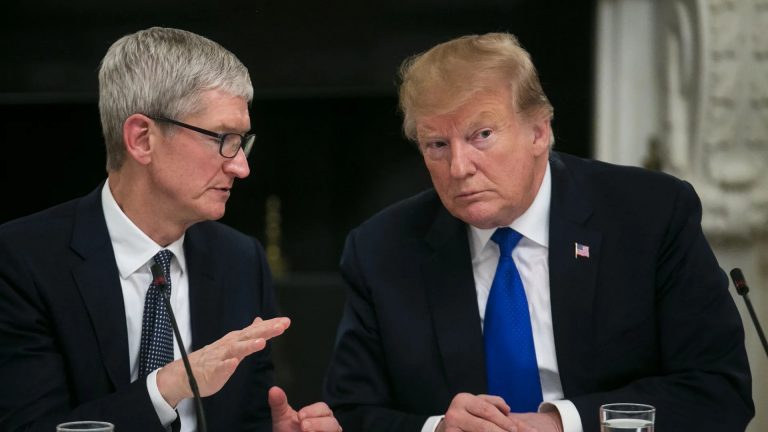
President Donald Trump on Friday ramped up pressure on Apple and other smartphone makers, demanding they move production of their devices to the United States or face a crippling 25% tariff.
In a post on his social media platform Truth Social, Trump warned, “I expect their iPhones that will be sold in the United States of America will be manufactured and built in the United States, not India, or anyplace else. If that is not the case, a Tariff of at least 25% must be paid by Apple to the U.S.”
But the fallout from that post was swift and far-reaching—financial markets trembled, Apple shares nosedived 3.6% in premarket trading, and the broader S&P 500 index fell 1.5%. European markets also stumbled, reacting not only to the Apple threat but to another salvo from Trump: a proposed 50% tariff on European Union goods beginning June 1.
Register for Tekedia Mini-MBA edition 20 (June 8 – Sept 5, 2026).
Register for Tekedia AI in Business Masterclass.
Join Tekedia Capital Syndicate and co-invest in great global startups.
Register for Tekedia AI Lab.
“Trump just threatened to impose 50% tariffs on imports from Europe, much higher than what Americans pay to import goods from China. The skeptic in me thinks this is just market manipulation, giving insiders opportunities to trade before the tariffs are called off with a fake win,” said Peter Schiff, Chief Economist and Global Strategist at Euro Pacific.
Schiff’s comments echo a growing suspicion among investors, analysts, and some former officials that Trump’s aggressive trade posturing is not just economic policy—it’s a deliberate tactic to jolt markets, drive panic selling, and let allies or insiders capitalize on wild swings.
Familiar Playbook
The theory is not new. Just last month, Trump launched a sweeping round of tariff threats targeting multiple countries—including China, Mexico, Canada, Vietnam, and the EU—causing global stock markets to plunge. The S&P 500 dropped nearly 14% in four days, wiping out over $5.7 trillion in value.

Then, without warning, Trump declared on Truth Social: “THIS IS A GREAT TIME TO BUY!!! DJT.”
Less than four hours later, he announced a 90-day suspension of nearly all the tariffs he had just imposed. Markets roared back, with the S&P 500 closing the day up 9.5%, recovering around $4 trillion in lost value. Investors who had bought the dip immediately after Trump’s post saw massive returns—raising questions about who had advance knowledge of the president’s plans.
“It was a prescient call by the president,” said Richard Painter, a former White House ethics lawyer and vocal Trump critic. “Maybe too prescient.”

Painter warned that while presidents are allowed to speak about policy, there are legal limits to using that information for financial gain.
“He’s loving this, this control over markets, but he better be careful. Securities law prohibits trading on insider information or helping others do so,” he said. “The people who bought when they saw that post made a lot of money.”
Behind the Tariff Threat
Trump’s latest clash with Apple comes amid growing frustration over the company’s decision to shift manufacturing to India. On Apple’s recent earnings call, CEO Tim Cook said he expects “the majority of iPhones sold in the US will have India as their country of origin.” Trump, who met Cook last week in Riyadh, scolded him for the move.
“I had a little problem with Tim Cook,” Trump said in Qatar. “I said to him, ‘Tim, you’re my friend. I treated you very good. You’re coming in with $500 billion.’ But now I hear you’re building all over India. I don’t want you building in India.”
The president reiterated his demand on Friday, telling reporters in the Oval Office after signing executive orders that the tariff would extend beyond Apple.
“It would be more. It would be also Samsung and anybody that makes that product,” he said. “Otherwise it wouldn’t be fair.”
Samsung, however, has largely pulled out of China, having shuttered its final phone plant there in 2019. Most of its smartphone assembly is now spread across South Korea, Vietnam, India, and Brazil. Apple, on the other hand, still relies heavily on China, with about 90% of its iPhones assembled there, according to estimates by Wedbush Securities.
Cook, who also met with Trump at the White House on Tuesday, has not commented publicly on the president’s ultimatum. Apple, which recently began sourcing some of its chips from a TSMC plant in Arizona, remains tight-lipped about how the tariff threat will affect its supply chain.
According to Cook, Apple already expected up to $900 million in tariff burdens this quarter. That figure may balloon significantly if Trump follows through on the 25% levy.
Trump’s threats are now reaching beyond individual companies or trade policy. Analysts warn they are beginning to resemble a larger strategy of chaos-driven market manipulation. The dramatic rise-and-fall pattern, from public threats to abrupt reversals, has prompted concern that financial markets are being used as levers for political or personal gain.