

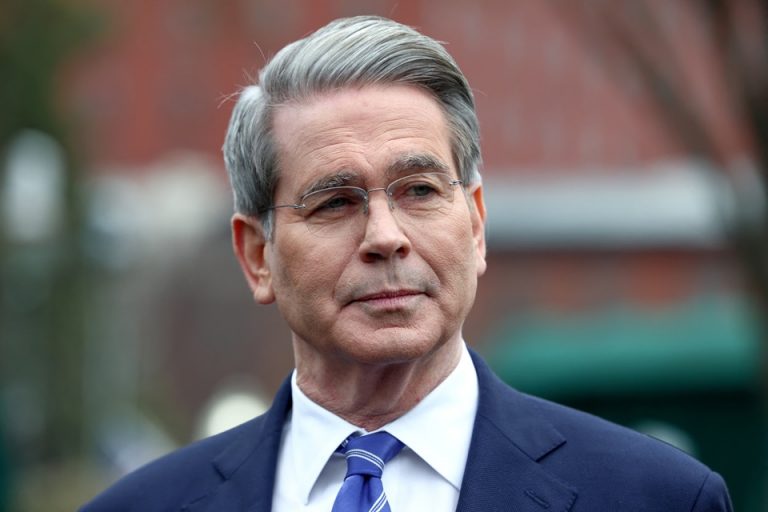
Treasury Secretary Scott Bessent projected confidence in America’s economic foundations on Tuesday, insisting that the underlying U.S. economy remains strong and that annual growth could still surpass 3 percent or even reach 3.5 percent this year, even as the U.S.-Israeli war with Iran continues to roil energy markets and unsettle global forecasts.
Speaking at the WSJ Opinion Live event in Washington, Bessent pushed back against recent downgrades from international institutions, framing them as an overreaction to temporary shocks stemming from elevated oil prices and supply disruptions.
“I think the underlying economy remains strong,” Bessent said. “I do think that the growth could easily exceed 3%, 3.5% this year, still.”
Register for the next Tekedia Mini-MBA.
Register for Tekedia AI in Business Masterclass.
Join Tekedia Capital Syndicate and co-invest in great global startups.
His remarks come amid fresh turbulence triggered by the conflict that erupted in late February. The fighting has driven oil prices sharply higher, with Brent crude trading above $100 per barrel, prompting the United States to enforce a blockade of Iranian ports and shipping routes through the Strait of Hormuz. That narrow waterway, through which roughly 20 percent of global oil and natural gas exports flowed before the war, has become a focal point of volatility, tightening supplies, and amplifying inflationary pressures worldwide.
Bessent cast the International Monetary Fund’s decision on Tuesday to cut its 2026 global growth outlook—now pegged at 3.1 percent in its baseline scenario, assuming a relatively short-lived conflict—as overly pessimistic. The IMF cited energy price spikes and Hormuz-related disruptions as key factors, warning that a more adverse scenario could see world growth slow to 2.5 percent or lower, potentially pushing the global economy toward recession if hostilities drag on.
The World Bank has similarly revised its projections upward for inflation risks. Bessent, however, maintained that such adjustments underestimate the durability of U.S. domestic momentum and the market’s capacity to adapt, pointing to a well-supplied oil environment beyond the immediate Gulf disruptions.

The administration has already signaled pragmatic steps to ease price pressures, including earlier considerations of lifting sanctions on Iranian oil already at sea, potentially releasing up to 140 million barrels, or roughly 10 to 14 days of global supply, to prevent excessive tightening.
Bessent has emphasized that the oil market itself is adequately supplied when accounting for floating cargoes and alternative sources, suggesting that any short-term volatility will give way to longer-term stability once the conflict resolves.
On the trade front, Bessent addressed the future of U.S. tariffs following the Supreme Court’s February ruling that President Donald Trump had overstepped his authority by imposing sweeping duties under the International Emergency Economic Powers Act (IEEPA). The decision struck down those emergency-based tariffs, forcing a reset in the administration’s trade toolkit. Bessent indicated that equivalent measures could soon return through alternative legal avenues, such as investigations under Section 301 of the Trade Act of 1974.

“The tariff could be back in place at the previous level by beginning of July,” he said, referring to options the Trump administration is actively pursuing.
This timeline would allow the White House to reimpose targeted or broader duties after completing required probes, restoring leverage in ongoing negotiations with trading partners while sidestepping the legal constraints highlighted by the Court. The move fits into a broader strategy of using trade policy to address perceived imbalances, even as the Iran conflict adds another layer of complexity to global supply chains and inflation dynamics.
Bessent’s upbeat assessment contrasts with the cautionary tone from multilateral bodies, yet it aligns with the administration’s emphasis on American economic strength as a buffer against external shocks. Domestic indicators, ranging from steady consumer spending to a resilient labor market, provide some support for his view that the United States can weather the energy-driven headwinds better than more import-dependent economies.
Still, prolonged closure or restricted access through the Strait of Hormuz risks feeding higher gasoline prices and broader cost pressures that could eventually test consumer confidence and corporate margins.
By downplaying the IMF’s revisions and reaffirming a path to solid growth, Bessent sought to project steadiness at a moment when markets remain sensitive to developments in the Middle East. His comments also preview a more assertive trade posture later this year, blending fiscal optimism with a determination to reassert tariff tools as a core element of economic statecraft.