

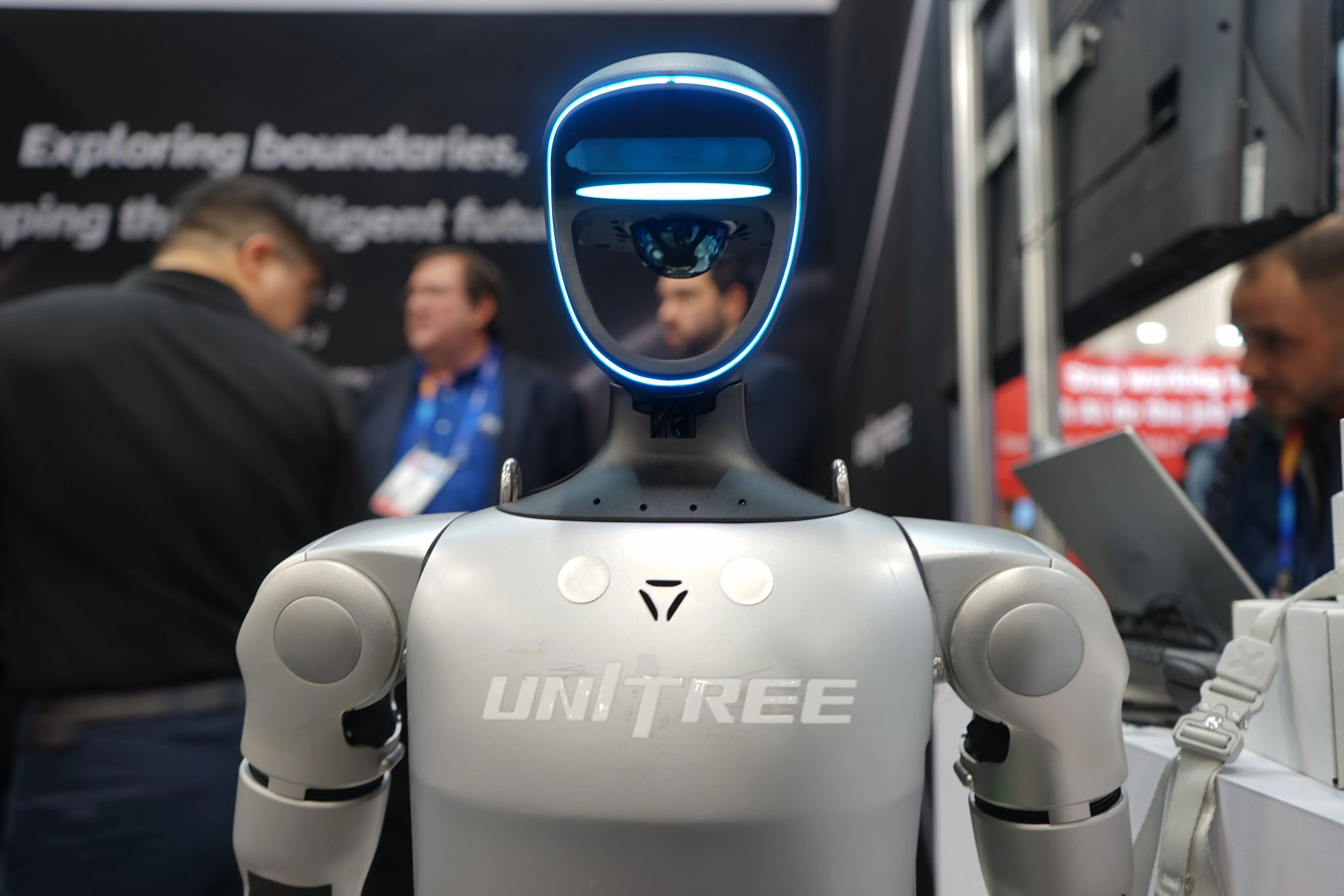
Unitree, China’s best-known humanoid robot maker, has lost roughly 45% of its market value since a spectacular Shanghai debut, raising fresh concerns about speculative excess, retail investor losses, and the way China prices high-profile technology IPOs.
The sharp reversal has wiped about $30 billion from Unitree’s valuation after the company briefly reached roughly $66 billion following its listing on the Shanghai Stock Exchange’s STAR Market. The stock surged more than fivefold on its first trading day last Wednesday before falling for three consecutive sessions.
The volatility has turned Unitree’s debut into a test of whether investor enthusiasm for artificial intelligence and robotics is running significantly ahead of the industry’s commercial fundamentals.
Register for the next Tekedia Mini-MBA.
Register for Tekedia AI in Business Masterclass.
Join Tekedia Capital Syndicate and co-invest in great global startups.
The company’s plunge is reverberating because Unitree had emerged as one of the most visible symbols of China’s ambition to establish global leadership in humanoid and quadruped robotics. Its robots have attracted international attention for running, dancing and performing martial arts, but the company has yet to demonstrate commercial adoption on a scale that would readily support its post-listing valuation.
“Investors were carried away by the technology revolution narrative,” said Dong Baozhen, chairman of Beijing-based asset manager Lingtong Shengtai. “All bubbles are doomed to burst.”
Unitree shares stabilized on Tuesday after the three-day selloff, but the episode has already raised questions about whether China’s capital markets are capable of supporting strategic technology companies without fueling excessive speculation.

The concern extends beyond Unitree. Its debut was expected to provide a benchmark for other Chinese robotics companies preparing to list as Beijing encourages investment in industries considered strategically important to the country’s technological self-sufficiency.
The contrast between Unitree’s stock-market performance and its underlying financial results has made the valuation debate acute. According to its prospectus, the company’s adjusted net profit fell 53% year-on-year to 40 million yuan ($5.95 million) in the first three months of 2026.
Its spectacular debut also far exceeded the broader performance of China’s IPO market. Unitree shares finished their first trading day 460% above the offer price, compared with an average first-day gain of 226% for newly listed Chinese companies over the past three years.

That gap has prompted some investors and market participants to question whether the IPO price accurately captured demand for the company or whether trading after the listing became detached from fundamentals.
Abraham Zhang, chairman of venture capital firm China Europe Capital, said Unitree’s debut was “not fueled by a rosy prospect,” but by attempts to push the stock higher before selling at elevated prices.
The development has also reignited debate over China’s IPO pricing system. Chinese stock exchanges vet listing candidates and provide guidance on IPO pricing, which can limit the ability of investment banks to adjust offer prices to reflect extreme demand.
When a stock subsequently opens at several times its offering price, the difference can effectively transfer wealth between investors who obtain shares at the IPO and those who buy after trading begins. Unitree’s experience illustrates that problem succinctly. Investors who secured allocations before the listing benefited from the enormous first-day surge, while retail investors who entered during the rally were left exposed when the stock reversed.
“The capital drama seen in the Unitree listing is not the first in China, and will not be the last,” Zhang said.
The structure of China’s equity market can amplify such moves, according to analysts. This is because restricted short-selling makes it harder for investors betting against an overvalued stock to exert immediate downward pressure, while strong retail participation can intensify momentum when a popular technology theme captures investors’ attention.
The STAR Market listing may have added to the enthusiasm. The Shanghai board is designed for technology-intensive companies in areas considered important to China’s industrial and technological development. For investors, a fast-track listing on such a market can be interpreted as an indication that a company has strategic importance to Beijing, even though government support does not guarantee commercial success.
Against that backdrop, Unitree’s IPO became more than a bet on one robotics company. It became a bet on China’s broader strategy to dominate physical AI, in which robots combine advanced software, sensors and increasingly capable AI models to operate in the real world.
That long-term opportunity remains significant, but the industry’s economics are still developing.
“Many robot makers spend a lot on research, but commercial orders are not yet in sight,” said Gao Xingkun, a fund manager at China Southern Asset Management. “It’s not fair if you only look at profit,” he said, arguing that robotics could follow a trajectory similar to China’s electric-vehicle industry, which required years of investment before reaching mass commercial adoption.
Unitree’s challenge is that investors must distinguish between the potential size of the future robotics market and the ability of individual companies to capture that opportunity.
Humanoid robots could eventually find applications in manufacturing, logistics, healthcare and other labor-intensive industries. But the technology remains at an early stage, and many machines are still being deployed primarily for demonstrations, research, and limited industrial applications rather than replacing human workers at scale.
That creates a difficult valuation problem. Investors are attempting to price companies based partly on markets that may take years to develop, leaving share prices vulnerable to abrupt changes in expectations.
Unitree is also facing competition from better-capitalized global players, including Tesla and Hyundai Motor Group-owned Boston Dynamics, as well as a growing group of Chinese robotics startups.
The frenzy surrounding Unitree also follows the blockbuster debut of Chinese memory-chip maker CXMT, whose shares surged 466% on their first trading day last month. Such performances suggest that investor appetite is especially strong for companies positioned at the intersection of national industrial policy and frontier technology.
But China’s tighter regulatory scrutiny has constrained the supply of new listings. Only 21 companies went public in Shanghai during the first seven months of the year, compared with 104 in Hong Kong, according to the report. That limited supply of high-profile technology companies can increase competition among investors for shares in the few companies that reach the market, potentially amplifying first-day price swings.
Therefore, the Unitree situation is telling a story of a broader tension in China’s technology industry: Beijing wants deep pools of domestic capital to finance strategic industries, but excessive speculation can undermine that objective by exposing retail investors to large losses and pushing valuations far beyond companies’ current earnings capacity.
The long-term investment case will ultimately depend less on Unitree’s IPO debut than on its ability to turn technological demonstrations into recurring commercial orders, expand production and improve profitability. Analysts believe that the 45% retreat does not by itself disprove the potential of humanoid robotics. It does, however, show how quickly expectations can detach from operating performance when a new technology becomes the focus of a speculative trade.