

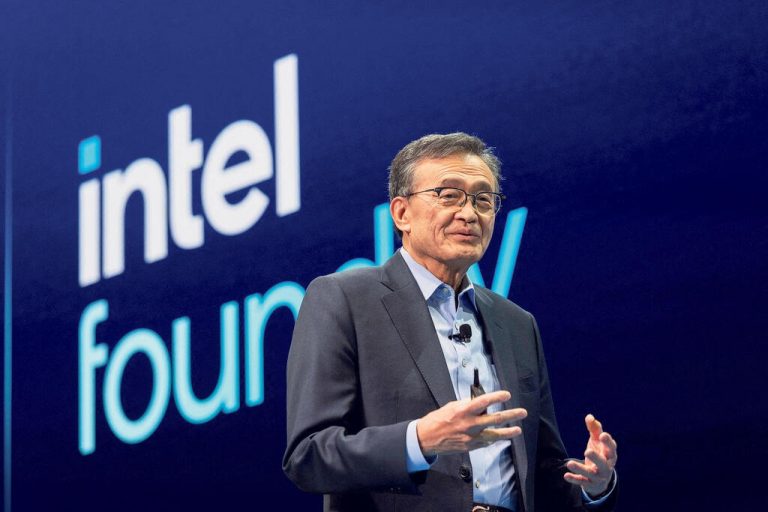
The reported claim that the U.S. government is now up $40 billion on its 10% ownership stake in Intel Corporation (INTC) represents more than a simple mark-to-market gain. It signals a deeper shift in how states may increasingly interact with strategic technology firms in an era where industrial policy, national security, and capital markets are becoming tightly interwoven.
At face value, a $40 billion unrealized gain implies a significant appreciation in Intel’s equity value since the government’s stake was acquired or revalued. Whether this position was established through direct equity injection, structured rescue financing, or a broader industrial policy initiative, the outcome highlights the potential upside of sovereign participation in foundational semiconductor infrastructure.
Intel, as one of the most strategically important chip manufacturers in the world, sits at the center of advanced computing, AI acceleration, defense systems, and global supply chain security. From a fiscal perspective, the gain introduces an unusual but increasingly relevant phenomenon: the state as an active equity investor in critical private-sector technology.
Traditionally, governments intervene in markets through regulation, taxation, subsidies, or procurement. Direct ownership stakes, especially at scale, blur the line between public policy and investment strategy. In this case, the appreciation of the stake effectively functions as a paper windfall for the public balance sheet, potentially offsetting fiscal pressures or funding future industrial initiatives without immediate tax increases or debt issuance.
Register for the next Tekedia Mini-MBA.
Register for Tekedia AI in Business Masterclass.
Join Tekedia Capital Syndicate and co-invest in great global startups.
However, such gains are inherently volatile. Equity value is not realized until liquidation, and semiconductor firms like Intel operate in highly cyclical, capital-intensive markets. Revenue fluctuations tied to global chip demand, manufacturing transitions, and competitive pressure from rivals in the U.S. and Asia can materially alter valuation in relatively short timeframes.
As such, the $40 billion figure should be interpreted as a snapshot of market sentiment and performance rather than a guaranteed fiscal resource. Strategically, the government’s position in Intel reflects broader geopolitical concerns about semiconductor sovereignty. Chips are no longer just commercial products; they are foundational infrastructure for artificial intelligence, military systems, telecommunications, and cloud computing.
A domestic champion like Intel carries strategic weight, particularly as global supply chains remain sensitive to geopolitical fragmentation and export controls. A government stake may therefore function not only as a financial investment but also as a stabilizing mechanism ensuring continuity of domestic production capacity.
The implications for corporate governance are also significant. A 10% government ownership position is large enough to influence board decisions, capital allocation, and long-term strategic planning. While not necessarily conferring outright control, it introduces a stakeholder whose objectives may extend beyond shareholder return maximization. Priorities such as domestic manufacturing resilience, workforce retention, and national security compliance could shape corporate strategy alongside traditional metrics like revenue growth and margin expansion.

Market participants would likely interpret such a stake through a dual lens. On one hand, government backing may be seen as a form of implicit floor support, reducing perceived downside risk in times of stress. On the other hand, it may introduce concerns about policy-driven decision-making, reduced operational flexibility, or distortion of competitive dynamics. Investors typically price these trade-offs into valuation multiples, particularly in sectors where state involvement is material.
More broadly, the reported gain underscores a trend toward the financialization of industrial policy. Governments are no longer only regulators of markets but increasingly participants in them, with exposure to both upside and downside outcomes. If managed effectively, such positions could generate substantial public wealth while reinforcing strategic autonomy. If mismanaged, they could expose public finances to the same volatility that private investors routinely navigate.
The $40 billion gain on Intel stock is less a conclusion than a moment within a longer structural transition. It reflects a world in which semiconductors are strategic assets, capital markets are geopolitical instruments, and governments are increasingly behaving as long-term investors in the technological foundations of the modern economy.
