

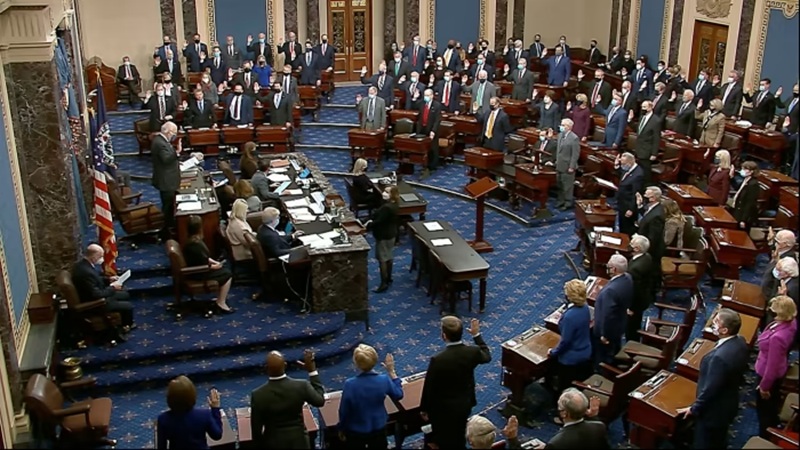
The United States Senate’s approval of legislation to withhold lawmakers’ pay during federal government shutdowns marks a significant symbolic and institutional shift in how Congress is held accountable during budgetary standoffs.
The measure, which targets one of the most politically sensitive optics in Washington, reflects growing public frustration with repeated shutdown episodes and the perception that elected officials remain insulated from the consequences faced by ordinary federal workers. The bill addresses a long-standing structural criticism: during government shutdowns, hundreds of thousands of federal employees are furloughed or forced to work without immediate pay, while members of Congress have continued to receive their salaries without interruption.
Although the U.S. Constitution guarantees congressional compensation through permanent appropriations, the new legislation works within that framework by creating a mechanism to withhold or escrow pay during lapses in government funding.
Supporters of the measure argue that it restores a measure of fairness and moral consistency to the budget process. If Congress fails to meet its most fundamental obligation—passing appropriations bills or a continuing resolution—then lawmakers, too, should experience direct financial consequences. Proponents also frame the bill as a deterrent, designed to increase the political cost of allowing shutdowns to occur in the first place.
Register for the next Tekedia Mini-MBA.
Register for Tekedia AI in Business Masterclass.
Join Tekedia Capital Syndicate and co-invest in great global startups.
In their view, shared sacrifice could incentivize more disciplined negotiations and reduce the frequency of fiscal brinkmanship. Critics, however, caution that the policy is more symbolic than structural. They argue that withholding congressional pay does little to resolve the underlying drivers of shutdowns, which are rooted in partisan conflict over spending priorities, debt limits, and broader ideological disagreements about the size and scope of government.
Some legal scholars also question whether any mechanism that indirectly delays congressional compensation could face constitutional challenges, given the protection of legislative pay under the Constitution’s Compensation Clause. Within the broader political context, the move reflects heightened sensitivity to public perception of governance dysfunction.
Government shutdowns have become increasingly visible and disruptive over the past two decades, affecting air travel, national parks, regulatory agencies, and critical public services. Each episode intensifies scrutiny of Congress and reinforces narratives of institutional gridlock. By targeting their own compensation, senators are attempting to signal accountability without yet resolving the deeper procedural and partisan impasses that cause shutdowns.
The passage of the bill in the Senate also underscores a rare area of bipartisan alignment. Lawmakers from both parties have, at various times, expressed discomfort with the optics of receiving uninterrupted pay while federal employees and contractors face financial uncertainty.

Even so, agreement on symbolic reforms has historically proven easier than consensus on substantive budget policy. If enacted by the House and signed into law, the legislation would introduce a new precedent in federal governance: tying legislative pay more directly to fiscal responsibility outcomes. While its practical effects may be limited, its political implications are more pronounced.
It signals an acknowledgment within Congress that public trust is eroding and that institutional credibility requires visible, even if modest, reforms. The bill represents less a solution to shutdown politics than a reflection of them. It is an attempt to align incentives and optics in a system where deadlock has become routine. Whether it meaningfully changes behavior in future budget negotiations remains uncertain.