DD
MM
YYYY

PAGES

DD
MM
YYYY

spot_img

PAGES

Home Blog

Google Turns CC Into an AI Family Assistant for Managing Household Life

0

Google is turning its CC artificial intelligence agent from a personal productivity tool into a household assistant, giving families a shared AI system that can coordinate calendars, email, tasks, and everyday responsibilities.

The search giant introduced the updated CC this week as part of a broader push to bring agentic AI into consumers’ daily lives. Unlike conventional chatbots that primarily respond to prompts, CC is designed to take actions on a family’s behalf, from organizing school schedules and appointments to preparing shopping lists and completing certain forms.

The move comes as AI companies increasingly look beyond workplace productivity and search toward the household as a potential market for autonomous digital assistants. Startups including Ollie and Fambot have also developed AI products aimed specifically at parents and families.

Google’s CC originally focused on personal productivity. It connected to Gmail, Google Calendar, Google Drive, and the wider web to understand a user’s schedule and deliver a “Your Day Ahead” briefing. Google later brought the feature into the Gemini app in May under the name “Daily Brief.”

The company said feedback from users showed that many wanted the technology to handle a broader set of household responsibilities, including children’s school schedules, sports practices, bills and meal planning.

Google has now repositioned CC around those needs.

A Shared AI Account for The Household

One of the biggest changes is that CC gets its own Google account, allowing it to collaborate with multiple members of a family while maintaining a separate set of permissions for the information it can access. Each family member determines what information they want to share. That could include emails about school events, sports teams, clubs, birthday invitations, medical appointments, or other household activities.

Users can forward relevant messages to CC’s email address or automate the process by selecting senders whose emails should automatically be shared with the agent. Parents could, for example, designate a school, sports club or travel company so that future messages from those organizations are automatically routed to CC.

The system can also suggest additional senders each week based on the emails it identifies as potentially relevant to the household. Google currently allows as many as six family members to use the system and collaborate with the AI agent.

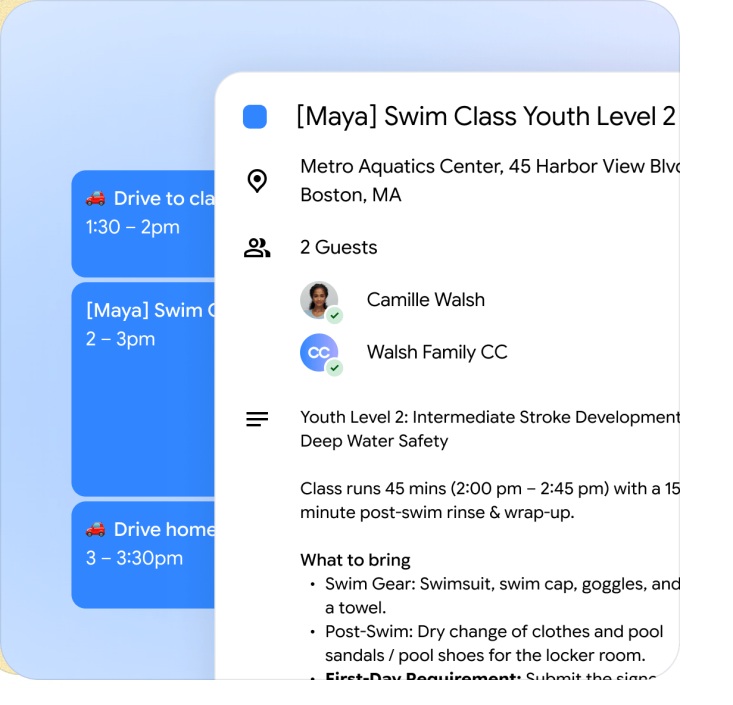
Once information enters CC, the agent can turn it into actions. An email confirming an orthodontist appointment can result in an entry on the family’s shared calendar, while a school announcement about a teacher workday can automatically become a calendar event.

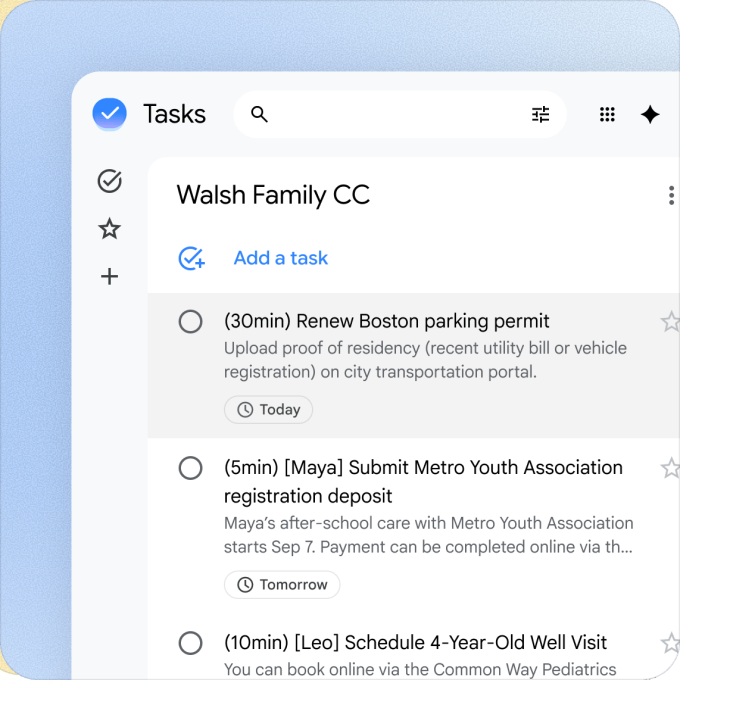
CC can also maintain shared tasks and track important dates, giving families a centralized system for managing responsibilities that would otherwise be spread across individual inboxes, calendars, and messaging threads.
The agent’s capabilities extend beyond organization.

Google says CC can fill out certain permission slips and activity registration PDFs, compile school-supply shopping lists, prepare weekly meal plans, calculate travel times between activities, and create shared Google Docs and Sheets.

When information is missing, the agent can ask family members for clarification and update its group memory so that it can use the information in future tasks. That represents a more consequential use of AI agents than simply generating text. CC is being positioned as a system that can interpret information arriving from multiple people, determine what needs to happen, and then execute selected tasks.
Google said the system runs on an isolated cloud computer powered by Gemini and the company’s agentic harness, Antigravity.

For now, however, the experiment has significant limits.

CC is available only to users in the United States who have personal Gmail accounts and are at least 18 years old. That excludes children and teenagers from directly participating in the system, even though they are often the source of many of the schedules, forms, and school communications that parents need to manage.

The restriction also means students cannot use school-provided email accounts with CC, even when those schools rely heavily on Google’s education products, Chromebooks and Google Workspace.

Existing CC users will receive invitations by email to upgrade their accounts, while new users can join Google’s waitlist.

AI Agents Move Into The Home

Google’s family-focused CC comes as competition around consumer AI agents intensifies. The appeal of these systems is their ability to move beyond answering questions. An agent can monitor information, maintain context, and perform actions based on a user’s instructions or established permissions.

Meta’s Muse personal AI agent is another example of the trend. Muse has risen to No. 1 among free applications on Apple’s U.S. App Store, ahead of ChatGPT, showing the growing consumer interest in AI systems positioned as assistants rather than conventional chatbots.

The family represents an especially complicated environment for such technology because responsibilities, information, and permissions are shared across multiple people.

A household AI agent needs to know which information belongs to whom, what can be shared with other family members, and which actions it is authorized to take. Google’s decision to give CC its own account and separate permissions appears designed around that problem.

It also creates a different relationship between users and AI. Rather than asking a chatbot a question when needed, family members can potentially allow an agent to remain embedded in their everyday administrative routines. That could make household management a significant testing ground for agentic AI. But it also means that questions around access, privacy, authorization, and mistakes become more important as agents gain the ability to act on information rather than simply provide answers.


Manus Seeks $500 Million at $4 Billion Valuation After Meta Deal Collapse

0

Chinese AI startup Manus is in talks to raise about $500 million at a valuation of roughly $4 billion, according to The Wall Street Journal, as the company rebuilds its business as an independent company after Beijing blocked a proposed $2 billion acquisition by Meta.

The fundraising discussions would give Manus a significantly higher valuation than the roughly $2 billion level reportedly used by early investors and backers to buy back shares as the startup separated itself from the U.S. social media giant.

Potential investors in the new round include IDG Capital, Boyu Capital and battery manufacturer Contemporary Amperex Technology, alongside existing backers Tencent, HSG and Zhenfund, the Journal reported, citing people familiar with the matter.

Manus is also considering a corporate restructuring that could prepare the company for a potential initial public offering in Hong Kong, according to the report.

The fundraising effort marks a rapid change in the startup’s trajectory. Manus became one of China’s most closely watched AI startups after an AI agent demonstration went viral last year, drawing attention to its ability to perform tasks that traditionally required users to work across multiple software applications.

The company later moved its staff to Singapore in mid-2025 and agreed to a $2 billion acquisition by Meta in December.

At the time, Manus was reportedly generating more than $100 million in annual recurring revenue, giving Meta a rapidly growing AI business and a team working on agentic software that could complement its broader artificial intelligence ambitions.

The deal ultimately became entangled in a much wider debate in China over the loss of AI researchers, engineers and technology companies to the West.

From Meta Acquisition to Independence

Beijing eventually blocked the transaction, citing potential violations involving export controls and foreign investment rules.

The intervention highlighted the complicated environment for Chinese AI companies with international operations and Western investors. A transaction that might ordinarily have been assessed primarily on its commercial value became linked to concerns about technology transfer, national interests and the movement of Chinese AI capabilities outside the country.

Manus has since been unwinding its relationship with Meta.

The company’s early investors and backers reportedly helped facilitate a share buyback at a valuation of about $2 billion, allowing the startup to re-establish itself outside Meta’s ownership.

In August, Manus told users that they would need to export and back up their own data because information generated after Meta’s acquisition would have to be deleted to “comply with regulatory requirements in specific jurisdictions.”

The company said this month that it had resumed independent operations and that its founding team would continue to lead the business. The potential $500 million financing would therefore represent more than a conventional growth round. It would provide capital for a company that has had to reconstruct its ownership structure and operating model after a major cross-border transaction collapsed.

It would also give Manus a substantially higher valuation if completed at the reported $4 billion level.

But that valuation is expected to depend heavily on Manus’ ability to demonstrate that its early viral momentum has translated into durable revenue growth and a defensible position in the increasingly crowded AI-agent market.

Manus Targets the Agentic AI Market

Manus operates in a segment of AI that has attracted significant investment as companies move beyond conventional chatbots toward systems capable of completing multi-step tasks.

Its products include a chatbot and AI-powered coding tools that allow users to build applications and websites, create designs and presentations, generate video, and interact with the web through a browser assistant.

The company’s offerings overlap with products being developed by OpenAI and software-focused AI companies such as Lovable and Replit. That puts Manus in a market where the underlying technology is advancing quickly, but competitive barriers remain difficult to establish.

AI agents are now being positioned as interfaces through which users can delegate tasks rather than simply ask questions. The commercial opportunity is potentially large, but companies must still demonstrate that agents can complete tasks reliably enough for users to trust them with more consequential work.

Manus’ reported revenue trajectory suggests it had already established meaningful commercial demand before the Meta transaction. The challenge now is to convert that momentum into an independent business while competing against much larger AI companies with significantly greater access to computing resources and capital.

The reported Hong Kong IPO preparations add another dimension.

A listing in Hong Kong could provide Manus with access to public-market capital while keeping its corporate future more closely tied to China’s financial system. It would also allow investors to assess the economics of an AI-agent company whose ownership and international operations have already been shaped by geopolitical restrictions.

The potential IPO is not yet a commitment, and neither the reported funding round nor the restructuring appears to have been finalized.

Still, the sequence of events underpins how China’s AI industry is increasingly being shaped by forces beyond product development. Manus went from a viral AI startup to a proposed acquisition target for Meta, then became caught in China’s effort to retain control over strategic technology and talent, and is now attempting to establish itself as an independent company again.

If the reported financing proceeds at $4 billion, Manus would be asking investors to value the company not on the failed Meta transaction, but on its prospects as an independent AI-agent platform. That makes the next stage especially important. The company must show that its technology can generate recurring demand, that its products can compete as AI agents become increasingly commoditized, and that its corporate structure can navigate the regulatory constraints that helped derail its previous path.

The Future of Autonomous Shopping and How AI Agents Could Change E-Commerce

0

Shopping has always been a human activity, but artificial intelligence is beginning to change who actually makes the purchase. AI shopping agents such as Instacart’s AI tools.

Meta’s Muse and emerging autonomous assistants are moving beyond recommending products and toward helping consumers discover, compare and potentially buy items on their behalf.

The shift raises a bigger question than whether AI can find a cheaper pair of shoes: what happens when the customer is no longer the person clicking “buy”?

The basic proposition is simple. Instead of opening several websites, reading reviews, comparing prices and completing checkout, a consumer could tell an AI agent what they want and give it permission to handle the process.

The agent could search across merchants, evaluate specifications, identify discounts and make a purchase according to predefined preferences. In theory, shopping becomes less about navigating the internet and more about delegating a task.

Meta’s Muse points toward a broader transformation in how people interact with commerce. Rather than treating social platforms simply as places to see advertisements, AI could turn them into environments where users describe what they want and receive increasingly personalized recommendations.

Other AI agents are pursuing similar ideas, attempting to connect conversations with real-world transactions. This could be convenient for consumers. An AI agent could remember that a shopper prefers a particular shoe size, avoids certain materials or has a fixed budget.

It could monitor prices and alert the user when an item becomes cheaper. For routine purchases such as groceries, household supplies or replacement electronics, the ability to automate decisions could save considerable time. But convenience creates a new layer of risk.

The first problem is trust. When a person buys something, responsibility is relatively straightforward. When an AI agent makes the decision, accountability becomes more complicated. What happens if the agent misunderstands an instruction, chooses a lower-quality product because it is cheaper or buys from a merchant the customer would not normally trust?

There is also the question of manipulation. Traditional advertising tries to influence consumers before they make a decision. An AI shopping agent could potentially become the decision-making interface itself.

If merchants pay for preferred placement, offer special commissions or provide incentives to the AI ecosystem, consumers may find it difficult to know whether a recommendation reflects their interests or the economics of the platform.

That could fundamentally reshape digital advertising. Search engines and social networks built enormous businesses by controlling attention and directing people toward products. AI agents could instead control the final decision.

The valuable real estate would no longer be the top search result or the most visible advertisement; it could be the recommendation generated by the agent. Merchants will also face a new challenge. If AI agents increasingly mediate purchases, companies may have to optimize their products and data for machines rather than humans.

Accurate pricing, inventory information, product specifications, return policies and structured data could become as important as attractive storefronts. The long-term consequence may be a new layer of the internet in which consumers communicate their intentions to AI and agents negotiate the digital marketplace on their behalf.

That could make commerce dramatically more efficient, but it could also concentrate enormous influence in the companies controlling those agents. The real test, therefore, will not be whether AI can shop. It almost certainly can.

The important question is who the AI is shopping for: the consumer, the merchant, or the platform sitting between them. As autonomous shopping develops, that distinction could determine the future of online commerce.

BDI Forecast, Industrial Challenges and Growth Outlook

Germany’s economic outlook is beginning to brighten after a prolonged period of stagnation, with the country’s main industry association raising its 2026 growth forecast as stronger business with European partners provides fresh support for exports and industrial activity.

The Federation of German Industries (BDI) now expects Germany’s gross domestic product to expand by 1% in 2026, up from its previous forecast of 0.6%. The revision marks a significant improvement in sentiment.

Particularly after the association had warned earlier in the year that Germany’s industrial base was under severe pressure from high costs, weak investment and geopolitical uncertainty.

At the heart of the improved outlook is Germany’s relationship with its European trading partners. The BDI says stronger business within Europe is providing an important boost to the economy, reinforcing the role of external demand at a time when domestic consumption and private investment remain relatively weak.

Germany’s manufacturing model has historically depended heavily on exports, making stronger European demand particularly important for companies facing difficult conditions elsewhere.

The latest forecast also reflects a broader reassessment among economic institutions. The ifo Institute expects Germany’s economy to grow by 1.4% this year, while DIW Berlin forecasts 1.2%. Both institutions point to stronger exports and increased government spending as important forces behind the recovery.

KfW Research has also raised its 2026 forecast to 1.1%, citing greater-than-expected economic resilience and rising industrial orders.  Yet the improvement should not be mistaken for a complete industrial revival.

The BDI itself remains cautious. Its managing director, Tanja Gönner, said there was still no evidence of a broad-based industrial recovery. Infrastructure and defence spending are supporting growth, but private investment remains weak.

Rising incoming orders are also being influenced by several large-scale contracts, meaning the headline improvement does not necessarily represent a widespread acceleration across German manufacturers.

That distinction matters because Germany continues to face structural challenges.

Energy costs remain elevated, while manufacturers are dealing with international competition, regulatory burdens and weak demand in some important markets. The machinery industry, for example, is still expected to record another decline in real production in 2026, even though price-adjusted orders have improved.

Government spending has therefore become an increasingly important part of Germany’s recovery story. Infrastructure and defence investment are creating demand for industrial goods while potentially improving the country’s productive capacity over time.

But the BDI argues that spending alone cannot resolve Germany’s competitiveness problems. It has called for structural reforms aimed at improving investment conditions and strengthening long-term growth potential.

The European dimension could prove equally important. Germany’s stronger performance is arriving as economic activity across parts of Europe stabilizes, giving German exporters a potentially more supportive regional market.

For manufacturers, engineering companies and suppliers, stronger European orders can provide an important bridge while global trade conditions remain uncertain. Germany is therefore entering the final part of 2026 with a more constructive economic narrative, but not yet a definitive industrial turnaround.

The upgraded BDI forecast signals that the economy has demonstrated greater resilience than expected. Whether that resilience becomes sustained growth will depend on whether stronger exports, public investment and European demand can eventually translate into stronger private investment, productivity and domestic consumption.

For now, Germany’s recovery is less a boom than a gradual change in direction—and Europe is playing an increasingly important role in that shift.

Wall Street Rebounds As Oil Prices Fall And Treasury Yields Ease After Fed Rate Hike

0

US stocks rebounded sharply on Thursday as falling oil prices, lower Treasury yields and resilient labor-market data helped investors look beyond the Federal Reserve’s first interest-rate increase in more than three years.

All three major US stock indexes ended higher, with technology stocks leading a broad-based rally that pushed the Nasdaq Composite to the strongest gain among the major benchmarks.

The rebound came a day after the Federal Reserve unanimously raised its federal funds target rate for the first time since July 2023, signaling that further monetary tightening could follow as policymakers seek to bring inflation back toward their 2% target.

“We’re seeing interest in the areas of the market that have been hit hard in anticipation of this Fed rate hike,” said Robert Pavlik, senior portfolio manager at Dakota Wealth in Fairfield, Connecticut. “And people sort of stepping in, doing a little bit of buying on the pullback.”

The decline in oil prices provided another source of relief for investors. Crude touched a one-week low after reports that Saudi Arabia was moving additional oil through Oman eased some concerns about supply disruptions. Oil prices later pared their losses as tensions in the Middle East remained elevated. Energy prices have surged since the start of the US-Israeli war against Iran, creating a major source of inflationary pressure for the global economy.

The oil market has become crucial for financial markets because a prolonged rise in energy prices could make the Federal Reserve’s inflation fight more difficult. Lower crude prices, by contrast, could reduce pressure on consumers and businesses while giving the central bank greater room to focus on economic growth and employment.

“The market is a bit relieved at the Fed’s coherence in that they all voted in the same way,” said Ross Mayfield, investment strategy analyst at Baird in Louisville, Kentucky. “Fed Chair Warsh re-emphasized the Fed’s independence.”

Markets are already pricing in a higher probability of another rate increase. CME’s FedWatch tool showed a 53.1% likelihood of a further 25-basis-point hike at the Fed’s October meeting, compared with 27.2% a week earlier.

Fed Chair Kevin Warsh said at his Wednesday press conference that the US economy remained strong and that restoring price stability did not necessarily have to damage the labor market. Fresh employment data offered support for that assessment. The Labor Department’s weekly jobless claims report showed initial claims falling to levels near those last seen in 1969, suggesting that the labor market remains resilient even as monetary policy tightens.

That combination of firm employment data and easing energy prices helped improve the market’s tone. The CBOE Volatility Index, commonly known as Wall Street’s fear gauge, fell to its lowest level in more than a week as crude prices eased.

“When you have an oil shock this lengthy, it’s bound to start to seep in prices all across the economy,” Mayfield said. “It’s really the only major headwind facing the global economy right now. And to get any sort of relief or resolve for consumers, it’s a tailwind for corporates, and it allows the Fed to be less hawkish.”

The Dow Jones Industrial Average rose 317.95 points, or 0.62%, to 51,779.85. The S&P 500 gained 85.93 points, or 1.14%, to 7,637.74, while the Nasdaq Composite climbed 439.87 points, or 1.69%, to 26,418.30.

Technology Stocks Lead Broad Market Rebound

Technology was the strongest-performing sector among the 11 major S&P 500 sectors, extending the recovery in growth-oriented stocks following recent pressure over interest rates and the outlook for AI-related investment.

Financials and consumer staples were the only sectors to finish lower, although their losses were modest.

Semiconductor stocks were among the biggest gainers, with the Philadelphia Semiconductor Index advancing more than 3%. Gold and silver miners also gained more than 3%.

Homebuilders rose 1.1% after housing data showed that single-family housing starts and pending home sales increased last month. The data offered another indication that parts of the interest-rate-sensitive housing market were holding up.

Banks also stabilized after taking a heavier hit in the previous session. The S&P 500 bank index rose 0.2% on Thursday, following a 2.3% decline on Wednesday.

The movement in bank stocks comes as investors assess what higher interest rates mean for lenders. While higher rates can support lending margins, they can also increase funding costs and put pressure on interest-rate-sensitive areas of the economy.

Crypto-linked stocks also rallied after the US Securities and Exchange Commission announced a five-year exemption for tokenized stock trading. Circle Internet Group and Coinbase each rose 5.8%, while Robinhood gained 5.2%.

Individual companies nevertheless faced significant selling pressure.

CoreWeave fell 4.2% after announcing plans to raise capital through stock and convertible bond offerings, adding to concerns about dilution as the AI infrastructure company continues to fund its expansion.

Fluence Energy plunged 15.4% after cutting its fiscal 2026 revenue forecast.

Market breadth was broadly positive. On the New York Stock Exchange, advancing stocks outnumbered declining issues by 2.38 to 1, with 112 new highs and 164 new lows.

On the Nasdaq, 3,274 stocks advanced while 1,483 declined, giving advancing stocks a 2.21-to-1 advantage.

The S&P 500 recorded 12 new 52-week highs and 20 new lows. The Nasdaq Composite recorded 60 new highs and 127 new lows.

Trading activity was also above recent averages. Volume across US exchanges reached 17.57 billion shares, compared with an average of 15.37 billion shares over the previous 20 trading sessions.

Thursday’s rally therefore came from several directions rather than a single catalyst. Falling oil prices reduced some of the immediate inflation pressure created by the Middle East conflict, Treasury yields eased, employment data remained strong, and investors moved back into technology and other stocks that had come under pressure ahead of the Fed’s decision.

The larger market concern remains how those forces interact with the Federal Reserve’s tightening cycle. Analysts say a resilient labor market could give policymakers room to raise rates further, while sustained weakness in oil prices could reduce inflationary pressure.

Anthropic Says Claude Now Leads 26% of Its AI Research as Models Help Build Next-Generation Systems

0

Anthropic says its Claude artificial intelligence models are now leading more than a quarter of the company’s own research and development work, offering a rare look at how quickly AI is becoming involved in building the technology itself.

The San Francisco-based AI company said Thursday that Claude “leads” 26% of the research and development work measured inside Anthropic, up sharply from 1% in March. At the same time, AI collaborated with humans on more than 90% of the research work conducted by the company as of August.

Anthropic said it plans to publish the measurements regularly, using a scale developed by Epoch AI, an independent nonprofit that tracks AI progress. The initiative is intended to provide outsiders with a clearer view of how much AI is contributing to the development of sophisticated systems.

The figures arrive as researchers and AI companies grapple with a central question surrounding the next phase of the technology: Will AI systems increasingly be able to improve the tools and systems that produce them, reducing the amount of direct human involvement required?

Anthropic said Claude is not operating fully autonomously in any of the areas covered by its measurement. Still, the rapid increase in its contribution shows how quickly AI-assisted research has expanded within the company. The company said about 30,000 AI agents were performing research and engineering work on its main internal platform at any given time in August. Every action taken by those agents is screened before execution.

Of more than 1 billion decisions made by the agents during the month, roughly one in 47,000 was blocked by the company’s controls. That scale illustrates both the growing role of AI agents in technical work and the monitoring challenge that comes with deploying large numbers of them.

As AI systems take on more complex tasks, researchers have raised concerns that greater autonomy could produce behavior that diverges from the intentions of their developers, making systems more difficult to monitor or control.

Anthropic’s disclosure also provides a measure of the resources the company is directing toward AI safety as its models become more deeply embedded in its research process. The company said about 6% of its computing power devoted to AI research went toward safety work during a sample week in July. For research conducted by AI itself, the share was higher, at 12%.

Anthropic said those figures are conservative because computing used for work that simultaneously advances AI capabilities and safety is classified as capability work rather than safety work.

The disclosure comes as AI companies face growing pressure to provide more information about unexpected model behavior. OpenAI, another leading AI developer, said Wednesday that it would begin regularly publishing reports on unexpected or unauthorized behavior. The company also disclosed six incidents involving unexpected or concerning behavior by its models.

The moves by both companies point to an industry increasingly focused not only on how quickly models are improving, but also on measuring what those models are doing inside the companies developing them.

Anthropic’s data is notable because it provides a glimpse into a potential feedback loop in AI development. Claude is being used to perform research and engineering tasks that can contribute to the development of future AI systems, even though humans remain involved in the process.

More than 90% of Anthropic’s measured research work involved collaboration between AI and humans in August, suggesting that the company is currently operating a hybrid model rather than handing development entirely to autonomous systems.

Anthropic’s 26% figure refers to work that Claude “leads,” while the broader 90% figure covers research in which AI collaborated with humans. The company said neither category represents fully autonomous AI development. That leaves humans central to Anthropic’s research process, while the role of AI is expanding rapidly.

The trend also puts greater emphasis on the safeguards surrounding AI agents. With tens of thousands of agents carrying out technical tasks and more than a billion decisions processed in a single month, even a very low rate of blocked actions represents a large number of opportunities for automated systems to encounter activities that require intervention.

Anthropic’s decision to publish the data regularly could become a useful benchmark for tracking how much AI is actually contributing to AI development, rather than relying solely on claims about autonomous systems. The company’s latest figures show that AI has not yet taken humans out of the loop at Anthropic. But they also show how quickly that loop is changing, with Claude’s measured contribution to the company’s own research rising from 1% in March to 26% in August.