

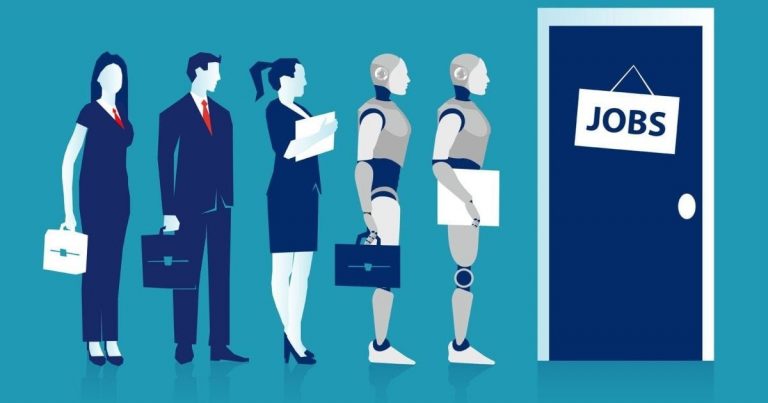
As the global rush to adopt artificial intelligence reshapes corporate priorities, a new trend is emerging: companies that once trimmed staff to cut costs or make room for automation are now bringing many of those workers back.
Fresh data from workplace analytics firm Visier, shared with Axios, shows that organizations are rehiring a rising number of employees they had previously laid off—a reversal that highlights how the practical limits of AI are colliding with boardroom optimism.
Visier analyzed employment data from 2.4 million workers across 142 companies worldwide and found that 5.3 percent of laid-off employees later returned to their former employers. While that rate has been steady for years, it has recently started to tick up—an early sign that automation technologies are not replacing human labor as quickly as many executives once projected.
Register for Tekedia Mini-MBA edition 20 (June 8 – Sept 5, 2026).
Register for Tekedia AI in Business Masterclass.
Join Tekedia Capital Syndicate and co-invest in great global startups.
Register for Tekedia AI Lab.
Andrea Derler, principal at Visier, said the trend reflects a growing realization inside many firms: AI tools are impressive, but they are not yet capable of fully performing or managing complex human work.
She said Artificial Intelligence has been a convenient explanation for layoffs, but not yet an entirely justified one.
That disconnect between promise and performance is now forcing companies to rethink their workforce strategies. While AI-driven agents and digital workflow systems are becoming more common, most have proven to be supplements rather than substitutes for skilled employees. Instead of eliminating positions outright, the technology often automates select tasks—leaving gaps that still require human oversight, judgment, or creativity.

The cost of filling those gaps has been unexpectedly high. Many companies, Derler said, underestimated the true expense of large-scale AI deployment—from acquiring hardware and building secure data infrastructure to training models and ensuring regulatory compliance.
Executives are finding that these investments don’t come cheap, and the timeline for realizing returns is longer than expected, she noted.
According to Techspot, her observation echoes findings from MIT research showing that about 95 percent of organizations have yet to record measurable financial benefits from their AI spending. Steve Sosnick, chief strategist at Interactive Brokers, put it more bluntly, saying: “Maybe all this money is not actually being spent all that wisely.”

This wave of course correction has been amplified by another reality: the hidden costs of layoffs. Data from workforce management firm Orgvue shows that companies spend roughly $1.27 for every $1 saved from workforce reductions, once factors like severance, unemployment benefits, rehiring, and lost productivity are taken into account.
That math is prompting many businesses to rethink the “AI efficiency” narrative that drove mass layoffs in 2023 and early 2024, when companies across sectors—from tech to logistics to finance—shed tens of thousands of jobs citing automation readiness. But as integration challenges mount, some of those same firms are rehiring engineers, analysts, and operations staff to stabilize workflows that AI systems failed to fully replace.
Behind the scenes, many executive teams are discovering that AI projects, far from being plug-and-play solutions, require sustained investment in human capital—data scientists, systems integrators, compliance experts, and experienced staff familiar with the company’s processes. Without that human layer, AI models can underperform, produce inaccurate results, or cause costly disruptions.
Derler said the pattern now confronting many leaders is cyclical: Layoffs bring temporary relief to the balance sheet or appease investors. But as the limits of automation become clear, companies often end up calling back the very people they let go.
That cycle is becoming increasingly visible in industries like customer service, finance, and retail, where firms that replaced human agents with chatbots or AI systems are reinstating staff to handle complex or high-value interactions that automation couldn’t manage effectively.
The message, experts say, is not that AI has failed—but that its economic impact remains uneven and often overestimated in the short term. As organizations race to modernize, the most successful ones may be those that blend automation with human judgment rather than treating the two as substitutes.
In the end, the return of laid-off workers may be less a sign of retreat and more an acknowledgment that the “AI revolution” still needs a distinctly human workforce to run it.