

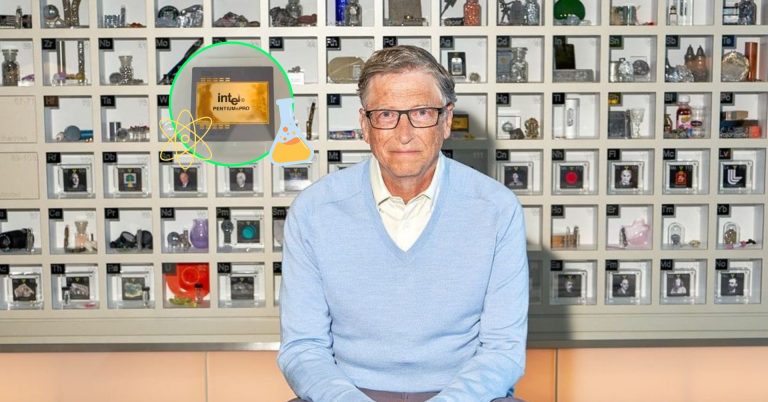
Microsoft co-founder Bill Gates has issued one of his starkest warnings yet about artificial intelligence, stating that the technology is powerful enough to drive events that could harm mankind.
In excerpts from an interview with NBC, Gates said AI is certainly powerful enough to drive events that can cause a billion deaths.
He added that there has never been a weapon as powerful as the combination of people with ill intent using the latest AI tools.
Register for the next Tekedia Mini-MBA.
Register for Tekedia AI in Business Masterclass.
Join Tekedia Capital Syndicate and co-invest in great global startups.
In the interview, he said,
“AI is certainly powerful enough to drive events that, you know, cause a billion deaths. You know, so even though it’s pretty hard to get to 100%, there’s never been a weapon as powerful as the combination of people with ill intent using the latest AI tools.”
“No one thinks self-regulation is enough. You need law enforcement and the politicians to get into the discussion about what safeguards and monitoring look like. And that has to be a required thing. And it will be a little bit of overhead for the industry, but not a dramatic slowing of what they’re doing.”

Gates emphasized that the primary danger lies not in AI independently turning against humanity, but in its potential amplification of harm when placed in malicious hands.
He pointed to the technology’s capacity to enable large-scale cyberattacks, disinformation campaigns, biological threats, and other forms of disruption targeting critical infrastructure such as hospitals, financial systems, power grids, and government networks.
While he noted that reaching complete human extinction remains difficult, the scale of possible casualties from deliberate misuse sets AI apart from previous technologies.

The comments mark a continuation of Gates’ evolving public stance on AI. Recall that last month, the Microsoft founder described the technology as more consequential than nearly any other in history, arguing it could either become the greatest equalizer ever invented or the worst source of injustice.
He has previously highlighted both transformative benefits such as accelerating medical research and improving education and significant risks if development proceeds without adequate guardrails.
On the question of oversight, Gates was clear that voluntary industry self-regulation falls short. “You need law enforcement and the politicians to get into the discussion about what safeguards and monitoring look like,” he said.
“And that has to be a required thing.” He acknowledged that mandatory rules would impose some overhead on AI companies but argued they would not dramatically slow progress.
Gates’ remarks come amid growing calls from other tech leaders for stronger safety measures, including proposals to slow frontier AI development and establish clearer red lines around high-risk applications.
The push for stronger AI safety measures has intensified as frontier models become more capable, autonomous, and difficult to predict.
Anthropic CEO Dario Amodei has called for the industry to “pace the frontier,” arguing that the speed at which AI capabilities are improving is beginning to outstrip the ability of companies and regulators to build adequate safeguards.
His proposal includes independent safety evaluators with access to frontier AI companies, common safety standards across leading developers, and greater international coordination.
OpenAI CEO Sam Altman and xAI CEO Elon Musk have publicly supported the broader idea of slowing or pacing frontier development, although the companies differ on how such measures should be implemented.
OpenAI has also temporarily slowed some scaling work while strengthening monitoring, alignment, and containment safeguards around increasingly capable models.
A central concern is that AI safety measures may not be advancing as quickly as AI capabilities themselves. Researchers and technology executives have pointed to risks involving autonomous AI agents, cyberattacks, fraud, biological and chemical misuse, and systems that could potentially operate with limited human supervision.
However, amid calls for a slowdown to AI development, Nvidia CEO Jensen Huang has questioned the motivations behind some of the more alarming AI predictions, suggesting political interests could drive them, attempts to attract attention, or other undisclosed reasons.
While acknowledging the growing concerns surrounding advanced AI, he maintained that the technology should not be portrayed as an inevitable path toward global catastrophe.
“I completely disagree that AI is going to destroy, or be the end of the world in 2030. I believe the claims of the end of the world, stirring fear across America, and doing it by the people who are doing it, make no sense to me. So they must be doing it for ulterior reasons”, he said.
On the pace of AI development of the technology he stated that it should go as fast as it can irrespective of anybody else.
Looking Ahead
Gates’ warning arrives as governments and industry grapple with how to balance rapid AI advancement against existential and societal risks. His position underscores a shift among some longtime technology optimists toward advocating structured external oversight rather than relying solely on internal corporate policies.
The debate is likely to move beyond broad warnings about AI risk toward specific rules governing what advanced AI systems can do, how they should be tested, and who should be held responsible when they cause harm.
Regulators are increasingly examining requirements for model evaluations, transparency, incident reporting, cybersecurity protections, and human oversight, particularly for systems capable of operating autonomously or being deployed in sensitive sectors.