

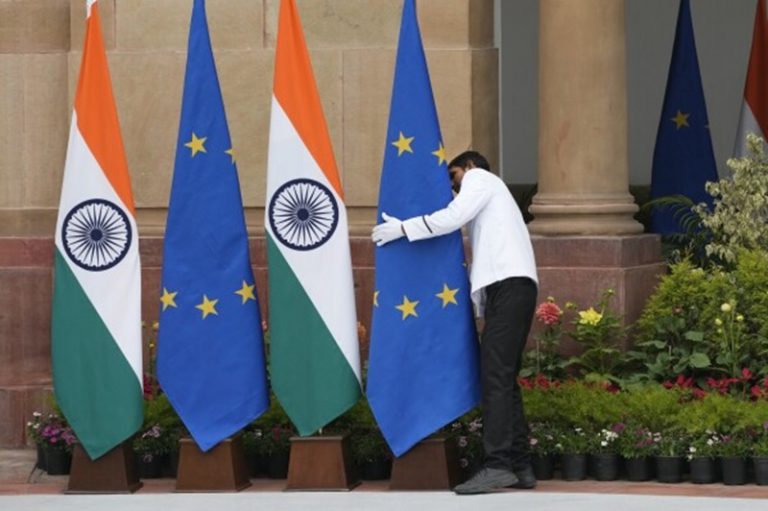
India and the European Union have agreed to grant each other Most Favored Nation (MFN) status for five years after their long-delayed free trade agreement (FTA) takes effect, preventing either side from offering more favorable tariff terms to third countries during that period, according to a draft text released by India’s trade ministry on Friday.
The deal — finalized last month after more than a decade of negotiations — aims to slash tariffs on most goods, double EU exports to India by 2032, and generate annual duty savings of €4 billion ($4.7 billion) for European companies. It covers 96.6% of traded goods by value, eliminating or significantly reducing tariffs on the vast majority of bilateral trade flows.
Key exclusions include agriculture-related items such as soya, beef, sugar, rice, and dairy products, which remain outside the tariff liberalization scope — reflecting sensitivities on both sides regarding farm sectors.
Register for Tekedia Mini-MBA edition 20 (June 8 – Sept 5, 2026).
Register for Tekedia AI in Business Masterclass.
Join Tekedia Capital Syndicate and co-invest in great global startups.
Register for Tekedia AI Lab.
Core Commitments and Implementation Mechanisms
Both sides have locked in commitments to avoid imposing new import or export restrictions beyond existing World Trade Organization (WTO) rules.
The agreement also deepens cooperation on digital trade, customs facilitation, and sustainability:
Customs and Trade Facilitation — Alignment of food safety and plant health measures with WTO standards, streamlined certification and audit procedures, enhanced customs cooperation, and faster clearance of goods. Annual import data exchange will begin one year after entry into force to monitor implementation and tariff preference utilization. Both parties commit to non-discriminatory, accessible appeal procedures for customs decisions affecting imports, exports, or goods in transit.

Digital Trade — Commitments to curb unjustified barriers, promote an open and secure online environment, and recognize electronic contracts, signatures, and authentication. The draft explicitly preserves each side’s authority over personal data protection and cross-border data transfer rules while recognizing privacy as a fundamental right.
Green Transition — The EU will mobilize finance and investment to support India’s greenhouse gas emission reduction efforts, aligning with broader climate cooperation goals.
The agreement is expected to enter into force approximately one year after legislative ratification by both sides.

The Economic Significance
The MFN clause for five years provides mutual assurance against future preferential deals that could undermine the benefits of the agreement. For the EU, the deal opens India’s rapidly growing consumer market — the world’s third-largest economy — while securing better access for European goods in sectors like machinery, pharmaceuticals, automotive components, and chemicals. For India, it offers enhanced export opportunities in textiles, apparel, leather goods, chemicals, and engineering products, while attracting European investment in manufacturing and green technologies.
The exclusion of key agricultural products is believed to underline political realities on both sides: India protects its large farm sector and food security concerns, while the EU safeguards its heavily subsidized agricultural producers.
The India-EU FTA arrives amid heightened global trade tensions, including U.S. tariff actions under President Trump and ongoing disruptions from U.S.-China decoupling. The agreement strengthens India’s position as a “China+1” alternative for European companies seeking diversified supply chains, while giving the EU preferential access to one of the world’s fastest-growing consumer markets.
Both sides have emphasized the deal’s role in promoting economic security and resilience. The digital trade chapter addresses emerging issues like data flows and e-commerce, while the green finance commitment aligns with EU climate goals and India’s net-zero ambitions by 2070.
Implementation and Ratification Outlook
Ratification processes are expected to take 12–18 months. In the EU, the agreement requires approval from the European Parliament and member states. In India, it will need parliamentary endorsement and alignment with domestic regulations. Once in force, annual data exchanges and joint committees will monitor compliance and address implementation issues.
The deal is widely seen as a win-win for both economies: the EU gains market access and supply-chain diversification, while India secures investment, technology transfer, and export growth in non-agricultural sectors. The MFN clause provides a five-year stability window, shielding both sides from third-country preferential deals that could dilute benefits.
Amid accelerating global trade fragmentation, the India-EU FTA stands out as a major counterweight — deepening ties between the world’s largest democracy and the world’s largest single market while promoting rules-based commerce, digital cooperation, and green transition in an increasingly uncertain geopolitical environment. While the exclusion of agriculture underscores the pragmatic limits of liberalization, the agreement’s breadth and ambition signal a new chapter in one of the world’s most consequential economic relationships.