

Adam Smith’s The Wealth of Nations (published in 1776) remains one of the foundational texts of modern economics. It shifted humanity’s understanding of wealth away from merely accumulating gold and treasures toward productivity, labor, specialization, and trade. It introduced enduring concepts such as the Invisible Hand and the Division of Labor.
On the Invisible Hand, Smith argued that individuals pursuing their own self-interest within a free market can unintentionally create broad benefits for society by driving innovation, efficiency, and value creation. On the Division of Labor, he explained that breaking production into specialized tasks dramatically increases productivity and expands overall wealth. He also criticized excessive government interference through tariffs and monopolies, arguing that natural competition often allocates resources more efficiently.
OA Lawal did an exceptional job teaching many of us these ideas through O’Level Economics textbooks. But for me, things evolved when I entered Federal University of Technology Owerri (FUTO) as an undergraduate.
Register for the next Tekedia Mini-MBA.
Register for Tekedia AI in Business Masterclass.
Join Tekedia Capital Syndicate and co-invest in great global startups.
There was a course called Polity and Economy of Nigeria; if memory serves me right, GST 108. Like the Logic and Philosophy course, this one expanded many constructs carried from secondary school. The Professor introduced another variable into the equation: Power. She noted that Nigeria was running a Mixed Economy.
She explained Wealth. Then she explained Power. And somewhere in that lecture came a statement that shocked me: much of Nigeria’s government revenue came not from crude oil, but from taxation and broader economic activities around it. Good People, education truly liberates the mind because great learning rearranges assumptions.
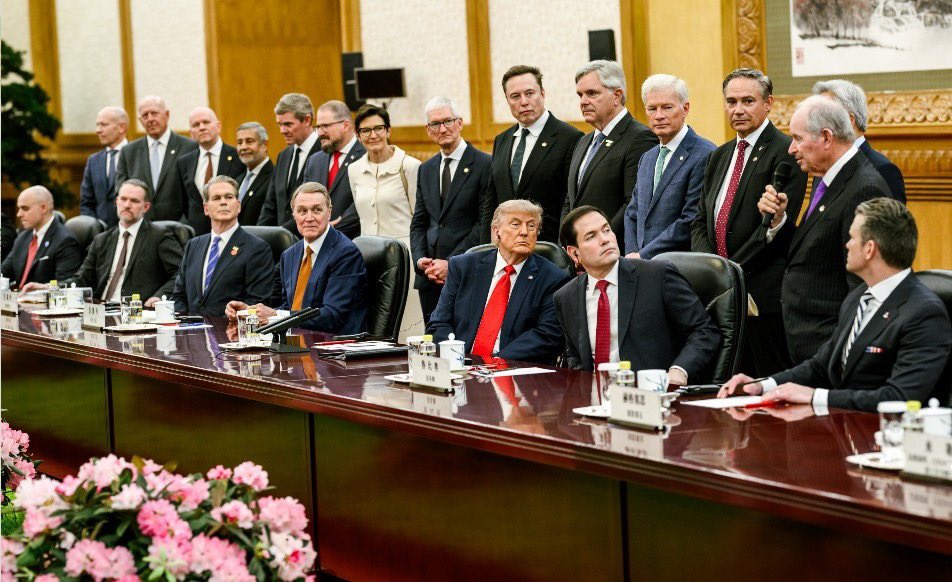
Today, see this photo from Trump’s trip to China; Power vs Wealth. And in many ways, Power appears to win. Power is seated; Wealth is standing. Why? Because Power is concentrated. It commands attention. It can direct resources and shape outcomes rapidly. But political power, especially in a democracy, is often transient. Within a few years, many seated around today’s tables of power may exit those positions.

Wealth behaves differently. Foundational wealth often compounds over decades. It continues producing influence long after political cycles expire. While wealth may not possess the concentrated force of political power at a specific moment, it carries an enduring form of power of its own.
Of course, some individuals possess both Power and Wealth simultaneously.
If I model political power mathematically, I often see a Gaussian curve: it rises, stabilizes briefly, and eventually declines. Wealth, especially productive wealth, can continue compounding over time. Nations therefore require both. Development is rarely driven by Power alone or Wealth alone. The real challenge is optimization: creating a healthy balance where institutions provide direction while wealth creation sustains prosperity.

Because Power has clocks.
But Wealth has time.
---
Connect via my
LinkedIn |
Facebook |
X |
YouTube