DD
MM
YYYY

PAGES

DD
MM
YYYY

spot_img

PAGES

Home Blog Page 107

Bessent Insists U.S. Faces “No Recession Risk” in 2026 as Trump’s Tax and Trade Agenda Phases In

0

U.S. Treasury Secretary Scott Bessent said on Sunday that the United States was not in danger of slipping into recession in 2026, arguing that Americans would soon experience the full gains of the Trump administration’s economic agenda as more provisions of its flagship fiscal package take effect.

In a wide-ranging interview on NBC News’ Meet the Press, Bessent projected confidence about the economy’s direction despite lingering worries over inflation, sluggish housing activity, and the political gridlock that recently froze Washington for more than six weeks.

“I am very, very optimistic on 2026,” he said. “We have set the table for a very strong, noninflationary growth economy.”

His optimism centers on the One Big, Beautiful Bill Act — the GOP’s sweeping spending package — whose remaining provisions continue to roll out. The law locks in President Donald Trump’s 2017 tax cuts permanently and layers additional incentives on top of that structure. It adds a senior “bonus” to offset Social Security taxes, expands the state and local tax deduction, and creates tax breaks on tip income, overtime pay, and auto loans.

Bessent said the economic effects of these components have not yet been fully felt, but will begin showing up in household finances and business investment over the next year.

He also said health-care costs are expected to become more affordable, noting that the administration would have “more news” on that later this week.

A Tension Point: Health-Care Subsidies Still Uncertain

Even as Bessent pledged relief ahead, millions of Americans are bracing for higher health-care expenses due to the congressional impasse over extending enhanced subsidies for the Affordable Care Act marketplace. Lawmakers have not resolved the issue, meaning many households may see their premiums jump.

Bessent acknowledged that parts of the economy remain under strain, particularly housing and other sectors heavily shaped by interest-rate movements. He said the services sector continues to exert upward pressure on inflation, but argued that declining energy prices would help slow price increases in the near term.

Adding to the uncertainty, Kevin Hassett, director of the White House National Economic Council, said on Sunday that fourth-quarter economic data could show weakness because of the 43-day government shutdown. The stalemate — the longest in U.S. history — disrupted federal operations, delayed projects, and added another layer of instability to the economic outlook.

Public Sentiment Cuts Across Income Lines

Despite the administration’s upbeat message, public dissatisfaction remains widespread. A recent NBC News poll found that around two-thirds of registered voters believe the Trump administration has fallen short on handling the economy and cost of living.

Perceptions vary sharply by income. JPMorgan’s latest Cost of Living Survey reported that high-income respondents rated their economic confidence at an average of 6.2 out of 10, with more than half scoring the outlook between 7 and 10. Low-income consumers, however, gave an average rating of 4.4, highlighting the imbalance in how Americans are experiencing inflation, housing costs, and the effects of tighter financial conditions.

However, Bessent’s argument rests on the idea that the Trump administration’s mix of permanent tax cuts, supply-side incentives, and a trade policy reshaped around “America First” priorities will yield stronger, sustainable growth by 2026 without driving a new burst of inflation.

But the short-term picture remains uneven. Capital-intensive sectors are cooling, borrowing remains expensive for homebuyers and small businesses, and the federal government is still processing the financial and logistical fallout of the shutdown.

The administration maintains that as the final elements of the One Big, Beautiful Bill Act filter through the economy, the effects will accumulate — eventually delivering the stronger growth Bessent predicts. Whether Americans feel that improvement, however, remains an open question, and one likely to shape the economic narrative through 2025.

CBN Issues Fresh Capital Computation Order, Ending Weeks of Confusion That Delayed HoldCos’ Earnings

0

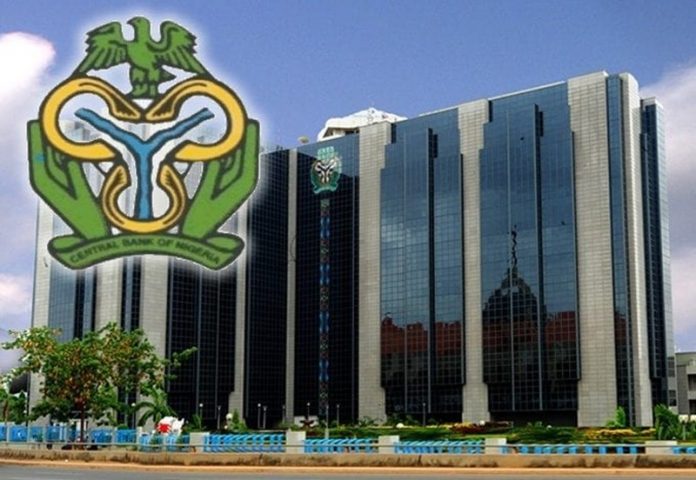
After weeks of anxiety across Nigeria’s financial sector, the Central Bank of Nigeria has stepped in with a decisive clarification on how banks and Financial Holding Companies must calculate their minimum paid-up capital — a move aimed at ending regulatory disputes that had stalled the release of half-year and nine-month financial statements.

In a circular dated November 14, 2025, the CBN ruled that the minimum paid-up capital referenced under Section 7.1 of the 2014 Guidelines for Licensing and Regulation of Financial Holding Companies must be calculated strictly as the par value of issued shares plus any share premium arising from their issuance. The clarification overrides all previous interpretations and takes immediate effect.

The order closes a messy chapter of conflicting internal readings that had split the industry. Some institutions treated minimum capital as strictly paid-up share capital, others added share premiums, and a few even counted reserves or retained earnings — creating discrepancies that frustrated ongoing regulatory reviews.

The circular, signed by the Director of Senior Secondary Education, Hajia Abdulkadir, on behalf of the Minister, stated: “For the purpose of Section 7.1 of the Guidelines, minimum paid-up capital shall be the aggregate of the par value of issued shares and any share premium arising from their issuance. Accordingly, all Financial Holding Companies are required to apply this definition in computing their minimum capital requirement, including those of their subsidiaries, without exception. This directive takes immediate effect, and all previous interpretations that conflict with this position should be discontinued forthwith.”

The dispute over what constitutes minimum capital had grown into a stumbling block during regulatory reviews, according to people with inside knowledge of the matter. Some banks and HoldCos were instructed to reconcile their capital positions before submitting results, delaying approvals of their audited and unaudited earnings.

The confusion arrived at a sensitive moment. With recapitalization deadlines approaching, banks were under pressure to show clean, compliant capital structures. Instead, many found themselves trapped in back-and-forth sessions with examiners, slowing down disclosures and freezing planned communications with investors.

HoldCos in the Spotlight

The directive carries major implications for HoldCos, which were a particular focus of the CBN’s clarification. Under existing rules, a HoldCo must maintain higher issued share capital than the combined capital positions of all its regulated subsidiaries.

In the past, some groups relied on retained earnings or reserves to meet this threshold. The CBN has now wiped that option off the table.

This means several HoldCos may need to adjust their capital structures, halt or reconsider dividend payouts, or rework restructuring plans. Upstreaming of profits — a sensitive point in an era of tight liquidity — may also face new constraints.

The timing of the clarification coincides with the banking sector’s most ambitious recapitalization programme since 2004. New thresholds are already in motion, and regulators want uniformity in how banks report capital to avoid loopholes or creative accounting.

By insisting that only issued shares and share premium count, the CBN is reinforcing its consolidated supervision model. It wants capital to reflect real shareholder contributions — not accumulated profits or accounting reserves that could fluctuate.

What the Numbers Show: FUGAZ Capital Positions Under the New Rule

The strongest banking groups — the FUGAZ banks — hold sizeable capital bases once share premiums are consolidated into the computation.

  • First HoldCo: N20.94bn share capital + N377.10bn premium = N398.04bn
  • UBA: N20.52bn share capital + N329.56bn premium = N350.08bn
  • GTCO: N18.21bn share capital + N489.37bn premium = N507.58bn
  • Access Holdings: N26.66bn share capital + N568.24bn premium = N594.90bn
  • Zenith Bank: N20.54bn share capital + N594.11bn premium = N614.65bn — the largest among the five.

These figures reveal how heavily Nigerian banks have come to rely on share premiums — a product of past capital raises — as buffers in their capital structures.

What This Means

With the new directive now in force, banks and HoldCos are expected to revalidate their capital computations ahead of upcoming filings. Sources say more guidance may follow under the broader recapitalization framework, especially as the CBN moves to streamline capital reporting templates.

The CBN, by this move, aims to reduce regulatory friction, clear the backlog of delayed earnings releases, and ensure a level playing field as banks prepare for the next phase of capital expansion. The new directive means that ambiguity has been removed from the sector, uniform capital reporting has been introduced, and the recapitalization timeline is not slowing down.

U.S. EXIM Bank to Deploy $100bn as Washington Accelerates Global Scramble for Critical Minerals

0

The U.S. Export-Import Bank (EXIM) is preparing to deploy $100 billion to secure supply chains for critical minerals, nuclear energy, and liquefied natural gas across the United States and its allies, the bank’s chair, John Jovanovic, told the Financial Times.

It is one of the most aggressive U.S. financing moves yet in the worldwide competition for strategic resources that underpin both energy security and advanced manufacturing.

Jovanovic said the first wave of projects will land in Egypt, Pakistan, and Europe. He warned that Western economies had become overly dependent on a limited pool of suppliers for essential materials, describing the current situation as “no longer fair”. Stable access to these resources, he said, is central to the industrial and technological ambitions Washington and its partners are pursuing.

“We can’t do anything else that we’re trying to do without these underlying critical raw material supply chains being secure, stable and functioning,” he said.

Congress had authorized $135 billion for EXIM to deploy, leaving $100 billion still available. According to Jovanovic, the bank’s early deals include a credit insurance guarantee for $4 billion worth of natural gas being delivered to Egypt by Hartree Partners and a $1.25 billion loan for Barrick Mining’s Reko Diq project in Pakistan — one of the world’s most significant undeveloped copper and gold deposits.

EXIM did not immediately respond to requests for comment outside regular working hours. But the bank’s strategy aligns closely with President Donald Trump’s energy-dominance agenda. Since taking office, Trump has prioritized expanded domestic energy output, faster project approvals, and the removal of environmental and regulatory constraints — while also backing U.S. companies pursuing strategic resources abroad.

Why Washington Is Rushing to Diversify: The Rare Earth Shock

The U.S. acceleration into critical minerals did not begin with EXIM’s new plan. It traces back to the trade tensions with China, particularly the rare earth episode that reshaped Washington’s thinking.

AS the U.S.–China tariff war intensified, Beijing moved to restrict exports of rare earth elements — a group of 17 minerals essential for military equipment, electric vehicles, semiconductors, missiles, and advanced electronics. China controls the vast majority of global rare earth processing capacity and accounts for more than 80 percent of the supply, giving it unparalleled leverage.

Chinese state media openly described rare earths as a “powerful countermeasure” if negotiations soured, a message widely interpreted as a warning that these minerals could be withdrawn as part of the bargaining toolkit. The threat was never formally executed due to a compromise reached by Chinese President Xi Jinping and his U.S. counterpart Donald Trump last month, but it landed with full force in Washington. The Pentagon, the White House, and major industries saw it as a clear demonstration of how vulnerable the U.S. had become.

That moment triggered a sweeping effort to diversify supply chains. The U.S. began backing mining and processing projects in Australia, Canada, Africa, and parts of Latin America; supporting domestic processing initiatives; and reclassifying several minerals as vital to national security. It also expanded cooperation with Japan and the European Union around non-Chinese sources of lithium, cobalt, nickel, and rare earth elements.

The EXIM initiative is now one of the strongest financial arms of that diversification mission.

The countries chosen for EXIM’s first tranche reflect regions Washington considers both strategic and urgent.

Egypt remains a major LNG importer, and the $4 billion Hartree-backed supply guarantee is expected to stabilize its energy balance at a time of rising domestic shortages. Pakistan’s Reko Diq mine is viewed as a valuable asset in reducing global reliance on dominant suppliers of copper — a metal expected to face huge demand pressure due to electrification and battery technologies. Europe, reshaping its energy landscape after recent supply disruptions, is also a priority partner in the broader mineral diversification push.

A New Phase in U.S. Strategy

The EXIM programme, with $100 billion still available for deployment, is set to influence investment flows for years. Washington is now leaning heavily on state-backed financing to reshape the global supply chain map — ensuring that minerals, nuclear technology inputs, and LNG remain accessible to U.S. industries and allied economies.

By moving aggressively, the U.S. aims to avoid any repeat of the rare earth scare, where a single country’s dominance threatened to upend entire sectors. The message embedded in this new wave of financing is that securing critical resources is central to America’s industrial strategy and geopolitical posture.

What Will Ozak AI Be Worth by 2030? A Deep Analysis of Its Utility, Tokenomics, and Growth Strategy

0

An analysis of three sectors of Ozak AI sheds light on what $OZ can be worth in 2030. These are its utility, tokenomics, and growth strategy. A rough estimate hints at the possibility of reaching 8; however, it could go as high as $10. This would be a 10,000x ROI from the initial value and a 714x ROI from the current value.

Utility and Tokenomics of Ozak AI

Both the departments of Ozak AI are worth noting together. They are fueling massive growth potential of $OZ.

The utility of the token encompasses practical aspects of being in a community. Holders of the Ozak AI token can participate in governance and staking activities. Both position them at the center to further assist them in contributing to the expansion of the ecosystem.

Holding $OZ also grants community members exclusive access to Ozak AI’s AI-powered agents and auto-optimization yield mechanism.

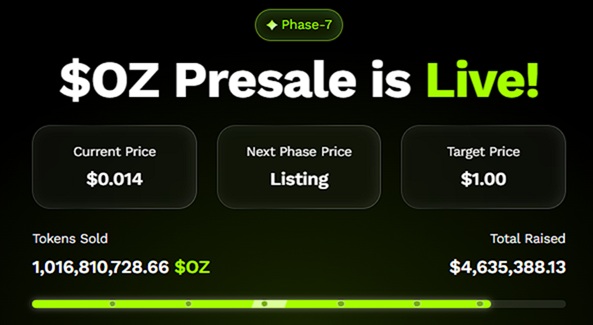
Its tokenomics has been crafted meticulously to ensure that the total supply of 10 billion tokens is distributed efficiently. The presale phase has been allocated 3 billion tokens, or 30% of the total supply. As of now, slightly over 1 billion $OZ tokens have been sold, with Phase 7 ongoing.

Ecosystem & Community have the same share of 30% to their names. Future Reserve has been allocated 20%, or 2 billion tokens. Team has received 10% of the total supply. Liquidity & Listings has received 1 billion tokens, or 10%.

Growth Strategy of Ozak AI

The growth strategy of Ozak AI mainly relies on strengthening or upgrading its technical components. Network security is backed by Certik and Sherlock through frequent audits. Their technical integration helps to identify and address smart contract vulnerabilities. Cross-chain functionality enables automation, optimization, and access to smart analytics.

DePIN stands out because it, first, secures the data structure from malicious manipulation or tampering. It then helps to orchestrate payments, work, and staking using Ozak AI Contracts, which run on a smart contract execution layer.

Market Recognizing Ozak AI’s Efforts

The market has started to recognize the efforts of the AI-powered crypto project. Some of them have even joined hands with Ozak AI to carry forward its operations seamlessly. An association with Meganet was announced earlier in October and proves the point. The partnership aims to work on saving costs for AI processes and jointly undertake community projects.

At the heart of the collaboration is their intention of creating a computing capability that can provide financial insights to the community in real time. The capability is being architected to remain efficient and distributed. Meganet has even agreed to contribute with its node-based bandwidth sharing. Thereby marking a significant mutual strategic advancement with Ozak AI.

$OZ in 2030

An analysis of Ozak AI’s utility, tokenomics, and growth strategy helps to understand that it has the potential to reach $10. It could alternatively hover around $8. Nevertheless, both will mark massive strides from the current value of $0.0014 and the initial offer value of $0.001.


For more information about Ozak AI, visit the links below:

Website: https://ozak.ai/

Twitter/X: https://x.com/OzakAGI

Telegram: https://t.me/OzakAGI

DOGE & Pepe Forecast Strength, But Ozak AI’s 2026 Outlook Appears More Promising

0

Dogecoin and Pepe maintain to expose robust momentum as meme-coin sentiment heats up beforehand of 2026, with both properties leaning on powerful groups and viral traction to fuel clean rallies. Their upside ability stays substantial, but analysts note that their growth nonetheless depends closely on social media traits and market hype rather than long-term technological price

Ozak AI, by contrast, is drawing far stronger long-term forecasts thanks to its early-stage position, rapidly expanding AI ecosystem, and utility-driven architecture powered by high-speed prediction agents, real-time blockchain analytics, and advanced AI partnerships. With presale demand accelerating and its tech stack positioned for real-world adoption, Ozak AI’s 2026 outlook appears far more promising than sentiment-driven meme coins, giving it the kind of structural advantage that supports exponential, sustainable growth.

DOGE & Pepe Forecast

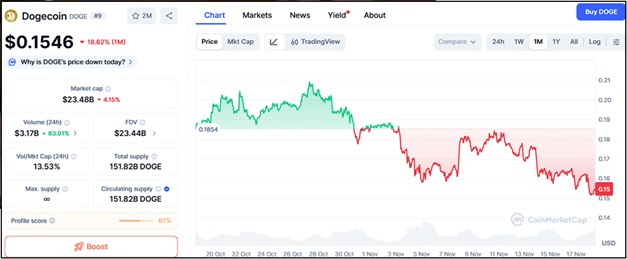
Dogecoin and Pepe continue to capture attention as meme-coin enthusiasm rises once again, with both assets showing renewed strength heading into 2026. Dogecoin currently trades near $0.1546, supported by strong community sentiment and recurring social media momentum. DOGE maintains a bullish structure as long as the price holds above support at $0.148, $0.136, and $0.122, areas where long-term holders typically accumulate. Momentum will depend on whether DOGE can break resistance at $0.167, $0.182, and $0.205, levels that historically trigger large spikes when breached.

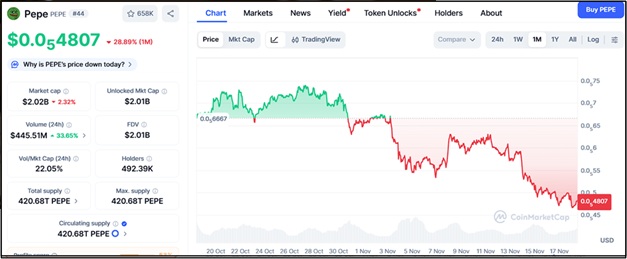
Pepe (PEPE), trading around $0.000004807, also shows considerable strength as one of the fastest-moving small-cap meme coins. PEPE’s trend remains intact as long as the price stays above $0.00000432, $0.00000396, and $0.00000357, while resistance at $0.00000519, $0.00000574, and $0.00000630 defines the next wave of potential upside.

Ozak AI’s Utility and Technology Give It a Much Steeper Growth Curve

Ozak AI (OZ) stands apart from meme-driven assets because its core value comes from real utility, not social speculation. The project integrates AI prediction agents, cross-chain analytics, and intelligent automation built to interpret blockchain data at high speed.

This technology is strengthened through partnerships with Perceptron Network’s 700,000+ nodes, HIVE’s 30-millisecond market signal engine, and SINT’s AI-agent infrastructure—all of which create a functional intelligence layer capable of powering next-generation trading insights, research analytics, and decentralized AI-driven applications. These features give Ozak AI a foundation for sustained demand and adoption, something meme coins fundamentally lack. Because Ozak AI is still in OZ presale stages with a low market valuation, its upside potential for 2026 is significantly larger than DOGE or PEPE.

Ozak AI Presale Momentum Signals a Much Larger 2026 Breakout

Ozak AI’s presale has already surpassed 1 billion tokens sold and raised over $4.5 million—clear signs of strong early demand. This early participation matters because tokens with meaningful utility, strong partnerships, and low initial valuations often deliver the largest returns during bull cycles.

With no resistance levels limiting early growth and a rapidly expanding narrative around AI-powered crypto tools, Ozak AI sits in prime position for exponential price discovery once listings begin. Analysts believe its 2026 outlook could exceed 50x–100x if the AI narrative continues dominating the tech sector, especially as traditional industries increasingly integrate machine learning, automation, and predictive intelligence.

DOGE and PEPE Look Strong

Dogecoin and Pepe remain strong contenders for impressive returns in the next market cycle, supported by enthusiastic communities and high-volatility upside. Yet their long-term growth still depends heavily on sentiment cycles rather than technological advancement. Ozak AI, by contrast, delivers utility, innovation, and powerful AI-integrated systems—creating a steeper and more sustainable growth trajectory as crypto moves into a more utility-driven era. For traders eyeing 2026 opportunities, DOGE and PEPE offer strong speculative upside, but Ozak AI offers transformational potential—making it one of the most compelling projects to watch in the years ahead.

About Ozak AI

Ozak AI is a blockchain-based crypto project that provides a technology platform that specializes in predictive AI and advanced data analytics for financial markets. Through machine learning algorithms and decentralized network technologies, Ozak AI enables real-time, accurate, and actionable insights to help crypto enthusiasts and businesses make the correct decisions.


For more, visit:

Website: https://ozak.ai/

Telegram: https://t.me/OzakAGI

Twitter: https://x.com/ozakagi