DD
MM
YYYY

PAGES

DD
MM
YYYY

spot_img

PAGES

Home Blog Page 17

German Exports Stagnate Amid Declining US Shipments

0

Germany’s export-driven economy is facing renewed headwinds, with official data showing near-stagnation in October 2025.

Total exports rose by just 0.1% month-on-month, a sharp slowdown from September’s 1.4% gain, signaling that the brief post-summer rebound has fizzled out.

This sluggish performance underscores broader challenges, including U.S. tariffs, Chinese overcapacity, and shifting global supply chains, which are dampening prospects for an export-led recovery.

Exports to the United States—Germany’s largest single-country market—plummeted nearly 8% in October, exacerbating a downward trend. This follows earlier drops, such as 7.7% in May and 10.5% in April, largely attributed to a 15% U.S. tariff on EU goods implemented in July 2025.

Analysts note that while companies initially “frontloaded” shipments to dodge the tariffs, the reversal has now fully materialized, with no near-term EU-U.S. trade deal in sight. Overall, U.S.-bound exports remain down year-on-year, despite a temporary rebound in September.

Shipments to China fell almost 6% in October, hit by Beijing’s economic slowdown and rising domestic competition that favors local brands over German imports. This “triple China shock”—weaker demand, increased rivalry in third markets including the EU, and reliance on Chinese rare earths—has intensified uneven trade dynamics.

Meanwhile, imports from China to Germany surged over 10% this year, highlighting competitive strains. Broader global export volumes have been treading water since the pandemic, with supply chain disruptions and geopolitical fragmentation adding drag.

Bright Spots in Europe

Intra-EU trade provided some offset, with exports to other European countries jumping nearly 3%. However, economists warn this regional resilience is insufficient to counter global pressures, leaving the European market unable to fully compensate.

The data points to ongoing stagnation for Europe’s largest economy, with exports unlikely to drive growth in the near term. Germany’s trade surplus widened slightly to €16.9 billion in October, buoyed by a 1.2% drop in imports, but the overall picture is one of vulnerability.

Fiscal stimulus, including €52 billion in pending military procurement, could offer a buffer, but risks from U.S. policy under a potential Trump administration and China’s slowdown loom large. Looking ahead, about 80% of German exporters anticipate further sales declines in 2025, potentially leading to job cuts in export-reliant sectors like automotive and machinery.

This trend aligns with a modest global slowdown in 2025, where resilience in services and domestic demand hasn’t fully translated to goods trade. For context, Germany’s total exports for the first nine months of 2025 reached €1.18 trillion, up just 0.7% from 2024—far below pre-pandemic levels.

Germany’s automotive industry, a cornerstone of its export economy contributing over 5% to GDP and employing around 800,000 people pre-crisis, is reeling from the dual blows of U.S. tariffs and China’s economic slowdown.

As global exports stagnate—particularly to the U.S. down ~8-9% year-to-date and China down nearly 6% in October—the sector faces profit erosion, massive job cuts, and a painful pivot toward electrification amid fierce Chinese competition.

Analysts forecast a 1.7% contraction in global motor vehicle production this year, heavily influenced by these trade frictions. The sector’s workforce has shrunk dramatically, signaling long-term pain beyond cyclical downturns.

As of September 2025, employment in automotive manufacturing and parts stood at 721,400—a 6.3% drop (48,700 jobs) from the prior year and the lowest since mid-2011. This marks the steepest decline among Germany’s major industrial sectors.

Broader figures paint an even grimmer picture: 51,500 auto jobs were slashed between June 2024 and June 2025 alone, with total employment now 112,000 below 2019 pre-COVID peaks. Across the industrial base, 114,000 positions evaporated in the same period.

These cuts stem directly from export woes: U.S.-bound car and parts shipments fell 8.6% in the first half of 2025, while China’s “triple shock”—weak demand, overcapacity flooding third markets, and supply chain dependencies—has eroded competitiveness.

Chip shortages, exacerbated by U.S.-China disputes, have further idled factories. Major players like Volkswagen, BMW, and Mercedes have announced restructuring, with warnings of more layoffs if tariffs persist into 2026.

Earnings reports from Germany’s “Big Three” automakers highlight the financial carnage. Mercedes-Benz saw first-half 2025 net profits crater 56% to €2.7 billion from €6.1 billion in H1 2024, with Q2 alone down 69%; revenue dipped 10%, and EBIT fell 68%.

The company attributes €360 million of this to U.S. tariffs—initially 27.5% on EU vehicles, later negotiated to 15%—plus one-off costs from its cost-cutting overhaul. China, Mercedes’ top market, saw sales plunge nearly 20% year-on-year in Q2, hammered by affordable domestic EVs from BYD and others.

VW’s nine-month profits dropped amid U.S. tariff hits and Chinese market share erosion, while BMW cited similar pressures despite resilient margins. Overall, U.S. tariffs have already cost major global automakers $11.7 billion through mid-2025, with Germany’s exposure acute given the U.S. absorbs ~10% of its auto exports.

Porsche, too, reported squeezes from the 27.5% Q2 tariff rate before the partial EU-U.S. deal. While U.S. tariffs grab headlines, China’s woes pose an existential risk. German brands lost ground as Beijing’s EV boom favors locals.

Chinese-made cars now hold 5.5% of Europe’s market double from 2024, despite EU countermeasures up to 45% tariffs. In China itself, demand for German luxury and combustion-engine vehicles has softened amid economic malaise and subsidies for domestics.

Exports to China fell 6% in October, part of a broader “China shock” pummeling Germany’s “Mittelstand” suppliers. This has forced a scramble: BMW’s CEO recently urged an EU-U.S. trade deal to offset losses, while firms eye deeper localization in China or diversification to India and Southeast Asia.

The automotive slump ripples through Germany’s economy, dragging on mechanical engineering and machine tools—evident in Swiss suppliers like Pfiffner reporting order drops from German clients.

Domestically, EV adoption offers glimmers: Germany’s new-car market eyes full-year growth, buoyed by electric registrations, but overall volumes lag pre-pandemic norms. Yet, with 80% of exporters bracing for further 2025 declines, risks mount from potential Trump-era escalations and China’s property crisis spillover.

Fiscal aids like €52 billion in defense spending provide some insulation, but without trade breakthroughs, the sector could shed another 50,000 jobs by mid-2026. Transitioning to EVs remains key, though Chinese dominance in batteries and components complicates this. For now, Germany’s auto titans are in survival mode, underscoring the fragility of its export model in a fragmenting world.

Octra Public Token Sale on Sonar As Rainbow Token ICO Launches on CoinList

0

Octra, a privacy-focused Layer 1 blockchain leveraging fully homomorphic encryption (FHE) for programmable privacy, announced its public token sale (ICO) on Sonar, the platform founded by Jordan “Cobie” Fish and recently acquired by Coinbase.

The sale is set to run from December 18 to December 25, 2025, aiming to raise $20 million by offering 10% of the total OCT token supply at a $200 million fully diluted valuation (FDV)—a price of $0.20 per OCT.

This marks a doubling of Octra’s valuation from its earlier $4 million raise on Echo earlier in 2025. Early investors hold 18%, Octra Labs 15%, and 67% is community-directed including early users, validators, grants, Echo participants, and ICO buyers. No single investor exceeds 3% ownership.

100% unlocked at token generation event (TGE) for public buyers; unsold tokens will be burned. Allocation could expand based on demand. Founded in 2021 by Octra Labs, Octra enables encrypted computations without decryption, serving as a standalone L1 or co-processor for chains like Ethereum and Solana.

Its testnet has processed over 100 million transactions since June 2025, hitting 17,000 TPS peaks with no downtime. Mainnet and EVM compatibility are slated for Q1 2026. $4 million pre-seed from Big Brain Holdings, Finality Capital Partners, Karatage, and Presto Labs; another $4 million on Echo.

Over 1,000 registrations already, with inclusive access for US, UK, and China residents—no KYC preferences for influencers. X discussions highlight its FHE edge over ZK/TEE privacy tech, amid rising interest in projects like Zcash and Aztec.

This sale positions Octra in a hot privacy tech wave, but skeptics (e.g., Delphi Labs) question the valuation jump without proven mainnet demand. Registrations are live via Octra’s site—early sign-up recommended for equal allocation.

Rainbow Wallet RNBW Token Sale on CoinList

Rainbow, the popular non-custodial Ethereum wallet known for its intuitive design often called “Onchain Robinhood”, is launching its native RNBW token via a public sale on CoinList.

The sale kicks off December 11 at 17:00 UTC and runs through December 18, 2025, offering 3% of total supply (30 million RNBW) at $0.10 per token for a $100 million FDV—a 33% discount to the prior private round.

Treasury 47%, airdrop 15% (fully unlocked at TGE), future community 15%, team 12.2% (4-year vest, 1-year cliff), investors 7.8% (2-year vest, 1-year cliff), ICO 3%. 100% unlocked at TGE for most buyers (US participants face a 1-year lockup). Minimum purchase: $100 via USDC/USDT (ERC-20).

Bottom-up allocation prioritizes small buyers to avoid whale dominance. Rainbow supports asset/NFT management, swaps, bridging, perps trading (via Hyperliquid), and prediction markets across EVM chains like Base, Arbitrum, and BSC.

The RNBW token enables governance, fee discounts, and revenue-backed rewards like real-time buybacks from platform fees, no emissions. It ties into Rainbow’s points program launched in 2023, converting user activity like swaps, holdings, referrals into tokens.

The Rainbow Foundation holds 20% equity for token holders, linking company value directly to RNBW. ~$20 million total, led by Seven Seven Six (Alexis Ohanian), Digital Currency Group, Y Combinator, and Coinbase Ventures.

Open to US users which is rare for ICOs, with hype around its 5+ million downloads and app upgrades like real-time pricing. X threads praise the fair structure and potential 2-3x TGE upside, though some note risks in wallet token trends.

Rainbow’s sale emphasizes user ownership in a maturing wallet ecosystem—register now; non-US: CoinList link, US: separate portal to participate. Both events signal December’s ICO surge; DYOR as market rotations could impact liquidity.

Fragment NFT Marketplace Surpasses Hyperliquid in 24-Hour Revenue

0

The TON-based NFT marketplace Fragment, integrated with Telegram, generated $2.83 million in fees over the prior 24 hours, edging out Hyperliquid’s $2.25 million or approximately $2.08 million as reported in some trackers.

This milestone propelled Fragment to the #3 spot among all DeFi protocols by daily revenue, trailing only stablecoin giants Tether and Circle. Launched by the Telegram team on the TON blockchain, Fragment is a specialized NFT marketplace focused on Telegram-native assets like usernames, anonymous numbers, premium subscriptions, and collectible gifts.

It supports anonymous peer-to-peer trades, fixed-price sales, and public auctions—all settled in TON coins. Its seamless Telegram mini-app integration has made it a gateway for over 900 million users to dip into Web3 without leaving the chat app.

This surge aligns with a broader NFT market rebound, where global NFT sales jumped ~50% in the last 24 hours and market cap rose 33%. Fragment’s weekly revenue hit $7.08M, with $36.97M over 30 days, driven by high-demand auctions for rare Telegram identities.

In contrast, Hyperliquid—a high-performance Layer 1 for perpetuals trading—saw $6.3B in 24h perp volume but lower fee capture due to its model 99% of fees funneled to an Assistance Fund for buybacks and ecosystem support.

TON’s on-chain activity is booming, with Fragment as a key catalyst for consumer-facing NFTs. Amid a choppy crypto market, this shows “social” NFTs tied to apps like Telegram can outpace DeFi trading volumes during hype cycles.

For Hyperliquid its no cause for alarm—its $237B 30-day perp volume dwarfs Fragment’s scale, and the “flip” is temporary, underscoring how niche consumer apps can spike ahead of infrastructure plays.

Charles Hoskinson’s Take on Quantum Threats to Crypto

Cardano founder Charles Hoskinson recently addressed the growing buzz around quantum computing as an existential risk to cryptocurrencies, calling it a “big red herring” and largely overhyped for the near term.

In a podcast discussion around December 8, 2025, he emphasized that while quantum-resistant cryptography is technically feasible today, the practical hurdles make widespread adoption unnecessary and inefficient right now.

This aligns with broader expert consensus that meaningful quantum threats to blockchain signatures like those in Bitcoin or Ethereum won’t materialize until the 2030s or later, giving the industry ample time to prepare without panic.

Hoskinson’s core argument boils down to three key points, rooted in real-world trade-offs for blockchain networks. Quantum-safe protocols, such as those based on lattice cryptography, are currently about 10x slower and 10x more expensive to run than standard elliptic curve cryptography (ECC).

For high-throughput chains like Cardano which aims for thousands of transactions per second, this could slash efficiency dramatically. As Hoskinson put it: “I have a thousand transactions a second. Now I’m going to do a hundred transactions a second, but I’m quantum proof. Nobody wants to be that guy.”

Rushing into non-standard algorithms risks obsolescence. Hoskinson urges waiting for the National Institute of Standards and Technology (NIST) to finalize its post-quantum cryptography standards (FIPS 203–206), expected soon.

These will enable hardware-accelerated support from chipmakers like Intel and ARM, making quantum-safe tech 100x faster than unoptimized alternatives. Adopting prematurely could lock networks into “inefficient cryptography for a decade.”

Current quantum computers lack the scale to break real-world ECC keys which require millions of stable qubits. Experts, including Hoskinson, peg a “strong possibility” of viable threats in the 2030s, not tomorrow.

This echoes sentiments from Ethereum’s Vitalik Buterin, who in 2020 dismissed immediate quantum risks as overblown, noting that upgrades like BLS signatures already mitigate many concerns.

Quantum computers could theoretically crack ECC via Shor’s algorithm, exposing private keys from public ones. But this needs fault-tolerant systems with 1–10 million qubits—far beyond today’s ~1,000-qubit noisy prototypes.

Cardano has been proactive: Its Ouroboros consensus is modular for post-quantum upgrades, and sidechains like Midnight incorporate zero-knowledge proofs with quantum resistance in mind. Bitcoin, however, faces steeper challenges due to its rigid design—upgrading would require a contentious hard fork.

Not everyone agrees it’s “overhyped.” BlackRock’s 2025 warnings flagged quantum risks to Bitcoin as a “precipice,” and some researchers like MIT’s Elena Vertsova argue chains are “woefully unprepared.”

Ripple’s CTO David Schwartz has claimed XRP is inherently more quantum-proof, but that’s debated. This stance is bullish for Cardano ($ADA), as it positions the network to focus on scalability like the upcoming Leios upgrade for parallel processing without diverting resources prematurely.

Hoskinson ties it to ecosystem growth, like the Midnight token launch on December 9, 2025, which enhances privacy without quantum FUD. Overall, his message: Match urgency to actual threats—build efficiently now, upgrade smartly later.

If you’re holding crypto, this reduces short-term doom-scrolling but underscores the need for chains to monitor NIST progress. If you’re trading or collecting, Fragment’s low-friction entry via Telegram wallet makes it worth exploring—bullish on TON if this momentum holds.

When One Oasis Morphs Into “Capability IP” in Business: Lesson from Dangote Group

1

I have noted repeatedly that the most important business unit within the Dangote Group is not cement, sugar, fertilizer, or even the refinery; it is logistics. That logistics backbone is the One Oasis upon which the conglomerate has built its competitive moats. In a nation where the supply chain architecture struggles, following the collapse of the railways and the weakening of postal systems, owning logistics is equivalent to owning the arteries through which commerce flows.

Intellectual property strategist Freddy Guemeni deepened this thesis in his piece for IP Business Academy, introducing the concept of “Capability IP.” He describes it as a fusion of assets, processes, and know-how that, while not protected by patents, becomes functionally exclusive because no competitor can realistically replicate it within the same operating environment.

In the Dangote universe, this capability IP is unmistakable: a logistics and supply chain machinery originally optimized for cement, but now powering sugar, salt, flour, fertilizers, and increasingly refined petroleum products. Dangote’s edge does not emerge from having the most sophisticated cement formula; rather, the moat is the reusable logistics oasis, a capability that can be ported across sectors, delivering efficiencies and pricing leverage competitors cannot match.

As I explained in Harvard Business Review when proposing the One Oasis Strategy, when a firm invests in, and continually deepens its oasis, it unlocks multiple paths for capturing value. That oasis becomes a platform, and a capability generating returns across many business lines.

By framing this as “IP,” Freddy advances the argument that a business model anchored on a One Oasis Strategy can deliver returns equivalent to classical intellectual property, because the capability itself becomes defensible, unique, and commercially irreplicable.

Good People, in modern business, patents may expire and products may be copied. But capability-based moats (i.e. operational IP as we have in Dangote Group) endure, because they are built over decades, accumulated through knowledge, perfected through execution, and made exclusive by the very terrain in which they operate.

Divided Fed Delivers “Hawkish Cut,” Lowers Rates to 3.5%-3.75% But Signals Policy Pause

0

The Federal Reserve’s Federal Open Market Committee (FOMC) cut its key overnight borrowing rate by a quarter percentage point on Wednesday, fulfilling market expectations for a “hawkish cut”—a policy easing move accompanied by a cautious future outlook.

The decision, which places the federal funds rate in a new target range of 3.5%-3.75%, was passed by a highly fractured 9-3 vote, the largest number of dissents since September 2019, underscoring the deep split among policymakers.

The FOMC’s final decision of the year was based on a mandate to balance stubbornly elevated inflation against a weakening job market. The three dissenting votes clearly delineated the committee’s division.

Governor Stephen Miran favored a steeper half-point reduction, arguing that the labor market weakness—where job gains have slowed, and the unemployment rate has edged up to 4.4%—required a more aggressive response. Regional Presidents Jeffrey Schmid (Kansas City) and Austan Goolsbee (Chicago) backed holding the rate unchanged, signaling their primary concern that inflation, still elevated, remains the greater risk.

The caution signal about the future path of policy was embedded in the rate statement, which repurposed language used a year ago to signal a pause: “In considering the extent and timing of additional adjustments to the target range for the federal funds rate, the Committee will carefully assess incoming data, the evolving outlook, and the balance of risks.”

This phrase, when used previously, signaled that the committee was likely done cutting for the time being.

The closely watched “dot plot” reinforced this cautious stance, with the median projection indicating just one cut in 2026 and another in 2027. Seven officials explicitly indicated they favor no cuts at all next year, while four nonvoting meeting participants registered “soft dissents” against the current cut, suggesting a majority of the 19 participants are hesitant to ease further without clear data.

Economic Backdrop and Policy Measures

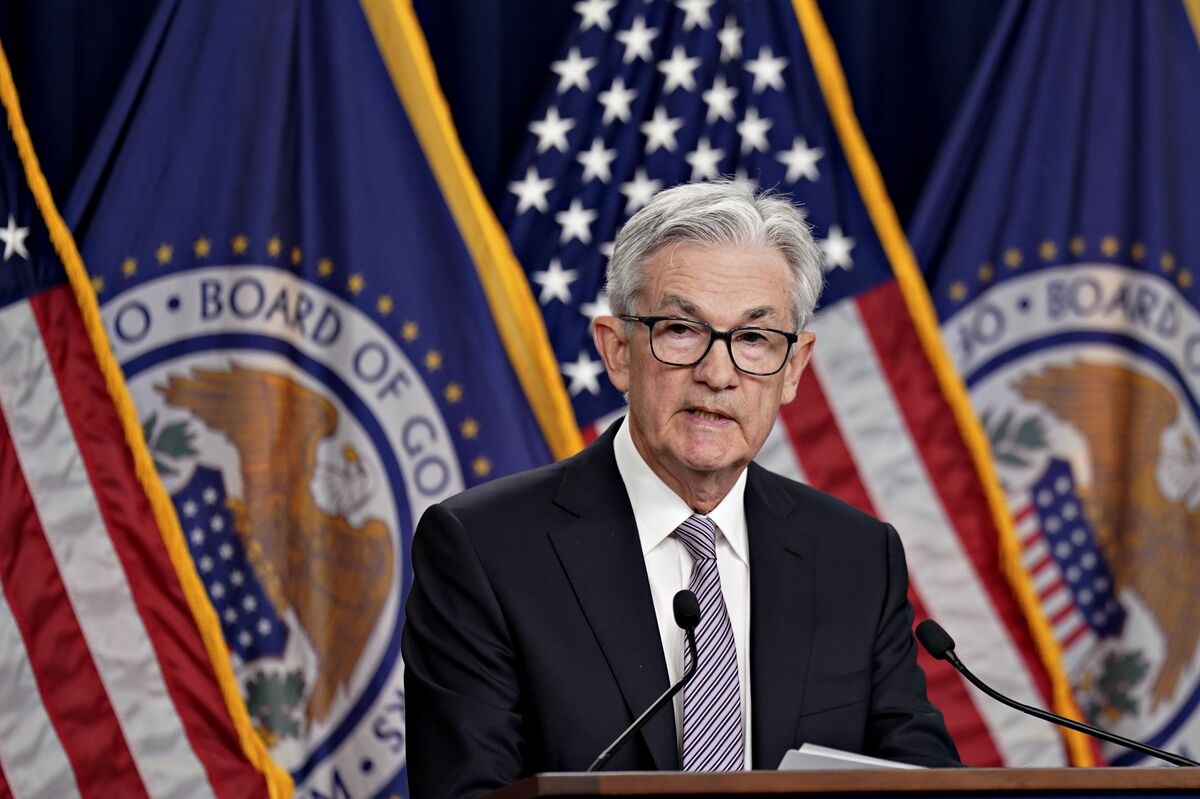
Fed Chair Jerome Powell, at his post-meeting news conference, justified the cut by pointing to labor market concerns, noting that the reported 40,000 jobs added per month since April could be revised lower by as much as 60,000, implying the job market may actually be shedding workers. He stated, “We are well positioned to wait and see how the economy evolves,” adding that the current rate is likely at the high end of the “neutral” range.

The economic outlook was slightly more optimistic regarding growth, with the committee raising its collective view of Gross Domestic Product (GDP) growth for 2026 by half a percentage point, boosting its projection to 2.3%. However, the committee continues to expect inflation to remain above its 2% target until 2028, with the latest available PCE price index (the Fed’s preferred gauge) at 2.8% in September.

In a move to address pressures in overnight funding markets and maintain an “ample level of reserves,” the Fed also announced it will resume buying Treasury securities, following up on its decision to halt its balance sheet runoff this month. The central bank will initiate purchases of $40 billion in Treasury bills starting Friday, a program expected to remain elevated for a few months before being significantly reduced.

Political Pressure and Succession Risk

The decision comes as the Fed grapples with unprecedented political pressure, with Chair Powell nearing the end of his second term and President Donald Trump preparing to name his successor.

President Trump immediately criticized the quarter-point reduction as a “rather small number,” arguing the cut “could have been at least doubled” and calling Powell “a stiff.” Trump asserted that the Fed is “so afraid of inflation” that “they kill the growth,” and he signaled his intention to appoint a new chair committed to sharper rate cuts, not necessarily the Fed’s traditional dual mandate.

Trump confirmed he plans to interview former Fed Governor Kevin Warsh, one of the top contenders. However, prediction markets currently favor National Economic Council Director Kevin Hassett (72% chance) as the likely nominee, a choice that could heighten concerns over the central bank’s independence.

The market reaction was positive, with the Dow Jones Industrial Average rising 500 points and Treasury yields moving mostly lower, reflecting investor approval of the immediate cut despite the committee’s guarded outlook for 2026.