DD
MM
YYYY

PAGES

DD
MM
YYYY

spot_img

PAGES

Home Blog Page 25

Why Do We Have Companies?

0

The live Zoom sessions for the 21st edition of the Tekedia Mini-MBA will begin on Saturday at 7:00 p.m. WAT. I will open our academic excursion with a lecture on the mission of firms and the fundamental reason companies exist.

That understanding is foundational as we begin a 12-week journey to master the mechanics of building great companies and advancing professional careers.

Every company has three primary elements with which to operate: tools, people and processes. How those elements are assembled, organized and combined will determine the capacity of the firm to transform inputs, including the foundational factors of production, into outputs, to fix market frictions. That transformation of inputs into outputs is what companies do. But business is not a game in which companies award themselves points. The output must resolve a friction experienced by the customer.

When a company creates a great product or service, customers respond by supporting its mission. They pay because the company has solved a problem for them. Hahaha…when they pay, the company earns revenue, and that revenue becomes the compensation for removing the friction. We will examine case studies.

In secondary school physics, friction is a resistive force that must be overcome by another force before an object can move from one state to another. Business operates on the same construct.

A hungry person faces the friction of hunger. Food becomes the force that moves that person from hunger to satisfaction. Making that “force of food” exceptional is the foundation of a great restaurant business.

In all forms and dimensions, companies create forces called products and services. The finest companies become known by the quality and relevance of the forces they produce to overcome frictions: Apple for the iPhone, Dufil Prima for Indomie noodles, Dangote for cement and McKinsey for advisory services.

Build a great force, deploy it against an important market friction, and the market will reward your mission. Your customers will become your finest investors, funding your progress through their purchases. That is why companies exist: they are the most effective vehicles ever invented for organizing the factors of production to create products and services that resolve frictions in markets.

I welcome everyone to Africa’s finest school for understanding the physics of entrepreneurial capitalism. We continue to welcome co-learners; join us here as we begin https://school.tekedia.com/course/mmba21/

Ndubuisi Ekekwe
Lead Faculty, Tekedia Institute

South Korea’s Stock Rally Fuels Surge in Retail Investment Scams, With Losses Near $250 Million

0

South Korea’s spectacular stock-market rally has created a lucrative hunting ground for investment scammers, with retail investors claiming losses of about $250 million from stock-tip chatroom fraud in the first half of 2026, according to police data reviewed by Reuters.

Police investigated 3,506 cases involving stock-tip chatrooms between January and June, with 336 billion won ($246.57 million) in money involved, the data showed. The number of cases increased 4.1% from the same period a year earlier, but the amount of money involved jumped 19.8%, suggesting that scammers are extracting substantially larger sums from victims.

The increase came during an extraordinary period for South Korean equities. The KOSPI was the world’s best-performing major stock benchmark during the first half of the year, attracting enormous attention from retail investors. But the rally also demonstrated how quickly sentiment can turn: the index subsequently fell as much as 44% from its June 19 peak.

The combination of rapid gains and sharp reversals created fertile conditions for fraudsters, lawyers specializing in financial crime said.

“Volatility creates favorable conditions for criminal organisations,” said Kim In-ho, an investigator at Jeongbyeok Law Firm who specializes in helping fraud victims.

The scams exploit a familiar psychological cycle. When markets rise rapidly, investors fear missing out on further gains. When prices become volatile, uncertainty increases, and investors become more receptive to people claiming to possess information, expertise, or access that ordinary investors do not have.

In South Korea, lawyers say fraudsters have adapted their methods to capitalize on that environment.

From Crypto and Property to Stock Tips

Investment scams have long targeted South Koreans through cryptocurrencies and property schemes. But the market rally has shifted the focus toward equities, particularly retail investors eager to capitalize on surging technology stocks.

One common method involves impersonating or exploiting the reputations of legitimate financial professionals.

Scammers post comments beneath videos featuring well-known brokerage analysts or financial influencers, directing viewers toward private investment chatrooms. Victims may believe they are joining a community connected to a recognizable securities company or market expert when, in reality, they are entering a network operated by fraudsters.

Once inside, the groups can take several forms.

Some charge subscription fees ranging from thousands to hundreds of thousands of dollars for supposedly exclusive stock recommendations. Others encourage members to transfer money directly to accounts controlled by the scammers, often promising unusually high returns.

The rapid KOSPI rally has become part of the sales pitch. According to one lawyer, fraudsters pointed to the market’s gains, fueled in part by debt-financed bets on technology stocks, as evidence that victims should put more money into equities.

“When market volatility rises, so does uncertainty and that’s when retail investors’ psychology gets shakier,” said Lee Tae-kyung, a lawyer at Wanbong Law Firm. “These groups exploit that, telling people to trust them.”

The scale of the losses also means individual cases can conceal multiple victims. Police said each investigation may involve several people who were persuaded to transfer money through the same operation.

South Korea’s Financial Supervisory Service said it does not maintain data specifically covering illegal stock-tipping chatroom cases because such investigations fall under law enforcement. The regulator did not respond to questions about whether it was considering additional measures to protect investors.

A Scam Built Around Trust

A case uncovered by Seoul police illustrates how far these operations can go. In June, police said they arrested 10 people after uncovering a Cambodia-based operation that allegedly defrauded 59 South Koreans of approximately 9.9 billion won over two years through February.

Members of the group allegedly impersonated employees of securities firms and persuaded victims to purchase stocks recommended by artificial intelligence through fake investment applications.

Police said the alleged ringleader was a foreign national, while Korean personnel operated call centers. The case has been referred to prosecutors and is awaiting a court date.

For victims, the danger is often not simply the promise of an implausibly high return. The schemes can be designed to manufacture credibility gradually, beginning with ordinary market commentary before introducing aggressive investment opportunities.

That was what happened to Jay, a 47-year-old South Korean logistics worker who said he lost 60 million won after joining a chatroom in February, according to Reuters.

Jay asked to be identified only by his English name because his family does not know about his losses.

He found the group through a TikTok video he believed had been posted by the director of a well-known securities firm. The video directed him to a chatroom on Naver, South Korea’s dominant online platform.

“At the time there was a lot of discussion around not putting your money into real estate, but to put it in stocks,” Jay said. “That mood was prevalent and I got pulled along without realizing it.”

Initially, the chatroom appeared to provide ordinary market commentary. Members later began discussing large profits supposedly generated by investing six- and seven-figure sums through employees of the securities firm.

The claims persuaded Jay to borrow money and initially invest 20 million won.

The operation then introduced what it described as a rare opportunity involving a construction company expected to benefit from potential post-war reconstruction in Iran. Believing the person managing the chatroom was an employee of the securities firm, Jay transferred another 40 million won and was told his investment could rise by 600%.

The opportunity disappeared along with the people offering it.

The chatroom went silent and shut down in April. Jay has since filed a criminal complaint with the police and a civil complaint against the holder of the bank account into which he transferred the money.

Jeonbuk Bank, which hosts the account, said it was aware of ongoing fraud cases and would continue improving its systems for detecting scams. Naver said it takes action against chatrooms when they are reported and is strengthening its monitoring.

He is now working two additional jobs to repay the debt incurred after the fraud.

His experience illustrates why the market’s extraordinary performance can become a vulnerability as well as an opportunity. A rising market creates legitimate stories of investors making large gains, making fraudulent claims of extraordinary returns easier to believe. Sharp volatility then provides another tool, allowing scammers to frame urgency and uncertainty as reasons victims should act before an opportunity disappears.

The result is a market where the risks are no longer limited to whether an individual stock will rise or fall. Retail investors also have to determine whether the person offering the investment opportunity is who they claim to be, whether the trading platform is legitimate, and whether the promised returns bear any relationship to the underlying asset.

Why Chip-Race Silicon Like OpenAI’s Jalapeño ASIC Matters for Real-Money Gaming Platforms

0

Broadcom just built a chip that beats Nvidia at its own game, and almost nobody outside the semiconductor trade press noticed. OpenAI’s Jalapeño, unveiled in detail last month, is a reticle-sized inference ASIC that reportedly edges out Nvidia’s Rubin architecture on performance-per-watt. That’s not a spec-sheet curiosity. It’s the kind of shift that eventually shows up in places nobody expects, including the fraud engine sitting behind your favorite betting app.

Tekedia readers have been tracking this chip race for a while now, from ChipMango’s semiconductor talent push to the broader OpenAI-Nvidia-Broadcom standoff playing out in real time. What gets less attention is where all that inference capacity actually goes once it leaves the data center slide deck. A meaningful chunk of it goes into consumer platforms that need decisions made in milliseconds: is this transaction fraudulent, is this account being farmed by a bot, should this player see bonus offer A or offer B. Real-money gaming sits right in the middle of that use case, whether the operators say so publicly or not.

Here’s the part that matters for anyone actually tracking platform quality rather than just chip specs. As inference silicon gets cheaper and faster, the gap widens between operators who’ve invested in real-time infrastructure and operators still running batch-processed fraud checks overnight. Figuring out which platforms have actually made that leap isn’t obvious from a homepage. It’s the kind of granular, platform-level tracking that NewGameNetwork has built a reputation around, cataloguing not just game libraries but the operational backbone operators run underneath them.

What Jalapeño Actually Does Differently

Most of what you read about AI chips focuses on training, the process of teaching a model. Jalapeño is built for inference instead, which is the process of runningan already-trained model against live data. Training happens once. Inference happens every single time a user does anything.

According to CNBC’s report on the Broadcom-OpenAI partnership, the chip was purpose-built to move away from Nvidia’s general-purpose GPU approach toward something narrower and far more efficient for repetitive, high-volume decisioning. That’s a fundamentally different design goal than training a frontier model from scratch.

Tom’s Hardware went deeper on the architecture, noting the chip went from concept to silicon in roughly nine months, an unusually fast cycle for custom ASIC development. Nine months. For context, a full-custom chip normally takes two to three years. That speed only makes sense if you assume there’s a backlog of inference-hungry applications waiting for cheaper compute. Gaming platforms, payment processors, and ad-tech networks are three of the biggest queues.

Why does perf-per-watt matter more than raw speed here? Because inference workloads run constantly, not in occasional bursts. A model checking every login attempt for account-takeover patterns runs 24/7, across millions of sessions. Shave the power draw per inference call and you’re not saving a few dollars. You’re saving enough to change whether a mid-size operator can afford real-time fraud scoring at all, or whether they’re stuck running it in overnight batches like it’s 2015.

Where This Actually Touches Real-Money Platforms

I’ve spent enough time poking around operator infrastructure (mostly through withdrawal delays and KYC hiccups, which tend to reveal exactly how automated or manual a backend is) to notice a pattern. The platforms with genuinely fast, low-friction verification are almost always the ones that have quietly modernized their inference stack. The slow ones are running rules-based fraud checks that flag everything and resolve nothing quickly.

Three areas where cheaper, faster inference silicon shows up on the player-facing side:

  • Real-time fraud and AML scoring. Instead of flagging a withdrawal and parking it in a manual review queue for 48 hours, a model can score the transaction against behavioral patterns the moment it’s submitted. I had a withdrawal flagged once at a mid-tier operator on a Friday night. It sat for three days because their review process was entirely human. That’s the exact failure mode faster inference is meant to eliminate.
  • Personalization and bonus targeting. The offer you see after a losing session versus a winning one isn’t random. It’s a model deciding, in real time, what’s likely to keep you engaged. Cheaper inference means smaller operators can afford this too, not just the giants with in-house data science teams.
  • Bot and multi-accounting detection. This one’s less visible but arguably more important for game integrity. Detecting whether the same person is running six accounts to farm a welcome bonus requires pattern matching across sessions in near real time, not a weekly audit.

None of this touches RNG certification or RTP, to be clear. Random number generation is a separate, heavily audited process and no inference chip changes how a slot’s math model works. What’s changing is everything aroundthe game: the layer that decides who gets to play, how fast they get paid, and whether the account behind the screen is real.

The Infrastructure Gap Is Becoming a Trust Signal

Here’s my actual opinion, and it’s one plenty of affiliate content won’t say out loud: platform infrastructure quality is becoming a better predictor of a good user experience than bonus size. A 200% welcome bonus with a 40x wagering requirement means nothing if your withdrawal sits in review for five days because the operator’s fraud stack can’t clear you fast enough.

The McKinsey-cited data center investment analysis from Data Center Dynamics puts a number on how much capital is chasing exactly this kind of compute buildout, and it’s not small. When that much investment flows into inference-optimized infrastructure, the operators who adopt it early get a durable edge. Not a flashy one. A boring, structural one: faster payouts, fewer false-positive account freezes, better fraud catch rates without punishing legitimate players.

South Korea just committed $597 billion toward AI and chip industries this year alone, and that kind of national-scale investment tends to trickle down into exactly the commodity inference hardware that smaller platforms eventually get to license cheaply. Give it 18 to 24 months and the chips that seemed exotic in an OpenAI keynote will be running fraud models for operators nobody’s heard of yet.

Why African and Emerging Markets Should Care

This isn’t just a Silicon Valley story. Cheaper inference compute lowers the barrier for smaller regional operators, including ones building for African markets where payment rails are already more fragmented than in the US or UK. A platform processing mobile money transactions alongside card payments needs fraud detection that can handle multiple payment behaviors simultaneously. That used to require infrastructure only a handful of global operators could afford.

As inference costs keep dropping (and Jalapeño’s perf-per-watt gains are exactly the kind of pressure that keeps pushing prices down across the industry, not just for Broadcom’s direct customers), the operators building for underserved markets get access to tools that were previously out of reach. That’s a genuinely underrated knock-on effect of the chip race Tekedia readers already follow closely.

Frequently Asked Questions

Does Jalapeño affect how slot games calculate payouts? No. RNG and RTP calculations are separate, independently audited systems unrelated to inference chips. Jalapeño and similar ASICs affect the infrastructure layer around games, things like fraud detection and personalization, not the game math itself.

Why would a betting platform need an AI inference chip at all? Real-time fraud scoring, account verification, and bonus abuse detection all run inference models continuously against live user data. Faster, cheaper inference silicon means these checks happen in seconds rather than being queued for manual review hours or days later.

Is this the same technology used in casino table games or live dealer streams? Not directly. Live dealer video processing uses different hardware entirely. The inference chips discussed here are for backend decisioning, fraud, personalization, risk scoring rather than video rendering or streaming infrastructure.

How can I tell if an operator has invested in this kind of infrastructure? Watch withdrawal speed and how verification issues get resolved. Operators with modern fraud stacks tend to clear standard KYC checks in minutes rather than days, and flagged transactions get resolved faster because a model, not a queue, is doing first-pass triage.

Will chip advances like this lower costs for players? Indirectly, yes. Cheaper backend infrastructure lowers operating costs, which can translate into better bonus terms or lower fees over time, though there’s no guarantee operators pass savings on rather than pocketing the margin.

The chip race between OpenAI, Nvidia, and Broadcom will keep making headlines for the training side of AI, the flashy model releases and benchmark wars. But the inference side, unglamorous as it sounds, is what actually reaches your bank account when you cash out a bet. Watch the perf-per-watt numbers, not just the model releases. They’re a better predictor of which platforms will feel fast and trustworthy two years from now.

Gambling involves risk. Please play responsibly and only wager what you can afford to lose. If you feel gambling is becoming a problem, visit BeGambleAware.org or call 1-800-GAMBLER.

The Economics of an Online Casino: Where Revenue Comes From and Where Costs Go

0

An online casino is more than a digital storefront for casino games. From a business perspective, it combines gaming products with software infrastructure, payment processing, marketing, customer support, compliance, and data management. Its financial performance therefore depends on considerably more than the amount players wager.

The basic economic flow begins with player wagers and payouts and continues through revenue deductions, customer acquisition expenses, technology costs, supplier payments, taxes, and regulatory obligations. Understanding this structure requires looking at several metrics, including Gross Gaming Revenue (GGR), Net Gaming Revenue (NGR), Return to Player (RTP), Customer Acquisition Cost (CAC), and Player Lifetime Value (LTV).

Together, these metrics help explain how an online casino converts gaming activity into revenue and how much of that revenue remains after the costs of operating the business.

How Online Casinos Generate Revenue

From wagers to Gross Gaming Revenue

Gross Gaming Revenue (GGR) is one of the central financial measures used in online gambling. At a basic level, GGR represents the difference between the amount wagered and the amount paid back to players as winnings.

For example, if players collectively wager $1 million and receive $950,000 in winnings, the resulting GGR would be $50,000. “GGR is an important starting point for understanding an online casino’s economics, but it should not be confused with profit. Operators still need to account for customer acquisition, technology, payment processing, game suppliers, taxes and compliance when assessing the business’s overall financial performance,” says Steve Thompson, Lead iGaming Auditor and founder of Pokies Australia. GGR should therefore be viewed as a top-line gaming metric rather than a measure of the operator’s final earnings.

RTP and house edge

The economics of individual casino games are closely connected to Return to Player (RTP) and house edge.

RTP represents the theoretical percentage of wagers that a game is designed to return to players over a sufficiently large number of plays. A game with a theoretical RTP of 96%, for example, has a corresponding theoretical house edge of 4%.

These figures describe mathematical expectations over large samples rather than the outcome of an individual player’s session. Actual short-term results can vary substantially.

For operators, game mathematics is important because it helps determine the expected relationship between wagering volume and GGR. For players, RTP provides information about the mathematical design of a game rather than a prediction of individual results.

From GGR to Net Gaming Revenue

GGR is not necessarily the amount an operator can use to cover its wider business expenses. Net Gaming Revenue (NGR) provides a measure that accounts for certain deductions from gaming revenue.

Depending on the operator and jurisdiction, NGR calculations may account for items such as bonuses, promotional costs, transaction fees and gaming taxes or duties.

This makes NGR particularly relevant when calculating affiliate commissions and evaluating the economics of customer acquisition. However, NGR is not defined identically across every market or commercial agreement, so published figures need to be interpreted according to the methodology used.

Where the Revenue Comes From

RNG slots and table games

RNG slots and digital table games are important product categories because software can serve many customers without requiring a physical casino floor.

Once a game has been integrated into an operator’s platform, serving additional players generally does not require the same type of incremental physical infrastructure as adding customers to a land-based casino. This creates potential operating efficiencies, although operators still incur costs for software licensing, platform infrastructure, customer support, payments, and regulatory compliance.

The mathematical characteristics of each game, including RTP and house edge, influence its expected long-term contribution to GGR.

Live dealer studios

Live dealer games introduce a different cost structure. Instead of relying entirely on automated game software, live casino products use real dealers, physical gaming equipment, cameras, production systems, and real-time streaming.

Companies such as Evolution and Pragmatic Play Live operate live casino products and studios serving online operators.

Live dealer games can increase product variety and provide a more interactive experience, but they also require substantially more operational infrastructure than a purely automated game. Studio staff, production facilities, broadcasting technology, and related overheads all contribute to the cost of delivering the product.

This creates a trade-off between the economics of automated digital games and the additional infrastructure required for live gaming.

Crash and fast games

Crash and other fast-paced games represent another product category within digital gambling. Their relatively short game cycles and mobile-friendly interfaces have helped them become part of the broader online gaming product mix.

From a business perspective, these games illustrate how operators and suppliers continue to experiment with different formats and user experiences. Their economic contribution still depends on factors such as player activity, game mathematics, retention, and the costs associated with supplying and operating the product.

VIP and high-roller programs

VIP and high-roller programs are designed around player retention and differentiated service. Rather than treating every customer identically, operators may offer different benefits based on activity, loyalty, or other criteria.

These programs can generate significant revenue from a relatively small customer segment. At the same time, they can create additional costs through personalized account management, promotional benefits, customer service, and risk monitoring.

This is where Player Lifetime Value (LTV) becomes particularly important. An operator needs to consider the expected long-term economic contribution of a customer alongside the costs involved in acquiring and retaining that customer.

Where the Money Goes

Generating GGR is only the beginning of the financial calculation. Online casino operators typically have several major categories of expenditure.

Game providers and aggregators

Most operators do not develop every casino game themselves. Instead, they can obtain games from specialized B2B developers and distribute them through direct integrations or game aggregators.

Game Providers & Aggregators may receive fees based on commercial agreements that can include revenue-sharing arrangements, fixed fees, or other structures. Industry discussions sometimes cite revenue-share ranges such as 8–15% of GGR, but there is no universal rate. Commercial terms can vary significantly according to the supplier, market, game portfolio, and negotiating relationship.

Aggregators can provide an additional business advantage by allowing operators to connect to multiple game studios through a common technical integration.

Affiliate marketing networks

Customer acquisition is another major expense.

Affiliate Marketing Networks connect operators with publishers and performance-marketing partners that introduce potential customers. Common commercial arrangements include Cost-Per-Acquisition (CPA), revenue share, and hybrid models.

Under a revenue-share agreement, the affiliate receives a percentage of the revenue generated by referred players. Some agreements can use percentages in the 20–45% range, although actual terms vary considerably.

The economic question for an operator is whether the cost of acquiring a customer is justified by that customer’s expected lifetime value.

Payment service providers and payment rails

Online casinos also depend on payment infrastructure to process deposits and withdrawals.

Payment Service Providers (PSPs) and payment rails can include card processors, Open Banking or account-to-account systems, digital wallets and, in some markets, cryptocurrency payment gateways.

Transaction costs can include processing fees, currency conversion charges, chargebacks, fraud-related losses, and withdrawal expenses. An illustrative transaction-fee range of 1.5–5% is sometimes used when discussing payment economics, but actual costs depend on the payment method, market, transaction profile and provider.

Payment infrastructure therefore affects both the cost of serving customers and the overall user experience.

Gaming taxes and regulatory duties

Taxes and regulatory charges can represent another significant component of an operator’s cost structure.

Depending on the jurisdiction, an operator may face gaming taxes, point-of-consumption taxes, gross-revenue levies, licensing fees, and annual regulatory charges.

The difference between markets can be substantial. For example, licensing and taxation arrangements in the UK, Malta, Ontario, and individual U.S. states are governed by different regulatory frameworks.

This means that geographic expansion is not simply a marketing decision. An operator must consider the licensing, tax, compliance, and technology requirements associated with each market.

Compliance and anti-fraud technology

Compliance is also an important part of the technology stack.

KYC and AML systems help operators verify customers and meet applicable identity and financial-crime requirements. Providers such as Sumsub and Onfido offer identity-verification technology, while companies such as GeoComply provide geolocation and related compliance solutions.

Operators can also use automated risk systems to identify unusual transactions, account activity, or other indicators requiring review.

These systems add operating costs, but they also form part of the infrastructure needed to operate within regulated markets.

Responsible gaming infrastructure

Responsible Gaming Infrastructure is another component of the operating model.

Depending on the jurisdiction, operators may need to provide tools such as deposit limits, time controls, self-exclusion mechanisms, and customer-interaction systems. Operators serving the UK market, for example, operate within a framework that includes GAMSTOP, a multi-operator online self-exclusion scheme.

These systems require technical integrations, monitoring, customer-service processes, and ongoing compliance work. They are therefore both a regulatory requirement in relevant markets and an operational component of the digital gambling business.

The Technology Stack Behind the Business

The economics of an online casino are closely connected to its underlying technology.

Player Account Management (PAM) platforms provide much of the infrastructure required to operate an online casino. Depending on the system, a PAM can manage player accounts, wallets, transactions, bonuses, game integrations, and other operational functions.

Companies such as EveryMatrix and SoftGamings operate in this technology segment.

Using an established PAM can allow an operator to access existing infrastructure instead of developing every component internally. However, the operator then needs to account for platform fees, integration costs, and its commercial relationship with the technology provider.

Independent testing and certification also form part of the technology ecosystem. Testing laboratories such as eCOGRA, iTech Labs, and GLI can assess gaming systems and software against relevant technical or regulatory requirements.

Testing adds another expense, but it can also support regulatory compliance and provide independent verification of technical characteristics such as game mathematics and RNG performance.

Why CAC and LTV Matter

Revenue figures alone provide an incomplete picture of an online casino’s economics.

Customer Acquisition Cost (CAC) measures how much an operator spends to acquire customers. Depending on the business model, this can include advertising, affiliate commissions, promotional incentives, and other acquisition-related expenses.

Player Lifetime Value (LTV), meanwhile, estimates the economic value a customer generates over their relationship with the operator.

The relationship between these metrics is particularly important. If acquiring a customer costs more than the value that customer is expected to generate after relevant costs, the acquisition strategy may be difficult to sustain. Conversely, an operator with effective retention and controlled acquisition costs may be able to generate more value from its marketing expenditure.

LTV can be influenced by factors including retention, wagering activity, payment costs, bonuses, product preferences, and customer-service expenses.

How Regulation Changes the Economics

Regulation influences almost every layer of an online casino’s business model.

The UK Gambling Commission (UKGC), Malta Gaming Authority (MGA), Curaçao Gaming Control Board (GCB), Alcohol and Gaming Commission of Ontario (AGCO), and U.S. state-level regulators operate under different frameworks and impose different licensing, technical, financial, and responsible-gambling requirements.

For example, the UKGC requires businesses providing remote gambling to consumers in Great Britain to hold the relevant operating licence. Licensing fees are also structured according to factors including the operator’s gross gambling yield.

Malta has its own licensing and taxation framework, including application fees, annual licence fees and gaming-tax requirements for relevant services.

Consequently, the economics of an online casino cannot be separated from the jurisdiction in which it operates. Market selection affects the potential customer base, but also determines many of the costs and compliance obligations attached to serving that market.

Conclusion: Revenue Is Only Half the Equation

The economics of an online casino can be understood as a sequence rather than a single revenue figure.

Players generate wagers; those wagers produce payouts, and the difference contributes to GGR. From there, bonuses, payment costs, taxes, and other applicable deductions can influence NGR. The operator must then account for game suppliers, marketing, technology, staff, compliance, responsible-gaming systems, and other operating expenses.

Metrics such as RTP, house edge, CAC, and LTV help connect the individual gaming product with the wider business model.

Ultimately, an online casino operates at the intersection of gaming, technology, payments, marketing, and regulation. Examining each component separately provides a clearer picture of how revenue is generated, how costs accumulate, and why the financial performance of different operators can vary even when their headline gaming activity appears similar.

Tekedia Mini-MBA Begins, Registration Continues

0

Invent, innovate and drive organizational transformation, performance, and growth. Capture emerging opportunities in changing markets while optimizing innovation and profitability. Digitally evolve your business or functional area, turning digital disruption into a competitive capability and advantage. Master the concepts of building category-king companies, and thrive.

Registration for another edition of Tekedia Mini-MBA opens. Tekedia Mini-MBA, from Tekedia Institute, is an innovation management 12-week program, optimized for business execution and growth, with digital operational overlay. It runs 100% online. The theme is Innovation, Growth & Digital Execution – Techniques for Building Category-King Companies. All contents are self-paced, recorded and archived which means participants do not have to be at any scheduled time to consume contents. Our programs are designed for ALL sectors, from fintech to construction, healthcare to manufacturing, agriculture to real estate, etc.

More so, the sector- and firm-agnostic management program comprises videos, flash cases, challenge assignments, labs, written materials, webinars, etc and is delivered by a global faculty coordinated by Prof Ndubuisi Ekekwe. When we finish, we will issue a certificate from the Tekedia Institute, Boston USA.

Register and join us. You will emerge transformed with tools and capabilities that engineer confidence, performance and growth.  Accelerate your leadership ascent with us! Here are our programs and costs.

Program Cost 

How To Register

Curriculum for Tekedia Mini-MBA


Unlock Your Potential: Enroll in Tekedia Institute

From Lead Faculty

Welcome! Unleash your leadership potential, master business excellence, and embrace transformation with Tekedia Mini-MBA. Join us and experience a cutting-edge business management & leadership program: online, self-paced, and world-class. At Tekedia Institute, we co-learn with thousands of professionals and students, from many countries, on the mechanics of business, connecting innovation, growth and operational execution, across market territories and industrial sectors.

Our faculty members come from Microsoft, Google, Shell, Flutterwave, Nigerian Breweries, NNPC, Jobberman, Coca Cola, PwC, BUA Cement, and other great organizations. Besides pre-recorded courseware, thrice weekly, we hold live Zoom sessions (Tue, Thur and Sat at 7pm WAT) – Prof Ndubuisi Ekekwe, Tekedia Institute Lead Faculty.

More Early Registration Benefits 

Capstone Program

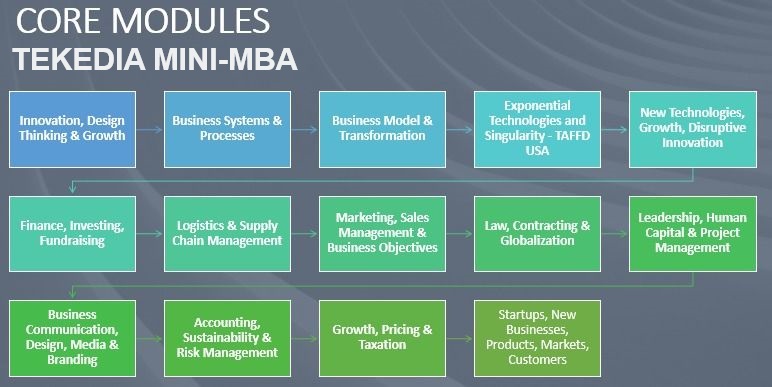
Here are the 12 tracks:

The program is completely capstone-based. Tekedia capstone is a research paper or a case study exploring a topic, market, sector or a company. It is the project component of Tekedia Min-MBA.

ALL Tekedia Programs and Costs Here

Selected Tekedia Mini-MBA Corporate Clients


Tekedia Mini-MBA Syllabus

Theme: Innovation, Growth & Digital Execution – Techniques for Building Category-King Companies

Introduction

Over the last few decades, digital technology has emerged as a very critical element in organizational competitiveness. It has transformed industrial sectors and anchored new business architectures, redesigning markets and facilitating efficiency in the allocation and utilization of factors of production. The impacts have been consequential: continents like Africa are moving towards knowledge-based economic structures and information societies, comprising networks of individuals, firms and states that are linked electronically and in interdependent relationships. In this program, we will examine this redesign within the context of fixing market frictions and deploying growth business frameworks in a world of perception demand where meeting needs and expectations of customers are not enough.

Program Time: Sep 14 – Dec 5, 2026

Venue & Format: Online via videos, articles, webinars, and flash cases. Program is self-paced which means you consume the materials at your own time and pace. It is completely online. Where you live or your time zone would not be an issue as program is not live-delivered.

Cost: US$170 (N120,000 naira). We have a payment plan, i.e. installment payment plan (email us for details)

Target Audience: This program is designed for professionals and students across functional areas like sales, marketing, technology, administration, legal, strategy, finance, etc across all business sectors and domains. The program is designed for:

  • Ambitious mid-level managers seeking to advance their careers by acquiring essential business knowledge and skills.
  • Busy professionals who value continued education but require a flexible alternative to a traditional MBA program.
  • Experienced professionals aiming to broaden their business acumen, enhance leadership capabilities, and explore new career opportunities.
  • Professionals in transition, committed to staying informed about business trends and developing skills for continuous professional growth.
  • Mid-level managers and executives across industries, driven to accelerate career growth and take on increased responsibilities.
  • Technology and innovation-focused professionals looking to strengthen business acumen and strategic thinking.
  • Aspiring entrepreneurs seeking a solid foundation in business management and growth strategies.
  • Consultants and advisors aiming to expand their knowledge base and provide comprehensive solutions to clients.
  • Professionals transitioning into new roles or industries, recognizing the value of upskilling for success.
  • Students and recent graduates seeking a competitive edge in the job market by combining academic qualifications with practical business skills.

Tekedia Mini-MBA program offers a flexible and comprehensive learning experience tailored to the needs of ambitious professionals, providing the tools and knowledge necessary to thrive in today’s dynamic business landscape. Participants will have the opportunity to acquire knowledge that has value and can be used in everyday business activities.

Learning Objectives: To innovate is to set a new basis of competition in an economy, business sector or market. Sometimes, it results in disruption. This program is designed for private (large, SMEs, startups, sole businesses), public and government institutions, and individuals. Participants will:

  • Master the mechanics of growth – the reward of innovation – through frameworks, cases and evolving strategies.
  • Understand how to undergo transformation journey that is fully aligned with corporate objectives through measurable and realizable benchmarks.
  • Acquire business capability tools that do not just RUN their firms but can TRANSFORM them.
  • Design corporate growth experiments in Lab sessions based on One Oasis Strategy, Aggregation Construct, Double Play Strategy, Accumulation of Capability Construct, and more.
  • ETC

Why Tekedia Institute

Interactive Online Learning: Engage with industry experts and fellow professionals through our state-of-the-art online learning platform, where you can access course materials, participate in discussions, and collaborate on real-world case studies.

Comprehensive Curriculum: Gain a deep understanding of key functional areas such as strategy, marketing, finance, operations, and more, equipping you with the knowledge and skills to excel in any business environment.

Practical Case Studies: Apply your learning to real-world scenarios through hands-on case studies and projects, allowing you to develop critical thinking and problem-solving skills.

Flexibility and Convenience: Access the program online from anywhere at your own pace, fitting your studies into your busy schedule without compromising your professional and personal commitments.

Expert Faculty: Learn from renowned industry practitioners and thought leaders who bring their expertise and real-world insights to the program, ensuring you receive the most relevant and up-to-date knowledge.

Benefits of Tekedia Mini-MBA

Enhance Your Leadership Potential: Unlock your leadership capabilities and develop the skills to lead teams, drive innovation, and navigate complex business challenges with confidence.

Master Business Excellence: Gain a holistic understanding of business functions, strategies, and best practices, enabling you to make informed decisions and contribute to organizational success.

Embrace Digital Transformation: Stay ahead of the curve by embracing digital technologies and leveraging them to transform your business and stay competitive in the digital age.

Accelerate Your Career: With the Tekedia Mini-MBA on your CV, you’ll stand out to employers, demonstrating your commitment to continuous learning and your readiness to take on new responsibilities.

Network and Collaboration: Connect with a diverse community of professionals, expand your network, and foster collaboration opportunities that can lead to future partnerships and career advancements.

Cost-Effective Investment: Enjoy the benefits of a comprehensive business education at a fraction of the cost of traditional MBA programs, maximizing the return on your investment.

Tekedia Institute offers the best business education in Nigeria and Africa you can get for value/

Tekedia Live Sessions

We run optional three Live Zoom sessions (two weekdays and one Saturday). This provides a way for our members to ask our Faculty and experts live questions and get feedback.

Tekedia Mini-MBA certificate sample

Tekedia Institute offers certificates at the end of all programs.

Our Contact Email: info@tekedia.com

Refund policy is full refund within 6 days from start of a program; after that, none, but we can defer as requested.

Lead Faculty of Tekedia Institute

Prof Ndubuisi Ekekwe is the Lead Faculty of Tekedia Institute

  • PhD, Electrical & Computer Engineering, Johns Hopkins University, USA
  • MBA, University of Calabar, Nigeria
  • BEng Electrical & Electronics Engineering ( Federal University of Technology, Owerri, Nigeria)

Prof Ndubuisi Ekekwe invented and patented a robotic system which the United States Government acquired assignee rights. Dr Ekekwe holds two doctoral and four master’s degrees including a PhD in engineering from the Johns Hopkins University, USA. He earned undergraduate degree from FUT Owerri where he graduated as his class best student. While in Analog Devices Corp, he co-designed an accelerometer for the iPhone. A recipient of IGI Global “Book of the Year” award, a TED Fellow, IBM Global Entrepreneur and World Economic Forum Young Global Leader, Prof. Ekekwe has held professorships in Carnegie Mellon University and Babcock University, and served in the United States National Science Foundation Committee.

The South African press called him “a doctor of innovation” for helping organizations on the mechanics of business innovation, strategy, and growth. Since 2009, the Chairman of Fasmicro Group which controls many startups and entities has been writing in the Harvard Business Review. He was recognized by The Guardian as one of 60 Nigerians Making “Nigerian Lives Matter” on Nigeria’s 60th Independence Day (Oct 1, 2020).

Enroll in Tekedia Mini-MBA today

Selected Faculty & Testimonials

We have more than 250 Faculty members; see the full list here.  For selected testimonials on our program, click here.