DD
MM
YYYY

PAGES

DD
MM
YYYY

spot_img

PAGES

Home Blog Page 26

The Economics of an Online Casino: Where Revenue Comes From and Where Costs Go

0

An online casino is more than a digital storefront for casino games. From a business perspective, it combines gaming products with software infrastructure, payment processing, marketing, customer support, compliance, and data management. Its financial performance therefore depends on considerably more than the amount players wager.

The basic economic flow begins with player wagers and payouts and continues through revenue deductions, customer acquisition expenses, technology costs, supplier payments, taxes, and regulatory obligations. Understanding this structure requires looking at several metrics, including Gross Gaming Revenue (GGR), Net Gaming Revenue (NGR), Return to Player (RTP), Customer Acquisition Cost (CAC), and Player Lifetime Value (LTV).

Together, these metrics help explain how an online casino converts gaming activity into revenue and how much of that revenue remains after the costs of operating the business.

How Online Casinos Generate Revenue

From wagers to Gross Gaming Revenue

Gross Gaming Revenue (GGR) is one of the central financial measures used in online gambling. At a basic level, GGR represents the difference between the amount wagered and the amount paid back to players as winnings.

For example, if players collectively wager $1 million and receive $950,000 in winnings, the resulting GGR would be $50,000. “GGR is an important starting point for understanding an online casino’s economics, but it should not be confused with profit. Operators still need to account for customer acquisition, technology, payment processing, game suppliers, taxes and compliance when assessing the business’s overall financial performance,” says Steve Thompson, Lead iGaming Auditor and founder of Pokies Australia. GGR should therefore be viewed as a top-line gaming metric rather than a measure of the operator’s final earnings.

RTP and house edge

The economics of individual casino games are closely connected to Return to Player (RTP) and house edge.

RTP represents the theoretical percentage of wagers that a game is designed to return to players over a sufficiently large number of plays. A game with a theoretical RTP of 96%, for example, has a corresponding theoretical house edge of 4%.

These figures describe mathematical expectations over large samples rather than the outcome of an individual player’s session. Actual short-term results can vary substantially.

For operators, game mathematics is important because it helps determine the expected relationship between wagering volume and GGR. For players, RTP provides information about the mathematical design of a game rather than a prediction of individual results.

From GGR to Net Gaming Revenue

GGR is not necessarily the amount an operator can use to cover its wider business expenses. Net Gaming Revenue (NGR) provides a measure that accounts for certain deductions from gaming revenue.

Depending on the operator and jurisdiction, NGR calculations may account for items such as bonuses, promotional costs, transaction fees and gaming taxes or duties.

This makes NGR particularly relevant when calculating affiliate commissions and evaluating the economics of customer acquisition. However, NGR is not defined identically across every market or commercial agreement, so published figures need to be interpreted according to the methodology used.

Where the Revenue Comes From

RNG slots and table games

RNG slots and digital table games are important product categories because software can serve many customers without requiring a physical casino floor.

Once a game has been integrated into an operator’s platform, serving additional players generally does not require the same type of incremental physical infrastructure as adding customers to a land-based casino. This creates potential operating efficiencies, although operators still incur costs for software licensing, platform infrastructure, customer support, payments, and regulatory compliance.

The mathematical characteristics of each game, including RTP and house edge, influence its expected long-term contribution to GGR.

Live dealer studios

Live dealer games introduce a different cost structure. Instead of relying entirely on automated game software, live casino products use real dealers, physical gaming equipment, cameras, production systems, and real-time streaming.

Companies such as Evolution and Pragmatic Play Live operate live casino products and studios serving online operators.

Live dealer games can increase product variety and provide a more interactive experience, but they also require substantially more operational infrastructure than a purely automated game. Studio staff, production facilities, broadcasting technology, and related overheads all contribute to the cost of delivering the product.

This creates a trade-off between the economics of automated digital games and the additional infrastructure required for live gaming.

Crash and fast games

Crash and other fast-paced games represent another product category within digital gambling. Their relatively short game cycles and mobile-friendly interfaces have helped them become part of the broader online gaming product mix.

From a business perspective, these games illustrate how operators and suppliers continue to experiment with different formats and user experiences. Their economic contribution still depends on factors such as player activity, game mathematics, retention, and the costs associated with supplying and operating the product.

VIP and high-roller programs

VIP and high-roller programs are designed around player retention and differentiated service. Rather than treating every customer identically, operators may offer different benefits based on activity, loyalty, or other criteria.

These programs can generate significant revenue from a relatively small customer segment. At the same time, they can create additional costs through personalized account management, promotional benefits, customer service, and risk monitoring.

This is where Player Lifetime Value (LTV) becomes particularly important. An operator needs to consider the expected long-term economic contribution of a customer alongside the costs involved in acquiring and retaining that customer.

Where the Money Goes

Generating GGR is only the beginning of the financial calculation. Online casino operators typically have several major categories of expenditure.

Game providers and aggregators

Most operators do not develop every casino game themselves. Instead, they can obtain games from specialized B2B developers and distribute them through direct integrations or game aggregators.

Game Providers & Aggregators may receive fees based on commercial agreements that can include revenue-sharing arrangements, fixed fees, or other structures. Industry discussions sometimes cite revenue-share ranges such as 8–15% of GGR, but there is no universal rate. Commercial terms can vary significantly according to the supplier, market, game portfolio, and negotiating relationship.

Aggregators can provide an additional business advantage by allowing operators to connect to multiple game studios through a common technical integration.

Affiliate marketing networks

Customer acquisition is another major expense.

Affiliate Marketing Networks connect operators with publishers and performance-marketing partners that introduce potential customers. Common commercial arrangements include Cost-Per-Acquisition (CPA), revenue share, and hybrid models.

Under a revenue-share agreement, the affiliate receives a percentage of the revenue generated by referred players. Some agreements can use percentages in the 20–45% range, although actual terms vary considerably.

The economic question for an operator is whether the cost of acquiring a customer is justified by that customer’s expected lifetime value.

Payment service providers and payment rails

Online casinos also depend on payment infrastructure to process deposits and withdrawals.

Payment Service Providers (PSPs) and payment rails can include card processors, Open Banking or account-to-account systems, digital wallets and, in some markets, cryptocurrency payment gateways.

Transaction costs can include processing fees, currency conversion charges, chargebacks, fraud-related losses, and withdrawal expenses. An illustrative transaction-fee range of 1.5–5% is sometimes used when discussing payment economics, but actual costs depend on the payment method, market, transaction profile and provider.

Payment infrastructure therefore affects both the cost of serving customers and the overall user experience.

Gaming taxes and regulatory duties

Taxes and regulatory charges can represent another significant component of an operator’s cost structure.

Depending on the jurisdiction, an operator may face gaming taxes, point-of-consumption taxes, gross-revenue levies, licensing fees, and annual regulatory charges.

The difference between markets can be substantial. For example, licensing and taxation arrangements in the UK, Malta, Ontario, and individual U.S. states are governed by different regulatory frameworks.

This means that geographic expansion is not simply a marketing decision. An operator must consider the licensing, tax, compliance, and technology requirements associated with each market.

Compliance and anti-fraud technology

Compliance is also an important part of the technology stack.

KYC and AML systems help operators verify customers and meet applicable identity and financial-crime requirements. Providers such as Sumsub and Onfido offer identity-verification technology, while companies such as GeoComply provide geolocation and related compliance solutions.

Operators can also use automated risk systems to identify unusual transactions, account activity, or other indicators requiring review.

These systems add operating costs, but they also form part of the infrastructure needed to operate within regulated markets.

Responsible gaming infrastructure

Responsible Gaming Infrastructure is another component of the operating model.

Depending on the jurisdiction, operators may need to provide tools such as deposit limits, time controls, self-exclusion mechanisms, and customer-interaction systems. Operators serving the UK market, for example, operate within a framework that includes GAMSTOP, a multi-operator online self-exclusion scheme.

These systems require technical integrations, monitoring, customer-service processes, and ongoing compliance work. They are therefore both a regulatory requirement in relevant markets and an operational component of the digital gambling business.

The Technology Stack Behind the Business

The economics of an online casino are closely connected to its underlying technology.

Player Account Management (PAM) platforms provide much of the infrastructure required to operate an online casino. Depending on the system, a PAM can manage player accounts, wallets, transactions, bonuses, game integrations, and other operational functions.

Companies such as EveryMatrix and SoftGamings operate in this technology segment.

Using an established PAM can allow an operator to access existing infrastructure instead of developing every component internally. However, the operator then needs to account for platform fees, integration costs, and its commercial relationship with the technology provider.

Independent testing and certification also form part of the technology ecosystem. Testing laboratories such as eCOGRA, iTech Labs, and GLI can assess gaming systems and software against relevant technical or regulatory requirements.

Testing adds another expense, but it can also support regulatory compliance and provide independent verification of technical characteristics such as game mathematics and RNG performance.

Why CAC and LTV Matter

Revenue figures alone provide an incomplete picture of an online casino’s economics.

Customer Acquisition Cost (CAC) measures how much an operator spends to acquire customers. Depending on the business model, this can include advertising, affiliate commissions, promotional incentives, and other acquisition-related expenses.

Player Lifetime Value (LTV), meanwhile, estimates the economic value a customer generates over their relationship with the operator.

The relationship between these metrics is particularly important. If acquiring a customer costs more than the value that customer is expected to generate after relevant costs, the acquisition strategy may be difficult to sustain. Conversely, an operator with effective retention and controlled acquisition costs may be able to generate more value from its marketing expenditure.

LTV can be influenced by factors including retention, wagering activity, payment costs, bonuses, product preferences, and customer-service expenses.

How Regulation Changes the Economics

Regulation influences almost every layer of an online casino’s business model.

The UK Gambling Commission (UKGC), Malta Gaming Authority (MGA), Curaçao Gaming Control Board (GCB), Alcohol and Gaming Commission of Ontario (AGCO), and U.S. state-level regulators operate under different frameworks and impose different licensing, technical, financial, and responsible-gambling requirements.

For example, the UKGC requires businesses providing remote gambling to consumers in Great Britain to hold the relevant operating licence. Licensing fees are also structured according to factors including the operator’s gross gambling yield.

Malta has its own licensing and taxation framework, including application fees, annual licence fees and gaming-tax requirements for relevant services.

Consequently, the economics of an online casino cannot be separated from the jurisdiction in which it operates. Market selection affects the potential customer base, but also determines many of the costs and compliance obligations attached to serving that market.

Conclusion: Revenue Is Only Half the Equation

The economics of an online casino can be understood as a sequence rather than a single revenue figure.

Players generate wagers; those wagers produce payouts, and the difference contributes to GGR. From there, bonuses, payment costs, taxes, and other applicable deductions can influence NGR. The operator must then account for game suppliers, marketing, technology, staff, compliance, responsible-gaming systems, and other operating expenses.

Metrics such as RTP, house edge, CAC, and LTV help connect the individual gaming product with the wider business model.

Ultimately, an online casino operates at the intersection of gaming, technology, payments, marketing, and regulation. Examining each component separately provides a clearer picture of how revenue is generated, how costs accumulate, and why the financial performance of different operators can vary even when their headline gaming activity appears similar.

Tekedia Mini-MBA Begins, Registration Continues

0

Invent, innovate and drive organizational transformation, performance, and growth. Capture emerging opportunities in changing markets while optimizing innovation and profitability. Digitally evolve your business or functional area, turning digital disruption into a competitive capability and advantage. Master the concepts of building category-king companies, and thrive.

Registration for another edition of Tekedia Mini-MBA opens. Tekedia Mini-MBA, from Tekedia Institute, is an innovation management 12-week program, optimized for business execution and growth, with digital operational overlay. It runs 100% online. The theme is Innovation, Growth & Digital Execution – Techniques for Building Category-King Companies. All contents are self-paced, recorded and archived which means participants do not have to be at any scheduled time to consume contents. Our programs are designed for ALL sectors, from fintech to construction, healthcare to manufacturing, agriculture to real estate, etc.

More so, the sector- and firm-agnostic management program comprises videos, flash cases, challenge assignments, labs, written materials, webinars, etc and is delivered by a global faculty coordinated by Prof Ndubuisi Ekekwe. When we finish, we will issue a certificate from the Tekedia Institute, Boston USA.

Register and join us. You will emerge transformed with tools and capabilities that engineer confidence, performance and growth.  Accelerate your leadership ascent with us! Here are our programs and costs.

Program Cost 

How To Register

Curriculum for Tekedia Mini-MBA


Unlock Your Potential: Enroll in Tekedia Institute

From Lead Faculty

Welcome! Unleash your leadership potential, master business excellence, and embrace transformation with Tekedia Mini-MBA. Join us and experience a cutting-edge business management & leadership program: online, self-paced, and world-class. At Tekedia Institute, we co-learn with thousands of professionals and students, from many countries, on the mechanics of business, connecting innovation, growth and operational execution, across market territories and industrial sectors.

Our faculty members come from Microsoft, Google, Shell, Flutterwave, Nigerian Breweries, NNPC, Jobberman, Coca Cola, PwC, BUA Cement, and other great organizations. Besides pre-recorded courseware, thrice weekly, we hold live Zoom sessions (Tue, Thur and Sat at 7pm WAT) – Prof Ndubuisi Ekekwe, Tekedia Institute Lead Faculty.

More Early Registration Benefits 

Capstone Program

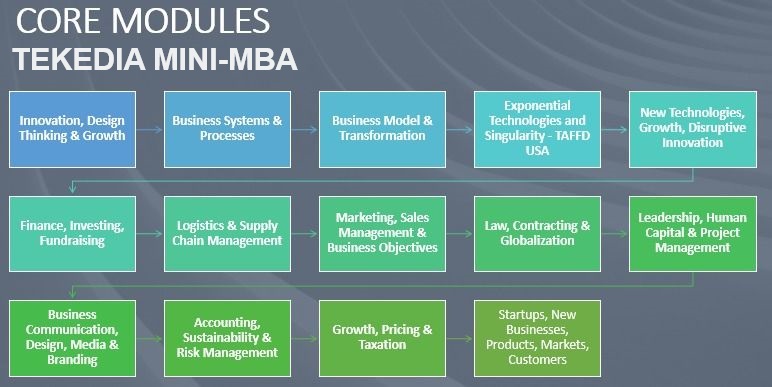
Here are the 12 tracks:

The program is completely capstone-based. Tekedia capstone is a research paper or a case study exploring a topic, market, sector or a company. It is the project component of Tekedia Min-MBA.

ALL Tekedia Programs and Costs Here

Selected Tekedia Mini-MBA Corporate Clients


Tekedia Mini-MBA Syllabus

Theme: Innovation, Growth & Digital Execution – Techniques for Building Category-King Companies

Introduction

Over the last few decades, digital technology has emerged as a very critical element in organizational competitiveness. It has transformed industrial sectors and anchored new business architectures, redesigning markets and facilitating efficiency in the allocation and utilization of factors of production. The impacts have been consequential: continents like Africa are moving towards knowledge-based economic structures and information societies, comprising networks of individuals, firms and states that are linked electronically and in interdependent relationships. In this program, we will examine this redesign within the context of fixing market frictions and deploying growth business frameworks in a world of perception demand where meeting needs and expectations of customers are not enough.

Program Time: Sep 14 – Dec 5, 2026

Venue & Format: Online via videos, articles, webinars, and flash cases. Program is self-paced which means you consume the materials at your own time and pace. It is completely online. Where you live or your time zone would not be an issue as program is not live-delivered.

Cost: US$170 (N120,000 naira). We have a payment plan, i.e. installment payment plan (email us for details)

Target Audience: This program is designed for professionals and students across functional areas like sales, marketing, technology, administration, legal, strategy, finance, etc across all business sectors and domains. The program is designed for:

  • Ambitious mid-level managers seeking to advance their careers by acquiring essential business knowledge and skills.
  • Busy professionals who value continued education but require a flexible alternative to a traditional MBA program.
  • Experienced professionals aiming to broaden their business acumen, enhance leadership capabilities, and explore new career opportunities.
  • Professionals in transition, committed to staying informed about business trends and developing skills for continuous professional growth.
  • Mid-level managers and executives across industries, driven to accelerate career growth and take on increased responsibilities.
  • Technology and innovation-focused professionals looking to strengthen business acumen and strategic thinking.
  • Aspiring entrepreneurs seeking a solid foundation in business management and growth strategies.
  • Consultants and advisors aiming to expand their knowledge base and provide comprehensive solutions to clients.
  • Professionals transitioning into new roles or industries, recognizing the value of upskilling for success.
  • Students and recent graduates seeking a competitive edge in the job market by combining academic qualifications with practical business skills.

Tekedia Mini-MBA program offers a flexible and comprehensive learning experience tailored to the needs of ambitious professionals, providing the tools and knowledge necessary to thrive in today’s dynamic business landscape. Participants will have the opportunity to acquire knowledge that has value and can be used in everyday business activities.

Learning Objectives: To innovate is to set a new basis of competition in an economy, business sector or market. Sometimes, it results in disruption. This program is designed for private (large, SMEs, startups, sole businesses), public and government institutions, and individuals. Participants will:

  • Master the mechanics of growth – the reward of innovation – through frameworks, cases and evolving strategies.
  • Understand how to undergo transformation journey that is fully aligned with corporate objectives through measurable and realizable benchmarks.
  • Acquire business capability tools that do not just RUN their firms but can TRANSFORM them.
  • Design corporate growth experiments in Lab sessions based on One Oasis Strategy, Aggregation Construct, Double Play Strategy, Accumulation of Capability Construct, and more.
  • ETC

Why Tekedia Institute

Interactive Online Learning: Engage with industry experts and fellow professionals through our state-of-the-art online learning platform, where you can access course materials, participate in discussions, and collaborate on real-world case studies.

Comprehensive Curriculum: Gain a deep understanding of key functional areas such as strategy, marketing, finance, operations, and more, equipping you with the knowledge and skills to excel in any business environment.

Practical Case Studies: Apply your learning to real-world scenarios through hands-on case studies and projects, allowing you to develop critical thinking and problem-solving skills.

Flexibility and Convenience: Access the program online from anywhere at your own pace, fitting your studies into your busy schedule without compromising your professional and personal commitments.

Expert Faculty: Learn from renowned industry practitioners and thought leaders who bring their expertise and real-world insights to the program, ensuring you receive the most relevant and up-to-date knowledge.

Benefits of Tekedia Mini-MBA

Enhance Your Leadership Potential: Unlock your leadership capabilities and develop the skills to lead teams, drive innovation, and navigate complex business challenges with confidence.

Master Business Excellence: Gain a holistic understanding of business functions, strategies, and best practices, enabling you to make informed decisions and contribute to organizational success.

Embrace Digital Transformation: Stay ahead of the curve by embracing digital technologies and leveraging them to transform your business and stay competitive in the digital age.

Accelerate Your Career: With the Tekedia Mini-MBA on your CV, you’ll stand out to employers, demonstrating your commitment to continuous learning and your readiness to take on new responsibilities.

Network and Collaboration: Connect with a diverse community of professionals, expand your network, and foster collaboration opportunities that can lead to future partnerships and career advancements.

Cost-Effective Investment: Enjoy the benefits of a comprehensive business education at a fraction of the cost of traditional MBA programs, maximizing the return on your investment.

Tekedia Institute offers the best business education in Nigeria and Africa you can get for value/

Tekedia Live Sessions

We run optional three Live Zoom sessions (two weekdays and one Saturday). This provides a way for our members to ask our Faculty and experts live questions and get feedback.

Tekedia Mini-MBA certificate sample

Tekedia Institute offers certificates at the end of all programs.

Our Contact Email: info@tekedia.com

Refund policy is full refund within 6 days from start of a program; after that, none, but we can defer as requested.

Lead Faculty of Tekedia Institute

Prof Ndubuisi Ekekwe is the Lead Faculty of Tekedia Institute

  • PhD, Electrical & Computer Engineering, Johns Hopkins University, USA
  • MBA, University of Calabar, Nigeria
  • BEng Electrical & Electronics Engineering ( Federal University of Technology, Owerri, Nigeria)

Prof Ndubuisi Ekekwe invented and patented a robotic system which the United States Government acquired assignee rights. Dr Ekekwe holds two doctoral and four master’s degrees including a PhD in engineering from the Johns Hopkins University, USA. He earned undergraduate degree from FUT Owerri where he graduated as his class best student. While in Analog Devices Corp, he co-designed an accelerometer for the iPhone. A recipient of IGI Global “Book of the Year” award, a TED Fellow, IBM Global Entrepreneur and World Economic Forum Young Global Leader, Prof. Ekekwe has held professorships in Carnegie Mellon University and Babcock University, and served in the United States National Science Foundation Committee.

The South African press called him “a doctor of innovation” for helping organizations on the mechanics of business innovation, strategy, and growth. Since 2009, the Chairman of Fasmicro Group which controls many startups and entities has been writing in the Harvard Business Review. He was recognized by The Guardian as one of 60 Nigerians Making “Nigerian Lives Matter” on Nigeria’s 60th Independence Day (Oct 1, 2020).

Enroll in Tekedia Mini-MBA today

Selected Faculty & Testimonials

We have more than 250 Faculty members; see the full list here.  For selected testimonials on our program, click here.

How to Transfer Data from iPhone to Android on iOS 27 without a Factory Reset

0

Moving data can be difficult when your Android phone is already set up. Fortunately, you can Transfer data from iPhone to Android without resetting iOS 27 using methods such as Android Switch, Tenorshare iTransGo, Samsung Smart Switch, and Google Services. Compare these four options to find the best way to transfer your contacts, photos, videos, messages, and other data.

Part 1. What You’ll Need to Transfer Data from iPhone to Android without Resetting iOS 27

Before transferring data from iPhone to Android without resetting iOS 27, make sure the Android phone has enough storage and both devices have sufficient battery. Keep your iPhone unlocked and prepare a compatible USB cable or stable Wi-Fi connection, depending on the transfer method.

Create a fresh iPhone backup using iCloud or another method, and sign in to the Google Account you plan to use on Android. Keep both devices available throughout the transfer, and do not delete any data from your iPhone until you confirm that everything has transferred successfully.

Part 2. Which Method Should You Choose to Transfer Data from iPhone to Android?

The best method depends on your Android brand, Android version, setup status, the types of data you want to move, and whether you have access to a computer. If you need selective transfer after setup, iTransGo offers a more direct option. Android Switch and Smart Switch work well when your device supports their transfer features, while Google Services works better for selected cloud-synced data.

Method Best For Setup Status Main Data Computer
Android Switch Supported Android phones Depends on device Photos, contacts, files, messages Usually no
iTransGo Selective cross-brand transfer After setup Photos, videos, contacts, messages, calendars, music Yes
Samsung Smart Switch Samsung Galaxy Depends on Galaxy model Photos, contacts, messages, calendars, files Optional
Google Services Selected cloud data After setup Photos, contacts, calendars, files No


Part 3. How to Transfer Data from iPhone to Android without Resetting

If you are deciding how to transfer data from iPhone to Android, first check whether your Android phone supports a built-in transfer option. If it does not meet your needs, you can use a computer-based tool or move selected content through Google Services. The four routes below can help you Transfer data from iPhone to Android while keeping the existing Android setup, but supported data and device compatibility differ.

Method 1. Transfer Data with Android Switch on iOS 27

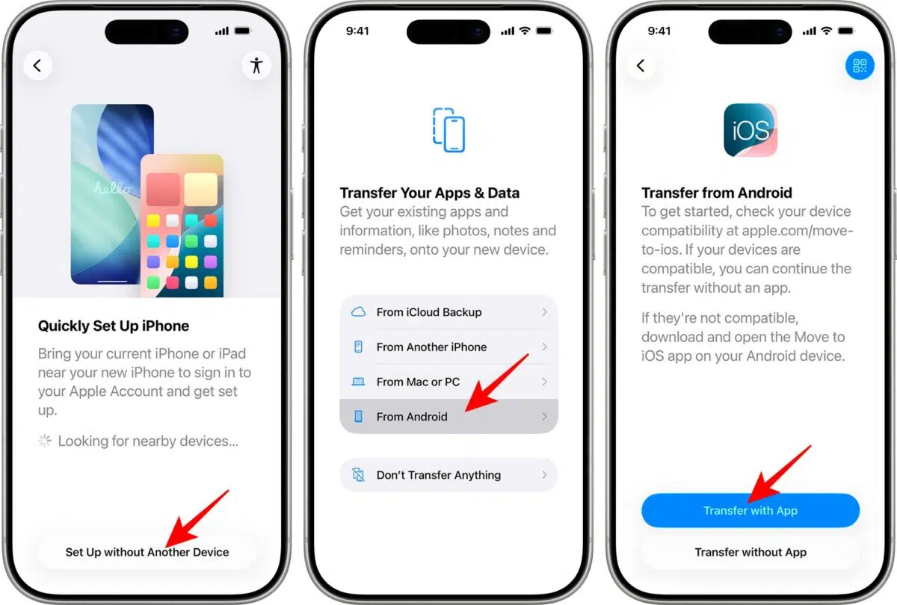
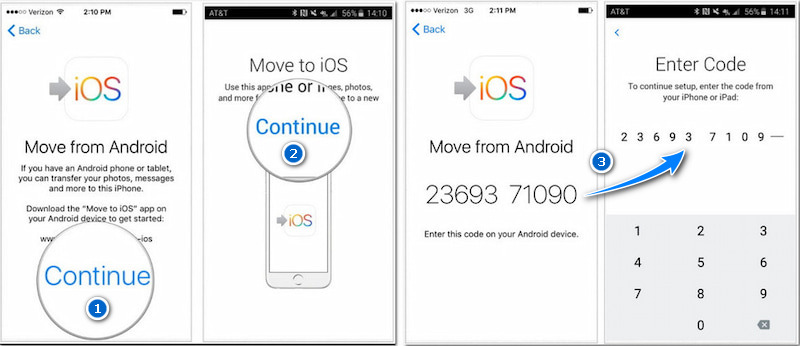
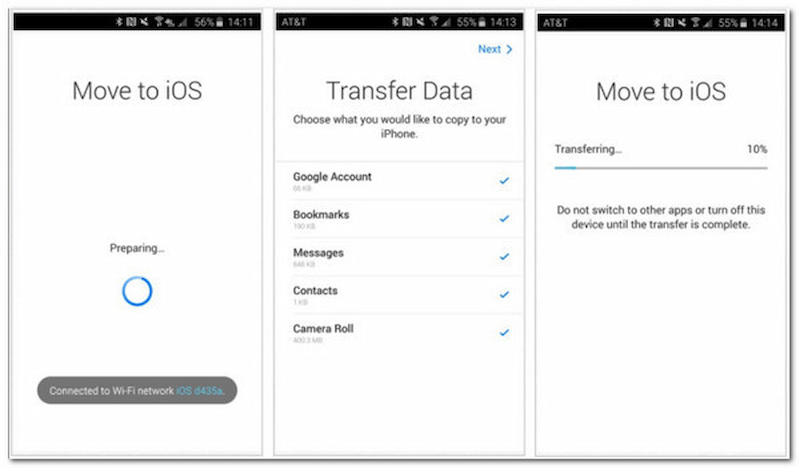
Android Switch offers an official way to transfer supported iPhone data to compatible Android phones. Depending on the device and Android version, some phones may support post-setup transfers without resetting. If you want to Transfer data from iPhone to Android without resetting iOS 27, check your Android phone’s transfer settings first.

Steps to Transfer Data with Android Switch

Step 1: Open the Settings app on your Android phone and look for the data-transfer or backup option. Select the option that lets you bring data from an iPhone.

Open the Settings app

Step 2: Connect your iPhone to the Android phone using a compatible cable, or select the wireless option if your Android model supports it.

select the wireless option

Step 3: Unlock your iPhone and approve the required permission when prompted. Select the supported photos, contacts, messages, or other data that you want to move.

data that you want to move

Step 4: Start the transfer and keep both phones connected and available until the process finishes. Check the transferred content on Android afterward.

Limitation: Android Switch does not offer the same post-setup transfer options on every Android phone. Supported data categories can also vary by device and Android version.

Method 2. Transfer Data from iPhone to Android after Setup with iTransGo

Tenorshare iTransGo suits users who already set up their Android phone and want to keep its existing content. It provides a computer-based way to Transfer data from iPhone to Android without resetting iOS 27 instead of making you start the Android setup again. You can select supported data categories and transfer only what you need. iTransGo also supports cross-brand iPhone-to-Android transfers, making it useful when your phones come from different manufacturers.

Key Benefits of iTransGo

  • No factory reset: Keep the existing Android setup while transferring supported iPhone data.
  • Selective transfer: Choose the data categories you want instead of moving everything.
  • Cross-brand transfer: Move supported content between an iPhone and different Android brands.
  • Computer-based process: Use a USB connection instead of depending on a wireless phone-to-phone transfer.

Steps to Transfer Data with iTransGo

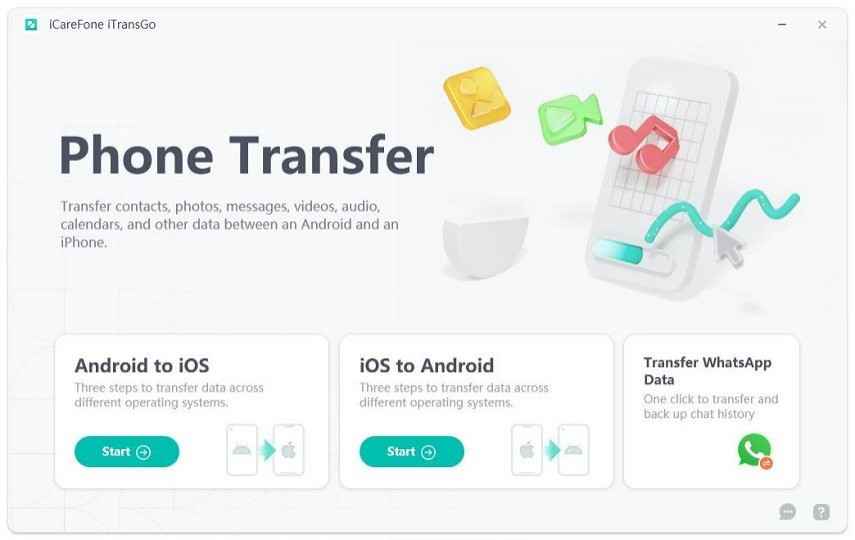
Step 1: Download and install iCareFone iTransGo on your computer. Open the program and select the iOS to Android transfer option from the main interface to begin the process.

Download and Launch iCareFone iTransGo

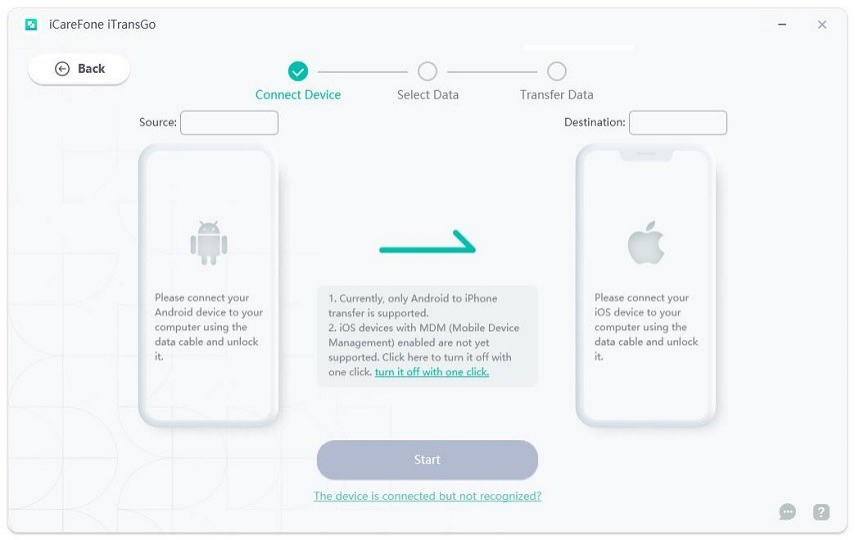
Step 2: Connect both your iPhone and Android phone to the computer using USB cables. On the iPhone, tap Trust when the permission prompt appears. On Android, follow the on-screen instructions to enable USB debugging so iTransGo can detect the device.

Connect Your iPhone and Android Phone

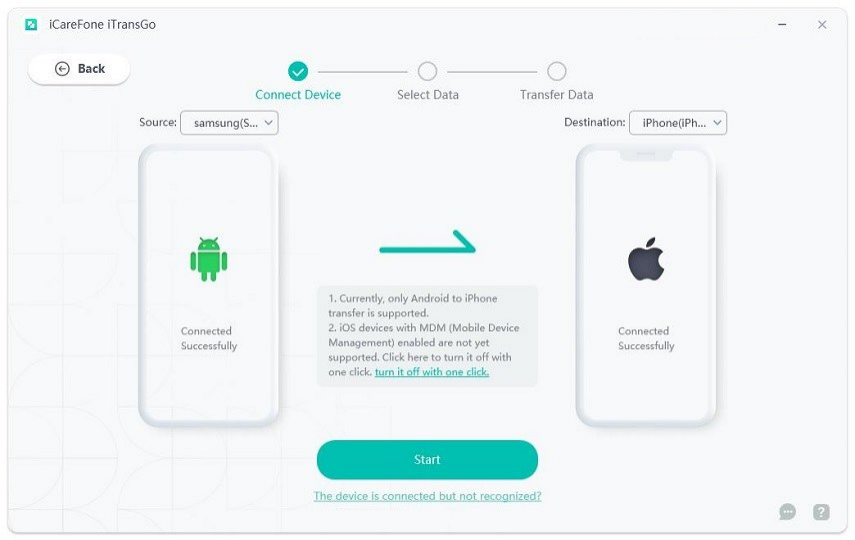
Once both phones appear in the program, check that the iPhone is the source device and the Android phone is the target device, then click Start.

Click Start

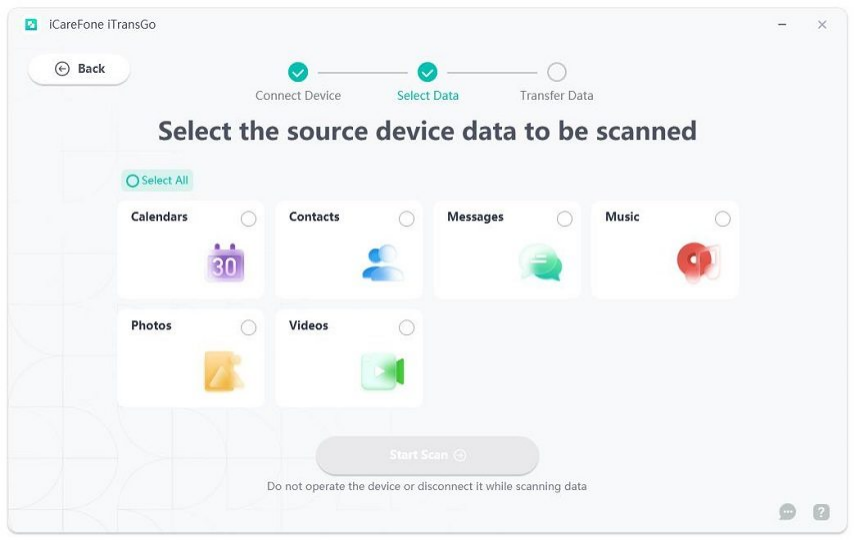
Step 3: Scan and Select the Data You Want to Transfer

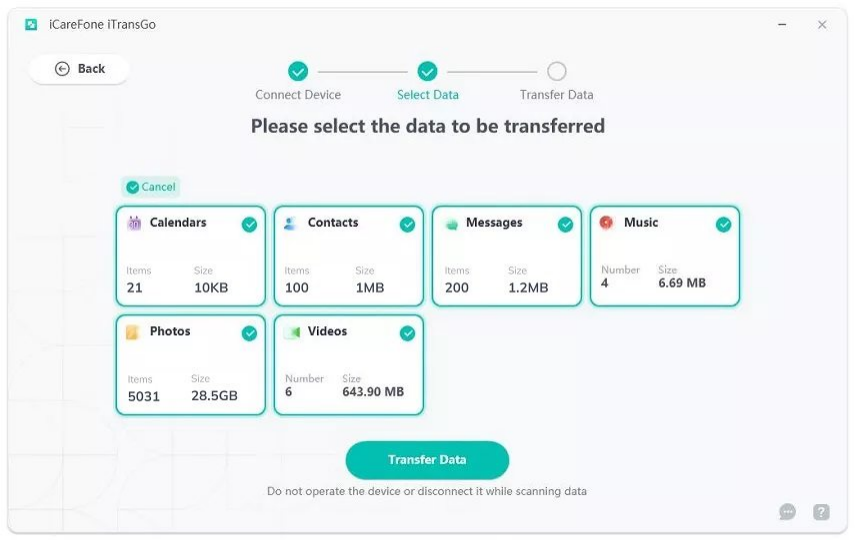
Select the data categories you want to move from your iPhone, then click Start Scan. iTransGo will scan the source device and display the available data with its size and quantity. Review the results, select the content you need, and click Transfer Data to begin.

Scan and Select the Data You Want to Transfer

If the program asks for additional permissions, follow the on-screen instructions before continuing.

program asks for additional permissions

Step 4: Transfer the Selected Data to Android

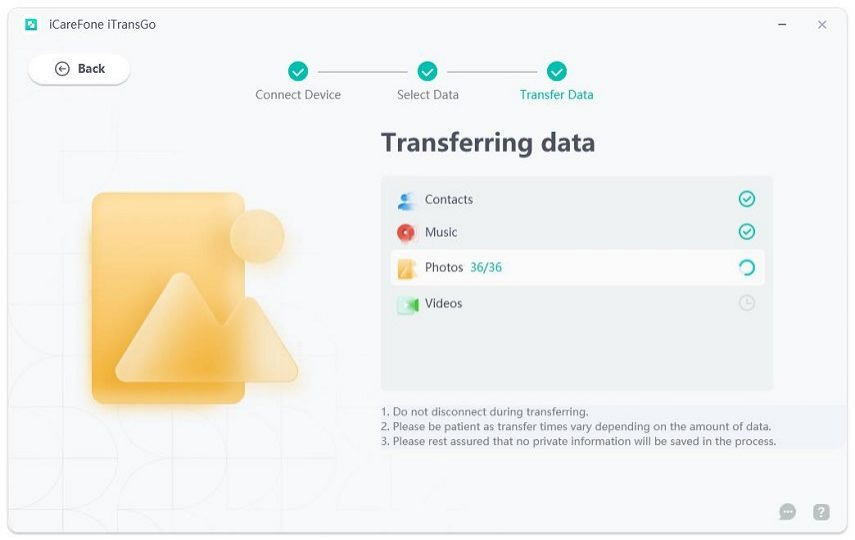
iTransGo will transfer the selected content from your iPhone to the Android phone. Keep both devices connected throughout the process and do not disconnect either phone until the transfer finishes. The required time depends on the amount of data you selected.

Transfer the Selected Data to Android

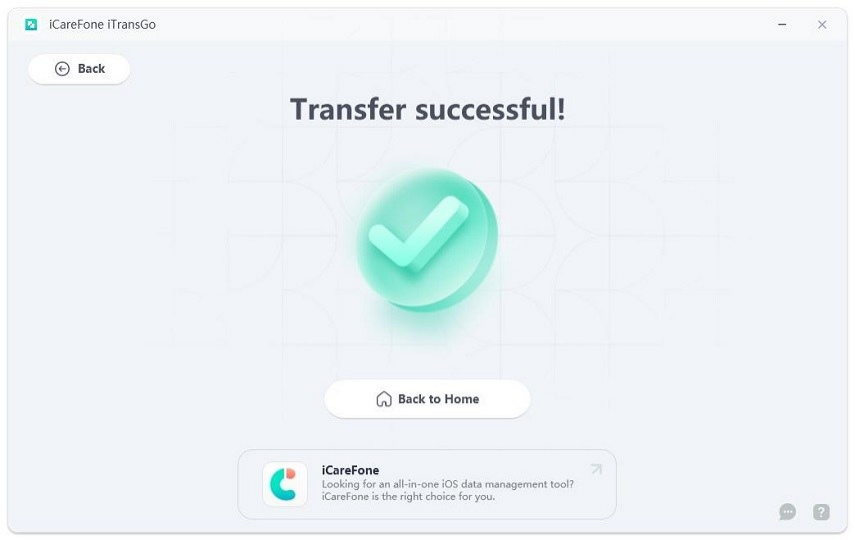
When the transfer completes, open your Android phone and check the transferred contacts, photos, videos, messages, and other supported content.

transfer completes

Limitation: iTransGo does not transfer every type of iPhone data or third-party app data. Check the supported data categories before starting your transfer.

Method 3. Transfer Data from iPhone to Samsung with Smart Switch

Samsung Smart Switch lets you transfer data from iPhone to compatible Samsung Galaxy phones via cable, wireless connection, or iCloud. It can transfer contacts, photos, videos, messages, calendars, and files, though some iPhone data may not be supported.

Steps to Transfer Data with Smart Switch

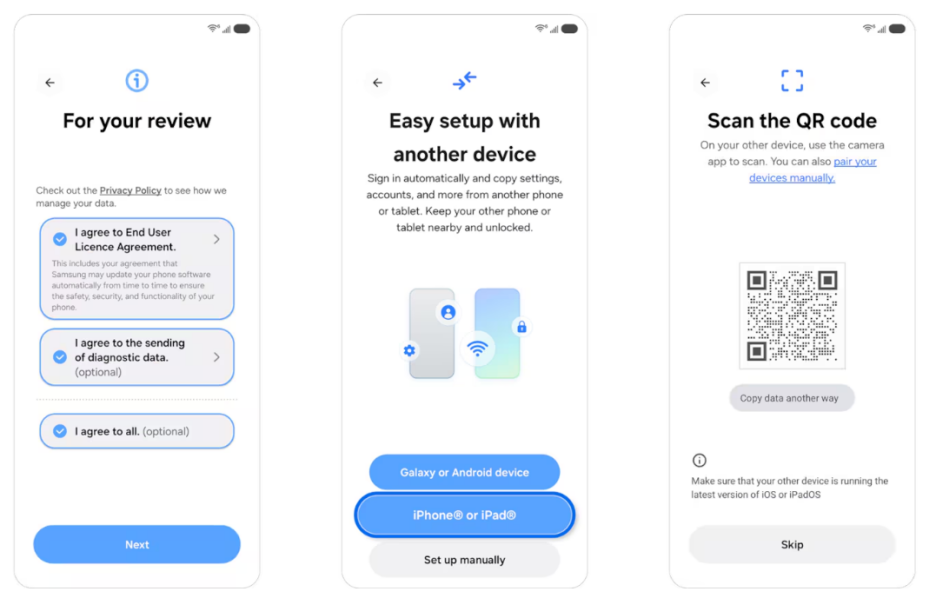
Step 1: Turn on your Galaxy and select iPhone or iPad when prompted. Scan the QR code with your iPhone Camera, keep both phones nearby, and tap Continue.

Start Galaxy setup and connect your iPhone

Step 2: On the Galaxy phone, tap Next, review the Smart Switch information, and allow the requested permissions. Continue on your iPhone and select the photos, contacts, messages, apps, or other supported content you want to move.

Step 3: After selecting your data, keep both phones close together and let Smart Switch begin the transfer. Watch the progress on the Galaxy screen and avoid closing the transfer screens or moving the devices away from each other until the process finishes.

Step 4: Complete the Galaxy setup by choosing your screen lock and reviewing Google and Samsung service settings. When setup finishes, open the Smart Switch notification to review the transfer results. Check your important content, turn off iMessage on the iPhone, and download remaining iCloud data if the available option supports it.

Limitation: Smart Switch mainly targets Samsung Galaxy devices, so it does not provide the same transfer experience on other Android brands. Some iPhone data may also remain unsupported.

Method 4. Transfer Data from iPhone to Android Wirelessly with Google Services

Google Services can help when you only need selected iPhone content rather than a full device transfer. This approach lets you transfer data from iPhone to Android wirelessly through services such as Google Photos, Google Contacts, Google Calendar, and Google Drive. You can upload your content from the iPhone and access it on Android by signing in to the same Google Account. This method works well for photos, videos, contacts, calendars, and supported files.

Steps to Transfer Data with Google Services

Step 1: Install Google Photos on your iPhone, sign in to your Google Account, and turn on backup. Keep the app active until your photos and videos finish uploading.

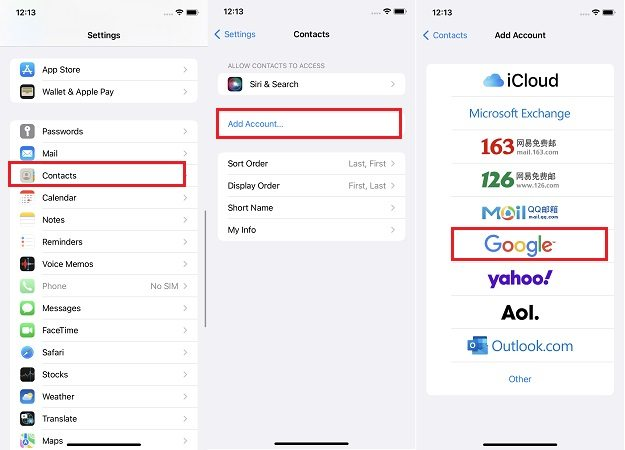
Step 2: Add your Google Account to the iPhone and enable contact and calendar syncing where supported. Then sign in to the same account on your Android phone.

Step 3: Open Google Drive on your iPhone and upload the documents or other supported files you want to access on Android.

Add your Google Account

Step 4: Open Google Photos, Contacts, Calendar, and Drive on your Android phone using the same Google Account. Check your uploaded and synced content before deleting anything from the iPhone.

Limitation: Google Services does not provide a complete phone-to-phone migration. You need to handle different data types through their separate Google services, and some iPhone content may not have a direct equivalent.

FAQs

1. Can I Transfer iPhone Data to Android after Setup?

Yes. You can transfer data from iPhone to Android after setup, depending on your Android device. Some phones support post-setup transfers, while others may require a third-party tool or cloud service. If you want to keep existing data, choose a method that supports merging or selective transfer.

2. Does Transferring Data from iPhone to Android Erase Existing Data?

No. Transferring data does not always require erasing your Android phone. iTransGo supports transfer data from iPhone to Android without resetting iOS, while cloud services can add selected content to an existing device. Always back up important data first.

3. Can I Transfer All Data from iPhone to Android?

Not necessarily. Contacts, photos, videos, calendars, messages, and files can often be transferred, but some apps, passwords, protected media, and app-specific data may not transfer. Check the supported data types before starting.

4. How Can I Transfer Data from iPhone to Android without a Cable?

You can use cloud services or wireless transfer features. Google Photos can transfer photos and videos, Google Contacts can sync contacts, and Google Drive can store supported files. Some Android and Samsung phones also support wireless transfers.

5. Should I Turn Off iMessage before Switching to Android?

Yes. Turn off iMessage and FaceTime before switching to Android to prevent messages from continuing through iMessage. If you no longer have your iPhone, Apple also provides a way to deregister your number from iMessage.

Conclusion

You have several ways to Transfer data from iPhone to Android without resetting iOS 27. Android Switch works on supported devices, Smart Switch fits Samsung Galaxy users, and Google Services works well for selected cloud-based content. If you need transfer data from iPhone to Android without resetting iOS on an already configured phone, Tenorshare iTransGo is a practical choice for selective cross-brand transfers. Try Tenorshare iTransGo to move the supported iPhone data you need without a factory reset.

Sen. Cynthia Lummis Accuses Democrats of Prioritizing Politics After CLARITY Act Fails to Advance in Senate

0

Republican U.S. senator representing Wyoming Sen. Cynthia Lummis, has accused Democrats of putting politics ahead of progress, after the CLARITY Act failed to advance in the U.S. Senate, dealing a setback to efforts to establish a comprehensive regulatory framework for the cryptocurrency industry.

In a statement following the vote, Lummis said Democrats proved they were never truly serious about protecting consumers and preserving American leadership.

She argued that after more than a year of negotiations and substantial concessions, the opposition amounted to political gamesmanship rather than genuine policy disagreement.

She wrote on X,

This afternoon, Senate Democrats proved they were never truly serious about protecting consumers and preserving American leadership. I sat at the table with Senate Democrats working in good faith to get this done while they played games. For over a year, they presented demands and the second we met them, they made new demands and moved the goalposts. Today they voted against real limitations on politicians’ personal crypto investments. They voted against protecting American consumers from the scammers and fraudsters this bill would have shut down.

They voted against American leadership, and handed China and every one of our foreign competitors exactly what they wanted. Democrats chose politics over the American people—again. That’s not leadership on their part, that’s surrender to their radical, socialist base. The once-proud Democratic Party is anti-consumer and pro-illicit finance, anti-ethics, anti-free enterprise, anti-worker, anti-livable wage jobs, and pro-socialism. The Democrats are now anti-American. Sad!”

The Senate voted 49-50 against invoking cloture on the motion to proceed to H.R. 3633. The measure needed 60 votes to advance to full debate. All Democrats opposed the motion.

Lummis, the bill’s lead Senate architect, had framed Tuesday’s vote as “now or never.” Ahead of the tally she told reporters that if the cloture motion failed, “I think we’re done. It’s over,” noting that sponsors had already granted more than 120 Democratic requests. On the Senate floor, she urged colleagues to “vote yes” and lead the digital age rather than cede ground to foreign competitors.

The CLARITY Act aimed to establish the first comprehensive federal regulatory framework for digital assets. It would have clarified jurisdiction between the Securities and Exchange Commission and the Commodity Futures Trading Commission, set rules for trading, stablecoins, and decentralized finance, and included consumer protections and ethics restrictions on public officials’ involvement with crypto assets.

Republicans released what they described as the final text on September 14, incorporating 126 substantive changes Democrats requested over months of bipartisan talks.

The updated version featured strengthened ethics language, including a role for state attorneys general in enforcement and restrictions covering the president, vice president, members of Congress, federal judges, and their spouses—provisions Republicans said reflected all of a bipartisan ethics proposal substantially.

Democrats who had engaged in negotiations ultimately voted no. Concerns centered on whether the ethics provisions adequately addressed potential conflicts of interest, particularly those involving President Donald Trump’s crypto-related businesses, as well as remaining issues around enforcement, illicit finance, and other safeguards. Some argued the language still fell short of preventing personal profit from the industry while setting its rules.

The House had passed an earlier version of the bill by a wide bipartisan margin in 2025. The Senate Banking Committee advanced related text earlier in 2026. The failure leaves the legislation stalled with limited time remaining on the congressional calendar before midterm elections and the subsequent recess.

While the bill remains on the calendar and could theoretically return, Lummis expressed strong skepticism about further progress this year.

The outcome marks a significant setback for the cryptocurrency industry, which had invested heavily in lobbying for market-structure legislation to replace regulatory uncertainty with clear rules.

Markets reacted with declines in bitcoin and shares of major crypto firms following the vote. With comprehensive congressional action now unlikely in the near term, attention is expected to shift to ongoing rulemaking efforts by the SEC and CFTC.

Samsung Backs Dutch AI Chip Startup Euclyd in $231 Million Round to Challenge Nvidia

0

Samsung has backed Dutch artificial intelligence chip startup Euclyd in a $231 million funding round, adding another major semiconductor company to a growing wave of investment aimed at challenging Nvidia’s dominance of the AI computing market.

Euclyd, founded in 2024, raised 200 million euros in its Series A round from Somerset Capital Partners, EQT’s Scaleup Europe Fund and Innovation Industries, which co-led the financing alongside Samsung, the company’s chief executive Bernardo Kastrup told CNBC.

The startup is developing an AI computing system built around an architecture different from the graphics processing units that have made Nvidia the dominant supplier of advanced AI chips. Euclyd is initially focusing on inference, the process of running trained AI models to generate responses and perform tasks.

Nvidia became the world’s most valuable company after its GPUs, initially developed primarily for gaming and graphics, became the industry standard for training and running sophisticated AI models. The company has established a near monopoly in the highest-end AI accelerator market, creating an enormous commercial opportunity for competitors seeking to offer alternatives on price, energy consumption or specialized performance.

The competitive landscape is already widening.

Hyperscalers including Google, Amazon Web Services and Meta are developing their own processors for AI workloads, while OpenAI announced in August that its first AI chip, Jalapeño, delivered what it described as “industry-leading speed and efficiency.”

For startups such as Euclyd, the opportunity is not necessarily to replicate Nvidia’s GPU architecture but to question whether the same computing approach will remain optimal as AI workloads evolve.

“AI is becoming a foundation of economic growth, scientific discovery and national competitiveness, but its potential will remain constrained unless we fundamentally change the infrastructure beneath it,” Kastrup said.

Euclyd is betting that inference presents an especially attractive opening.

Training a frontier AI model can require enormous amounts of computing power, but once a model is deployed, the number of times it is queried can quickly become much larger. As companies integrate AI into customer service, software development, enterprise search and other applications, the cost and energy required to generate those responses can become a significant part of operating expenses.

That creates room for specialized hardware if it can deliver lower power consumption and lower costs without sacrificing performance.

Euclyd said its silicon systems for foundation models are designed to reduce the energy requirements and costs of AI data-center infrastructure. The company has not yet demonstrated its technology through commercial deployments at scale, leaving a significant gap between its architectural claims and what customers will ultimately pay for.

Samsung’s Bigger Role Beyond the Investment

Samsung’s involvement could nevertheless give Euclyd an advantage that goes beyond capital.

Kastrup said the South Korean technology giant can contribute memory expertise, engineering capabilities and supply-chain relationships as Euclyd moves from chip design toward physical systems.

“Samsung can help us in more ways than money,” Kastrup said. “They are one of the biggest memory manufacturers in the world. They do a lot of engineering, they know a lot about systems, they know the supply chain, they have a huge network.”

Samsung’s involvement is crucial because AI accelerators are not standalone products. Their performance depends heavily on the interaction between processing, memory bandwidth, packaging, networking, and the broader data-center architecture.

The recent AI-chip boom has exposed bottlenecks well beyond processor design, particularly in advanced memory. High-bandwidth memory has become one of the most important components in AI infrastructure, while packaging and manufacturing capacity can determine how quickly promising chip designs reach customers.

Samsung’s position across memory and semiconductor manufacturing therefore potentially gives Euclyd access to capabilities that a young chip designer would struggle to build independently.

The investment also shows that the AI-chip race is becoming less concentrated around the question of who can produce the fastest accelerator.

For years, Nvidia’s advantage was reinforced by the combination of its GPUs, software ecosystem and close relationships with cloud providers and AI developers. Competing directly on raw computing performance is therefore extremely difficult.

A startup with a different architecture can instead target a narrower problem, such as inference efficiency, where customers may care less about peak performance and more about the cost of running millions or billions of AI queries.

Euclyd is pursuing two business models. It plans to sell hardware and complete physical rack systems to enterprises that want to run AI inference on their own infrastructure, particularly where security and control make self-hosting attractive. It also plans to license its intellectual property to companies that want to develop their own processors using Euclyd’s existing technology.

The second model could potentially give the company a way to scale beyond the number of physical systems it can manufacture and deploy itself. But it also introduces a different competitive challenge: customers buying intellectual property will need to believe that Euclyd’s architecture offers enough of an advantage to justify developing around it rather than using established chip platforms.

Euclyd expects to begin rolling out its physical chip systems in 2028 and aims to serve thousands of enterprise customers by 2030, according to Kastrup. Those targets are ambitious given that the company is only two years old and has yet to demonstrate its systems in large-scale commercial deployments.

The funding nevertheless shows how investors are becoming more willing to finance alternatives to Nvidia at a time when demand for AI computing remains exceptionally strong. The opportunity is attracting both startups and the largest technology companies, with hyperscalers developing internal chips to reduce dependence on external suppliers and improve control over the economics of their AI infrastructure.

Nvidia’s position has been built not only on chip performance but also on software, developer adoption and scale. Any challenger must therefore demonstrate more than an attractive processor design. It must prove that customers can deploy the technology reliably, that developers can build for it efficiently and that the total cost of ownership is materially better.

Euclyd’s focus on inference could give it a narrower path into the market. If AI usage continues expanding, inference could become a larger and more persistent infrastructure expense than the current training boom suggests. Lower energy consumption and cheaper computation would then become commercial advantages rather than simply technical specifications.

Samsung’s investment gives that bet additional semiconductor credibility, especially because memory and system engineering are becoming as important to AI infrastructure as the accelerator itself. But the real test will come in 2028 and beyond, when Euclyd’s systems are expected to reach customers. Until then, the company remains an ambitious challenger in a market where Nvidia’s technological and ecosystem advantages are substantial.

While the funding signals investor confidence that the AI-chip market will support multiple architectures, it does not yet prove that Euclyd can displace Nvidia. The more immediate bet is that the next phase of AI computing will reward companies that can make inference cheaper, more energy-efficient, and easier to deploy, rather than simply making another faster GPU.