DD
MM
YYYY

PAGES

DD
MM
YYYY

spot_img

PAGES

Home Blog Page 40

NYT Escalates Legal War With Perplexity, Accuses Startup of Lifting and Monetizing Its Journalism

0

The New York Times has taken its fight against Perplexity to a new level, filing a lawsuit in federal court that accuses the fast-growing AI startup of systematically lifting, reproducing, and monetizing the newspaper’s journalism without permission.

The complaint, submitted Friday in the Southern District of New York, alleges that Perplexity “unlawfully crawls, scrapes, copies, and distributes” Times content — often in forms that the Times says are either verbatim reproductions or so close that they function as substitutes for the original work. The lawsuit says the Times repeatedly warned Perplexity to stop, issuing cease-and-desist letters last year and again in July, but the company allegedly continued the practice.

The accusation arrives after months of scrutiny from news outlets whose paywalled reporting has been turning up inside Perplexity’s summaries. Investigations by Forbes and Wired earlier this year found that the startup’s systems had been bypassing standard protections — including the industry-accepted robots.txt file — to harvest material behind paywalls.

The Times is making the same claim, arguing that Perplexity’s crawlers “intentionally ignored or evaded technical content protection measures” that publishers use to control which parts of their sites automated tools can access.

The paper argues that the consequences are direct and measurable: if Perplexity delivers Times reporting to users in ready-made form, the user no longer needs to subscribe, click through, or visit the Times website. That, the lawsuit says, undercuts the revenue streams the outlet depends on — subscription, advertising, licensing, and affiliate income — all while Perplexity positions the appropriated content inside a for-profit AI product.

Perplexity, founded in 2022, markets itself as an “answer engine” built on generative AI. Its pitch is simple: instead of searching, you ask questions, and the system produces a consolidated answer drawn from the web. The model has gained traction quickly, attracting investors and positioning itself as a challenger to ChatGPT and Google’s AI search experiments. That rise has also meant increasing friction with publishers who believe Perplexity is building a business on other people’s work.

The lawsuit lands amid a broader wave of legal pressure on the startup ecosystem. One day before the Times filed its case, the Chicago Tribune brought its own copyright lawsuit against Perplexity, also accusing the company of bypassing paywalls and repackaging its content. More broadly, the Times itself is no stranger to legal battles with AI firms: it sued OpenAI in December 2023 over similar claims, before eventually reaching a licensing deal that allows Amazon to bring Times content to products like Alexa.

The legal landscape around AI training and output remains unsettled. Major AI firms argue that scraping publicly available content is protected under fair use, and that generated summaries are distinct creative outputs. News publishers counter that AI systems powered by their articles are siphoning off their audience and financially undermining the journalism that AI companies rely on.

Perplexity has attempted in recent months to show publishers it wants a cooperative relationship, launching a revenue-sharing program last year and later expanding it to include its Comet web browser in August. But the Times says the startup’s current practices still amount to unauthorized copying.

“By copying The Times’s copyrighted content and creating substitutive output derived from its works, obviating the need for users to visit The Times’s website or purchase its newspaper, Perplexity is misappropriating substantial subscription, advertising, licensing, and affiliate revenue opportunities that belong rightfully and exclusively to The Times,” the complaint states.

Perplexity pushed back in a statement sent to The Verge. Spokesperson Jesse Dwyer said: “Publishers have been suing new tech companies for a hundred years, starting with radio, TV, the internet, social media and now AI. Fortunately it’s never worked, or we’d all be talking about this by telegraph.”

The Times is seeking damages and a permanent injunction that would bar Perplexity from what it describes as unlawful scraping and redistribution of its journalism. What the federal court decides could set one of the most consequential precedents yet in the standoff between generative AI companies and the news industry — a conflict that now stretches from OpenAI to Google, xAI, and a long list of AI upstarts whose systems rely on the work of reporters they neither employ nor pay.


Ana Marie Caballero Launches a free mint for her Latest Work “In Record Time” on OpenSea.

0

Ana María Caballero, the acclaimed poet and blockchain artist known for blending verse with digital collectibles, is launching a free mint for her latest work, “In Record Time”, on OpenSea.

This drop builds on her ongoing “Paperwork” series, which explores themes of bureaucracy, identity, and the poetic absurd through generative text-based NFTs.

As a free mint, it lowers the barrier for collectors—no ETH upfront for the initial claim—making it accessible amid fluctuating gas fees on Ethereum. Part of Caballero’s broader “Ana Maria Caballero” series on OpenSea, emphasizing “poem = work of art.”

Free; lazy minting via OpenSea, meaning no gas until resale; potential secondary fees apply. Limited passes, similar to her 2023 Buenos Aires unbundled mints where individual works from multi-artist packs became claimable.

Expect quick sell-outs based on past hype. Caballero’s work has gained traction for fusing poetry with Web3, as highlighted in her 2023 OpenSea interview where she discussed unbundling collections for broader access.

This drop continues that ethos, potentially including interactive elements like spoken-word audio or visual poetry variants. Head to OpenSea’s collection page (search “Ana Maria Caballero”). Connect your wallet, claim during the live window, and you’re in.

Use Polygon for even lower fees if cross-chain options appear. If you’re into literary NFTs, this is a gem—Caballero’s pieces often appreciate as cultural artifacts in the space. Past drops like her Paperwork passes (0.15 ETH) saw strong demand, so act fast.

Pump.fun Spotlights FIG Token in New Utility Program

Pump.fun, the Solana-based meme coin launchpad that’s generated over $850M in revenue since 2024, has expanded its freshly launched Spotlight program by adding the FIG token.

This move signals a pivot toward utility-driven projects, helping non-meme tokens cut through the noise with boosted visibility, liquidity pools, and community tools.

The Spotlight Program launched November 1, 2025, it’s designed to nurture “real” utility tokens think DeFi tools, Web3 business apps, or tokenized assets over pure hype plays.

Benefits include featured listings, automated liquidity mechanisms, tokenomics audits, and anti-rug safeguards—addressing pain points like discoverability and funding in early-stage crypto.

Advance the Internet Capital Market (ICM) by legitimizing tokenization for practical use cases, like payroll in Web3 banking or DeFi innovations. FIG likely standing for a utility-focused project, e.g., finance/figment-themed—details sparse but tied to Solana ecosystem tools joins as an early Spotlight selectee.

It gains instant exposure on Pump.fun’s platform, where launches cost just ~$2-3 0.02 SOL and include built-in scam prevention. Could see rapid liquidity growth, similar to how Pump.fun’s past ICOs raised $1.3B.

Expect integrations for trading, staking, or real-world utility like supply chain tokenization. Monitor for FIG-specific airdrops or AMM pools via the Spotlight dashboard.

Paperwork uses official government documents as raw poetic material. Caballero takes the cold, bureaucratic language of these forms — the boxes, stamps, signatures, and legalese — and transforms them into visceral, minimalist poetry that exposes the absurdity, violence, and intimacy hidden inside administrative systems.

She describes the series as: An exploration of how the state writes our most personal stories in the most impersonal way.” Each piece is a love/hate letter to bureaucracy: how paperwork simultaneously validates and erases human experience.

A smart contract layers generative text directly onto the forms. The text is drawn from Caballero’s original poetry fragments that deal with motherhood, migration, marriage, divorce, birth, death, and border crossings.

The output is different every mint: same form, different poem overlaid in Caballero’s handwriting-style font. Some versions include audio: Caballero reading the generated poem in English or Spanish. Editions vary 1/1s, small editions of 10–25, or open editions during specific drops.

WorldFirst major on-chain generative poetry project by a widely published “offline” poet Caballero has four print poetry books and has won major literary prizes. Bridges high literature and blockchain in a way that feels native rather than gimmicky.

In short, Paperwork is bureaucratic trauma and beauty run through a poetic algorithm — and it has become the gold standard for what serious literary art can look like on the blockchain. The current “In Record Time” free mint is essentially an accessible entry point into this landmark series.

Amid meme fatigue, this elevates sustainable projects; FIG could be a sleeper hit for long-term holders. Both updates highlight Web3’s maturation: artistic expression going gas-free on OpenSea and utility tokens getting a fair shot on Solana.

Meta Signs Real-Time News Deals, as Wikipedia Seeks Compensation on Data

0

Meta has struck new commercial agreements with major news publishers to feed its Meta AI chatbot with real-time global, entertainment, and breaking news, marking a sharp pivot from the company’s retreat from news distribution in recent years.

The tech giant said on Friday that users who ask Meta AI news-related questions will now get responses that surface information and links drawn from partner outlets. Those links point directly back to publishers’ websites, which Meta says will help those partners reach new audiences.

The initial group includes CNN, Fox News, Fox Sports, Le Monde Group, the People Inc. portfolio of media brands, The Daily Caller, The Washington Examiner, and USA Today. Meta plans to add more partners over time.

The shift reverses years of deliberate scaling-back: Meta killed Facebook’s News tab in 2024 and stopped compensating publishers as far back as 2022. Now it is paying again — not to revive news feeds inside its apps, but to supercharge Meta AI’s accuracy, speed, and usefulness by giving it real-time access to professional reporting.

“We’re committed to making Meta AI more responsive, accurate, and balanced,” the company said.

It noted that rapid live-event coverage is especially hard for current AI systems to handle, and argued that onboarding multiple news sources would help balance viewpoints and deliver more timely information.

The move comes amid rising pressure for Meta to stay competitive in the AI race. Llama 4’s controversial early-year rollout drew complaints of weak performance, at a time when rivals are pushing out increasingly powerful models. Meta AI is already available in more than 200 countries across Facebook, Instagram, WhatsApp, Messenger, and a standalone app, but user adoption remains a key metric.

The Great Scramble for Quality Data

Meta’s new deals land in a world where the entire AI industry is straining under a “content crunch.” Large language models are trained on enormous quantities of text, much of it scraped freely from the open internet, but several of the highest-value information sources have begun to push back.

That backlash is driven by two forces:

  1. Big Tech’s model-training habits impose steep costs on the sites being scraped, especially when nonstop automated crawlers hammer the servers.
  2. Publishers argue that AI companies are now commercializing products built on datasets they never paid for, even as newsrooms themselves face declining revenue and heavy layoffs.

That tension is now visible everywhere, and the latest flashpoint is Wikipedia.

Wikipedia’s Costs Are Rising — and It Wants Compensation

Wikipedia co-founder Jimmy Wales said at the Reuters NEXT summit that the online encyclopedia is negotiating more deals with Big Tech to recover the financial burden created by AI companies training on its open-licensed content.

“The AI bots that are crawling Wikipedia are going across the entirety of the site,” Wales said. “So we have to have more servers, we have to have more RAM and memory for caching that, and that costs us a disproportionate amount.”

While Wikipedia’s text remains free for individual use — as required by its license — Wales drew a distinction between volunteers donating to keep the site running and multibillion-dollar corporations using Wikipedia as a backbone for commercial AI systems.

“Those people are donating money to support Wikipedia, and not to subsidize OpenAI costing us a ton of money. That doesn’t feel fair,” he said.

Wikipedia already signed a paid training-data deal with Google in 2022, and Wales confirmed that talks with other firms are ongoing. He didn’t rule out legal action against companies that continue training on Wikipedia without paying, saying that “soft power” shaming could be effective, but technical measures could also be deployed.

He mentioned Cloudflare’s AI Crawl Control, which allows websites to restrict how often and how deeply AI bots scrape their content. But that raises an ideological dilemma: limiting access contradicts Wikipedia’s long-standing commitment to free knowledge.

Still, Wales bluntly stated that the financial burden needs to be addressed.

Content Owners Strike Back

Between Meta’s new paid-news pipeline and Wikipedia’s push for licensing revenue, a new pattern is emerging in the AI ecosystem:
The era of “free training data” is ending.

Publishers — bruised by years of platform dominance over traffic and monetization — now see leverage in the AI boom. Professional newsrooms offer what models desperately need but cannot simulate:

• real-time reporting
• legally vetted information
• high-quality text at scale

That scarcity gives publishers negotiating power they didn’t have during the social-media era, when platforms controlled distribution and advertisers controlled revenue.

Nonprofits like the Wikimedia Foundation are now making the same argument: professional, volunteer-maintained knowledge bases are not cost-free inputs for trillion-dollar AI firms.

Why Meta’s Move Matters for the Industry

Meta’s new agreements signal three realities in the AI landscape:

  1. AI chatbots cannot stay competitive without reliable, real-time information.
    Users expect AI systems to answer breaking-news questions with human-grade accuracy. Without licensing deals, models remain weeks or months behind real events.

  2. Training-data scarcity is becoming an existential threat.
    As more websites block AI crawlers or demand payment, AI companies face a limited supply of high-quality material — especially news, science, medical content, and reference works.

  3. Big Tech is quietly moving toward a “paid knowledge economy.”
    The model is shifting from scraping everything for free to selective licensing, with newsrooms and knowledge institutions charging for access.

This dynamic could reshape model training for years. The open-web era gave AI its early fuel; the next phase may look more like traditional media licensing — and more expensive.

What It Means Going Forward

Meta’s partnerships, arriving alongside Wikipedia’s hardening stance, highlight a deeper negotiation over who owns digital knowledge and how AI companies should pay for it. The industry’s biggest models have already devoured most freely available high-quality text online. From here on, AI companies seem to have two choices:

• pay for professionally published material
• or risk quality decline in their models

Meta’s decision suggests that Big Tech knows which way the wind is blowing.

And as AI adoption accelerates, the pressure will only grow. Publishers want a cut of the value their work generates for AI firms. Nonprofits want compensation for the cost of being mined. Regulators are asking who profits from public knowledge.

Investors Are Loading Up on This Crypto Below $0.0025 Expected to Hit $0.45 Before XRP’s $10 Pump

0

The crypto community is buzzing again, but this time it isn’t about DOGE, SHIB, or even the recently revived PEPE surge. The spotlight has shifted to Little Pepe (LILPEPE), a meme coin that’s flipping the narrative and drawing in both seasoned investors and fresh degens looking for the next big move. At its current presale price of $0.0022, many believe LILPEPE could rally as high as $0.45 before XRP even begins its anticipated run toward $10. And honestly, when you look at what’s happening behind the scenes, it’s not hard to see why investors are jumping into this presale before it closes.

Presale Momentum: Stage 13 Is Almost Sold Out

At Stage 13 of its presale, LILPEPE tokens are currently priced at $0.0022. Stage 13 is already 96.93% full due to the unrelenting demand, indicating that investors are racing to enter while the opportunity is still open. With over 16.7 billion tokens sold and over $27.6 million raised thus far, this is a huge accomplishment for a meme coin that is still in the presale stage. Investor FOMO has been exacerbated by the price’s recent 10% spike from $0.0021 to $0.0022. Early buyers from Stage 1 are already sitting on around 120% gains, but even Stage 13 buyers still have an estimated 36.36% upside if LILPEPE launches at its projected price of $0.0030. That’s the kind of early-stage energy that makes even the most cautious frens consider aping in.

Growing Visibility: From ChatGPT Trends to Major Listings

One of LILPEPE’s biggest strengths is its rapid gain of mainstream visibility. Beyond the usual Telegram and X (Twitter) hype, LILPEPE achieved a massive milestone by being listed on CoinMarketCap, thereby establishing the project’s legitimate presence among global crypto trackers. Additionally, LILPEPE has undergone a security audit by CertiK, one of the most trusted auditing organizations in the blockchain space. This combination of visibility and security reassurance has pulled in investors who prefer projects backed by proper validation. Perhaps the most eye-opening development was LILPEPE’s surge in search interest. LILPEPE outperformed even the industry titans, PEPE, DOGE, and SHIB, achieving a flawless 100 score on the ChatGPT 5 Memecoin Question Volume Trend between June and August of 2025. Such interest usually indicates that the general public, not just cryptocurrency enthusiasts, is taking notice.

Price Potential: Can LILPEPE Really Hit $0.45?

Crypto prices are unpredictable, but investors aren’t dismissing the $0.45 target as unrealistic. LILPEPE boasts a potent mix of early-stage traction, substantial presale funding, a growing holder base, and a Layer-2 roadmap designed for meme tokens. The team is developing its own EVM-compatible Layer 2 with zero trading tax, fast speed, and anti-bot protection – features that attract builders, traders, and degens alike. If everything continues to scale as it has, it wouldn’t be shocking to see LILPEPE rally from presale levels into the multi-cent range and potentially aim higher. And with XRP’s $10 target still months away, many investors believe LILPEPE could move long before major blue-chip coins begin their next cycle pump.

Conclusion: A Closing Window of Opportunity

Investors are increasingly viewing this as one of the final opportunities to participate before the token listing, as LILPEPE is still priced at $0.0022, the presale is nearly sold out, and the hype cycle is intensifying. The blend of strong traction, community hype, massive giveaways, major visibility milestones, and impressive presale numbers puts LILPEPE in a rare position, the kind of setup that meme coin history has rewarded many times. If you’re considering joining the wave, this may be the moment before Stage 13 closes and prices begin moving upward again. As always, DYOR, manage your risk, and only invest what you’re comfortable with. But if you’ve been waiting for that one meme coin that feels early yet explosive, many believe LILPEPE might just be that play.

For more information about Little Pepe (LILPEPE) visit the links below:

Website: https://littlepepe.com

Whitepaper: https://littlepepe.com/whitepaper.pdf

Telegram: https://t.me/littlepepetoken

Twitter/X: https://x.com/littlepepetoken

$777k Giveaway: https://littlepepe.com/777k-giveaway/

Flipping Just $1,500 Into Ozak AI Could Build a Six-Figure Portfolio by 2026

0

Crypto market momentum is shifting rapidly toward early-stage AI projects as traders and analysts focus on where the next major parabolic wave will originate. Among all emerging tokens, Ozak AI has become the standout name—repeatedly appearing in analyst forecasts as one of the few projects capable of delivering life-changing multipliers in the 2025–26 cycle.

With its AI-native architecture, early-phase valuation, and accelerating demand from the Ozak AI Presale, investors are running scenarios that show how even modest entries could grow into extremely large returns. According to these projections, a strategic flip of just $1,500 into Ozak AI today could potentially transform into a six-figure portfolio if the project hits the 50x–100x range many analysts believe is realistic based on its fundamentals and early traction.

Why Ozak AI Is Being Viewed as a High-Probability 100x Project

The first reason Ozak AI is drawing massive attention is the strength of its utility. Unlike many early-stage tokens that launch without clear technology or product direction, Ozak AI begins with a complete AI-native infrastructure blueprint.

Its ecosystem features millisecond-speed prediction engines capable of reading market conditions instantly, cross-chain analytics modules that interpret multiple blockchain environments at once, and ultra-fast signal flows delivered through its partnership with HIVE that return insights in just 30 milliseconds. On top of this, Ozak AI integrates with SINT’s autonomous AI agent technology, enabling real-time on-chain execution, workflow automation, voice-responsive commands, and intelligence-driven decision-making.

This places Ozak AI at the center of the next major Web3 transformation: AI automation. Analysts repeatedly emphasize that the projects merging artificial intelligence with blockchain infrastructure stand to outpace traditional altcoins over the next several years—and Ozak AI enters the market from the perfect position: early, affordable, and technologically advanced.

How a $1,500 Allocation Could Grow to Six Figures

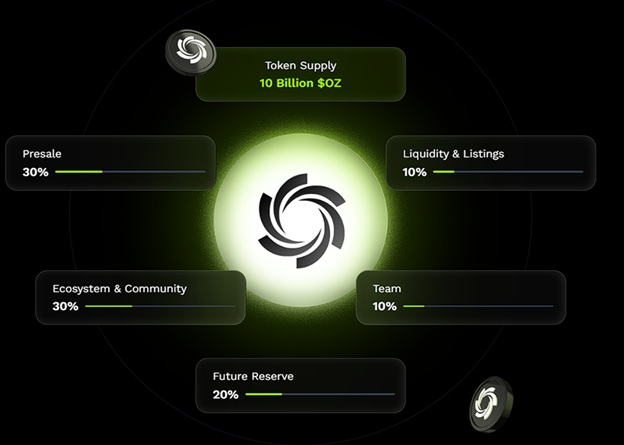
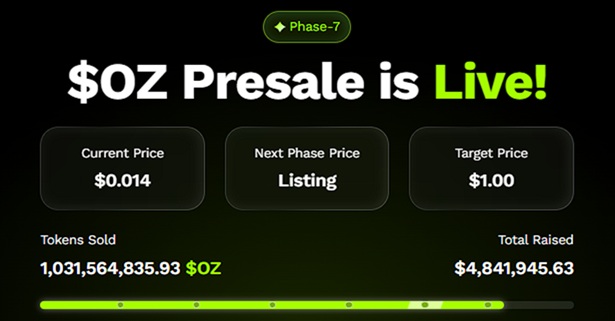
Because Ozak AI is still in the OZ presale phase and priced at an early-stage market cap, even small investments have significant upside potential. With over $4.8 million raised and more than a million tokens sold through the Ozak AI Presale, the project shows the same early adoption curve that characterized previous cycle winners that later surged 50x–100x.

  • At a 50x multiple, a $1,500 allocation becomes $75,000.
  • At a 100x multiple, the same allocation becomes $150,000.

These projections aren’t based on speculation alone—they’re grounded in Ozak AI’s strong partnerships with Perceptron Network’s 700K node ecosystem, HIVE’s ultra-fast signal infrastructure, and SINT’s autonomous AI agent layer. This gives Ozak AI real-world functionality that can scale immediately upon launch, making its long-term value potential far more tangible than hype-driven meme coins or single-utility projects.

Why Smaller Investments Can Outperform Large Caps

The reason analysts highlight Ozak AI over major assets like Bitcoin, Solana, or Ethereum is rooted in market structure. Large-cap tokens grow steadily, but they rarely produce 50x–100x moves due to their valuations. Early-stage AI tokens, however, sit at small market caps where exponential expansion is possible—especially when backed by real utility and early network effects. Ozak AI fits precisely into this category, which is why traders are labeling it a generational opportunity.

The Next Big Wealth-Building Window May Be Opening Now

With AI-driven projects expected to dominate the 2025–26 cycle, Ozak AI is emerging as the strongest candidate for explosive returns. Its early-stage pricing, real AI infrastructure, rapid adoption curve, and powerful partnerships all point toward long-term scalability—making it a prime contender for six-figure wealth creation from even modest initial contributions.

A $1,500 allocation won’t change anything overnight—but with Ozak AI’s current trajectory, it could be the smartest early move for building a six-figure portfolio by 2026.

About Ozak AI

Ozak AI is a blockchain-based crypto project that provides a technology platform that specializes in predictive AI and advanced data analytics for financial markets. Through machine learning algorithms and decentralized network technologies, Ozak AI enables real-time, accurate, and actionable insights to help crypto enthusiasts and businesses make the correct decisions.


For more, visit:

Website: https://ozak.ai/

Telegram: https://t.me/OzakAGI

Twitter: https://x.com/ozakagi