DD
MM
YYYY

PAGES

DD
MM
YYYY

spot_img

PAGES

Home Blog Page 4605

Elon Musk’s Acquisition of Twitter Sam Bankman-Fried CZ Binance Top 20 FORBES

0

The Goats in the game of Finance

On April 14, 2022, it was announced that Tesla and SpaceX CEO Elon Musk will start to acquire Twitter. This acquisition is a game-changer for the world of WEB3 and memecoins. Let’s take a closer look at what this means for the community. CZ Binance made a hefty investment in the Twitter deal banking $500,000,000, wow this is huge for all of you web3 crypto lovers out there. So What is all the fuss about over Sam Bankman-Fried and did CZ Binance cause his demise?

The Tweet What caused Toon Finance to go viral?

CZ Binance was a friend of Sam Bankman Fried, both gentlemen are owners of Cryptocurrency exchange sites that bank millions and billions of dollars in per year. These two gentlemen are very wealthy and well known in the crypto industry. This is one of the most prominent and iconic moments for crypto and the future of centralized exchanges.

CZ Binance founded and owns what is known as the Binance Exchange, the world’s leading crypto exchange by volume and users. CZ Binance heard that Bankman-Fried’s FTX exchange was having some issues with their LP which is basically the nuts and bolts of the entire business.

Without the liquidity to back it there would be no actual funds for its users to cash out and technically those are the user funds for the most part. It is similar to running a bank, in reality the bank borrows its clients money and pays it back to them when they wish to withdraw it and if the bank does not have the money then insurance pays the customer.

This is very rare and only happens when a bank goes completely bankrupt. Is this the case for Sam Bankman-Fried? Is he and his FTX exchange going bankrupt? That seems to be the word on the street as he scrambles to find over 2 Billion in user funds. This caused the exchange to crash and users are now flocking to decentralized exchanges like Toon Finance.

What is WEB3?

WEB3 is the third generation of the World Wide Web. It is a decentralized network that allows users to interact directly with each other without the need for intermediaries. This new generation of the internet is powered by blockchain technology and decentralization. With WEB3, users have more control over their data and are able to interact with each other in a more secure environment.

What are Memecoins?

Memecoins are digital tokens that can be used to purchase goods and services on the WEB3 platform. They are similar to traditional cryptocurrencies but have additional features that make them more suitable for use on the WEB3 platform. For example, memecoins can be used to reward content creators on WEB3 platforms. This incentivizes content creation and helps to grow the WEB3 community.

What Does This Mean for the Community?

The acquisition of Twitter by Elon Musk is a huge win for the community of WEB3 and memecoins. With Twitter, Musk now has access to a large audience that he can use to promote WEB3 and memecoins.

This will help to increase awareness of these technologies and grow the community even further. Additionally, Twitter is already integrated with many popular blockchain projects, which will make it easier for Musk to promote WEB3 and memecoins on this platform.

Elon Musk’s acquisition of Twitter is a big deal for the community of WEB3 and memecoins. With Twitter, Musk now has access to a large audience that he can use to promote these technologies.

This will help to increase awareness of WEB3 and memecoins and grow the community even further. Additionally, Twitter is already integrated with many popular blockchain projects, which will make it easier for Musk to promote WEB3 and memecoins on this platform.

Top 3 Memecoins to Invest in this Year

Dogecoin: The Classic & Original

Dogecoin is a cryptocurrency that was introduced in 2013. It was inspired by the “doge” meme that was popular at the time. Dogecoin quickly gained popularity due to its low price and friendly community. However, Dogecoin may be in trouble due to its old blockchain technology.

What is Dogecoin?

Dogecoin is a cryptocurrency that was created as a joke in 2013. It was inspired by the “Doge” meme, which featured a Shiba Inu dog. Dogecoin quickly gained popularity due to its low price and friendly community. However, Dogecoin may be in trouble due to its old blockchain technology.

Dogecoin’s Popularity

Dogecoin was created as a joke in 2013 but it quickly gained popularity. As of January 2021, Dogecoin has a market capitalization of $1.2 billion and is the 35th largest cryptocurrency. Dogecoin’s popularity is due to its low price and friendly community.

The Problem with Dogecoin

However, Dogecoin may be in trouble due to its old blockchain technology. The Dogecoin blockchain is based on Litecoin, which itself is based on Bitcoin. This means that Dogecoin is behind both Bitcoin and Liteoin when it comes to adopting new technologies.

For example, Bitcoin has already adopted Segwit, while Liteoin is currently testing Segwit. This puts Dogeoin at a disadvantage because it will take longer for new technologies to be adopted by the currency.

Dogeoin is a popular cryptocurrency that may be in trouble due to its old blockchain technology. The currency is based on Litecoin, which itself is based on Bitcoin. This means that new technologies will take longer to be adopted by Dogeoin. Although the currency has a friendly community and low price, this may not be enough to keep it afloat in the long term unless it can modernize its technology.

Shiba Inu: The “Sister” Project of DOGE

Shiba Inu is a cryptocurrency that was created in August 2020. It is a fork of the popular Dogecoin and itself is based on the Ethereum blockchain. The token was created with the intention of being used as a meme coin but has since gained popularity among investors and traders. However, Shiba Inu may face challenges in the future due to its reliance on old blockchain technology.

What is Shiba Inu?

Shiba Inu is a cryptocurrency that was created in August 2020. It is a fork of the popular Dogecoin and itself is based on the Ethereum blockchain. The token was created with the intention of being used as a meme coin but has since gained popularity among investors and traders. However, Shiba Inu may face challenges in the future due to its reliance on old blockchain technology.

The name “Shiba Inu” comes from the Japanese breed of dog of the same name. The face of the Shiba Inu dog is featured on the coin’s logo. As of May 2021, there are over 10 billion SHIB tokens in circulation with a total market capitalization of over $6 billion.

How Does Shiba Inu Work?

Shiba Inu works similarly to other cryptocurrencies like Bitcoin or Ethereum. Transactions are recorded on a public ledger called a blockchain. blockchains use cryptography to secure transactions and prevent fraud. Each transaction is verified by nodes on the network before it is approved and added to the blockchain.

However, unlike Bitcoin or Ethereum, which use proof-of-work (PoW) consensus algorithms, Shiba Inu uses a proof-of-stake (PoS) algorithm. This means that users can earn rewards for holding SHIB tokens in their wallets instead of mining them like PoW coins.

SHIB tokens can be used to purchase goods and services online or traded on cryptocurrency exchanges like Binance or Huobi Global for other digital assets like Bitcoin or Ethereum.

What’s Next for Shiba Inu?

While Shiba Inu has been successful so far, it faces some challenges in the future. One obstacle it will need to overcome is its reliance on an old blockchain platform like Ethereum. While this gives SHIB some existing infrastructure and developer support, it also exposes it to potential problems down the line if Ethereum experiences any issues or decides to change its roadmap in a way that doesn’t mesh with Shiba Inu’s goals.

Another thing to keep an eye on is transaction fees; because SHIB transactions are processed on Ethereum’s network, they are subject to Ethereum’s high gas fees which could make using SHIB impractical for small purchases down the road.

Overall, I think Shiba Inu has some potential despite its challenges. I like that it has low transaction fees and that it can be used to buy goods and services online. I think its reliance on Ethereum could be problematic though so I’ll be keeping an eye on how that develops. Are you holding any SHIB? Let me know your thoughts in the comments!

Toon Finance Cooks up a new DEX swap for it’s users

Toon Finance, a relatively new player in the DeFi space, has already shown great promise with the successful conclusion of their stage 1 presale. Now that they are entering stage 2, the team’s main focus is on marketing and getting the word out there with an aggressive plan to put up 70 billboards. But they are not neglecting their product development side, making sure that their goal is to create the best protocol in all of WEB3.

Toon Finance’s Road to Stage 2

Toon Finance’s journey to stage 2 started with a very successful stage 1 presale, which showed that there is definitely demand for their product. Now that they are entering stage 2, the team’s main focus is on marketing and getting the word out there with an aggressive plan to put up 70 billboards.

Additionally, they are also continuing to work hard on the product development side to make sure that their protocol is the best in all of WEB3. By doing this, they hope to achieve mainstream adoption and become the go-to protocol for dapps and DeFi projects.

Toon Finance also announced that they will be purchasing the Billboard that lies directly across the street from $50 Billion Dollar Twitter Headquarters. That is right, you heard it correctly, they will be getting one of the most iconic billboards in the world.

This is huge progress for the new ICO that is still in pre sale phase 2 shooting for a whopping 25 million USD.

DeFi dominance

With so many projects gunning for a slice of the DeFi pie, it is becoming increasingly difficult for any one project to stand out from the rest. This is where marketing comes in. Toon Finance recognizes that in order for them to become the dominant player in WEB3, they need to get exposure for their project and let people know about what they are creating.

That is why their main focus right now is on putting up 70 billboards across key cities around the world. Additionally, they are also active on social media and are working on building strategic partnerships with other projects in the space.

Toon Finance is definitely a project to watch out for in the coming months. With a strong focus on marketing and product development, they are well positioned to become one of the top protocols in WEB3. Be sure to follow them closely as they continue their journey towards DeFi dominance!

Investors are understandably bullish on meme coins due to their recent success. For example, Dogecoin has seen its price increase by 800% since January 2021. And Shiba Inu’s price has increased by 3,700% since January 2021. Given the current investing environment, it’s not surprising that investors are flocking to meme coins in droves.

If you’re looking for an investment with high potential upside, you may want to consider investing in meme coins like Dogecoin, Shiba Inu, or Toon Finance. While there’s no guarantee that these coins will continue to outperform other investments in the future, they have shown remarkable growth so far and could continue to do so for years to come.


To participate in Toon Finance’s presale, here are the links below:

Website: https://toon.finance/

Presale: https://buy.toon.finance/

Twitter: https://twitter.com/ToonSwapFinance

Telegram: https://t.me/ToonSwapFinance

CoinMarketCap: https://coinmarketcap.com/currencies/toon-finance/

DEX SWAP : https://swap.toon.finance
Pricing Surge; Improving Swaps and Protecting Liquidity Providers

0

Cryptocurrency markets are known to be highly volatile. It’s not rare to see double-digit daily price swings. While this volatility presents a golden opportunity for traders, it leaves liquidity providers on decentralised exchanges exposed.

Impermanent Loss (IL), defined as the difference in the performance of LP position compared to just holding assets in a wallet, is one of the biggest worries for liquidity providers. They have very little control over the price and even less control over the fee they charge for their services. That fee is often predefined by the exchange they use, with 0.3% considered an industry standard.

However, that fee alone is rarely enough to compensate for the Impermanent Loss (IL) when it comes to volatile pairs. This is where Trader Joe’s new Liquidity Book comes in.

Every time someone uses Liquidity Book to swap tokens, they are charged a flat Base Fee. Depending on current volatility, they might also be charged an additional fee based on a Surge Pricing mechanism. That fee is derived using two parameters:

  • Bin Step – variable set at the initialisation of the pair. It defines the price difference between each of the bins.
  • Volatility Accumulator – a novel counter introduced by the Liquidity Book to track on-the-spot pair volatility.

The Bin Step defines price increase or decrease for each bin in basis points. One basis point (BPS) is equal to 0.01%. For example, having a bin step of 20 BPS means that the price of each bin in the pair differs by 0.2%.

Consider an AVAX-USDC pair with a bin step of 10 BPS created when AVAX was worth $15. If the price moves up one bin, it will be worth 15.015 (151.001); if it moves down one bin, it will be 14.985 (150.999).

Consider an AVAX-USDC pair with a bin step of 10 BPS created when AVAX was worth $15. If the price moves up one bin, it will be worth 15.015 (15*1.001); if it moves down one bin, it will be 14.985 (15*0.999).

For volatile pairs, it makes sense to have a relatively high bin step to allow for bigger price movements. Smaller bin steps are more useful for pairs like USDC.e-USDC that are expected to trade within a might tighter range. Having bin step as a part of Surge Pricing calculations allows Liquidity Book to account for different pairs with different anticipated levels of volatility.

Volatility Accumulator

The Volatility Accumulator (VA) is one of the most significant innovations of the Liquidity Book. It allows for the calculation of the pair’s current volatility instantly and without delay. For each swap, it counts how many bin changes occurred during it (denoted by k).

Depending on how much time passed since the last transaction, it then either:

  • Decays – multiply the current count by the reduction factor R, which is set to a value between 0 and 1, then adds k to it;
  • Increases – adds k to the current count;
  • Resets – sets current to k.

The exact behaviour is governed by the contract’s upper and lower time limits. If the interval between two consecutive transactions is smaller than the lower time limit, the Volatility Accumulator increases. If it is larger than the upper time limit, it resets. Otherwise, the accumulator decays.

It is important to note that the Volatility Accumulator takes the direction of trades into account when they occur below the lower time limit. When buys and sales occur in short succession, the volatility accumulator movements counteract each other.

Consider an example in which someone sells tokens resulting in the price going five bins down. Instantly, another person buys the same tokens leading to the price going four bins up. As a result, the net change in the Volatility Accumulator would be the same as the one for a sale that crosses one bin.

Volatility Accumulator Example

Let’s say that the AVAX-USDC pair’s lower time limit is 10 seconds and the upper limit is 10 minutes. Four traders are using this pair to buy and sell tokens:

  1. The Volatility Accumulator starts at 0, with Bob selling some AVAX. His transaction is relatively small in size, so no bin changes occur. The k is 0, and VA is 0 as well.
  2. Seven seconds later, a whale named Alice decides that she also wants to sell some AVAX. Her transaction results in 3 bin changes. Because the swap occurred under the lower time limit, the k is 3, and VA at the last bin is 3 (0+3).
  3. Charlie sees Alice’s sale and uses this opportunity to buy some cheap AVAX 20 seconds later. Because his transaction, which also crossed 3 bins, occurred after lower but before upper limits, the k is now 3, and the final Volatility Accumulator is 4.5 (3/2+3).
  4. After this initial burst, the activity in the pair dies down with no swaps occurring for the next 10 minutes. Dan then decides to follow Charlie and also buy some AVAX, crossing 1 bin in the process. As it’s now past the upper time limit, the accumulator has reset and is now equal to 1 (4.5*0+1).

It’s important to note that because k records bin crossovers one by one, each bin’s volatility accumulator is calculated separately. For instance, in step 3, VA is 4.5 at the third bin. It will, however, be 1.5 at the starting bin, 2.5 at the next one and 3.5 when the swap crosses the second bin.

While this is a very simple example, it is easy to see how Volatility Accumulator adjusts to market participants’ actions to reflect current volatility levels accurately.

Nigeria’s Central Bank new cash withdrawal limits – N100k Weekly, POS N20k daily

5

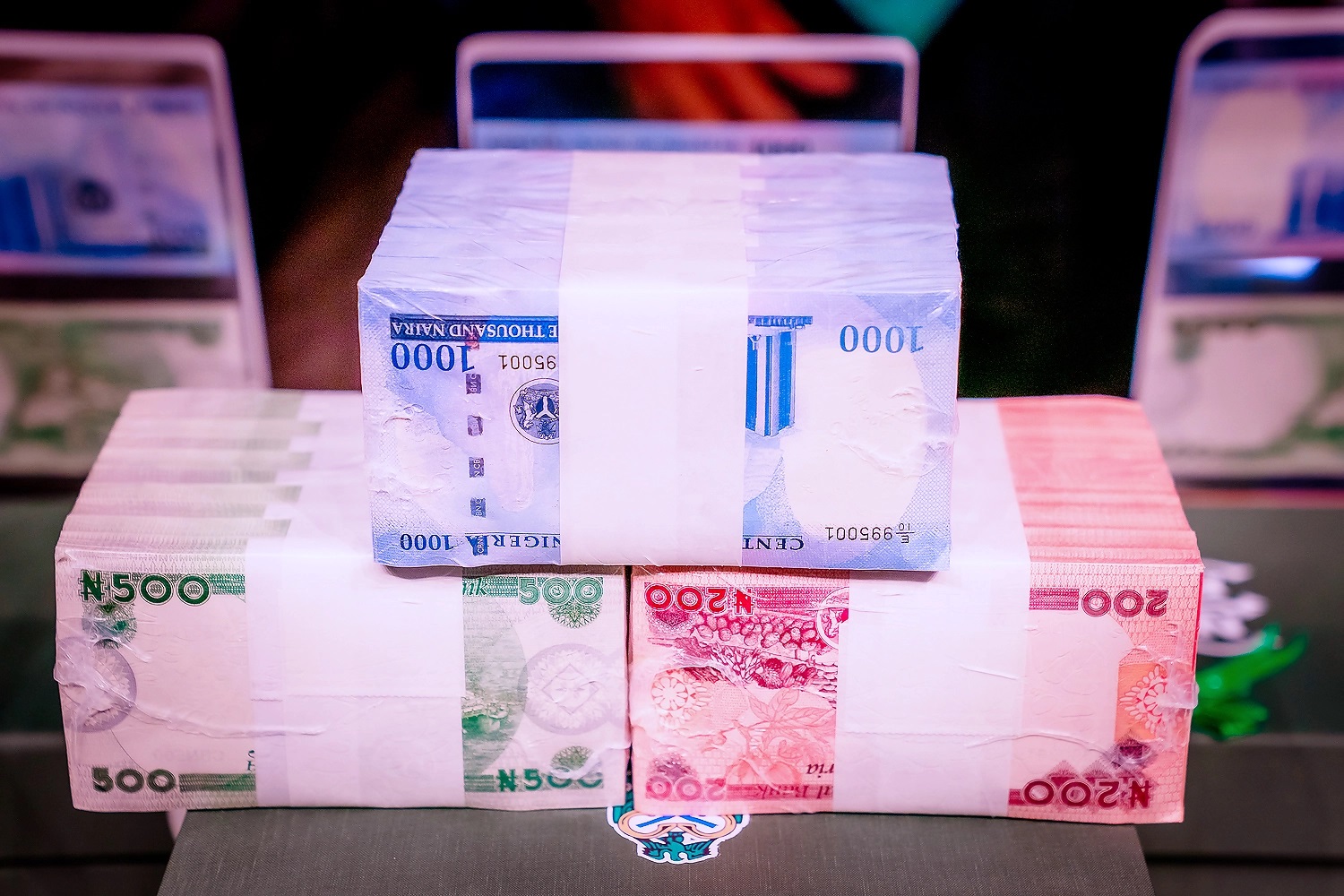
This is a new redesign and the digital age is here in Nigeria. Yes, the Central Bank of Nigeria wants to kill cash – and it has unleashed the biggest arsenal possible via clusters of policies.

First, provide e-naira and move more Naira transactions to the electronic domain. Secondly, mop all the informal cash vaults  and bring them into the official vaults by redesigning Naira. Now, make it impossible to transact in cash by setting a limit on withdrawals unless you want to lose some money: N100k weekly and N20k on POS daily. With that, we have an end-to-end fiat execution of digitization.

In such, “banks have also been directed to load only N200 and lower denominations into their ATM.” I support the CBN on this. If you say you are rich in Nigeria, we expect you to pay taxes and with this visibility, expect the tax receipts to improve. Those underground economies must normalize now. It is about time.

Yet, CBN must ensure its policies do not harm our non-literate or elderly citizens who cannot transition into this digital world. I expect a nuanced policy to ensure everyone is carried along. Take this case study. An Eziukwu palm oil seller comes to Oriendu Market Ovim to sell his palm oil. The total amount is N150k. If the buyer from Umuahia cannot pay cash, the implication is that CBN must ensure that Eziukwu has a bank to ensure that seller can use that money when he returns back to Eziukwu (6 hours trek away from Ovim). This policy must not just work for Lagos, Owerri, Kano and Uyo; it needs to work also in rural areas.


From the circular, courtesy of Punch:

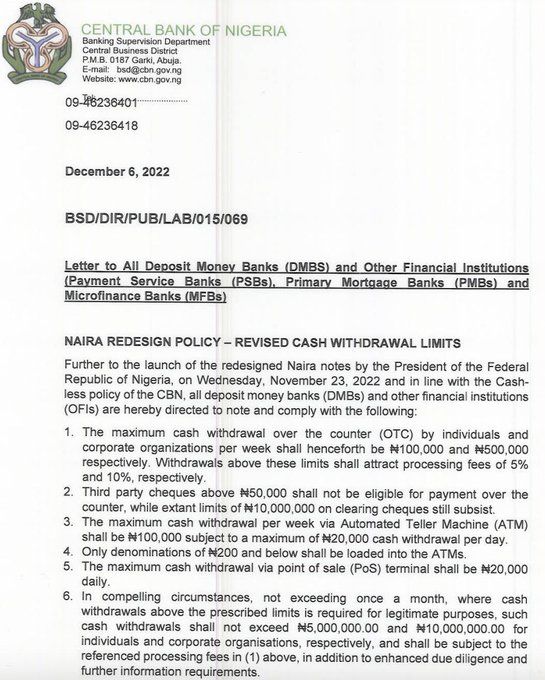
The Central Bank Of Nigeria has imposed fresh cash withdrawal limits on individuals and organisations, which takes effect from January 9, 2023.

According to a new memo to banks issued on Tuesday and signed by the Director of Banking Supervision, Haruna .B. Mustafa, individuals will only be able to withdraw N100,000 per week ( from over the counter, Point of Sale Machines or the Automated Teller Machines), while organisations can access N500,000 per week.

Banks have also been directed to load only N200 and lower denominations into their ATM.

The memo read, “Further to the launch of the redesigned naira notes by the President, Major General Muhammadu Buhari (retd.), on Wednesday, November 23, 2022, and in line with the cashless policy of the CBN, all deposit money banks and other financial institutions are hereby directed to note and comply with the following:

“1. The maximum cash withdrawal over the counter by individuals and corporate organisations per week shall henceforth be N100,000 and N500,000 respectively. Withdrawals above these limits shall attract processing fees of 5% and 10%, respectively.

“2. Third-party cheques above N50,000 shall not be eligible for payment over the counter, while extant limits of N10,000,000 on clearing cheques still subsist.

“3. The maximum cash withdrawal per week via Automated Teller Machine shall be N100,000 subject to a maximum of N20,000 cash withdrawal per day.

“4. Only denominations of N200 and below shall be loaded into the ATMs.

“5. The maximum cash withdrawal via the point of sale terminal shall be N20,000 daily.”

The  CBN said in compelling circumstances, not exceeding once a month, where cash withdrawals above the prescribed limits would be required for legitimate purposes, such cash withdrawals shall not exceed N5,000,000.00 and N10,000,000.00 for individuals and corporate organisations, respectively, and shall be subject to the referenced processing fees in (1) above, in addition to enhanced due diligence and further information requirements.

It also said banks were required to obtain the following information at the minimum and upload same on the CBN portal created for the purpose:

“a. Valid means of identification of the payee (National Identity Card, International Passport, Drivers License.). b. Bank Verification Number of the payee. c. Notarised customer declaration of the purpose of the cash withdrawal. d. Senior management approval for the withdrawal by the Managing Director of the drawee, where applicable. e. Approval in writing by the MD/CEO of the bank authorising the withdrawal.

“Please further note the following: i. Monthly returns on cash withdrawal transactions above the specified limits should be rendered to the Banking Supervision Department. ii. Compliance with extant AMUCFT regulations relating to the KYC, ongoing customer due diligence and suspicious transaction reporting etc., is required in all circumstances. iii. Customers should be encouraged to use alternative channels (internet banking, mobile banking apps, USSD, cards/POS. eNaira, etc.) to conduct their banking transactions.

“Finally, please note that aiding and abetting the circumvention of this policy will attract severe sanctions.

“The above regulatory directives take effect nationwide from January 9, 2023. Please be guided accordingly,” the memo added.

The Legal Framework Governing Environmental Protection in Nigeria

0

It is only recently in the face of global warming concerns that many people have realized the need to care for the environment, and in some cases there is still a lot that needs to be done regarding the conservation of the earth and its wildlife.

In Nigeria, environmental pollution is a very serious problem, with its Niger Delta facing some of the worst cases of environmental degradation known to man due to Oil Industry activities, and places like Lagos having to deal with astronomical heaps of garbage blocking many natural inland waterways in the state.

This article will thus be focused on the topics of:-

– The legal and regulatory framework governing environmental conservation in Nigeria.

– What actually constitutes environmental pollution under Nigerian law.

– Activities that are regarded under Nigerian law as having a potentially huge environmental impact.

– The available environmental pollution regulation licenses in Nigeria.

What constitutes the legal and regulatory framework governing environmental conservation and pollution in Nigeria?

The main pieces of legislation governing environmental conservation and pollution in Nigeria are :-

– The Federal Environmental Protection Agency (FEPA) Act 

– The National Environmental Protection (Pollution abatement in Industries & facilities generating waste) Regulations.

– The National Environmental Protection (Management of solid and hazardous wastes) regulations.

– The Environmental Impact Assessment Act

– The Harmful wastes act

– The Environmental guidelines & standards for the petroleum industry in Nigeria (EGASPIN).

The overall government agency in charge of coordinating the implementation and enforcement of these legislations is the Federal Ministry of Environment.

Is environmental protection/conservation under the exclusive jurisdiction of the Federal Government in Nigeria?

No it isn’t. Each state and local government can set up its own environmental protection agency pursuant to the FEPA Act as well as make environmental protection laws for their respective state jurisdictions.

How is environmental protection legislation to be complied with?

One major way of doing this is complying with the legal requirement for Environmental Impact Assessment (EIA) reports when any individual or organisation is carrying out any activity which may have a negative effect on the environment.

These reports must clearly state the environmental risks involved in the activity to be engaged in as well as the measures for dealing with these risks.

What are the activities deemed capable of posing a risk to the environment under Nigerian law?

These activities as outlined under Nigerian law are typically of a commercial nature and include the following :-

– Mining

– Housing and Construction

– Infrastructural development

– Power Generation & Transmission

– Manufacturing industries

– Petroleum drilling and refining activities

– Agricultural activities

– Forestry/Wood harvesting

– Waste/Sewage treatment and disposal

What are the environmental law permits available in Nigeria?

Apart from mandatory Environmental Impact Assessment EIA reports for certain activities deemed environmentally risky, there are permits applicable to certain economic sectors such as :-

– Permits from the Nigerian Nuclear Regulatory Authority for persons engaged in activities that generate radioactive waste.

– Permits from FEPA for the storage & treatment and evacuation/discharge of harmful toxic waste into natural waterways such as lakes or rivers.

Are there sanctions for violating the provisions of environmental legislation in Nigeria?

A violation of environmental protection legislation in Nigeria can lead to civil and criminal liabilities on either individuals or corporations found guilty.

Emmanuel Ifeanyi Ogbuka, Esq, a legal practitioner and consultant, writes from Lagos and can be reached via 07011261897 or ogbukalegal@outlook.com.

Background Hypothesis – How SBF Created Rabbit Holes for FTX

0

November 8th, FTX froze withdrawals due to a lack of collateral. What was one of the titans of the industry less than a month before the fall, seemingly overnight turned into a headline for one of the largest cases of fraud and financial mismanagement in over a decade.

After the FTX, Alameda Research and BlockFi bankruptcy, Proof of Reserves has emerged as a potential solution to regain investors’ trust.

How do we explain FTX’s $10 Billion in losses?

Where did the $2 Bn in venture funds go?

My working hypothesis is that FTX was a fraud even prior to recent events and as far back as 2021. SBF will go down in history as a fraud larger than Bernie Madoff. Alameda Research was indispensable to FTX, crucial for this analysis.

FTX must inventory customer funds 1:1. How then to match buy & sell orders? Both orders would have to arrive at the exact same time, the exact same size, and agree on the exact same price. That never happens. Alameda fixes this problem by serving as the Designated Market Maker (DMM). Under US securities law, the DMM is obligated to make a market under any market conditions.

The DMM stands ready to offer their own inventory of securities to the market, and stands ready to buy. FTX is a gift for Alameda. FTX is gathering and attracting tons of uninformed retail order flow for Alameda to monetize by trading against. Similar to PFOF

Alameda is a gift for FTX. Alameda offers valuable liquidity to customers. Otherwise, the exchange would have no volume. That exclusive FTX/Alameda relationship conferred a major advantage to Alameda.

Alameda could make a market with limited competition against uninformed retail order flow. Alameda would simply take the other side of random buy & sell orders and make money.

A good DMM or HFT can make money nearly every day. You are constantly turning over the portfolio. You make more money in volatile markets. It requires little capital. It’s a great business. That business attracts competition.

Mango Markets utilized a margin trading protocol allowing cross-margin between a basket of different crypto assets as collateral. They used an oracle which fed them spot prices of these assets from several major exchanges to determine the value of the collateral on the Exchange.

One of the assets that was allowed to be used for collateral was MNGO, the exchange’s native token. MNGO was extremely illiquid, and Avi realized that it would be relatively easy to manipulate the price of MNGO on the centralized exchanges that fed data into the oracle.

Sam Bankman Fried took large positions on MM at the same time using MNGO as collateral, was able to withdraw various forms of collateral from the exchange while the position was in profit, & by the time MNGO crashed back to fair market value, the exchange was left w/ a large sum of bad debt.

SBF wrote a great Twitter thread detailing the mechanics of this move less than a month before FTX’s collapse – & once we’re done peering through it – I think you’ll realize the mechanics between the MNGO exploit and the explanation for the FTX balance sheet hole are eerily similar.

His fictional asset for the sake of this example is XYZ – which is supposed to represent MNGO. Now, I’m getting a bit ahead of myself here, but I also want you to start picturing XYZ as tokens such as FTT or SRM that were used as forms of collateral by Alameda on FTX.

Here’s where things start to go wrong.

Imagine the Alameda is the House. The house has a slight ‘edge’ – a slight positive expectancy. Over time, the skillful poker players start to show up. Jump, Wintermute, and smaller shops. The HFT game rewards whomever has the lowest latency and fastest data.

FTX’s competitors invest in hardware: co-located servers, ultra-fast flexible gate programming arrays (FPGAs), and data. They compile in C.

FTX spent millions on AWS. They code in Python. Too slow… Great HFT firms will invest up to billions in proprietary high-speed data links such as microwave technology.

The mere curvature of a fiber optic cable creates a disadvantage for an HFT firm. The bending of the speed of light is unacceptable. Speed is everything.

FTX and Alameda now flip from a slight positive expectancy to a slight negative expectancy. They are the sucker at the poker table. They start to bleed. They lose a small amount of money per trade – on millions of trades.

At the same time, they are growing customers. Why?

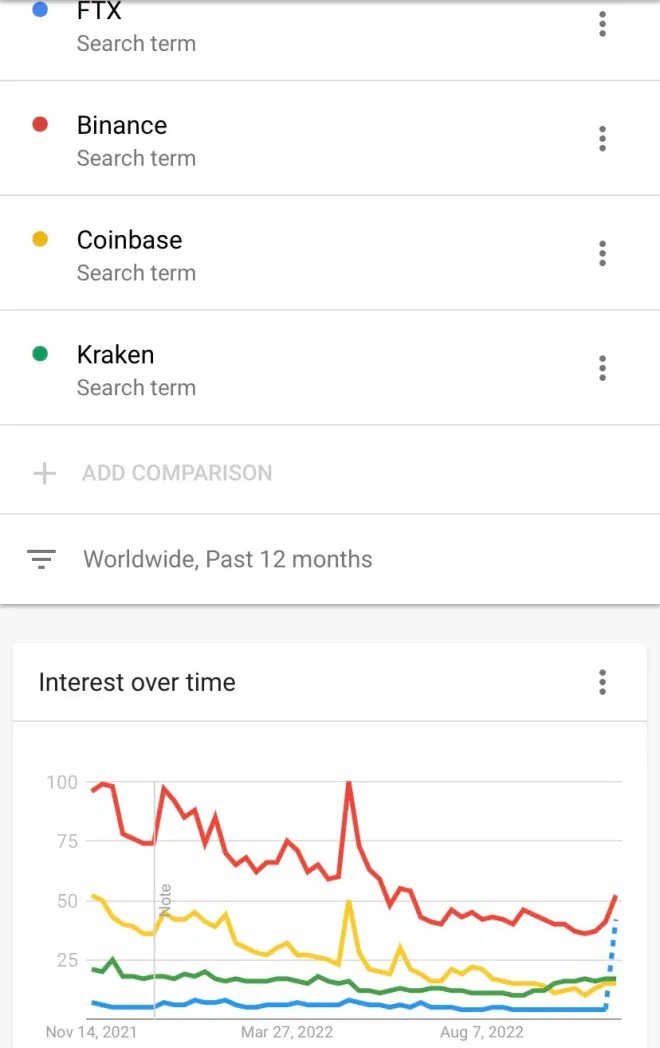
The same trading strategy that might not work profitably at at Coinbase would make profit at FTX Global. It’s was known known that FTX Global had the best ‘vig’ in town if you were an HFT. A lot of people assume FTX achieved major retail penetration. But search indicates near zero organic engagement for an exchange its size.

FTX seemed dominated by prosumers and trading firms. And if they made a killing in 2021, and there was no soft retail flow, who was losing?

At its core, the quotation service that FTX offered was broken. It was quoting stale prices. That exposes FTX Global to getting ‘picked off’ by faster traders with lower latency. ‘Picked off’ means an informed traders spot the mis-quotation and profit at Alameda’s cost.

William Clemente, Cofounder of ReflexivityRes Tweeted  apparently, Many crimes have an intent component where a prosecutors must prove at least circumstantially that there was intent by the person.

However, intent for the action underlying the crime is all that’s needed, Not intent to commit the crime nor knowledge it was a crime.

On his recent interview on Good Morning America, SBF explained what transpired on FTX leading to Implosion. 2:33 is where my confirmation of his guilt was solidified. The way he avoids that question… it’s a simple question dude… Yes or No. He danced around that answer… and continued to dance through the Alameda/FTX relationship questions.

Disgraced FTX founder Sam Bankman-Fried appears to be employing the “bad businessman strategy” to avoid facing jail time over the missing billions from the crypto platform, says CNBC. The shock collapse of FTX, valued just months ago at $32 billion, came after the company used customer deposits to fund bets made by its affiliated trading firm Alameda Research — with the effects rippling through the industry. While no charges have yet been filed, legal experts told CNBC the fallen crypto star should be “very concerned about prison time;” both the Securities and Exchange Commission and Justice Department are reported to be investigating the matter. Bankman-Fried has so far denied fraud. (LinkedIn News)