DD
MM
YYYY

PAGES

DD
MM
YYYY

spot_img

PAGES

Home Blog Page 467

Price Prediction: Ethereum vs. Digitap’s Live Crypto Card: Which Token Wins the Banking Race?

0

Ethereum is a key player among the world’s top blockchain projects by offering smart contracts for thousands of dApps. In fact, whenever crypto conversations about the adoption are held, Ethereum is almost always mentioned. Some findings indicate that its coin value might have a considerable rise in the next few quarters. The thing is that Ethereum is also struggling to grow.

For example, growing transaction fees, periods with network congestion, and the arrival of other chains like Solana have already caused some worries on how to expand. For the average user of banking, Ethereum is frequently so complicated that it is not considered a complete solution by itself.

This is the point where Digitap becomes the key player. Branded as the world’s first omnibank, DigiTap simply means that one live platform can serve users with both crypto and fiat.

DigiTap Enters as the Omnibank

DigiTap is a fully-fledged financial service for ordinary people. With a customer’s single account, banking operations can be done in any manner. For example, activities like funds deposited in local currency, crypto holding, and sending money anywhere in the world can be done easily.

The platform is not only user-friendly but also automatically converts funds at the best rate through its Smart Exchange Engine. This example of modern but straightforward banking is what allows DigiTap to be recognized beyond the pack when it is compared directly to Ethereum. This is because Ethereum needs third-party apps and many steps to get the same results.

DigiTap is not only about banking on the move. It brings privacy at the highest level for an offshore banking option. In the case of Ethereum, its ETH is used for gas, and it inflates with staking rewards. However, the $TAP is deflationary by default. The fees are generated in every transaction on DigiTap, and 50% of these profits are used to purchase $TAP from the market and burn it very permanently. This leads to a reduction in the amount over time, thus increasing scarcity along with the adoption.

Ethereum vs. DigiTap: Different Paths

While the core of DigiTap is directly tied to its $TAP token, $ETH is designed as a store of value and a base asset in the crypto space. It is often compared to “digital gold” rather than “deflationary gas.” Besides, every transaction fee is distributed among the node validators as an incentive. DigiTap does exactly the opposite. They mint a fee equal to 50% of the base-layer fees, then use half of those tokens to buy DigiTap off the market.

A decentralized network is the backbone of Ethereum for smart contracts, but it is sometimes limited with network congestion, high fees, and slow updates. On the other hand, DigiTap is a fully-audited and compliance-first project with a live app. A regular-use-first model is what sets DigiTap apart and gives the confidence to the investors beyond mere speculation.

At the moment, the price of $TAP is just $0.0125 which clearly shows a promising entry point for the investors. In fact, the presale has already raised more than $100,000 in a few days. So, the trend is very strong.

Conclusion : Best Cryptocurrency to Invest in 2025?

Ethereum will go on to be a strong hologram among the power players of the world of blockchain tech. The way in which it sets itself up as infrastructural is incomparable and will continue tracking usage in the overall crypto market, making it in the long run more valuable.

But, when it comes to the question of which banking solution is superior, DigiTap is leading thanks to its ability to help customers make easy transitions from crypto to fiat and back in a user-friendly daily manner. DigiTap is the one that finally brings privacy, accessibility, and a deflationary token model in an all-in-one platform.

To those pondering about the next massive venture, Ethereum is still a safe long haul investment, but DigiTap is a genuine, functioning product that is already popular in the mass market. In the banking competition, DigiTap seems to be the one that is better placed to win the race and come out on top first.

Discover how Digitap is unifying cash and crypto by checking out their project here:

Presale https://presale.Digitap.app

Social: https://linktr.ee/Digitap.app
Trump Says Strikes Deal with Xi to Keep TikTok Alive in U.S., But Questions Linger Over Security and Politics

0

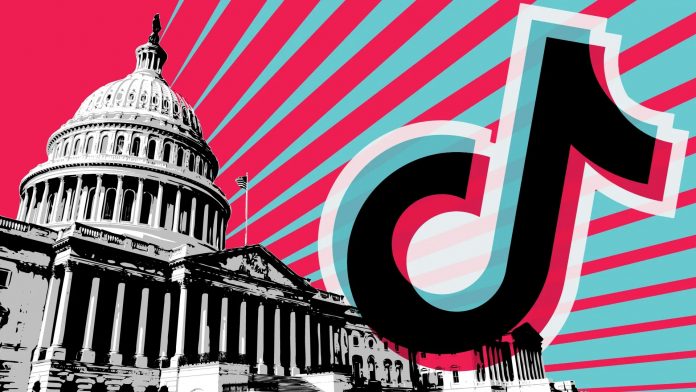
President Donald Trump said Friday he has struck a deal with Chinese President Xi Jinping to keep TikTok operational in the United States, easing months of uncertainty surrounding the app’s future but raising new questions about how national security concerns will be resolved.

Trump described a “very productive call” with Xi, writing on his social media platform that the two leaders made progress on “many very important issues including Trade, Fentanyl, the need to bring the War between Russia and Ukraine to an end, and the approval of the TikTok Deal.” He added that they would speak again by phone and meet face-to-face at the APEC summit in South Korea beginning October 31.

While Trump suggested Xi had approved a takeover plan, details remain murky. Reports in The Wall Street Journal said U.S. users would be migrated to a new version of TikTok using technology licensed from its Beijing-based parent, ByteDance. Oracle would manage U.S. user data at its Texas cloud facilities, with American investors owning about 80% of the new U.S. entity and Chinese shareholders retaining the rest.

Larry Ellison, Oracle’s co-founder and Trump ally, looms large in the deal. Ellison, the world’s second-richest man, is already preparing a bid for Warner Bros. Discovery after his Paramount takeover, further entrenching him in the intersection of politics, tech, and media.

At a Thursday news conference, Trump called TikTok “tremendously valuable,” adding: “I’d rather reap the benefits. The kind of money we are talking about is very substantial. It will be owned by all American investors.”

He also hinted the U.S. would collect a “fee-plus” for making the deal possible, though the structure of such a payment remains unclear.

TikTok, with more than 170 million American users, thanked both leaders for their efforts. ByteDance said it would “work in accordance with applicable laws to ensure TikTok remains available to American users through TikTok U.S.”

China’s official line was more restrained. Xinhua quoted Xi as saying Beijing “respects the wishes of companies and welcomes them to conduct commercial negotiations based on market rules and reach solutions that comply with Chinese laws and regulations and balance interests.”

The White House declined to comment on the exact terms.

From Ban Threats to Deal-Making

The announcement caps years of back-and-forth over TikTok’s presence in America. In his first term, Trump had pushed to ban the app outright over fears that ByteDance could be compelled to hand U.S. user data to Beijing. His administration even pursued a forced sale of TikTok’s U.S. operations, but court challenges stalled the effort.

President Biden reignited the pressure last year, signing a law requiring ByteDance to divest its American operations or face a nationwide ban. ByteDance had been staring down a January 19 deadline, later extended by Trump to December 16, as talks continued.

Trump’s reversal this time around is partly political. He has openly credited TikTok with helping him win the 2024 presidential election, having courted younger voters by pledging to keep the platform alive.

Industry and Legal Skepticism

Skepticism persists. Carl Tobias, a law professor at the University of Richmond, said the deal leaves “too many loose ends and too many things that could go awry” to fully reassure Congress.

Analysts also question whether migrating U.S. users to a new version of the app managed by Oracle will truly sever risks of Chinese influence, or whether ByteDance’s retained ownership could leave open back channels.

Columbia Business School professor Daniel Keum noted that many content creators have already diversified to Instagram and YouTube amid TikTok’s uncertain status, suggesting the deal may not substantially change user behavior in the short run.

What Happens Next?

Trump may tout the deal as both a political and economic win, especially among younger voters and U.S. investors. But Congress, which has grown increasingly hawkish on China, may still press for stricter guarantees on data security and content moderation.

The arrangement, if finalized, could become a blueprint for how Washington handles foreign-owned platforms — mandating local ownership and domestic data management. That precedent could ripple into other sectors, especially as tensions with China deepen over AI and semiconductors.

Beijing has signaled it is willing to compromise without fully ceding control by allowing a deal but retaining some Chinese ownership. The move could give Xi a bargaining chip in wider U.S.-China negotiations, particularly as trade disputes and AI competition intensify.

However, even with a deal, the platform’s long-term dominance is less certain. Creators hedging their bets with Instagram Reels and YouTube Shorts may erode TikTok’s cultural monopoly, forcing the company to invest heavily to keep its U.S. base engaged.

OpenAI Sets Sights on Hardware Product With Luxshare Partnership, Plans AI-Native Device for 2026 Launch

0

Artificial Intelligence company OpenAI is making a bold move into the hardware space as it forges strategic partnerships with key players in Apple’s supply chain, signaling its intention to disrupt the consumer electronics market.

Following its $6.5 billion acquisition of io Products, the hardware startup founded by former Apple design chief Jony Ive, in May this year, OpenAI is now preparing to launch its first AI-native device by late 2026 or early 2027.

According to sources familiar with the matter, OpenAI has recently signed a manufacturing contract with Luxshare, a Chinese company best known for assembling iPhones and AirPods. Luxshare, which currently assembles iPhones, AirPods, and Apple Watches, brings large-scale production and supply chain expertise to the table.

The collaboration highlights OpenAI’s ambitions to produce hardware at scale, leveraging Luxshare’s expertise in mass production. The startup has also approached Goertek, another Apple supplier responsible for assembling AirPods, HomePods, and Apple Watches, to provide components such as advanced speaker modules.

Aiming to launch its first device in late 2026 or early 2027, OpenAI’s potential products include a smart speaker without a display and a wearable pin. Unlike traditional smart devices, these products will be AI-native, meaning they are built entirely around real-time AI interaction and user context awareness rather than being retrofitted onto existing smartphone platforms.

The device itself remains under tight wraps, but insiders describe it as a contextual AI companion a small, portable gadget designed to seamlessly integrate with OpenAI’s ChatGPT intelligence.

Industry analysts say this move represents one of the boldest bets by an AI company, as it attempts to carve out a new category of devices that could eventually challenge smartphones and personal computers. If successful, OpenAI’s device could eat into the markets currently dominated by Apple, Samsung, and Google, offering consumers a new way to interact with AI in their daily lives.

The implications extend beyond hardware design. Experts believe this will trigger massive innovation in chip design, energy efficiency, and manufacturing techniques, particularly in areas like advanced packaging, sensors, and thermal management. The partnership with Luxshare also signals the importance of supply chain resilience, as companies seek to balance global production with onshore capabilities.

Notably, comparable projects are already in motion elsewhere: Humane’s AI Pin, Rabbit’s pocket-sized R1, and Meta’s AI-powered Ray-Ban glasses are all chasing the same vision, frictionless, ambient computing experiences. But OpenAI’s integration of its own models, paired with manufacturing giants like Luxshare, could give it an edge in reaching the mass market.

This isn’t just a side project it’s OpenAI’s “boldest bet yet” on hardware as the next frontier for AI ubiquity. With smartphones reaching maturity, companies are racing to redefine ambient computing.

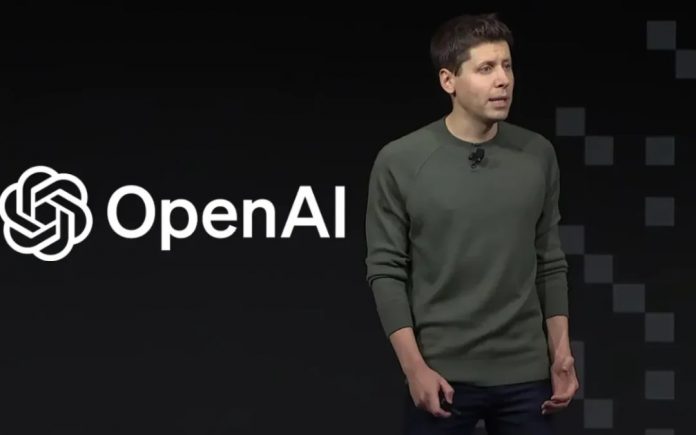
By entering the hardware space, OpenAI is not just competing with established tech giants, it is redefining what consumer electronics can be. Sam Altman’s vision appears to go beyond dominating the software and cloud sectors.

Instead, OpenAI aims to usher in a new era of AI-native devices, paving the way for tools that anticipate user needs, adapt to real-time environments, and transform the way humans interact with technology. If successful, this could disrupt the $500 billion consumer electronics market by making AI the primary interface, not an add-on.

As the AI wars spill over from software into hardware, this move marks the opening salvo of a new battlefront, one that could reshape the future of computing.

Top 3 Altcoins to Watch in 2025: Ozak AI, Ethereum, and Solana

0

Crypto markets are heading into 2025 with robust momentum, and investors are already scanning the space for tokens that would dominate the subsequent bull cycle. While Bitcoin will always continue to be the market chief, the real movement and exponential gains regularly come from altcoins. Among the numerous tasks competing for interest, three stand out as pinnacle initiatives: Ozak AI, Ethereum, and Solana. Together, they constitute a mix of innovation, adoption, and explosive upside capacity that would form portfolios in 2025.

Ozak AI: The Rising Star of AI + Crypto

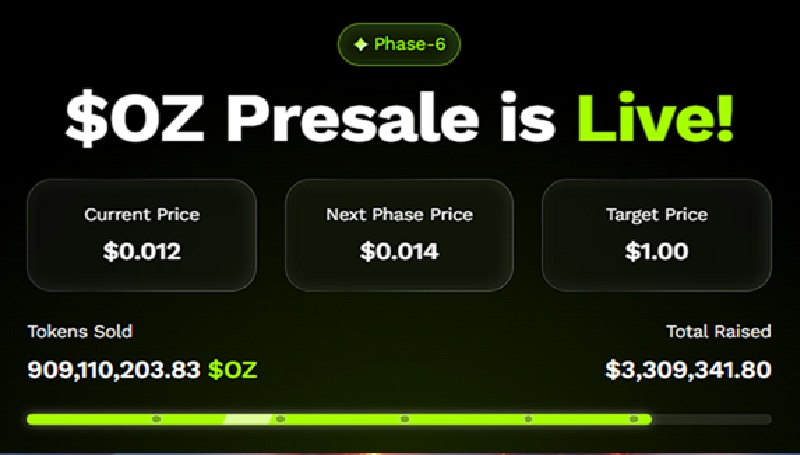
The biggest buzz in the crypto world right now is surrounding Ozak AI, a new token that is capturing attention with its presale success and bold growth potential. Currently in Stage 6 of its presale at $0.012, Ozak AI has already raised over $3.3 million. This momentum is fueled by the project’s unique value proposition—bringing artificial intelligence to blockchain in a way that benefits both traders and enterprises.

The narrative of AI + crypto is one of the most powerful drivers in the market. AI adoption is accelerating globally, and investors are betting that projects at this intersection will see extraordinary demand. Ozak AI isn’t just riding hype—it is building utilities such as predictive modeling, data-driven insights, and ecosystem rewards.

What makes Ozak AI so exciting is the ROI potential. Analysts speculate that the token could debut near $1 once it lists on major exchanges post-TGE. For presale buyers at $0.012, that would represent returns of 80x to 100x, a life-changing opportunity compared to the limited upside of more established tokens. With strong funding, community growth, and perfect timing in the cycle, Ozak AI could be the breakout altcoin of 2025.

Ethereum (ETH)

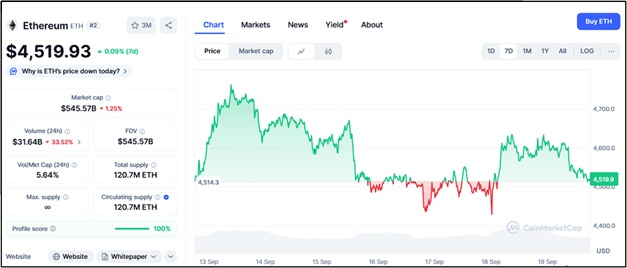
No discussion of top altcoins is whole without Ethereum (ETH), the second-largest cryptocurrency by market cap and the backbone of decentralized finance (DeFi). Trading close to $4,500, Ethereum remains the go-to community for smart contracts, decentralized applications, and token issuance.

Ethereum’s upcoming increase is tied to its scaling solutions and Layer-2 integrations, which can decrease transaction costs and increase throughput. Institutional adoption is also accelerating, with ETH being one of the few tokens along with Bitcoin to draw ETFs and mainstream economic interest.

Price predictions for Ethereum in 2025 are constructive, with many analysts anticipating ETH to attain or exceed $5,000–$6,000. While this doesn’t provide the 100x potential of Ozak AI, Ethereum stays a secure, high-fee asset that mixes stability with long-term increase. For traders, ETH remains a cornerstone asset.

Solana (SOL)

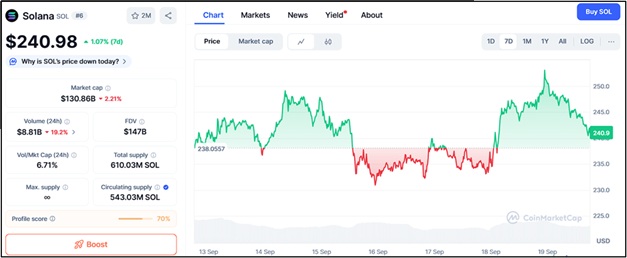
Another altcoin that remains firmly on buyers’ watchlists is Solana (SOL). Known for its speed and low fees, Solana has carved out a main function as a high-performance Layer-1 blockchain. Trading near $240, Solana has rallied strongly in 2024 and is entering 2025 with bullish momentum.

Solana is especially famous for DeFi protocols, NFTs, and gaming applications, in which its pace and value performance supply it with an edge over competitors. The ecosystem continues to increase with new dApps, projects, and partnerships that drive demand for SOL.

Technically, Solana faces resistance around $250, $270, and $300; however, it has robust help at $220, $200, and $185. If bullish momentum continues, many analysts expect Solana could take a look at new highs above $300 in 2025, making it one of the most attractive large-cap performers within the market.

Comparing Growth Potential

Each of these altcoins plays a different role in a balanced crypto portfolio. Ethereum provides security, adoption, and institutional-grade reliability. Solana offers speed, scalability, and a thriving ecosystem. Ozak AI, meanwhile, represents the high-risk, high-reward play with the potential for exponential gains.

The key difference lies in the upside potential. Ethereum and Solana may deliver steady 2x–3x growth, but Ozak AI has the realistic chance to generate 80x–100x returns from the OZ presale price, making it one of the most exciting tokens of the upcoming cycle.

As 2025 unfolds, crypto investors are preparing for what could be another historic bull run. Among the thousands of tokens in the market, three stand out as clear leaders to watch: Ethereum for its dominance, Solana for its speed and adoption, and Ozak AI for its presale-fueled breakout potential.

While Ethereum and Solana remain blue-chip altcoins, the possibility of flipping small Ozak AI bags into massive gains is what has retail investors excited. With $3.3 million raised already and growing hype around its launch, Ozak AI could very well become the defining altcoin story of 2025.

About Ozak AI

Ozak AI is a blockchain-based crypto project that provides a technology platform that specializes in predictive AI and advanced data analytics for financial markets. Through machine learning algorithms and decentralized network technologies, Ozak AI enables real-time, accurate, and actionable insights to help crypto enthusiasts and businesses make the correct decisions.


For more, visit:

Website: https://ozak.ai/

Telegram: https://t.me/OzakAGI

Twitter: https://x.com/ozakagi 

Trump Administration Announces $100,000 Fee for H-1B Visas In A Blow to U.S. Tech

0

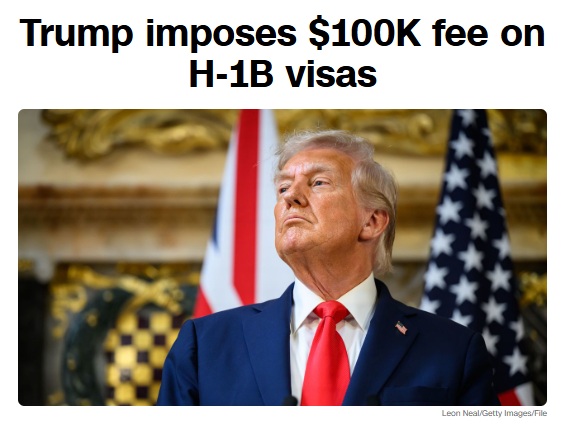
The Trump administration on Friday announced plans to impose a $100,000 annual fee on companies seeking H-1B worker visas, in what could be the most consequential shake-up to the program since its creation, potentially dealing a blow to the technology sector that relies heavily on skilled labor from India and China.

Since taking office in January, Trump has pursued an aggressive immigration crackdown, targeting both illegal and legal pathways. The H-1B overhaul marks the administration’s most high-profile attempt yet to reshape temporary employment visas, according to Reuters.

Commerce Secretary Howard Lutnick framed the move as a bid to prioritize American workers. “If you’re going to train somebody, you’re going to train one of the recent graduates from one of the great universities across our land. Train Americans. Stop bringing in people to take our jobs,” Lutnick said.

The proposal comes against the backdrop of a tense relationship between the White House and Silicon Valley. Tech companies, which contributed millions to Trump’s campaign, view the H-1B program as critical to filling skill gaps. Critics, however, argue that it suppresses wages and sidelines qualified Americans.

Tesla CEO and former Trump ally Elon Musk, himself once an H-1B visa holder before becoming a U.S. citizen, has defended the program, saying it ensures firms remain globally competitive. Yet even supporters acknowledge the system has been exploited, with employers accused of holding down wages — a concern cited in the executive order Trump signed alongside the announcement.

Government data shows the number of foreign STEM workers in the U.S. more than doubled between 2000 and 2019, reaching nearly 2.5 million, while overall STEM employment grew by just 44.5%.

Pushback from Industry and Analysts

The proposed $100,000 fee has triggered alarm among venture capitalists and start-up leaders. “Adding new fees creates disincentive to attract the world’s smartest talent to the U.S.,” said Deedy Das, partner at Menlo Ventures, in a post on X. “If the U.S. ceases to attract the best talent, it drastically reduces its ability to innovate and grow the economy.”

The costs could pile up quickly: Lutnick said the visa would cost $100,000 a year for each of the three years of its duration, though he admitted the specifics were “still being considered.” Analysts warn the fees may push companies to relocate high-value work overseas, weakening America’s position in the fast-moving artificial intelligence race with China.

“In the short term, Washington may collect a windfall; in the long term, the U.S. risks taxing away its innovation edge, trading dynamism for short-sighted protectionism,” said eMarketer analyst Jeremy Goldman.

India and China Most Affected

India remains the largest beneficiary of H-1B visas, accounting for 71% of approvals last year, with China trailing at 11.7%. The new fees could therefore disproportionately impact Indian IT firms and outsourcing companies.

The biggest U.S. tech employers of H-1B workers also stand to be hit. In the first half of 2025, Amazon and AWS alone had more than 12,000 H-1B visas approved, while Microsoft and Meta each surpassed 5,000.

Lutnick insisted major firms are on board. “All the big companies are on board with $100,000 a year for H-1B visas. We’ve spoken to them,” he said.

The market reaction was immediate. Shares of IT services firm Cognizant, which leans heavily on H-1B workers, slid nearly 5%, while U.S.-listed Indian tech giants Infosys and Wipro each closed 2% to 5% lower.

The Legality Question

Aaron Reichlin-Melnick, policy director at the American Immigration Council, questioned whether the administration even has the authority to impose the new fee.

“Congress has only authorized the government to set fees to recover the cost of adjudicating an application,” he said on Bluesky.

Currently, the H-1B program allocates 65,000 visas annually, plus another 20,000 for advanced-degree holders. Employers pay only modest lottery fees, followed by several thousand dollars in processing costs, most of which are borne by the company. Visas are typically valid for three to six years.

In parallel, Trump signed an executive order creating a new “gold card” path for permanent residency — offering U.S. green cards to individuals willing to pay $1 million.

Weighing the Implications

Some analysts expect tech firms to absorb the costs, which will impact smaller firms negatively. Some believe that if Silicon Valley’s biggest players — Amazon, Microsoft, Meta, and others — choose to shoulder the fees, the industry may consolidate further. Start-ups and smaller firms unable to afford the $100,000 annual charge could be priced out of the global talent race, leaving the largest corporations with an even tighter grip on innovation. That dynamic could accelerate monopolistic concerns already under scrutiny in Washington.

There are also concerns that the new fee could result in work shifting offshore. For cost-sensitive companies, especially Indian outsourcing firms and U.S. IT service providers, the steep fee may prompt a shift of high-value work to countries such as India, Canada, or Singapore. That would blunt the administration’s goal of “bringing jobs home” and risk hollowing out America’s standing in cutting-edge fields like artificial intelligence, where China is moving quickly to gain an edge.

Last month, China announced it is set to introduce its new K Visa on October 1, 2025, in a move widely seen as part of its strategy to open its economy further and compete for global talent. The visa is designed to attract young professionals in science, technology, and entrepreneurship, marking a shift towards policies similar to talent visa schemes in the U.S., Europe, and Singapore, which have long been magnets for skilled migrants.

In addition, analysts note that the new fee will create a two-tier immigration system, with the launch of the $1 million “gold card” for wealthy immigrants. While highly skilled but less wealthy foreign professionals face steep barriers, ultra-rich individuals could buy their way into permanent residency. That dual-track system could further polarize the debate over who gets to build a future in America — and under what terms.

U.S. and The Global Race for Talent

While Washington debates ways to raise barriers, other nations are moving to lower them. Canada, long seen as the United States’ closest competitor for skilled immigration, recently launched a special visa program allowing U.S.-based H-1B holders to relocate north with minimal red tape — a policy so popular that its annual cap was met within 48 hours.

The United Kingdom has expanded its Global Talent visa to target scientists, engineers, and AI specialists, explicitly pitching itself as a hub for innovators who may find the U.S. less welcoming. Singapore, meanwhile, has introduced the Overseas Networks & Expertise Pass, offering five-year visas for top professionals without requiring a local sponsor.

This means that while Trump’s plan could make it prohibitively expensive for firms to hire global talent, rivals like Canada and the UK offer them affordable alternatives. Analysts warn that if the U.S. retreats from its historic role as a magnet for skilled immigrants, it risks ceding the next wave of innovation to competitors.