DD
MM
YYYY

PAGES

DD
MM
YYYY

spot_img

PAGES

Home Blog Page 495

Top Online Gambling Platforms 2025: Spartans, Stake.com, FanDuel, Roobet, & More

0

Online gambling in 2025 is being reshaped by fresh ideas, bold updates, and a focus on fairness that breaks away from the past. Among the many names driving change, Spartans CASHRAKE™ stands out for its system that gives back to players, while Stake.com pushes the crypto-first model. FanDuel, Roobet, BetMGM, LeoVegas, and DraftKings also bring their own shifts, making this list of top online gambling platforms one that shows the key changes shaping how people play today.

1. Spartans CASHRAKE™: Building Fairness into Every Bet

Spartans Games has launched something no other site has tried before: value on each bet. The CASHRAKE™ setup is not a promo or short deal. It is part of the system, giving rakeback on all wagers and cashback on every loss.

Unlike many platforms where rewards are hidden in fine print or limited to VIP players, CASHRAKE™ works for all. This changes how users view risk. For the first time, the house gives back on every turn. This new balance between platform and player makes Spartans one of the top online gambling platforms in 2025, and sets it apart from the rest.

2. Stake.com: Crypto-first gambling made simple

Stake.com set itself apart by cutting out fiat. Its crypto-only rule gave players fast deposits and instant withdrawals worldwide. Where other casinos waited, Stake built its name as a digital-first platform.

This move brought in users who already worked with BTC, ETH, and USDT, removing banks from the process. While it does not use a system like CASHRAKE™, its crypto-only path has helped Stake.com become one of the top online gambling platforms for digital-native players.

3. FanDuel and DraftKings Shift Sports Betting Culture

FanDuel and DraftKings turned US legalization into more than a rule change; they made it cultural. By joining with major leagues and weaving sports betting into everyday sports viewing, they reshaped public acceptance.

These names became part of game day, not just apps. Their edge lies in presence and legitimacy. Still, reward setups stay regional and follow old models, limiting reach outside North America. Both remain among the top online gambling platforms but have yet to expand global rewards.

4. Roobet Connects Gambling with Esports

Roobet found its path by embracing esports fully. Where others hesitated, it leaned into a generation driven more by streaming and online contests than by standard sports.

Its markets for games like League of Legends and Counter-Strike shifted what users expect from a sportsbook. Though short on classic betting choices, Roobet still reshaped who joins gambling. Its role among the top online gambling platforms shows how esports can redefine reach.

5. BetMGM Builds a Complete Mobile World

BetMGM moved beyond a single app, creating a full mobile ecosystem. It focused on slots, live casino, and sports betting in one clean setup, with push alerts, geofencing, and live odds making play easier anywhere.

Its link between real-world casinos and mobile loyalty gave users seamless moves across channels. Yet, while its structure is strong, promos stay region-bound, and payout speeds lag behind crypto sites. Still, its design earns it a place in the top online gambling platforms list.

6. LeoVegas Shapes Mobile Play Early

LeoVegas stood out early by making mobile-first design its core long before it became standard. Smooth touch, vertical design, and fast-loading play set the mark that later brands followed.

This early vision fueled the mobile gambling surge. Yet, despite its strength, LeoVegas has not matched the scale or disruptive depth of newer rivals. Still, as one of the top online gambling platforms, its role in shaping mobile UX remains clear.

7. DraftKings Expands Through Its Own Tech

DraftKings invested in building its own systems, from odds engines to user paths and data security. Owning its stack lets it release new tools faster and manage behavior with more control.

While others use white-label setups, DraftKings keeps tech in-house, giving it long-term strength. Still, its reward model does not match the instant, universal reach of CASHRAKE™. Yet its role among the top online gambling platforms stays firm as it grows its tech edge.
Wrapping Up the Change

Online gambling in 2025 is marked by fierce growth, as platforms chase new ways to blend tech, access, and experience. Spartans CASHRAKE™ stands apart, not by adding more games or sports, but by shifting value itself.

By giving back on every action, win or lose, it creates a fresh model of trust. The design is not tied to chance or tiers but instead to fairness and clarity. In doing so, Spartans defines a new path while others refine the edges. Among the top online gambling platforms, it does not just compete but rewrites the rules for the future.


Shiba Inu (SHIB) and Dogecoin (DOGE) at Risk as Fierce Competitor Gains Attention With Projected 12055% Upside

0

Little Pepe (LILPEPE) begins to pick up speed in the meme-coin industry, threatening such market leaders as Shiba Inu (SHIB) and Dogecoin (DOGE). SHIB and DOGE have been viral through the years, but the tide has changed. According to market analysts, Little Pepe may provide an estimated upside of 12,055, which will attract investors across the globe.

Presale Nears Completion at $0.0021 With 98% of Tokens Sold

Little Pepe is in Stage 12 of its presale and is almost over. The tokens are valued at $0.0021, and the next stage will be $0.0022. Little Pepe has already reached 99% of its target, having collected more than $25.14 million of its $25.475 million target. Further, 15.59 billion out of 15.75 billion tokens are sold, which is almost complete. The current situation is that the investors have a slim time to get tokens before the next price increase.

Layer-2 Power and Ecosystem Tools Drive Little Pepe’s Growth

Little Pepe is built upon its own Ethereum-compatible Layer-2 blockchain as opposed to many other meme coins that are merely tokens on bigger blockchain networks. A design has increased the speed of transactions, reduced fees, and enhanced scalability. The network is also compatible with popular Ethereum wallets and smart contract tools, making it easy to adopt by users and developers. Another characteristic is an anti-sniper bot protection that facilitates fair launches and minimizes the potential of market manipulation.

Little Pepe establishes itself as an object beyond the token of memes. Its roadmap also consists of a Meme Launchpad that will assist new token projects and decentralized apps. Plans are also characterized by staking and DAO governance, where holders are able to receive rewards and affect decision-making. In its future, it will feature the integration of NFTs, allowing the creation of a trading ecosystem. These aspects indicate the ambition of the project to integrate the meme culture with real use cases.

Community-Driven At The Core

As a way of marking its expansion, Little Pepe has introduced two big giveaways as part of its presale play. One is the $777,000 giveaway, where ten winners will claim tokens worth $77,000 each. The other one is a 15 ETH giveaway. The bigger the bid, the bigger the win. The 1st biggest buyer would get 5 ETH, the second highest would get 3 ETH, and the third biggest buyer would get 2 ETH. The entry ticket is just $100 as part of the minimum contribution. The project pledges to reward its community; hence, the campaign reflects that the project is coming with its Layer-2 blockchain.

Conclusion

The aggressiveness of Little Pepe, its high presale rate, loyal blockchain, and community-oriented approach have made it a powerful player. As the representatives of meme coins, Shiba Inu and Dogecoin have always been regarded as the leaders; the appearance of Little Pepe may disorient the situation. Its estimated upside of 12,055% underscores the rising view that this venture will transform the meme-coin market.


For More Details About Little PEPE, Visit The Below Link:

Website: https://littlepepe.com

Africa’s Cannabis Economy: Opportunities and Challenges

0

For decades, cannabis in Africa was relegated to the shadows, associated more with prohibition than economic promise. Today, however, the tide is shifting. As global demand for both medical and recreational cannabis expands, Africa is emerging as a potential powerhouse – a continent with fertile land, favorable climates, and centuries of cultivation knowledge. The question is not whether Africa can play a role in the cannabis economy, but how it will navigate the opportunities and challenges ahead.

The Global Market and Africa’s Advantage

The global cannabis industry is projected to exceed $100 billion by 2030, driven by medical research, wellness products, and shifting consumer perceptions. Countries from Canada to Uruguay have already embraced regulation, while the United States continues its patchwork state-by-state legalization. Against this backdrop, Africa offers a compelling advantage: lower production costs and climates well-suited for cultivation.

Several African nations are already experimenting with regulatory frameworks. Lesotho, in 2017, became the first African country to issue licenses for medical cannabis cultivation, attracting investment from Canadian and European firms. South Africa followed with a landmark Constitutional Court ruling in 2018 that decriminalized private use, setting the stage for a broader domestic market. The decision not only created space for personal cultivation but also sparked interest in ancillary industries, from wellness products to cultivation equipment. Local entrepreneurs have begun exploring opportunities ranging from licensed medical production to consumer-facing platforms where people can legally buy cannabis seeds and related supplies, signaling a slow but steady shift toward a more formalized cannabis economy.

In Zimbabwe and Uganda, governments have looked outward, focusing on cannabis exports to Europe and North America.

Economic Opportunities

Cannabis presents Africa with a chance to diversify economies traditionally dependent on commodities like oil, minerals, and cash crops. Analysts argue that legal cultivation could generate tens of thousands of jobs for farmers, particularly in rural regions where employment opportunities are scarce.

Medical cannabis and CBD products represent one of the most promising avenues. Global demand for cannabidiol is expected to grow at a compound annual rate of over 20% through the decade, with applications ranging from pharmaceuticals to nutraceuticals. Africa, with its low-cost agricultural base, could position itself as a supplier to international pharmaceutical companies seeking scale.

Beyond medical use, industrial hemp opens doors to new industries. Hemp-derived textiles, bioplastics, construction materials, and biofuels align closely with sustainability goals already being discussed by policymakers. For Africa, this could mean new value chains that extend well beyond cultivation.

The Challenges Holding Back Growth

Despite the promise, the path forward is far from straightforward. Regulation remains patchy and often inconsistent. While countries like Lesotho have created structured licensing regimes, others lag behind, creating a fragmented legal environment that deters investors.

Infrastructure is another hurdle. High-quality cannabis cultivation requires reliable electricity, advanced irrigation systems, and post-harvest facilities – all of which remain underdeveloped in many regions. Even countries with favorable climates often lack the processing plants necessary to transform raw cannabis into export-ready medical-grade products.

Financial systems also pose barriers. Cannabis remains internationally controlled under the Single Convention on Narcotic Drugs (1961, as amended) and related UN drug treaties; even after the UN Commission on Narcotic Drugs’ 2020 decision to remove cannabis from Schedule IV, it remains in Schedule I, which keeps strict controls in place. As a result, banks are often cautious about extending credit to growers, and without access to financing many smallholder farmers who could benefit most from the crop are locked out of the industry.

Then there is the social dimension. Cannabis carries deep stigma across much of Africa, tied to decades of prohibition and moral opposition. Shifting public perception will be as important as regulatory reform if governments hope to integrate cannabis into the formal economy.

Lessons from Early Movers

The early adopters offer lessons for the rest of the continent. Lesotho’s licensing model attracted foreign investment but also sparked criticism for favoring large-scale producers over small farmers. South Africa, by contrast, is grappling with how to balance its domestic market with international opportunities. Zimbabwe initially pursued aggressive export licensing, though limited global demand and high compliance costs have slowed progress.

These examples underscore a key point: regulation must balance inclusivity with competitiveness. Without mechanisms to involve local farmers, the risk is that cannabis becomes an industry dominated by foreign capital with little benefit to domestic communities.

What Africa Needs to Succeed

For Africa’s cannabis economy to thrive, several steps are critical. First, regulatory harmonization is essential. Clear, consistent frameworks across borders would create confidence for investors and open pathways for regional trade.

Second, infrastructure investment must keep pace with demand. Public-private partnerships could help finance greenhouses, laboratories, and processing plants. Training programs for farmers, scientists, and entrepreneurs would ensure that human capital matches the sector’s growth.

Third, financial innovation is needed. Alternative funding models, from microfinance tailored to cannabis growers to impact investing, could expand access for smallholders.

Finally, governments must prioritize social equity. Community reinvestment, licensing quotas, and farmer cooperatives could prevent the industry from becoming another extractive economy dominated by elites.

A Continent on the Cusp

Africa stands at the threshold of a new era in cannabis. With the right policies and investments, the plant could evolve from a source of stigma into a driver of inclusive growth. If the continent can balance regulation with opportunity, infrastructure with innovation, and foreign investment with local benefit, cannabis has the potential to transform economies – not as a quick fix, but as part of a broader strategy for sustainable development.

The world is watching. Whether Africa becomes a global cannabis leader will depend on how decisively it seizes the moment.

Apple’s $600bn U.S. Manufacturing Push, Cook Says, Will Spark ‘Domino Effect’ in Communities

0
An Apple logo is seen at the entrance of an Apple Store in downtown Brussels, Belgium March 10, 2016. REUTERS/Yves Herman/File Photo

Apple CEO Tim Cook says the iPhone maker is preparing to transform America’s manufacturing landscape with a multiyear, multibillion-dollar bet on factories across the country.

In an interview with CNBC’s Jim Cramer, Cook outlined a sweeping $600 billion commitment over the next four years, a scale of investment he argued could reshape not just Apple’s operations, but local economies nationwide.

“We can’t be everywhere. I wish we could, but we are putting $600 billion to work in the next four years,” Cook told Cramer. “And so it is an extraordinary commitment. And there’s 79 factories across the U.S. that will benefit from this.”

Cook suggested the initiative would spark a “domino effect,” encouraging other corporations to follow Apple’s lead and build out facilities in communities where Apple sets up shop. He added that there will be “some surprises” in towns that have yet to learn Apple will be bringing business their way.

Big bets on glass and chips

Among the flagship projects is Apple’s $2.5 billion investment to expand its partnership with Corning and its glass factory in Kentucky. The facility will provide glass for all iPhones and Apple Watches, Cook said, describing the move as “a great start, and a very important one, because the glass is something you interface with all the time.”

Beyond glass, Apple’s plan stretches deep into semiconductors. The company has said it will partner with Taiwan Semiconductor, Texas Instruments, and Applied Materials to boost domestic chip production. Those efforts dovetail with broader U.S. ambitions to reassert leadership in semiconductor manufacturing, an area where Apple has become one of the world’s largest buyers.

Cook emphasized that Apple’s ambitions extend beyond bricks and mortar. The company is also investing in workforce development through its new “Manufacturing Academy” in Detroit. Apple intends to help train employees for the new roles and share its curriculum with community colleges, with a focus on preparing small and mid-sized businesses to thrive alongside Apple in these supply chains.

Apple’s massive domestic spending plan has not drawn pushback from investors, according to Cook. “I think most of our shareholders believe that we’re in the best position to, to make these type of decisions,” he said. “I haven’t gotten a single complaint about the $600 billion.”

Cook framed the move as not just corporate strategy but civic duty. He argued Apple’s scale gives it the ability—and the responsibility—to play a pivotal role in revitalizing American industry.

Tied to Trump’s tariff war

Behind Apple’s public narrative of community investment lies another critical driver: political pressure from Washington. President Donald Trump has made domestic manufacturing a central pillar of his economic agenda, repeatedly using tariffs as leverage against foreign-made goods, including electronics. During the height of Trump’s tariff battles with China, Apple was often singled out as a symbol of American dependence on Chinese supply chains.

Trump publicly pressed Cook to shift more Apple production to the U.S., warning that tariffs could hit iPhones and other devices assembled in China. While Apple managed to secure some temporary exemptions, the company knew it could not fully escape Washington’s crosshairs. Cook’s announcement of a $600 billion domestic investment plan is therefore widely seen as Apple’s effort to hedge against tariff risks, appease Trump’s administration, and demonstrate alignment with the “Made in America” agenda.

Apple’s push into semiconductors and factory buildouts also responds directly to Trump’s warnings that U.S. reliance on overseas production for critical technology—especially chips—was a national security vulnerability. Apple is thus seen as placing itself not only as a corporate innovator but also as a strategic partner in Washington’s bid to reclaim control over high-tech supply chains.

The $600 billion commitment is as much about optics as operations for the Cupertino giant. Cook’s comments about sparking a “domino effect” suggest the company wants to be seen as a catalyst for broader industrial revival, aligning with Trump’s rhetoric about rebuilding American manufacturing towns hollowed out by globalization.

The “Manufacturing Academy” in Detroit and workforce training efforts reinforce this narrative, showing Apple is not only building factories but also creating pathways for American workers to step into high-tech jobs.

While the company seeks to satisfy Trump’s calls for reshoring, it remains deeply reliant on Chinese manufacturing and global supply chains. Apple signals goodwill in Washington while ensuring its core overseas networks remain intact by pledging hundreds of billions to U.S. factories.

For Cook, this dual approach allows Apple to project patriotism at home, avoid punitive tariffs, and maintain the shareholder-friendly margins that come from globalized production. The strategy shows Apple responding not only to market forces but also to political ones.

Best ICOs for Early Investors in 2025: Nexchain Among Top Picks

0

Crypto markets pushed past $4 trillion in total capitalization last week before cooling over the weekend. U.S. equities climbed to record levels at the same time, with traders expecting the Federal Reserve to trim interest rates. Weekly jobless claims increased sharply, strengthening forecasts for a 0.25% cut.

Amid these broader shifts, presale cryptocurrency projects continue to capture early-stage investor interest. Presales allow participants to secure allocations at discounted prices before exchange listings. The year 2025 is already showing a competitive mix of new infrastructure platforms, meme tokens, and payment solutions. Nexchain is emerging as one of the strongest names on the list.

Nexchain: AI Blockchain in Stage 27

Nexchain has positioned itself at the front of the pre sale cryptocurrency market. The project combines Proof-of-Stake with its NEX AI framework to create a hybrid consensus model. This approach is designed to deliver speed, security, and interoperability across blockchain networks.

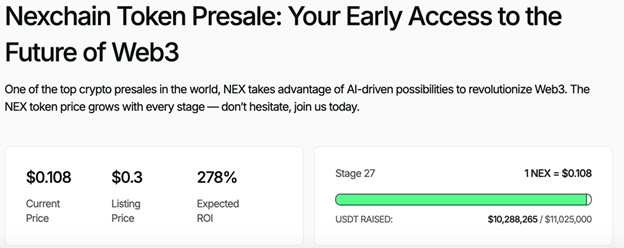
At Stage 27 of its presale, the token is priced at $0.108 with a confirmed listing price of $0.30. The project has raised over $10.26 million out of a $11.02 million target. The expected return for early participants is calculated at 278%.

Key benefits of the NEX token include: 

  • Low transaction fees near $0.001
  • Daily revenue share from network gas fees
  • On-chain governance and voting rights
  • Access to AI-powered smart contracts and dApps
  • Cross-chain functionality with major ecosystems

With Whitepaper 2.0 set for release in mid-September, Nexchain is updating tokenomics and staking programs. Its combination of scalability, low fees, and transparent milestones makes it one of the top presale crypto opportunities in 2025.

Bitcoin Hyper: Scaling Bitcoin With Layer 2

Bitcoin Hyper ($HYPER) is building a Layer 2 designed to address Bitcoin’s scalability. Using an SVM rollup, transactions are batched and then settled back on the Bitcoin chain. This method allows faster and cheaper transfers without sacrificing security.

Its design is supported by the Bitcoin Relay Program, which verifies Bitcoin block headers and pairs this with Solana’s high throughput. This enables near-instant transaction finality.

HYPER tokens are priced at $0.012925 during presale, with staking returns reaching up to 79% APY. Early buyers gain governance rights as well as exposure to a developing Bitcoin DeFi ecosystem. The model makes HYPER one of the more ambitious pre sale crypto coins in circulation this year.

Maxi Doge: Community-Driven Meme Token

Maxi Doge ($MAXI) takes a more aggressive branding approach than traditional meme coins. It borrows from the Dogecoin legacy but adds a high-energy, profit-oriented identity.

The presale has raised over $2.22 million, showing strong uptake. The trend of dog-themed meme tokens remains intact, with Dogecoin itself recently rising more than 70%. This positions MAXI well within a market that values community engagement and cultural recognition.

Wall Street Pepe: Private Trading Network

Wall Street Pepe ($WEPE) blends meme branding with trading access. Token holders are connected to a private group offering market insights, alpha calls, and weekly competitions.

The group has already predicted sharp moves in smaller tokens, earning credibility. The project is also preparing a 5,000-NFT collection to reward early supporters. While not a classic ICO, WEPE has become one of the more visible crypto pre sales due to its trading utility.

Snorter Bot: Alerts and Copy Trading

Snorter Bot ($SNORT) provides early alerts on new project launches. Built into Telegram, it allows users to swap tokens, set limit orders, and copy trades.

Within hours of launch, the presale raised over $100,000. By combining community with trading tools, SNORT is drawing attention from investors seeking practical presale token crypto opportunities.

SUBBD: Entertainment Meets Crypto

SUBBD is entering the presale cryptocurrency market with a focus on the $85 billion pay-per-view sector. The project enables holders to create AI-assisted photos and videos linked to influencer engagement.

By connecting entertainment content with token rewards, SUBBD offers a hybrid approach that merges lifestyle with crypto presales. It is among the more unconventional entries in the 2025 cycle.

SpacePay: Retail Payment Integration

SpacePay ($SPY) aims to simplify crypto payments at checkout. Its SDK integrates with more than 325 wallets and automatically converts crypto to fiat for merchants.

SPY tokens reduce transaction fees, provide cashback, and include governance rights. At presale, tokens are priced at $0.003181, with more than $1.1 million already raised. Twenty percent of the supply is set aside for the public, with allocations for loyalty programs and reserves ensuring long-term support.

This mix of retail utility and presale traction keeps SpacePay on the radar of investors scanning top presale crypto projects.

Why Nexchain Remains the Top Pick

Despite competition, Nexchain holds a lead for several reasons. Its blockchain is designed for 400,000 transactions per second with minimal fees. The architecture supports interoperability, AI-powered contracts, and decentralized governance, giving it more functionality than typical presale tokens.

Investor participation confirms this strength. With over $10.26 million raised, a confirmed listing price of $0.30, and clear tokenomics, Nexchain offers both transparency and growth potential. The combination of speed, utility, and consistent delivery ensures it stays at the top of the crypto pre sales list for 2025.

Outlook for 2025

The presale market continues to grow as investors seek early entry into new projects. Nexchain leads with its AI-driven infrastructure, while Bitcoin Hyper extends Bitcoin through Layer 2 scaling. Meme projects like Maxi Doge and Wall Street Pepe capture community attention, while Snorter Bot and SUBBD bring unique applications. SpacePay adds a payments angle with practical use cases.

For investors, 2025 offers a broad mix of pre sale crypto coins. Nexchain’s strong fundraising, innovative technology, and clear roadmap put it ahead of peers, making it one of the best ICOs for early investors this year.


Learn more about the Nexchain presale here:

Website: nexchain.ai/

X: x.com/nexchain_ai

Telegram: t.me/nexchain_ai

LinkedIn: www.linkedin.com/company/nexchainai/