The superstar musician Oluwatobiloba Daniel Anidugbe popularly known as Kizz Daniel has been invited by the police and could be arrested or detained if he fails to honor the invitation of the police.
He was invited on account of the seizure of a property (laundry truck) belonging to a dry cleaning company. According to the story, Kizz Daniel gave out his clothes to be dry cleaned by the laundry company and the Landry company damaged some of his expensive and quality clothes. He decided to seize their truck until they replace the clothes for him or pay him the money worth of the clothes which is said to be running into multiple six digits. The laundry company reported him to the police for this act.
The act of Kizz Daniel seizing the property of his debtor/ offenders is referred to in law as self-help and resorting to self-help is always prohibited in a civilized society like Nigeria. Citizens are prohibited from taking the law into their hands, even if you are the singer of the famous hit song “Buga ”, you are expected to comfort yourself, be civil and follow the due course of law in addressing your grievances.
A dry-cleaning company mishandling the clothes of the artist is a civil wrong and the police have no power over that and Kizz Daniel has no legal right or bases to resort to self-help; the corresponding reaction of Kizz Daniel seizing the property belonging to the dry-cleaning company now falls under the purview of criminal wrong and Kizz Daniel could be charged for theft or illegal seizure of property belonging to another. He could as well be charged with assault and battery and if he damaged the property of the dry cleaning company he could also be charged for damaging the property belonging to another.
What the superstar singer should have done is to commence legal action against the laundry company in court and pray to the court to ask the laundry company to pay him back for the expensive clothes they damaged or replace the clothes and if Kizz Daniel makes a good case the court will grant him his prayers.
Self-help turns the society into a jungle; an animal kingdom where the strong feast on the weak and weaker animals are constantly harassed, killed, or chased around by the stronger ones.
When the relay began, the commentators were all over England. As it picked up, Australia was also in the midst. About 5 seconds into the race, she picked Nigeria, quickly noting that the team was running a remarkable race. Tobi Amusan had given them an edge – a really brilliant start. But it must still be finished – and the last exchange of baton was crucial. Then, it happened – seamlessly and flawlessly.
As that last baton exchanged hands, it was magical. In physics, you call that “momentum” because the last runner was put in a position to accelerate, overcoming her inertia at the highest speed possible. The commentators had quickly switched to Nigeria.
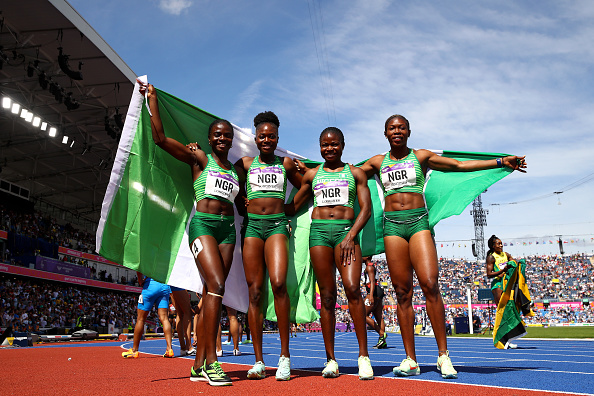
When it ended, Nigeria had won the 4x100m women’s relay final of the Commonwealth Games finishing ahead of England and Jamaica, respectively, and created a new African record. Commendations to Tobi Amusan, Favour Ofili, Rosemary Chukwuma and Grace Nwokocha.
Give the coach credit. The first leg of any 4x100m Relay is the most difficult because you are starting from zero with huge inertia to overcome. Tobi, the queen of hurdles, is a master of changing speed since running hurdles requires running, jumping, and changing pace at the highest speed possible. She did it brilliantly.
Tobi handed over to Ofili and by that time, they were near the curve. Running the curve is very tricky as you have to bend at high speed. It was Chukwuma who ran the curve before giving it to the fastest woman in Nigeria now, Nwokocha. Darly Neita of England put in an effort but Nwokocha’s speed finalized the deal. That is always the case – the last leg is always about sprinting and the fastest person runs it.
I am so proud of these young women; you can be Amusan, Ofili, Chukwuma and Nwokocha and win the world. Have confidence and work hard.
You could see – I do like sports but I really have no talent in that space. I was always coming last or being in the wrong place in football games! With no way to improve the outcome, I switched to analyses. I called and analyzed runs, games, scores etc, telling the athletes and players how to improve!!! Lol. Nicknamed Sausa – the game caller, strategist and analyst; we grew with it. (Secondary school was one of the most fascinating moments in life; hope you had a great one.)
The Commonwealth Games and the Olympic Games are two renowned international athletic events where competitors often come from various nations and compete in a variety of disciplines. The Commonwealth Games are primarily intended for former subjects of the British Empire and those who want a political and socioeconomic alliance with the UK. Many African nations, including Nigeria, take part in the games every four years. The Olympic Games, which are similarly held every four and two years (during the summer and winter seasons), do not place restrictions on participation based on colonial ties. Instead, they are open to all nations in the world.
The first Commonwealth Games was held in 1930, and the Second World War forced the cancellation of two subsequent events. The games was referred to as the British Empire Games from 1930 to 1950. In 1954, it was renamed the British Empire and Commonwealth Games, and it ran until 1966. The British Commonwealth Games was the new name given to it in 1970. Up until the 1974 edition, the Games went by this name. Since 1978, the term “British” has never appeared in the nomenclature of the Games.
According to our analyst, the elimination of “British” was done with the purpose of making the Games not represent Britain’s colonial control over the participating countries, as well as to demonstrate the essence of viewing the Games as communal efforts of all nations. Nigeria has attended 15 of the 22 editions of the festival between 1950 and 2022. Nigeria skipped the Games in 1962 (Perth), 1978 (Edmonton), 1986 (Edinburgh), and 1998 due to various regional and global political schisms (Kuala Lumpur). Nigeria similarly skipped the 1976 Olympic Games in Montreal owing to a similar cause.
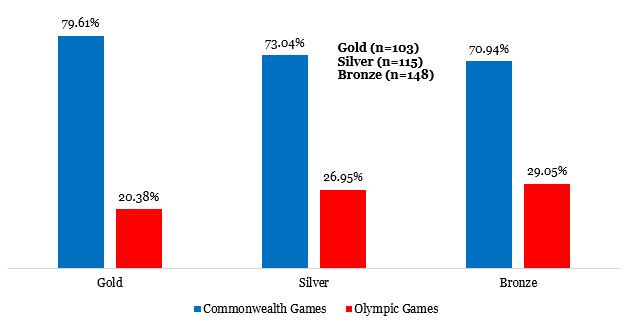
Exhibit 1: Nigeria’s Medal Performance at Both Games
Manufacturing One Game for Success of the Other Game
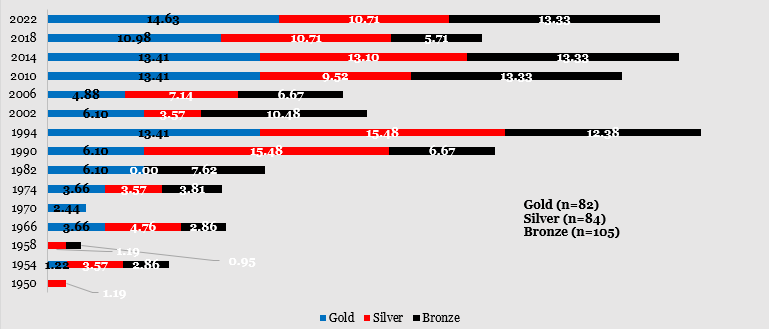
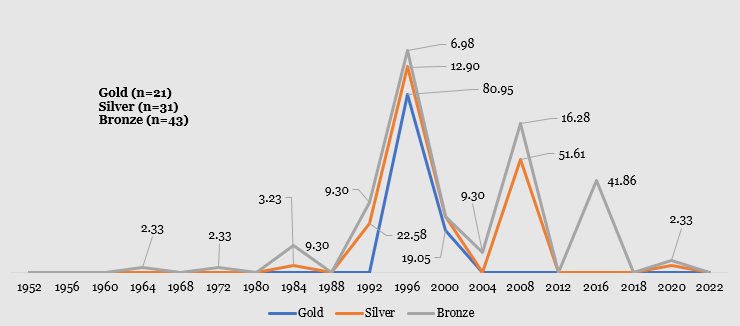
Nigeria competed in 11 Olympic Games before finally winning, but her second appearance (at the 1954 Commonwealth Games) resulted in her first gold medal (see Exhibit 2). Nigeria began winning gold at the Olympics in 1996, a year in which it won a sizable amount of gold medals. Nigeria made history by being the first African nation to ever win a football-related gold medal during the year. The country, however, was unable to maintain the momentum at the games in Sydney in 2000, Beijing in 2008, and Rio in 2016. She had one of its lowest performances in 2020, winning a small number of medals (see Exhibit 3).
As previously indicated, Nigeria earned a set number of medals across all medal categories at both games. Over the years, however, the country has performed better in the Commonwealth Games than in the Olympic Games (see Exhibit 1). In comparison to the Olympic Games, she has won more gold, silver, and bronze medals at the Commonwealth Games. Analysis of both games shows that Nigeria’s highest Olympic achievement was in 1996, and 2022 remains her year of great accomplishments in the Commonwealth games since 1950.
Exhibit 2: Nigeria’s Performance at Commonwealth Games 1950-2022
Source: Commonwealth Games Foundation, 2022; Infoprations Analysis, 2022
Exhibit 3: Nigeria’s Performance at Olympic between 1952 and 2022
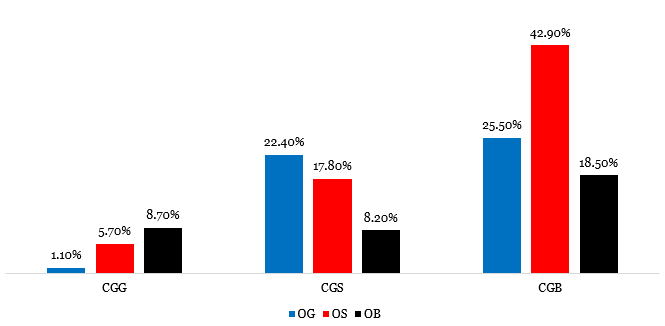
Bronze medals at the Commonwealth Games had a greater impact on the winning attitudes of athletes during previous Olympic editions than other medal categories, according to our analysis of the relationship between winning medals at the Commonwealth Games and achieving the same result during Olympic editions. Nigeria had a 42.90 percent greater chance of earning silver medals at previous Olympic competitions after winning bronze. Over a quarter of the gold medals won at the Olympic Games came from the bronze category. Analysis also reveals that Nigeria’s past Commonwealth Games silver medals helped the country achieve gold, silver, and bronze at the Olympics at a moderately high percentage (see Exhibit 4).
Exhibit 4: Percentage Contribution of Commonwealth Games Medals’ Winning to Olympic Medals’ Winning
The Need for Exploring Sustainable Policy, Infrastructure and Incentives
The key insight is that leveraging the country’s performance at the Commonwealth Games might help her put up a strong show at the Olympics. Concerned stakeholders should take into account other potential elements that could have improved the performance throughout the previous five Commonwealth Games editions in addition to using medal exploits to determine this. Does this imply that athletes competing in athletics for the Commonwealth Games received greater instruction using top-notch resources and rewards than those who competed in past Olympic competitions?
The orientation and readiness of each involved stakeholder to make sport contribute to Nigeria’s growth and development would heavily influence the answers to this question. According to our analyst, using sport as a tool to achieve specific SDG goals and targets cannot be done with “mere paper policy” without taking tangible steps to translate stated goals and policy focus into physical activity. As a result, both the private sector and the Nigerian government, through the Ministry of Youth and Sports Development, need to step up and find creative ways to deal with the sector’s many problems.
There is a need to reexamine school sport activities, which created many excellent athletics who competed in the early editions of both games. Genuine infrastructure development investment must be undertaken, with an emphasis on creating a win-win situation. Sports coverage by media professionals must also be improved. The government’s sole focus on football is not assisting in the development of other sports across the country. Meanwhile, fixing these issues and/or challenges without proper financial and non-financial incentives for athletes would continue to facilitate citizenship change. As a result, it is critical that the Nigerian government consider developing special pay and remuneration packages for men and women in the sport sector.
There have been historical events that disclose that every time there is a conflict between the people’s Republic of China and Taiwan, the U.S always intervenes in favor and supports Taiwan.
The tension between the two parties (China and Taiwan) however escalated when the U.S House of Representatives speaker, Nancy Pelosi visited Taiwan on an official visit that led to another spark of conflict between Taiwan and China, which has been disclosed to be severely affecting Global World Trade.
According to sources, China’s military drills are coming out to a disruption in one of the world’s busiest trade routes and commercial travel ships, forcing the ships to reroute. It is also revealed that a London-based shipping consultancy, presently around 256 container ships and other vessels have put their operations on hold in Taiwanese territorial waters due to the Chinese military drill.
American multinational technology company, Apple, which is set to launch its latest edition of iPhone 14 in September, might face a possible delay, causing the postponement of its product launch, as the Republic of China has strictly enforced a rule that Taiwanese-made parts must be labeled correctly.
Due to this policy, the Chinese government can even go as far as delaying and rejecting shipments from Taiwan. It is to be noted that Apple outsources the chip manufacturing to Taiwan semiconductor manufacturing company limited, and China is the most important hub when it comes to worldwide iPhone shipments.
Following this recent development, the technology manufacturing company has asked its suppliers to ensure that shipments from Taiwan to China comply with Chinese customer’s regulations to avoid them from being held for scrutiny.
Any shipment with the phrase “Made In Taiwan”, violates China’s rule and may be held hostage after it has been scrutinized by Chinese customs. A violation of this rule attracts a fine of up to 4,000 Chinese Yuan (roughly $592) which can lead to possible rejection of the shipment, which will no doubt lead to a delay in iPhone shipments.
The imposition of this policy by China and the timing is very sensitive for Apple, as its suppliers are already preparing components that will go into its next iPhones and other products that the company is set to launch in September. A delay in the iPhone 14 shipments may force Apple to postpone its launch of the stipulated date.
A recent report disclosed that one of the shipments from Taiwan to one of the iPhone assembler Pegatron’s facilities in China was held for review last week to see whether the import declaration has been made according to China’s rule.
As the World market is slowly trying to recover from the impact of the Russian-Ukraine war, the recent tension between China and Taiwan has been predicted to have a negative impact on global trade. Nearly half of the world’s container ships pass through the narrow Taiwan strait which separates the island from the Chinese mainland in the first seven months of this year.
Given that much of the world’s container feet passes through the waterway there will inevitably be disruptions to global supply chains due to rerouting.
Why There Is So Much Tension Between China And Taiwan, Here Is What You Should Know
Beijing asserts that there is only “one China” and that Taiwan is part of it. It views the PRC as the only legitimate government of China, an approach it calls the One-China principle and seeks Taiwan’s eventual “unification” with the mainland.
Beijing claims that Taiwan is bound by an understanding known as the 1992 consensus which was reached between representatives of the Chinese Communist Party (CCP) and the Kuomintang (KMT) party that then ruled Taiwan.
However, the two sides don’t agree on the content of this so-called consensus, and it was never intended to address the question of Taiwan’s legal status.
For the PRC, as Chinese President Xi Jinping has stated, the 1992 Consensus reflects an agreement that “the two sides of the strait belong to one China and would work together to seek national reunification.”
Tensions between China and Taiwan have been rising in recent years driven by differences over the island’s status.
The potential trade barriers that will arise from the current faceoff between China and Taiwan is prompting multinational companies in the island to take precautionary measures.
US phone maker Apple has asked suppliers to ensure that shipments from Taiwan to China strictly comply with Chinese customs regulations, and also to brand products with “Made in China” labels.
Sources familiar with the matter told Nikkei Asia that the Cupertino giant told suppliers on Friday that China has started strictly enforcing a long-standing rule that Taiwanese-made parts and components must be labeled as being made either in “Taiwan, China” or “Chinese Taipei.”
The tension between China and Taiwan escalated following the controversial visit of the US House Speaker Nancy Pelosi to the island last week, which defied China’s warnings.
According to the people, Apple has urged suppliers to treat the matter with urgency to avoid possible disruptions caused by goods and components being held for scrutiny.
Nikkei noted that the timing is sensitive for Apple, as its suppliers are preparing components that will go into its next iPhones and other new products set to launch this autumn.
A clever plan to avoid a potential hindrance in shipment is using “Taiwan, China” or “Chinese Taipei,” which indicates that Taiwan is part of China.
China is strongly laying claim on Taiwan as its territory and has vowed to reunite the island even if it means using military power. Pelosi’s visit ignited a wave of responses from Beijing that included military drills around Taiwan and economic sanctions.
For multinational companies caught in the conflict, the economic sanctions mean new rules that must be followed. But it presents a dilemma for suppliers in Taiwan.
The sources said using the phrase “Made in Taiwan” on any import declaration forms, documents or cartons could cause shipments to be held and checked by Chinese customs. Penalties for violating such a rule is a fine of up to 4,000 yuan ($592) or, in the worst-case scenario, the shipment being rejected, one of the sources said.
On the other hand, suppliers who need to ship materials, components or parts from Taiwan to China, are also required by the island to label all exports with product of origin, which means they must carry the words “Taiwan” or “Republic of China,” the island’s official name, according to suppliers and logistics companies.
The report said Apple’s warning comes after shipments from Taiwan to one of iPhone assembler Pegatron’s facilities in China were held for review on Thursday to see if the import declaration form or cartons are labeled with “Taiwan” or “Republic of China.”
To avoid any shipping chaos and further supply chain disruptions, Apple has also told suppliers to form contingency plans or quickly review and amend their labels on cartons and forms for shipments from Taiwan to China, if necessary, the people added.
With both countries calling the shots and not likely going to back down on whose label products bear, suppliers in Taiwan have inadvertently been caught in a controversy that will disrupt their exports.