DD
MM
YYYY

PAGES

DD
MM
YYYY

spot_img

PAGES

Home Blog Page 50

Top 3 Tokens to Invest in as Whale Buying Lifts Bitcoin Above $105,000

0

This week, Bitcoin accomplished a significant rally, essentially surpassing the $105,000 mark, and the whole crypto market got kind of lit because of that. Little Pepe, a Layer 2 blockchain combining fast transactions with meme culture, is benefiting from this trend. Large investors entering the market are driving prices higher, prompting interest in similar altcoins and early-stage opportunities. For investors seeking to spread their risk away from BTC, here might be the next turn in the journey of tokens like Little Pepe, TRX, and SUI.

Frogs with Power: Little Pepe’s Meme Kingdom

Little Pepe is making waves with its Layer 2 network designed for speed and ultra-low fees. Currently in Stage 13 of its presale, 1 LILPEPE trades at $0.0022, with nearly $27.6 million raised out of the $28.7 million goal. The presale has sold over 16.7 billion tokens, leaving only a fraction for new buyers. With whales now showing interest, Little Pepe could see accelerated demand as early backers secure positions before the next price jump. The ecosystem is built on security, with a CertiK audit scoring 95.49%. This gives investors confidence that $LILPEPE smart contracts are robust and safe. Besides being secure, Little Pepe has been giving back to its buyers through a series of giveaways, in which more than 15 ETH in prizes were included. Additionally, the coin has no trading tax, allowing users to benefit from staking rewards and from marketing efforts that will attract many social media users through memes, videos, and influencer collaborations.

TRX Gains Quiet Strength While Market Dips

TRON(TRX) has shown impressive resilience amid BTC’s rally. Currently around $0.29, TRX has maintained relative stability while other major coins struggle. Its liquidity heatmap suggests upside clusters above $0.30, pointing to a potential sweep higher. Analysts note that the market is quietly absorbing dips, making this a possible accumulation opportunity for whales. Technical setups on TRX hint at bullish momentum. An inverse head and shoulders pattern is forming, supported by a long-term ascending trendline near $0.28 to $0.30. The pattern indicates that continuation is favored if buyers hold this support zone. Even amid volatility, TRX remains green while the broader market turns red, suggesting strong rotation into defensive assets that could reward patient investors.

SUI Navigates Critical Levels

SUI is trading near $1.75, approaching key support zones after a period of consolidation. The token’s descending triangle pattern has tested traders’ patience, but the ecosystem shows signs of strength with active transaction volume and utility integration. This makes SUI a candidate for strategic accumulation while waiting for confirmation of a breakout above resistance levels. According to the charts, SUI seems to have been operating within a specified channel, decreasing its highs slowly. Early oversold conditions are indicated by RSI and MACD figures, suggesting a potential turning point. Traders consider $1.75 as the turning point, with short-term goals of $1.80 and $1.88.Whales could use this compression phase to position themselves ahead of a wider market recovery.

Layered Momentum in a Bullish Crypto Week

Altcoins, such as Little Pepe, TRX, and SUI, are benefiting from the recent BTC rally that surpassed $105,000. These three tokens have different stories unfolding: Little Pepe is a rapidly popularizing meme token, TRX is strengthening its position by defensively providing liquidity, and SUI is a token whose price is showing signs of consolidation and a possible breakout. Investors looking to diversify their portfolios with high-risk assets might consider these tokens as their next step, provided they also manage their entry timing properly.  The market is expected to behave like a combination of FOMO, whale accumulation, and cautious optimism this week. The rise of Bitcoin is a reason for market optimism. Altcoins remain highly volatile, rewarding only well-positioned investors. Monitoring liquidity zones, structural supports, and presale progress is key to managing risk and capturing early opportunities.

Conclusion: Your Next Steps

If you liked those memes and if you are a Little Pepe fan, the Little Pepe presale is still going on for $0.0022 per token, which is a chance to get in early before the last rounds shut. Buyers willing to invest can also be active in daily community discussions, receive updates, and enter giveaways by joining the Little Pepe Telegram group. This is an ideal time for investors to position themselves strategically across promising tokens as whales push Bitcoin to new highs. At the same time, the altcoin market responds with opportunities for early adopters.


For more information about Little Pepe (LILPEPE) visit the links below:

Website: https://littlepepe.com

Whitepaper: https://littlepepe.com/whitepaper.pdf

Telegram: https://t.me/littlepepetoken

Twitter/X: https://x.com/littlepepetoken

$777k Giveaway: https://littlepepe.com/777k-giveaway/

DOGE and Pepe Could Rally Hard; Ozak AI Forecast Dominates the Future Curve

0

Crypto market sentiment is shifting rapidly as meme coins begin showing renewed signs of strength, with Dogecoin and Pepe both entering technical phases that hint at major upside potential. As liquidity flows back into high-volatility assets and trader confidence improves, analysts are once again highlighting the possibility of explosive meme-driven rallies similar to previous market cycles.

Yet even as DOGE and PEPE prepare for strong upward moves, the project dominating long-term ROI discussions is Ozak AI, whose early-stage valuation and AI-native infrastructure give it a far steeper and more sustainable growth curve than traditional meme tokens.

DOGE Shows Strong Revival Momentum

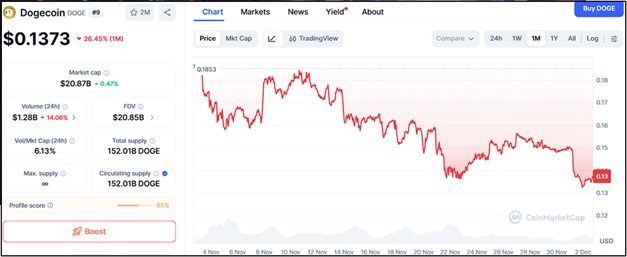
Dogecoin (DOGE), trading near $0.1373, is showing one of the most consistent recoveries among meme assets. The token continues to maintain key support zones at $0.1321, $0.1274, and $0.1225, where long-term holders and speculative buyers have repeatedly accumulated during dips. These levels demonstrate that the DOGE community remains deeply engaged and ready to push the token into the next meme-cycle surge.

Youtube embed:

For DOGE to break into a full bullish acceleration, it must clear resistance at $0.1435, $0.1511, and $0.1603, traditionally powerful breakout zones that have triggered sharp multi-week rallies in the past. With social attention increasing and large wallets starting to reposition, analysts believe DOGE could deliver strong multi-x gains. However, despite its potential, DOGE’s large market cap inherently restricts the kind of exponential upside that early-stage AI projects can achieve.

Pepe Prepares for Another High-Volatility Breakout

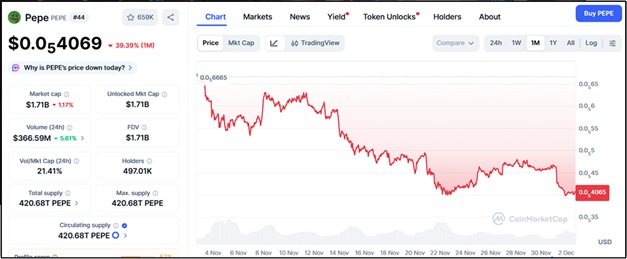
Pepe (PEPE), trading around $0.000004069, remains one of the fastest-moving meme coins in the market, supported by intense community enthusiasm and strong trading volume. PEPE maintains solid support at $0.00000391, $0.00000376, and $0.00000359, levels where bullish buyers have consistently defended the trend.

A major rally will depend on PEPE breaking through resistance at $0.00000420, $0.00000436, and $0.00000455, each representing historical inflection zones tied to high-volume breakouts. As meme-coin rotation intensifies, analysts expect PEPE to remain one of the most attractive candidates for double-digit or even triple-digit gains. Still, its reliance on social-driven momentum makes it far more unpredictable—and fundamentally weaker—than utility-backed AI projects.

Ozak AI’s Forecast Outshines DOGE and PEPE

Where DOGE and PEPE thrive on virality, Ozak AI (OZ) thrives on utility, intelligence, and technological depth. This is the core reason analysts believe Ozak AI represents the strongest long-term ROI candidate of the three. Ozak AI is developing a real AI-native ecosystem centered on automation, predictive modeling, cross-chain intelligence, and autonomous agents—capabilities that make it relevant to traders, developers, enterprises, and on-chain applications.

Ozak AI’s architecture includes:

  • Millisecond-speed prediction engines analyzing real-time market signals
  • Cross-chain intelligence modules monitoring multiple blockchains simultaneously
  • HIVE-powered 30 ms signal infrastructure delivering extremely fast trading insights
  • SINT-driven autonomous AI agents that execute strategies, analyze data, respond to voice instructions, and automate workflows

This deep level of utility places Ozak AI at the center of the fastest-growing global tech narrative: AI automation. As AI applications expand across the crypto ecosystem, Ozak AI becomes one of the most valuable infrastructure layers in the space.

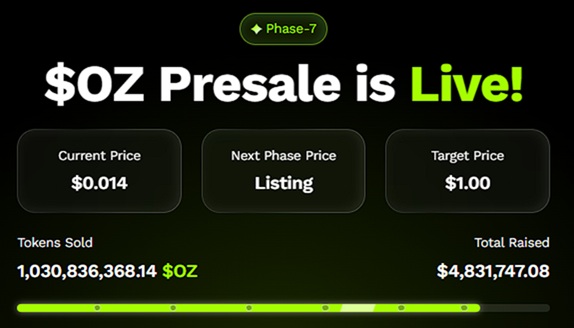
What amplifies its long-term projection is its explosive presale trajectory. With over $4.8 million raised and more than 1 million tokens sold, Ozak AI is tracing the same early-stage growth pattern seen in top-performing altcoins before they produced large-scale returns.

DOGE and PEPE Offer Strong Upside—Ozak AI Leads the Future Curve

Dogecoin has strong community momentum. Pepe brings high-velocity trading and meme-driven upside. Both can deliver strong gains during speculative phases.

But Ozak AI stands alone in terms of long-term ROI potential. Its early-stage valuation, real technological utility, and rapidly expanding AI ecosystem give it the steepest growth curve of the three—making it the project most likely to outperform DOGE and PEPE not just in the next breakout, but throughout the entire 2025–26 cycle.

About Ozak AI

Ozak AI is a blockchain-based crypto project that provides a generation platform that specializes in predictive AI and superior information analytics for financial markets. Through machine learning algorithms and decentralized network technology, Ozak AI permits real-time, correct, and actionable insights to assist crypto enthusiasts and businesses in making the proper decision.


For more, visit:

Website: https://ozak.ai/

Telegram: https://t.me/OzakAGI

Twitter: https://x.com/ozakagi 

Singapore Achieves Quantum Milestone as Horizon Quantum Launches City-State’s First Commercial Quantum Computer

0

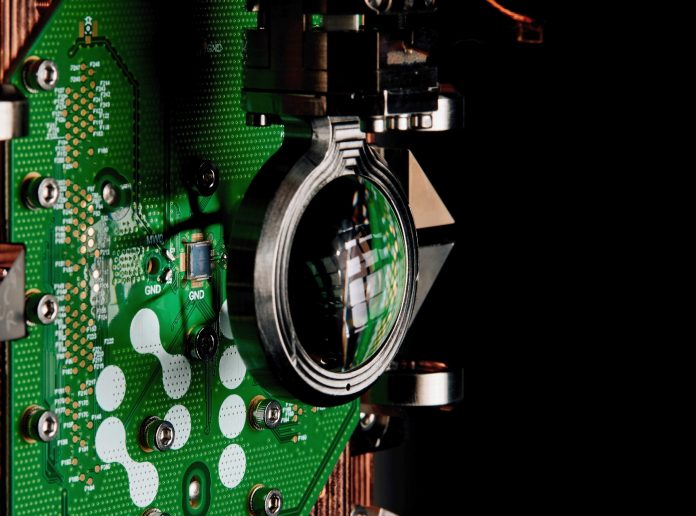
Singapore-based software firm Horizon Quantum has announced a major technological milestone, becoming the first private company to run a quantum computer for commercial use in the city-state.

The startup, founded in 2018 by quantum researcher Joe Fitzsimons, confirmed on Wednesday that the machine is now fully operational, utilizing components integrated from leading quantum computing suppliers, including Maybell Quantum, Quantum Machines, and Rigetti Computing.

The move is highly strategic for Horizon Quantum, as it also makes the company the first pure-play quantum software firm to own its own quantum computer—an integration designed to accelerate the development of real-world quantum applications.

Fitzsimons, the CEO, told CNBC, “Our focus is on helping developers to start harnessing quantum computers to do real-world work. How do we take full advantage of these systems? How do we program them?”

He added that while the company is heavily focused on the software side, “it’s really important to understand how the stack works down to the physical level… that’s the reason we have a test bed now.”

Accelerating the Quantum Race

Quantum systems aim to tackle problems too complex for traditional machines by leveraging the principles of quantum mechanics. Applications span industries from pharmaceuticals (designing new drugs through simulating molecular interactions) to finance (running millions of scenarios to assess portfolio risk), problems that are currently slow and computationally costly for conventional machines.

Despite today’s quantum systems remaining in the nascent stages of development, investment and confidence in the technology are soaring. A top executive at Google working on quantum computers stated in March that he believes the technology is only five years away from running practical applications. Nvidia CEO Jensen Huang also offered upbeat remarks in June, saying quantum computing is nearing an “inflection point” and that practical uses may arrive sooner than he had expected.

Investment in the space has been rising rapidly, with tech giants like Alphabet, Microsoft, Amazon, and IBM, along with the U.S. government, pouring millions into quantum computing research and development.

Singapore’s Ambition and Horizon’s Nasdaq Listing

Horizon Quantum’s launch significantly boosts Singapore’s national ambition to cement itself as a regional quantum computing hub. The city-state has been strategically investing in the technology for years, setting up its first quantum research center in 2007.

The National Quantum Strategy (NQS), unveiled in May 2024, pledged approximately S$300 million (Singapore dollars) over five years to strengthen development in the sector, with a significant portion directed toward building local quantum computer processors.

Before Horizon Quantum’s system came online, Singapore reportedly had only one quantum computer, used primarily for academic research. The commercial launch helps validate the government’s investment, especially as U.S.-based firm Quantinuum also plans to deploy another commercial system in Singapore in 2026.

The announcement provides a strong narrative ahead of Horizon Quantum’s plans to go public in the U.S. The startup is planning a merger with dMY Squared Technology Group Inc., a special purpose acquisition company (SPAC). The deal, agreed upon in September, aims to take Horizon public on the Nasdaq under the ticker “HQ.” The firm said in September that the transaction valued the company at around $503 million and was expected to close in the first quarter of 2026.

A Look into TikTok’s Major Data Center Investment in Brazil

0

Based on recent reporting from credible sources, the actual project involves a total commitment of around 50 billion Brazilian reais (BRL), equivalent to approximately $9.1–9.25 billion USD at current exchange rates.

This figure has been consistently reported since the project’s early stages in April 2025, with no announcements or updates today matching the inflated claim.

ByteDance— TikTok’s Chinese parent company has been in advanced talks for this data center since April 2025, with construction slated to begin in April 2026 six months from October 2025 statements by Brazil’s Mines and Energy Minister Alexandre Silveira. Operations are expected to start in 2027.

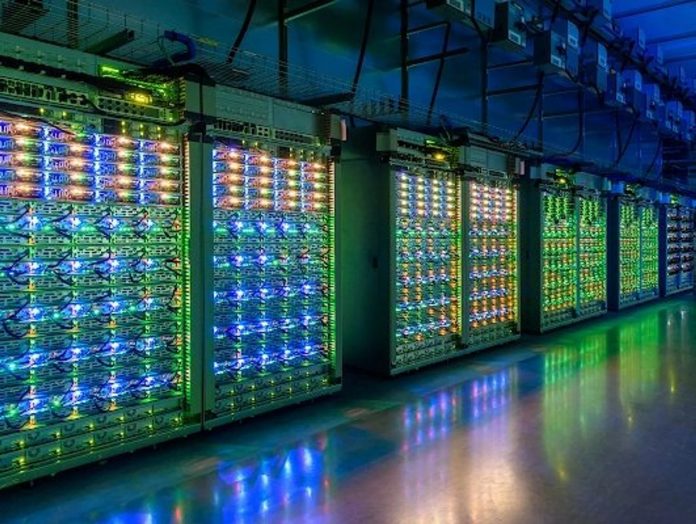
The facility will be built at the Pecém port complex in Ceará state, powered by 300 megawatts (MW) of renewable wind energy, with potential expansion to 900 MW or 1 gigawatt. It will be Brazil’s largest single-client data center, focused on TikTok’s operations in the Western Hemisphere to handle data storage, processing, and export services.

50 billion BRL ~$9.25 billion USD, split between infrastructure ~12 billion BRL by partner Omnia and IT equipment like servers funded primarily by ByteDance/TikTok. 3.5 billion BRL ~$640 million USD from wind farm developer Casa dos Ventos for dedicated renewable energy infrastructure.

Casa dos Ventos a Brazilian renewable energy firm for power supply and initial development. Omnia backed by investment firm Patria joined in November 2025 for infrastructure build-out, confirming TikTok as the sole client.

Brazil’s administration under President Luiz Inácio Lula da Silva has incentivized the project with federal tax exemptions on energy imports for data centers via an October 2025 executive order and approval for data export services.

This aligns with Brazil’s push to become a renewable-energy hub for tech investments, leveraging its wind resources in the northeast. ByteDance has declined to comment officially, but Brazilian officials have publicly confirmed TikTok’s involvement.

This seems to stem from a possible mistranslation, currency confusion, or deliberate hype—perhaps mistaking the 50 billion BRL for USD or inflating it for clicks 50 BRL × ~4.15 exchange rate doesn’t hit $37.6B; that would require ~207 billion BRL.

Earlier rumors in September 2025 mentioned a $10 billion pitch, but nothing close to $37.6B has appeared in verified news. No official TikTok or ByteDance statement today supports the higher number.

This project fits ByteDance’s global expansion strategy, similar to its $8.8 billion commitment to data centers in Thailand announced February 2025. For Brazil, it’s a boon for job creation in Ceará and bolsters its tech ecosystem amid growing demand for AI and cloud services.

However, it also raises questions about data privacy and U.S.-China tech tensions, given TikTok’s scrutiny elsewhere—though Brazil’s focus here is economic. Major economic boost for Northeast Brazil, thousands of direct jobs during construction and hundreds of permanent high-skill jobs afterward.

Ceará becomes a new tech hub; Pecém port already has logistics advantages and free-trade zone status, hotels, housing, schools, suppliers, and ancillary tech companies will follow.

Brazil emerges as a serious player in global cloud infrastructure Joins Chile, São Paulo, and Querétaro as one of the few places in Latin America with true hyperscale capacity. Cheap, abundant renewable energy gives Brazil a structural cost advantage over the U.S. Northeast, Northern Europe, or Singapore.

Green credentialing for TikTok 300–900 MW of dedicated wind power ? one of the world’s greenest large-scale data centers. Helps ByteDance counter criticism about its carbon footprint and Chinese coal-powered servers.

Data sovereignty and regulatory shield for ByteDance Latin America user data Brazil = 180+ million users, plus Argentina, Mexico, Colombia can stay in the future be legally stored in Brazil under LGPD compliance. Makes it much harder for the U.S. to force a TikTok sale or ban — the app’s Western Hemisphere backbone will no longer depend on U.S. soil.

Salesforce Lifts 2026 Forecast as Corporate Demand for AI Agents Intensifies, Fueling a New Phase of Enterprise Automation

0

Salesforce lifted its fiscal 2026 revenue and adjusted profit targets on Wednesday, banking on accelerating adoption of its Agentforce AI platform as large companies rush to integrate autonomous software into daily operations.

The updated outlook pushed the stock more than 2% higher in extended trading and signaled that the firm’s big push into AI is finally generating the kind of commercial traction investors have been waiting to see.

The company said mounting demand for AI agents—systems designed to act on their own and handle tasks that previously required human intervention—is now shaping its pipeline. The shift is widespread across corporate America, with firms looking for automation that cuts costs, speeds up workflows, and improves accuracy in recurring administrative processes. Big Tech players, including Oracle, have moved aggressively into this space, turning AI agents into a central battleground in enterprise software.

For Salesforce, the momentum is showing up in numbers. CEO Marc Benioff said in a statement that the company’s Agentforce and Data 360 products have reached nearly $1.4 billion in annual recurring revenue, climbing 114% in a year. Within that, Agentforce ARR alone exceeded half a billion dollars in the third quarter, more than quadrupling over the same period last year.

Many see the new forecast as evidence that early trials are converting into larger commercial deals. Rebecca Wettemann, chief executive of Valoir, said the guidance boost reflects confidence in Salesforce’s ability to turn today’s small-scale evaluators into full buyers in the months ahead. Her view echoes a broader trend across the market: enterprises that once experimented cautiously with generative and autonomous AI are now accelerating deployments, particularly as early use-cases show measurable productivity gains.

The enthusiasm comes during a period of heightened scrutiny from investors. Salesforce has poured billions into AI infrastructure, model training, data integration tools, and new platform capabilities. Shareholders have repeatedly pushed the firm to prove that these investments can generate sustainable returns, especially as concerns grow that the broader tech economy may be overheating. The company tried to reassure markets earlier in the year when it projected revenue above $60 billion in 2030, topping analysts’ estimates. Wednesday’s revision adds more weight to that long-range target by showing that near-term demand is solid.

The company now expects fiscal 2026 revenue between $41.45 billion and $41.55 billion, up from the prior range of $41.1 billion to $41.3 billion. Adjusted earnings per share were raised to between $11.75 and $11.77, above the earlier range of $11.33 to $11.37.

Salesforce’s third-quarter revenue came in at $10.26 billion. While that was a touch below the $10.27 billion expected by LSEG data, the market largely looked past the narrow gap because the AI-driven segments are showing momentum that traditional subscription lines have lacked over the past year.

The broader industry environment helps explain why Salesforce’s effort is drawing such close attention. AI agents have become the next major competitive front in cloud software after years of model-building and infrastructure races dominated by Nvidia, Microsoft, Google, and Amazon. While those giants continue to shape the supply side through chip production, model development, and hyperscale cloud services, the demand side has shifted noticeably.

Enterprises are moving from experiments to full integration, driven by the need to handle growing workloads with leaner teams. This change is forcing companies to rethink corporate software strategies, and the winners will be those who can blend automation with reliable data governance and customer-facing applications.

Agentforce sits at the center of Salesforce’s attempt to deliver that blend. It connects generative AI, workflow automation, CRM data, and process logic in a single environment. That integration gives Salesforce a lever that certain rivals—especially smaller, standalone AI developers—cannot easily match.

But the market remains open and highly contested. Microsoft is pushing its own Copilot ecosystem deep into enterprise systems, while Oracle is embedding autonomous agents across finance, HR, and supply-chain suites. Google Cloud and Amazon Web Services are also attempting to position their AI agent platforms as central hubs for corporate automation.

The renewed momentum around Agentforce shows that Salesforce sees an opening before these platforms become interchangeable. The company also understands that it needs proof points quickly, because the AI agent landscape is still fluid and customers are testing multiple providers at once. Salesforce’s raised forecast reflects the first time the firm has been able to show that a surge in interest is genuinely translating into multi-year recurring revenue rather than small trials or promotional commitments.

The next stages will test whether this growth can endure as AI adoption becomes more normalized and as enterprises scrutinize vendor lock-in, data security, and long-term costs.