DD
MM
YYYY

PAGES

DD
MM
YYYY

spot_img

PAGES

Home Blog Page 5453

Bias in the mind of a Robot

0

We may have seen cases where faces are misidentified on Facebook. But when algorithms misidentify the faces of crime suspects, it is not a joking matter. It is also not a laughing matter when face detection algorithms from well-known tech giant products misclassify faces of Serena Williams, Oprah Winfrey, and Michelle Obama as males.

In another note, On October 25, 2021, the Robomechanics research lab led by Professor Aaron Johnson of Carnegie Mellon University condemned the weaponization of mobile robots. According to Professor Aaron on his LinkedIn page:

“Robots should be used to improve people’s lives, not cause harm. As researchers driving the technological development behind these platforms, we have a responsibility to ensure that the technology is used in a constructive manner. As such, we will not work with companies that support the weaponization of their robots, whether autonomous or not. That is why last week my lab ended our partnership with Ghost Robotics and I resigned my (minor and unpaid) role as a scientific advisor to the company”
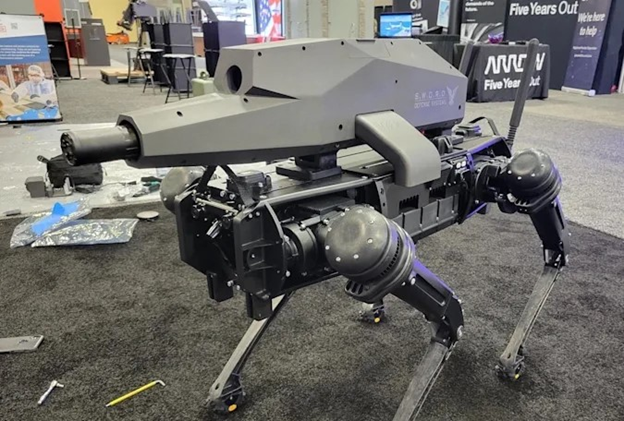
Photo Credit: IEEE Spectrum

The big question going forward is that should a robot be equipped for warfare and allowed to take kill or live decisions.

These are the current trending questions in robotics. They are, in fact, ethical questions and calls for concerns. They reveal very serious and genuine concerns. It gets worse when the robot is even more biased and this makes one ask, how should the autonomous vehicles be programmed to react in difficult or emergency situations? Who is to be blamed when an autonomous vehicle hits a person? The car manufacturer, owner of the vehicle or the (inactive driver) at the time of the accident? Should an autonomous vehicle have to choose in an unavoidable car accident, who should be hit.? An old person or a child? If you were faced with the Tunnel problem, what would you decide?

Tunnel Problem: You are traveling along a single-lane mountain road in an autonomous car that is fast approaching a narrow tunnel. Just before entering the tunnel a child attempts to run across the road but trips in the center of the lane, effectively blocking the entrance to the tunnel. The car has but two options: hit and kill the child, or swerve into the wall on either side of the tunnel, thus killing you. How should the car react?

Whether in autonomous cars or weaponized robots, ascribing responsibility for action during an emergency is a Gordian knot.

Photo Credit: becominghuman.ai

If humans are biased in the decision-making process, how then is the making of a human going to be less biased? If in our societies people of color are still protesting for cases of police racial profiling and discrimination, how then can we trust that a police robot equipped with warfare won’t be biased? Even if the police robot is not making decisions autonomously, the human remotely controlling it could be biased.

What should scientists and robotic engineers develop or research about? What happens when ethics clash with innovation. Should we sacrifice economics for ethics or vice versa?

Answers to many of these questions are going to determine the eventual acceptance and full deployment of autonomous systems (robots) in our society. We may not always blame the robot or its programmers for ethical issues as claims by car manufacturers say the self-driving car for example is not always the cause of the accident.

One of the original leaders of Google’s self-driving car project, Chris Urmson writes in 2015 about Google Driverless Car saying:

“If you spend enough time on the road, accidents will happen whether you’re in a car or a self-driving car. Over the 6 years since we started the project, we’ve been involved in 11 minor accidents (light damage, no injuries) during those 1.7 million miles of autonomous and manual driving with our safety drivers behind the wheel, and not once was the self-driving car the cause of the accident.”

The issue with ethics is not about whether robots are useful or not. We know they all are and can be put to very good use like in the surgical robots, farmlands robot, assistive robotic devices to mention but a few. In the 911 event, it’s the first time robots were deployed and used for rescue operations. Robot dogs are being used to deliver food in hostage situations, scout out a location where a gunman was located. The fear of the public, minority groups, and even researchers as regards robot dogs is the possibility of police violence, racism, and brutality, and unjustifiable killing which can come from weaponizing them, or the evolution of these robots from remote control to fully autonomous control and bias in the decision-making process. Thus, only until legal and ethical issues are solved, can we witness the full adoption of robots and autonomous vehicles in our society.

Algorithms today with the current state of development of AI and Robotics are still very much biased. David Berreby in a New York Times article wrote:

A robot with algorithms for, say, facial recognition, or predicting people’s actions, or deciding on its own to fire “non-lethal” projectiles is a robot that many researchers find problematic. The reason: Many of today’s algorithms are biased against people of color and others who are unlike the white, male, affluent, and able-bodied designers of most computer and robot systems.

Joy Buolamwin, founder of Algorithm Justice League in her Ted Talk also talks about algorithm bias and how a social robot could not detect her face in several instances. In one case, she had to borrow her white roommate’s face to finish the assignment. Later, working on another project as a graduate student at the M.I.T. Media Lab, she resorted to wearing a white mask to have her presence recognized by a facial detection algorithm because the people who coded the algorithm hadn’t taught it to identify a broad range of skin tones and facial structures. According to Joy, algorithms with bias can travel as fast as it takes to download files from the internet.
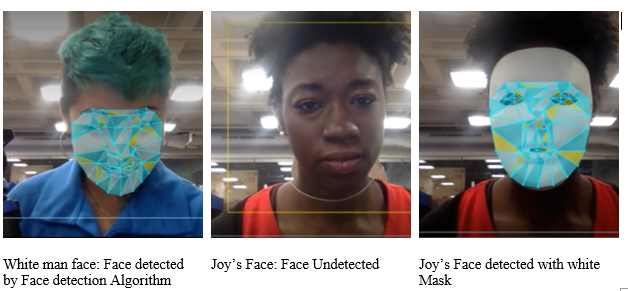
Another scenario by Professor Chris S. Crawford at the University of Alabama says:

“I personally was in Silicon Valley when some of these technologies were being developed,” he said. More than once, he added, “I would sit down and they would test it on me, and it wouldn’t work. And I was like, You know why it’s not working, right?”

Thus, there must be regulation and legislation and of course, full transparency before the public can fully accept and trust robots.

Robots are not just biased by nature; it starts with the algorithms that power these robots. Algorithms are also not self-written but written by humans. That is why solving bias really starts with people as opined by Joy in her TedTalk

Bias can lead to injustice which can be intentional or unintentional. Robert Julian-Borchak Williams was wrongfully accused by a facial detection algorithm of stealing in Detroit and he got arrested, spending hours in police custody and days in court trying to expunge his identity from a crime he didn’t commit.

The majority of cases of Bias come from the type of training data being used in the AI algorithm. Does the data have representatives in the whole sample population that will use the technology? If a facial detection algorithm is not trained with images of black men, such technology will not correctly identify a black man’s face. A machine learning algorithm will not make correct predictions or assumptions on information that is not accessible to it. Therefore, the training data must really represent the true population and not a skewed subset.

But beyond solving skewed dataset problems, a diverse engineering team will help in checkmating individual blind spots and biases.

Prof Chris Crawford says:

The long-term solution for such lapses is “having more folks that look like the United States population at the table when technology is designed. Algorithms trained mostly on white male faces (by mostly white male developers who don’t notice the absence of other kinds of people in the process) are better at recognizing white males than other people.

No matter how novel or innovative a technology is, how such a product will be used and who the end-users will use it matters a lot. A case in point here is the weaponization of robot dogs. A diverse training dataset representative of the true population, diverse team of different ages, gender, races, and ethnic groups including minority groups and multidisciplinary teams of engineers, lawyers, philosophers, psychologists, etc will be a game-changer in solving the challenge of bias in AI and robotics. Teachers and research lead also need to teach research methods and mentor students on identifying bias and solving the problem in their assignments and projects. This is why we now have several support and advocacy groups now like BlackInRobotics, BlackInAI etc

Importantly, minority groups need to step up their game and be part of the conversation. More students need to specialize and be subject matter expert in STEM, contribute to research and be part of the discussion since according to a West African adage, you cannot be absent from the meeting and complaint of not getting the share of the cake. African groups need to also develop a dataset that would represent their population and solve their challenges. Several works are being done along this line, but more work obviously needs to be done.

I will close with the words of Joy again, she says: “Thinking about the social impact of our biases matters. We need to create technology that works for all of us and not just some of us”


Hafeez Jimoh is a Power BI and Excel Trainer, Data Analyst and Robotics Researcher. You can connect with me on LinkedIn or twitter

Request for Your Tekedia Certificate in Business Growth Playbooks; Update LinkedIn Profile

0

Good People, the certificates for the just concluded Tekedia Business Growth Playbooks have been available. If you have not received yours, please contact our Admin. All our certificates are auto- verifiable via a code on the certificate; just go to tekedia.com/verify .

Also, please add your accomplishments here on LinkedIn. This is how to do it for Certificate in Business Growth Playbooks:

Go to the Education section in your LinkedIn profile:

  • School: Tekedia Institute
  • Degree: Certificate
  • Field of Study: Business Growth Playbooks

Now, look for another program at Tekedia Institute and continue to advance. We have since opened registrations for the new edition of Tekedia Mini-MBA. We also created a new program called Tekedia Startup Masterclass: from start-up to unicorn. Click here and begin a new journey with us.

Alumni, Add Tekedia Institute In Your LinkedIn Education Section

Before you register the name of your business conduct name check and search

0

Before choosing a name for your business, company, NGO or foundations and building a brand around the name, there’s every need for you to carry out some due diligence search and make sure that the name you chose or you want to name your organization has not already been taken or already in use by another fellow.

This was the mistake Mark Zuckerberg and his team made while changing the name of his company ‘Facebook’ to ‘Meta’ and this mistake is costing him about $20 million as there’s a start up company that already named their company ‘Meta. So the company is demanding $20million from Facebook to let them use the name Meta.

Background of the story

On the 28th of October, 2021 Facebook announced the name of its company from Facebook which it was previously known as Meta. The name ‘Meta’ refers to the metaverse that its founder, Mark Zuckerberg, wants to build, ‘a network with avatars, accessed by augmented reality devices, that mixes the physical and virtual worlds’.

An American company called Meta PCs, which are into the production of computers and related devices, claimed that they already trademarked the name ‘Meta’  as they applied for the name to be registered in August.

They are agreeing to sell the name to Facebook  only if Facebook agrees to pay the sum of twenty million dollars for the name.

This is why you need a lawyer to help you carry out the due diligence search, Business and company registration, incorporation, brand registration and trademark registration, patent rights acquisition etc.

On Approval Of N621.23 Billion For Road Projects In Nigeria

0

On 27th October 2021, the Nigeria’s Federal Executive Council (FEC) in its not unusual weekly meeting, approved the sum of N621.23 billion for reconstruction of 21 roads covering a total distance of 1,804.6 kilometres across the six geo-political zones in Nigeria.

It’s noteworthy that the proposed projects are to be undertaken by the Nigerian National Petroleum Corporation (NNPC) through the deployment of its own tax liabilities.

The development was graciously disclosed by the Minister of Works and Housing, Mr. Babatunde Fashola while briefing the State House correspondents at the end of the FEC meeting held in Abuja.

According to the Minister, who stated that there would be no more financing problems regarding the execution of road projects across the federation, nine among the 21 roads are in North Central, particularly Niger state. The reason is that Niger State is a major storage centre for the NNPC. He said “NNPC is doing this to facilitate the total distribution of its products across the country.”

He further gave an assurance that in the South-West, the Lagos-Badagry Expressway, the Agabara Junction, Ibadan to Ilorin (Oyo-Ogbomoso section) would be fixed.

Three other roads are reportedly located in the North-East, two in the North-West, and two others in the South-East. The Odukpani-Itu-Ikot/Ekpene road, the minister said, had now been fully covered to resolve the problem of financing.

He stated that in the South-East and South-South, there are Aba–Ikot Ekpene in Abia and Akwa Ibom States. Then the Umuahia-Ikwuamo-Ikot Ekpene road and so on. Similarly, in the North-West, it is Gada Zaima-Zuru-Gamji road, and also Zaria-Funtau-Gusau-Sokoto road. In the North-East, it is Cham, Bali Serti and Gombe-Biu roads.

It could be recalled that in July this year, the FEC approved the award of a contract to Dangote Industries for the construction of five roads totalling 274.9 kilometres at the cost of N309.9 billion, reportedly advanced by the company as tax credit.

In any given clime across the global community, capital projects are invariably what well-meaning citizens clamour for whenever a call to usher in good governance is raised in the public sphere.

This is so, because, it is only by establishment of such projects as good road network, creation of portable water, sound health and education systems, that the governed could feel the impact of the government.

This is the sole reason the ratio between the capital and recurrent expenditures of the annual budget of a particular nation for a certain fiscal year often tends to favour the former to the detriment of the latter. It suffices to enthuse that it has become unarguable that capital expenditures usually benefit virtually the entire occupants of the concerned clime compared to recurrent expenditures that’s targeted to favour only a few.

In view of these facts, successive governments all over the world that truly mean well for the governed have overtime made frantic and genuine efforts to initiate capital projects that would stand the test of time. Those who actualize this quest invariably succeed in writing their names in bold and gold.

In this part of the world, particularly Nigeria, issues pertaining to governance seem to be given a different attention and interpretation by the relevant authorities. We have hitherto observed a prevalent situation whereby a certain prospective government would rigorously embark on election campaigns with the mantra to treat capital projects as priority, but would abruptly sound differently the moment it assumed duty.

This uncalled nonchalant attitude of governments at all levels has continued unabated under our nose as if the people are a set of imbeciles. Sometimes when asked for clarification by the affected citizens, the enquiry would be regarded as unimportant by the failing government.

Lest we forget; on Thursday, 10th January 2019, the Federal Government (FG) led by President Muhammadu Buhari approved the sum of N100 billion for the Federal Ministry of Works, out of the proceeds of the Sovereign Sukuk fund, to finance critical road infrastructure across the country. The fund was for the construction and rehabilitation of 28 key economic road networks as captured in the 2018 budget.

The FG disclosed that the road projects were located in the six geo-political zones of the country with each zone having a total allocation of N16.67bn. This signifies that the capital projects were evenly distributed among the entire regions.

Speaking at the presentation of symbolic cheque to the concerned ministry, the Minister of Finance, Mrs. Zainab Ahmed noted that “the funds will be released to the Federal Ministry of Power, Works and Housing based on the framework agreed with the Trustees in order to ensure transparency and accountability in the use of proceeds.”

She added that “the Sukuk funding option is part of the initiatives of the government to diversify government funding sources, while also deepening the Nigerian capital market, mobilizing more savings and promoting financial inclusion.” The roads to be funded “will ease commuting, spur economic activities across the country and further close our infrastructural gap.”

In his response, the Minister of Power, Works and Housing (now Ministry of Works and Housing), Mr. Babatunde Fashola stated thus, “roads are coming, those are assets that would enable business that would enable transport, movement of goods and services and assets that will last 25, 30 to 40 years. This is a good investment to make. So, for those who asked why are we borrowing, we are borrowing to build at today’s prices assets that will last us for another 30 years.”

He further said “it will be more expensive to build but more importantly, where is the money going. As soon as I collect this cheque, I am going to give it to the contractors. But even, they can’t keep it; they have to give it to their suppliers because they need aggregates, they need materials and labourers but they first need suppliers.”

The Minister went further to assure that the Buhari-led administration “Is committed to follow the part of greatness, build the foundation for tomorrow by investing in infrastructure. It means that for example, we have to raise money and I am very happy to learn that over 1,876 investors are already doing business because Buhari government decides to build. That is how to build an economy.”

Two years down the line, the ‘28 key roads’ as mentioned in the said contract are still reportedly undergoing rehabilitation in spite of all the assurances tendered therein. One may then begin to wonder the kind of country called Nigeria we found ourselves.

In view of this omen, which has unabated been a recurring decimal in the Nigerian polity, the governed may have lost their trust in any government in power, or its allies. This is the reason the NNPC must take into cognizance that initiating a certain project is quite different from completing it, hence must consider the key steps needed to be followed towards ensuring the proposed projects are duly executed as planned.

The contracts are required to be awarded to corporate bodies of proven background and antecedents. Thus, no compromise should be reached for whatever reason. The contracts ought to be implemented in line with the country’s Public Procurement Act, thus a levelling playing ground is expected to be provided among the prospective construction firms.

In this regard, the memo for the proposed contracts should be made public to enable any interested firm apply for the job and due process ought to be followed afterwards in awarding the project to the deserving entities. Also, the contracts are meant to be awarded to only indigenous firms towards boosting our local content. So, the Executive Order 5 implemented by President Buhari must be adhered to.

When eventually awarded, the benefitting residents or communities should be properly made to comprehend the profile of the firms handling the respective projects with a view to making them able to alert/contact the relevant agencies whenever they observe any prank or foul play. It suffices to say that the beneficiaries must be a stakeholder in the overall implementation of the projects.

As regards adequate monitoring, viable mobile teams comprising reliable personnel ought to be constituted by the concerned authority. This would enable a regular supervision as the work progresses. In the same vein, the contractors must be mandated to complete the projects within a given time frame, else, should be made to face sanctions.

We are meant to acknowledge that initiating a capital project by the government is invariably the wish of the governed, but ensuring their completion remains their greatest desire.

Your personality does not expire in the minds of people even when titles and workplaces go

0

The greatest professional resilience is making sure that your job title and where you work do not define your personality and relationship with people.

Those two things are ephemeral, and if you allow men and women to relate with you, through them, the day they go, you will be looking for water in the boundless ocean.

Your personality does not expire in the minds of people even when titles and workplaces go. Great attitude will make your post workplace-career better.