DD
MM
YYYY

PAGES

DD
MM
YYYY

spot_img

PAGES

Home Blog Page 5585

Teach, Ensure Intellectual Property and Ignite Rapid Innovations in Nigerian Universities

0
National-Universities-Commission-NUC

Inventing new products and creating relatable services to problems have not been significant issues in most African countries. The real issue lies with the fact that the inventors or creators have always been denied the benefits of their ingenuity because of adequate knowledge of how Intellectual Property Protection works before and after developing the inventions.

Our analyst had earlier reported how the failure of protecting patent and intellectual property is weaning innovation ecosystem in Africa. In the piece, the submission was that concerned government stakeholders and individuals need to work collectively towards creation of a sustainable enabling environment for understanding and application of IP in all aspects of the society.

In Nigerian schools, little attention is being paid to the teaching of IP at the basic and secondary schools. This is not quite different at the higher education institutions. Ordinarily, law students are expected to be walked through the principles and practice of IP. However, neglecting other students in other faculties and colleges is doing a great disservice to the Nigerian society. Just as it does to other African societies, where little attention is being paid to inherent opportunities in IP as a business.

From the University of Ibadan to the Babcock University and the Bayero University to Obafemi Awolowo University, existing Intellectual Property policies address concerns of the academics and other staff in the academia more than the needs and concerns of the students. Mostly, according to our checks, the policies focus on issues within the contexts of ownership, rights, protection, commercialization and income sharing between academics and the universities’ authorities.

Beyond the university environment, our checks also established some research institutions and other higher education institutions equally have policies for strengthening intellectual rights. What remains to be done adequately is the teaching of IP as a course across disciplines.

In our experience, we have found that universities only have IP as course for students in the faculty of law and those who are doing programmes that relate to law. For instance, Mass Communication, Journalism and Media Studies programmes have courses that equip students with the skills, knowledge and experiences for understanding the terrain of copyright law.

In its quest of creating awareness about IP, the University of Lagos had the WIPO-Nigeria Summer School between July 19 and 30, 2021. This is laudable, being the first of its kind in Nigeria. Beyond Summer School, Nigeria needs to consider inclusion of IP as a course in all academic programmes. As hinted earlier, graduates of Mass Communication, Journalism, Media Studies and other programmes would always be willing to invent or create sustainable solutions when they realise the extent to which such solutions would be protected and capture value forever.

Never Raised Venture Capital, Bootstrapped MailChimp Sells for $12 Billion

1

MailChimp has been acquired by Intuit for $12 billion. I am not necessarily sure where MailChimp fits  into the Intuit playbook, except maybe QuickBooks, which has a dose of small and medium scale businesses which can be juiced by what MailChimp has prepared.  Intuit has a history of picking winners when you look at Mint, Credit Karma and other recent properties. In short, I have a playbook after Intuit which I called Fish Bait Acquisition Construct by merely observing how the tax-filing giant picks companies.

Founded in 2001, Mailchimp’s landmark cloud service enables businesses to design and send promotional emails and newsletters to customers. The company have since expanded, launching a software that allows online sellers to include a link to their ecommerce stores, a development which some speculate has contributed to the firm’s high asking-price. The company are still owned by their founders, and – surprisingly – have never raised venture capital.

Yet, that Intuit is spending $12 billion (about 8% of its market cap) in cash and stock to swallow MailChimp is not the main story; the main thing is that MailChimp generates close to $1 billion annual revenue now (extrapolated), and has NEVER raised a single venture capital dime! Yes, $0.00 venture funds. 

There are many things to learn about this company – expect many case studies from business schools. Yes, a company never raised venture funds, grew revenue to $1 billion and exited at $12 billion. That is a great business mission, executed!

The acquisition press release below.

Intuit (Nasdaq: INTU), the global technology platform that makes TurboTax, QuickBooks, Mint, and Credit Karma, today announced that it has agreed to acquire Mailchimp, a world-class, global customer engagement and marketing platform for growing small and mid-market businesses. The planned acquisition of Mailchimp for approximately $12 billion in cash and stock advances Intuit’s mission of powering prosperity around the world, and its strategy to become an AI-driven expert platform. With the acquisition of Mailchimp, Intuit will accelerate two of its previously-shared strategic Big Bets: to become the center of small business growth; and to disrupt the small business mid-market.

Together, Intuit and Mailchimp will work to deliver on the vision of an innovative, end-to-end customer growth platform for small and mid-market businesses, allowing them to get their business online, market their business, manage customer relationships, benefit from insights and analytics, get paid, access capital, pay employees, optimize cash flow, be organized and stay compliant, with experts at their fingertips. Delivering on the promise to be the single source of truth, small and mid-market businesses will have the power to combine their customer data from Mailchimp and QuickBooks’ purchase data to get the actionable insights they need to grow and run their businesses with confidence.

The Fish Bait Acquisition Construct

Microsoft Takes Lessons, Acquires Edtech TakeLessons; Lessons for Nigeria, Africa

0

Microsoft’s Teams supports an excess of 100 million students around the world. Today, we are learning that the software giant has acquired TakeLessons: “We’re so excited to announce that TakeLessons has been acquired by Microsoft. We believe this will further support TakeLessons’ mission: to empower people to learn, connect, grow, and live more meaningful lives through education.” 

TakeLessons is an aggregator, orchestrating students and tutors. Indeed, a “platform for students to connect with individual tutors in areas like music lessons, language learning, academic subjects and professional training or hobbies, and for tutors to book and organize the lessons they give, both online and in person.” By this acquisition, Microsoft is connecting atoms with bytes which is what most digital technology firms are doing these days.

Microsoft said in January this year that Teams, its online collaboration platform, was being used by over 100 million students — boosted in no small part by the COVID-19 pandemic and many schools going partly or fully remote. Now, it’s made another acquisition to continue expanding its position in the education market. [..]

Terms of the deal have not been disclosed but we are trying to find out. San Diego-based TakeLessons had raised at least $20 million from a range of VCs and individuals that included LightBank, Uncork Capital, Crosslink Capital and others. TakeLessons posted a short note in the form of a Q&A confirming the deal on its site. The note said that it will continue operating, business as usual, for the time being, with the intention of taking its platform to a wider global audience.

The message from this acquisition for Africa is simple: anything is an opportunity and some of these big technology giants will be looking for platforms and ecosystems with huge numbers as they expand into Africa at lower consumer levels.

 A credible ecosystem that makes it possible for parents to find tutors in Lagos, Kano, Owerri, etc may not be Microsoft’s interest but could be for  Flutterwave, Interswitch, etc as they need those pipelines for the future.

Simply, in summary, begin to build.

Dutch Court Rules Uber Drivers Are Employees

0

The gig business model being used by both ride-hailing and delivery services has continued to meet stiff opposition from labor unions and governments, and courts have been pandering to their yearning.

The bone of contention has been the classification of drivers as independent contractors instead of employees, which denies them minimum wage and workers’ benefits. Across markets, ride-hailing companies, mainly Uber and Lyft, are increasingly losing the fight to save the gig economy.

On Monday, a Dutch court ruled that Uber drivers are employees rather than independent contractors and are entitled to greater workers’ rights and in some cases are entitled to back pay.

The judgment follows a landmark ruling in London in February, classifying Uber drivers as employees and forcing the California-based taxi app operator to grant employment status to its drivers.

The Federation of Dutch Trade Unions had filed a complaint with the court arguing that drivers deserve the same benefits as other workers in the taxi sector. The Amsterdam District Court sided with union, upholding the labor law as it’s applicable to taxi transportation.

As it had responded in other places where the court had ruled in favor of drivers, Uber said it “has no plans to employ drivers in the Netherlands” and will appeal against the decision.

“We are disappointed with this decision because we know that the overwhelming majority of drivers wish to remain independent,” Maurits Schönfeld, Uber’s general manager for northern Europe said. “Drivers don’t want to give up their freedom to choose if, when and where to work.”

The ruling was based on the collective labor agreement for taxi transportation, which recognizes taxi drivers as employees, which the court found that Uber has flouted by giving them the self-employed status.

“The legal relationship between Uber and these drivers meets all the characteristics of an employment contract,” the ruling said.

The FNV hailed the ruling as “a huge victory for drivers” who it said will gain more pay and benefits.

“Due to the judge’s ruling, the Uber drivers are now automatically employed by Uber,” said Zakaria Boufangacha, FNV’s deputy chairman. “As a result, they will receive more wages and more rights in the event of dismissal or illness, for example.”

The judges also ordered Uber to pay a fine of 50,000 euros ($58,940) for failing to implement the terms of the labor agreement for taxi drivers.

Uber was forced by UK Supreme Court to accept drivers demand including the right to form a union, after it lost its bid to keep the classification of more than 70,000 drivers as independent contractors in February.

In March the ride-hailing giant, in an apparent effort to take the attention of the authorities off its business model, said it will improve workers’ rights, including the minimum wage in London, and allowed drivers to form a union for the first time. It also includes giving even more control over how they earn and providing new protections like free insurance in case of sickness or injury.

While the battle cuts across its markets, including Uber’s largest market California, where the government has enacted the AB5 law to force Uber to classify drivers as employees, Europe is swiftly kicking against the gig economy.

Last September, the Spanish Supreme Court ruled that delivery drivers are employees not independent contractors, prompting the Spanish government to enact a law backing the ruling up early this year.

Ndubuisi Ekekwe To Keynote Deeper Life’s YPF Leadership Summit

0

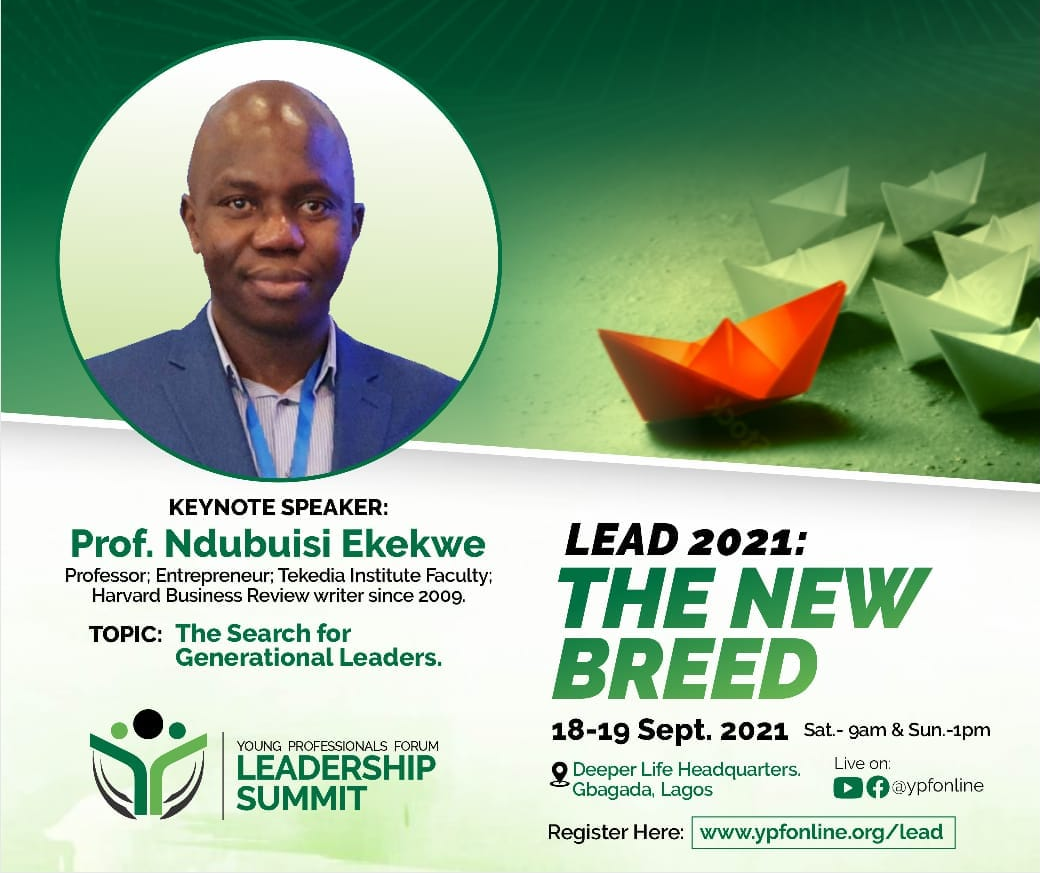
Join me at the headquarters of the Deeper Christian Life Ministry, Gbagada, Lagos, as I keynote this year’s Young Professionals Forum Leadership Summit. My presentation is titled “The Search for Generational Leaders”. Who would be the Nehemiah of our generation? Nehemiah grew up, and rose to become one of the most important men in Persia (in modern Iran): a cup-bearer to Artaxerxes, king of Persia, and later, the king made him a governor of Persian Judea. 

He managed projects; he delivered results. But not just that, he knew what mattered: he asked the king for permission to use the timber from his forest. Because timbers from the king’s forest are never wasted. Yes, if I get that special timber, the project is as good as done! Across nations, we need leaders who can see the future to create it. Yes, men and women who can connect the dots, and understand the critical enablers for economic  growth and development., advancement, etc.

  • Theme: The New Breed
  • Date/Time:  9 am on the 18th, and 1 pm on the 19th of September 2021
  • Venue: Deeper Life Bible Church Headquarters, Gbagada10 Ayodele Oke-Owo Street, Gbagada, Lagos, Nigeria
  • Registration: http://ypfonline.org/lead

You will breed and breathe newness! May His Grace shine on you and His abundance unbounded.