DD
MM
YYYY

PAGES

DD
MM
YYYY

spot_img

PAGES

Home Blog Page 5653

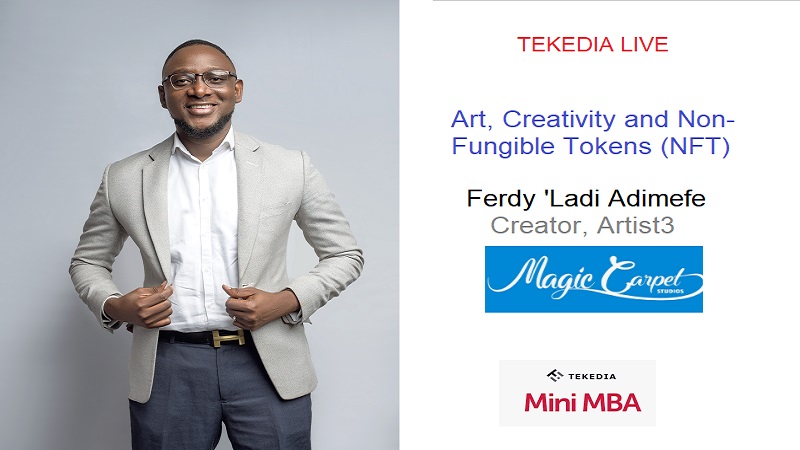
Tekedia Live – Art, Creativity and Non-Fungible Tokens (NFT) – July 20 @7pm

0

Ferdy ‘Ladi Adimefe is a creative entrepreneur and the Founder/CEO of Magic Carpet Studios, an innovation storytelling company that specializes in developing authentic African stories into the global market. The studio is one of the leading animations and game development studios in Africa playing a significant role in the development of the animation industry on the continent.

They create work of arts and then overlay one technology which is emerging out of the blockchain space. That tech is called non-fungible token (NFT): a non-fungible token is a unit of data stored on a digital ledger  that certifies a digital asset to be unique and therefore not interchangeable.

Ferdy is coming to discuss Art, Creativity and Non-Fungible Tokens (NFT)  at Tekedia Institute Mini-MBA Live as follows:

  • Tue, July 20 | 7pm-8pm WAT | Art, Creativity and Non-Fungible Tokens (NFT) – Artist3, Magic Carpet Studio (Lagos, Nigeria)  | Zoom link in the Board.

Registration continues for the next edition of Tekedia Mini-MBA; learn from the best. Register here.

Greenland Govt Bans Oil Exploration, Contrasting Nigeria’s Stance Amidst Global Push for Cleaner Energy

0
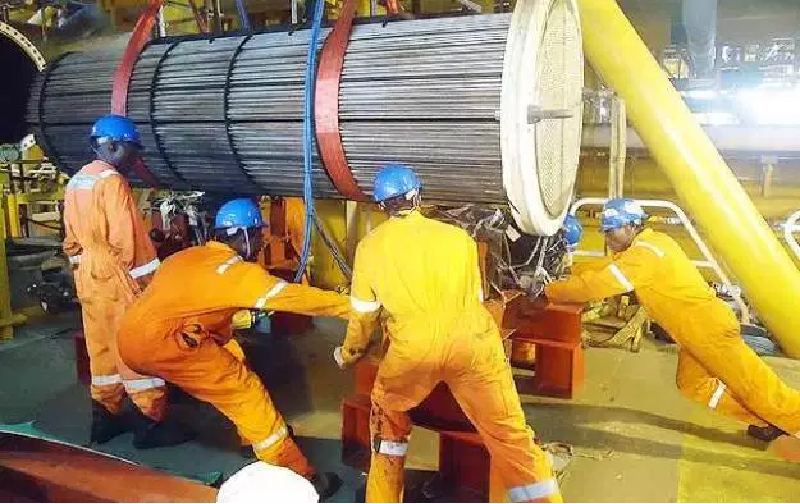
Oil workers

Greenland, a small Danish island territory in the Arctic, with rich oil and minerals resources, has thrown in the towel respecting oil exploration, citing the impact of fossil fuel on the environment and global push for a shift to cleaner energy.

The decision is the latest boost to the global quest to end carbon emission, and poses a striking contrast to the oil exploring moves that the Nigerian government has been making in frontier basins.

Though the Greenlandic government, Naalakkersuisut, remains committed to developing the country’s vast mineral potential, it is only focusing on where it does not involve the extraction of uranium. A draft-bill has been sent out for consultation, which bans preliminary investigation, exploration and extraction of uranium in Greenland.

The Greenlandic 57,000 population has based its livelihood on the country’s natural resources for centuries, and the ban on uranium mining is rooted in a profound belief that business activities must take nature and the environment into account. The government believes that the way the world is going, oil has no future.

“The future does not lie in oil. The future belongs to renewable energy, and in that respect we have much more to gain,” the Greenland government said in a statement. The government said it “wants to take co-responsibility for combating the global climate crisis.”

The Greenlandic underground contains large unexplored deposits of oil. A recent study from The Geological Survey of Denmark and Greenland (GEUS) estimates that there are DKK 18 billion de-risked barrels of oil on the west coast of Greenland. Large deposits are also expected to hide below the seabed on the east coast of Greenland.

However, the Greenlandic government believes that the price of oil extraction is too high. This is based on economic calculations, but considerations of the impact on climate and the environment also play a central role in the decision.

Against this background, Naalakkersuisut has decided to cease issuing new licenses for oil and gas exploration in Greenland.

The Minister for Housing, Infrastructure, Mineral Resources and Gender Equality, Naaja H. Nathanielsen said it’s time for soul-searching.

“As a society, we must dare to stop and ask ourselves why we want to exploit a resource. Is the decision based upon updated insight and the belief that it is the right thing to do? Or are we just continuing business as usual? It is the position of the Greenlandic government that our country is better off focusing on sustainable development, such as the potential for renewable energy,” he said.

No oil has been found yet around Greenland, but officials there had seen potentially vast reserves as a way to help Greenlanders realize their long-held dream of independence from Denmark by cutting the annual subsidy of 3.4 billion kroner ($540 million) the Danish territory receives. But in a sudden turn, the government is choosing the environment over oil revenue and independence from Denmark.

The government’s decision to stop oil exploration was welcomed by environmental group Greenpeace, which called the decision “fantastic.”

The Minister for Agriculture, Self-sufficiency, Energy and Environment, Kalistat Lund said the decision will help the government to fight climate change and focus on other sources of economic growth.

“Naalakkersuisut takes climate change seriously. We can see the consequences in our country every day, and we are ready to contribute to global solutions to counter climate change. Naalakkersuisut is working to attract new investments for the large hydropower potential that we cannot exploit ourselves. The decision to stop new exploration for oil will contribute to place Greenland as the country where sustainable investments are taken seriously,” he said.

Crude oil price is at $71, the highest in four years. For oil economies, it offers an opportunity for swift recovery from pandemic-induced economic losses but it also means further harm to the environment.

In Nigeria, the government has adamantly continued oil exploration even as the world moves on. The Petroleum Industry Bill (PIB), which has been under consideration by Nigerian lawmakers proposes that 30% of oil profits be dedicated to oil exploration, in clear opposition to the global push for clean energy.

Greenland Minister for Business, Trade, Foreign Affairs and Climate, Pele Broberg said businesses moving away from oil indicate it’s time the government considered the environment and explore futuristic opportunities.

“International investments in the energy sector in recent years are moving away from oil and gas and into renewable energy. It is therefore natural that we emphasize business on the opportunities of the future and not on the solutions of the past. The decision to halt oil exploration is also the story of a population that puts the environment first. It is a story I look forward to sharing with the tourism sector and include when I represent Greenland internationally,” he said.

Recently, many companies in the energy industry have announced plans to divest. Saudi Aramco, Shell, BP etc. all said they are moving away from crude oil to cleaner energy, winding down their operations in some countries and developing frameworks for environmentally friendly business.

The pro green Joe Biden administration has taken the United States back to the Paris Climate Accord, leading the charge for global climate action that will hurt oil production in the near the future.

With efforts collectively yielding alternatives to oil, and more governments and firms showing willingness to embrace the alternatives, Nigeria may need to find a new use for its abundant oil soon.

Beyond The Oba Carnival, The Obi Cubana’s Show In Scotland

2

One of the most “craziest” CEOs in America in recent memory was the CEO of T-Mobile. John Legere was annoyingly funny. But check his numbers: he rebuilt T-Mobile and redesigned the US telecommunication market. The man will run crazy in front of hotels, attracting attention, just to get local TVs to cover his brand. He pioneered no-contract mobile plans, and did many things that changed how AT&T and Verizon, the industry leaders, engaged with customers.

That takes me to the story of the moment in Nigeria: check Tekedia, my piece on Oba Cubana is trending #1. In other words, in less than 4 hours, its traffic is bigger than the cumulative 7-day averages of other articles. This is the piece, and it has been well received by many.

I am from Abia but I have many contacts in Anambra. What people may not know is that even though some of these men might not have gone to school, they do not play with education! Anambra state is now ranked top #3 (if not #1) in JAMB and WAEC in Nigeria with literacy rate above 95%. If you work with them, you understand the pursuit of perfection and excellence: “Prof, you will lead this presentation for our company and we are sending a business class ticket for you to arrive in Nigeria over the weekend”. Yes, they are ready to spend millions of naira to get someone to have the best delivery. 

The Obi Cubana and his pals run hotels and clubs. Using public data, I know they hold exclusive distribution of many wine brands in Nigeria. As they serve these drinks in their clubs and hotels, they build a customer base. Not only wines but many things. In short, they run the One Oasis strategy, capturing massive value using the Double Plays.

The Cubana team has been doing shows in their own ways!  They went to Scotland and wowed the company board to seal the exclusivity of the Glenfiddich in Nigeria.  They put on a show and the Scottish press recorded their presence; they brought the deal home. In business, open your playbook but it needs to align with your grand plan.

Do not be deceived, these are men going for alpha. In the Igbo Nation, the world is a market, and they are in the market now. If you can, try to understand what they do. According to rumours, the total worth of their hotels, clubs, etc would be in excess of $1 billion which means only 3 banks in Nigeria are worth more!

The Obi Cubana’s Carnival and Nigeria’s Acres of Diamonds

The Obi Cubana’s Carnival and Nigeria’s Acres of Diamonds

15

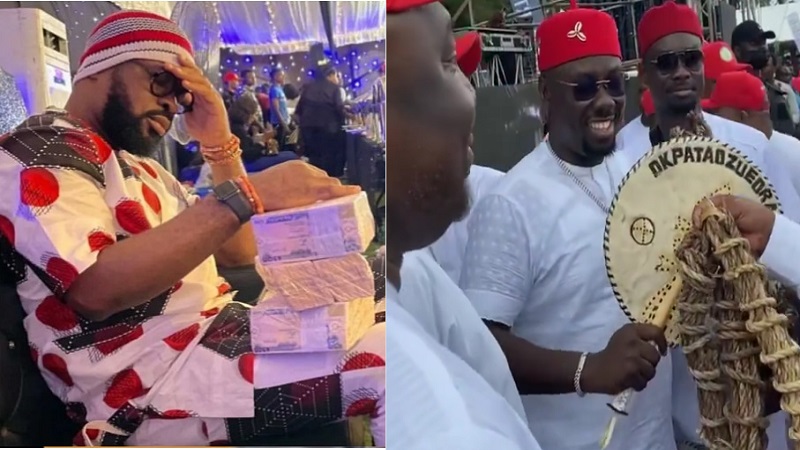
More than 400 donated cows.  $100,000 diamond pendant. 24-karat gold sunglasses by the House of Lunettes. Close to 70 private jets. Hundreds of the most expensive luxury cars.  Wines costing N3.5 million served. A burial so affluent that the host quipped: the burial “would make people crave death with relish”.  Obi Cubana’s mother’s burial has dominated the social-sphere of Nigeria.

He turned his village into an arena of the socialites, eclipsing another burial where a former bank CEO brought former presidents, bank executives, past and present central bank governors, etc for his mother’s burial. But those could not compete with a carnival which attracted Davido, D’banj, Kcee, and E-Money.

Why did Obi Cubana do this? Simply, that is what entertainers do. And they are not stupid. It is a business that wins on visibility and popularity. As the man who runs one of the largest nightclub chains in Nigeria, he understands that he could recruit more thousands if Cubana brand is more urbanized in the hearts of young people. And to do that, he called up his messengers, being the High Priest, and they responded.

The subjects are young people who are hypnotized by wealth. I promise you one thing: the market cap of Cubana would double in the next few months, mainly from more traffic into his clubs.

For this fanfare and carnival, it goes back to one thing: delivering alpha. I had been in a meeting where an entertainer was asking what he could do – no matter how crazy – to be in the news for 24 hours. It was in Tuskegee Alabama and I was trying to earn small money (as a student) to help a local entertainer on strategy. The wife there suggested that the man should slap her and she would call the police, and that would get all the local newspapers to cover it. But at the end, it would be captured as a mistaken incident (the wife would claim she was confused) and the next week, he would open a concert! I excused myself and left: many things are rigged in this world!

Obi needed to arrive in Nigeria – and he has done what most do to arrive in Nigeria: go through the minds of people, showcasing wealth, and become relevant at scale. Expect him endorsing politicians now! He is rumored to be worth at least $500 million with his Cubana empire estimated at excess of $2 billion, globally. In other words, he runs a business which could be valued more than most banks in Nigeria. His magic is simple: uncommon class of splendid quality in exotic clubs and hotels.

Anambra state passed an anti-money spraying in events. We will be watching if they will enforce the law because what happened in the burial was clear: there were many men whose problems are how fast they can spread money. Yes, someone in Nnewi makes a tool which helps you load cash and push a button so that spraying money will not be too much of a burden.

Same Nigeria and 99% of them live in that Nigeria: unbounded wealth. Sometimes, despite the obvious insanity of this carnival, it is good to remind people that Nigeria has acres of diamonds. Do not be tripped – all of them have built ROIs on,  and the destination is fatter bank accounts as free press has brought more brand recognition.

Obi and his group are in the same Nigeria. Yes, despite the obvious insanity of this carnival, it is good to remind people that Nigeria has acres of diamonds. As I watched them, I saw an opportunity: build a money-sprayer as I saw men in pain trying to spray money fast enough, but their hands were failing. Imagine if we have supersonic money-sprayer which allows only $100 papers!

But note this: Obi has elevated Cubana, and when he returns to business, he will check how the foot traffic has improved in his clubs and hotels! Like in Michael Jackson’s wake keep where the girl said it would be nice to do this type of show regularly, Cubana 2.0 has started. And before I go, I send my condolences. He truly wanted to celebrate his mother – and he has all the rights. 

The Umunneoma Economics and Igbo Apprenticeship System

Legends have it that most of the wealth displayed during the burial came through donations from men who Obi Cabana supported in their entrepreneurial journey. As I have written in Harvard Business Review, the Igbo Apprenticeship System remains a vehicle to accelerate wealth creation and insure a future. Obi Cubana is another case study.

The Igbo Apprenticeship System is a business philosophy of shared prosperity where participants co-opetitively participate to attain organic economic equilibrium where accumulated market leverageable factors are constantly weighted and calibrated out, via dilution and surrendering of market share, enabling social resilience and formation of livable clusters, engineered by major participants funding their competitors, with success measured on quantifiable support to stakeholders, and not by absolute market dominance.

For the Igbo Apprenticeship System, the main focus is to prevent poverty by mass-scaling opportunities for everyone, and not for building conglomerates! It makes no sense in Adam Smith Economics that a man will build a business, accumulate a market share, and one day decides to relinquish some – and even go further by funding his competitors. But he is accomplished by doing so: those competitors are his brethren (umunneoma) and they will RISE with him. In a world of inequality, despite the obvious inefficiency in this system – lack of scale reduces the capacity to solve big problems – it is all about ubuntu.

Comments on LinkedIn Feeds

Comment: There is no value in this kind of stuffs. It would not bring any development to his village. So what it is far?

Response: What is development? If a man spends $2 million and adds $50 million in his company valuation, is that not a good playbook? This guy is a UNN graduate, he built a massive empire from scratch; I will never think he is not going for alpha. It is part of building wealth: for every $1 billion Amazon puts in India, Wall Street rewards it with $20 billion for having exposure in India even though it may not make money in India for 10 years. But if it does not “waste” that money, Wall Street will punish it because it is not represented in frontier emerging market.

The total media attention he has received including from BBC, VOA, etch which are covering it as a special discovery carnival is already more than he spent. Cubana is a brand now and Cubana 2.0 has started. He is laughing at us because it is all a playbook!

I used to have a contract with Ifeanyi Ubah and I learnt how these guys shape brands even when you think they are clueless. Mr Ubah is now a Senator. He is the only senator not from APC or PDP because Ubah is a brand – he defeated APC and PDP. He wasted money – but he captured value.

Beyond The Oba Carnival, The Obi Cubana’s Show In Scotland

Mental Health Analytics: The Implications of Media Portrayer of Igboho and Kanu on Nigerians’ Mental Health Status

1

As the fourth arm of the society, people, businesses and governments usually rely on media activities for individual and collective decision making. Every day, one cannot do without consuming content of varied forms of the media. They have to be consumed directly or indirectly. If one does not have access to the messages due to financial constraint and time, opinion leaders, the people who have the resources and ‘better understanding’ of the messages would not hesitate to pass the messages to the person when a platform exists for it.  This has been further enhanced with the arrival of the new media, especially the social networking sites.

Meanwhile, the focus of this piece transcends information diffusion. It examines how the Nigerian newspapers are reporting the two ethnic-induced activists in the last few years and months. It is in the public domain that Nnamdi Kanu wants Biafra as a country for his Igbo ethnic group from the present Nigeria, which comprises Hausa, Igbo, Yoruba and other ethnic groups. It is also obvious, at least for the last few months, that Chief Sunday Adeyemo [alias Sunday Igboho] wants Yoruba Nation for his Yoruba ethnic group.

Our analyst notes that agitation is not novel as some prominent members of their ethnic groups have over the years been clamouring for self-independence, citing economic and political injustices from the ethnic group perceived to have largely been in charge of governance since 1960. However, the uniqueness of the agitation lies with the ways through which the duo are pursuing the agenda, attacking personalities, in some occasions causing physical harms to other citizens and destroying public facilities. According to the media practitioners and tutors, who spoke with our analyst, both the print and broadcast media, including online bloggers are framing them in ways that confer unnecessary status for them.

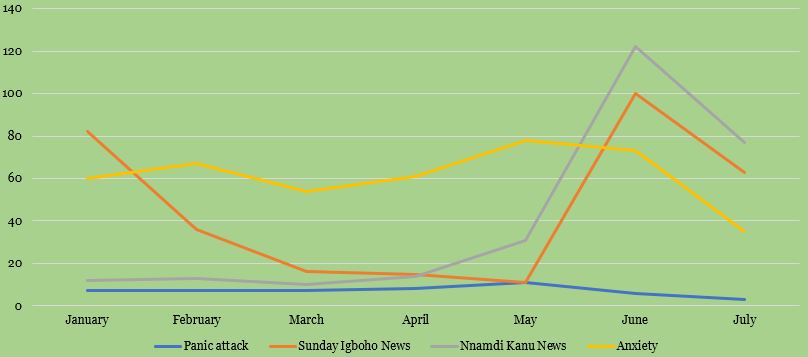
As the status conferral of different types continues with the adoption of varied frames and narratives, our analyst observes that people, especially those who lack adequate media literacy are being subjected to needless trauma based on the duo related news stories they are reading, listening to or watching in the last 28 weeks [January 1, 2021 to July 11, 2021]. In the first instance, our analysis reveals 80.8% linkage of the public interest in reading news about Sunday Igboho and Nnamdi Kanu. While they were searching for news about the duo, analysis indicates they also developed interest in understanding anxiety, one of the symptoms of mental illness. This basically occurs along with their interest in reading news about Nnamdi Kanu more than reading activities of Sunday Igboho during the weeks. For both activists, our analysis indicates that the public did not have a significant interest in panic attack, another symptom of mental illness while they were searching for news about them.

At a glance, this result looks good, however, it portends danger for management of the people with the mental illness when one examines the collectivity that exists when the public searched news of duo in relation to knowing a number of things about anxiety. The news of the duo collectively resonated with the public interest in anxiety by 60.8%. Reading the news of the two activists led to 36.9% public interest in anxiety between January 1, 2021 and July 11, 2021. The news of Nnamdi Kanu singlehanded contributed 11.2% to the public information seeking about anxiety. The news of the duo collectively resonated with the public interest in panic attack by 12.3%. Reading the news of the two activists led to 1.5% public interest in panic attack between January 1, 2021 and July 11, 2021. The news of Nnamdi Kanu singlehanded contributed 1.4% to the public information seeking about panic attack.

Exhibit 1: Nigerian Population Interest in select Mental Health Symptoms and the Activists

Source: Google Trends, 2021; Infoprations Analysis, 2021

How the Newspapers Framed the Duo

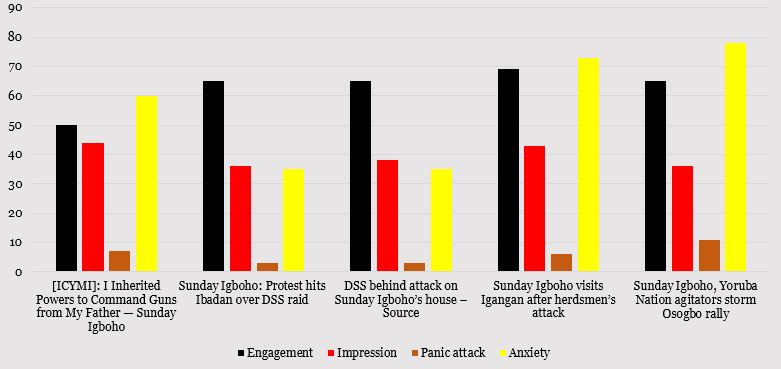
From our analysis, the Nigerian public had significant interest in anxiety in June. This is also applicable to the interest in the two activists [see Exhibit 1]. In January, the interest in Sunday Igboho was higher than the interest in Nnamdi Kanu. During this month, our analyst notes that the story titled “[ICYMI]: I Inherited Powers to Command Guns from My Father — Sunday Igboho, an interview, was one of the news reports that increased Sunday Igboho’s status. With the assertiveness frame adopted by the newspaper, our analyst notes that it is reasonable that people would seek information about him. Meanwhile, the story has the potential of inducing fear in people than informing them about Sunday Igboho’s “perceived ability to rescue his people,” during crisis.

Exhibit 2: The Punch’s Framing of Sunday Igboho in Select News Stories

Source: Google Trends, 2021; The Punch, 2021; Infoprations Analysis, 2021

From another newspaper, Sunday Igboho: Protest hits Ibadan over DSS raid and DSS behind attack on Sunday Igboho’s house –Source published in July, 2021 have great a tendency of creating fear. Sunday Igboho, Yoruba Nation agitators storm Osogbo rally and Sunday Igboho visits Igangan after herdsmen’s attack published in May and June, 2021 are not different. Analysis of these headlines by our analyst, using Headline Measurement Scale with engagement [presence of simple words and key people] and impression [presence of context words such as places and people] as categories, indicates that the stories had 15.4% influence on public interest in anxiety, while engagement singlehanded had no influence.

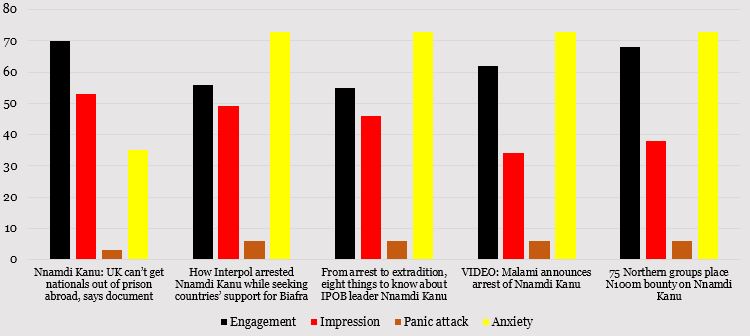
For Nnamdi Kanu with the select stories; 75 Northern groups place N100m bounty on Nnamdi Kanu, How Interpol arrested Nnamdi Kanu while seeking countries’ support for Biafra, From arrest to extradition, eight things to know about IPOB leader Nnamdi Kanu, VIDEO: Malami announces arrest of Nnamdi Kanu and Nnamdi Kanu: UK can’t get nationals out of prison abroad, says document published in June and July, 2021 also contributed to public information seeking about anxiety. According to our analyst, engagement and impression of the stories had 85.5% influence on public interest in anxiety, while engagement singlehanded had 41.2% influence.

Exhibit 3: The Punch’s Framing of Nnamdi Kanu in Select News Stories

Source: Google Trends, 2021; The Punch, 2021; Infoprations Analysis, 2021

The Place of Big Data Analytics in Managing and Providing Mental Healthcare

Despite the small samples of the headlines, it is obvious that the ongoing coverage of sociopolitical injustices by the media is increasing symptoms of mental illness. It is not surprising that the headlines resonate with the interest in anxiety because it is one of the mental illness symptoms which has been reported in south-western and north-central Nigeria. Hence, there is a need for the deployment of big data and its acquisition tools for the  provision of mental healthcare solutions and management of the patients.

For instance, agencies in charge of disease control and management need to have mindset and technical shifts towards the use of Google Trends for better understanding of population interest in mental health symptoms across regions. This will help in providing adequate behavioural and management intervention programme. This has been tested in some countries and the outcomes were surprising in all contexts.