DD
MM
YYYY

PAGES

DD
MM
YYYY

spot_img

PAGES

Home Blog Page 5939

What Is Your Sachetization Playbook in Nigeria?

1

How do you price to thrive in Nigeria? Answering that question is the most important job of any effective Board/Executive Management. In a nation under severe economic dislocation, finding a way to get people to choose you, within the expanding competitive supply base, is a serious matter. 

They taught us price elasticity in the secondary school, on the assumption that the “economic string” can expand and contract; in Nigeria today, there is no string! Yes, we have about 30 million people with decent income supporting more than 200 million, using tax numbers and informal sector upper estimates. 

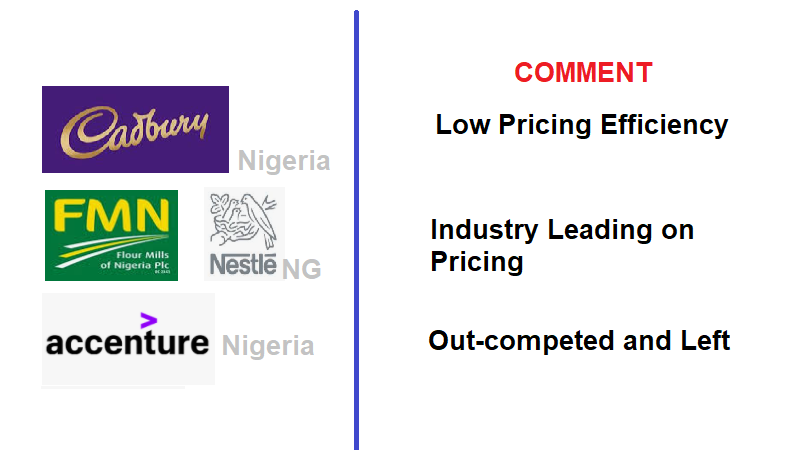
Flour Mills Nigeria Plc has improved its pricing and the market rewarded it. Nestle is now the queen of sachetization and it is doing amazingly fine. Cadbury is struggling because its products are not that well optimized on pricing. Unilever is also under siege but it has to clean its books first. In these entities, having well priced products, in segments that customers can afford, at their levels, is very important.

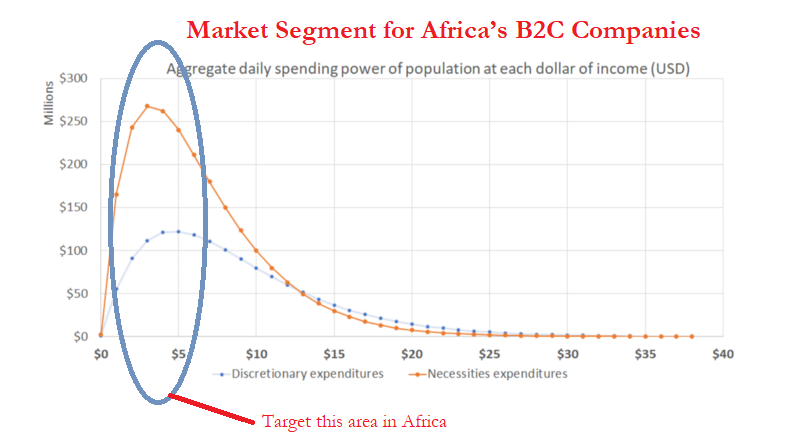
Now, you want to do business in the B2C space in Nigeria, the question is “where do you position the company”? You need to go back to this plot (above). It is called the Fortune at the middle of the pyramid:  “the most significant opportunity for African B2C startups lies with consumers who earn between $4 — $8 per day … This is largely because that income band holds the highest concentration of discretionary spending power on the continent, as the graph below shows.”

Companies like Bigi Cola and La Casera understand this redesign. You can also make a case that the sachetization in places like Nigeria where everything is now bundled in sachets has a root therein. Simply, there are not many consumers outside that $4-$8 per day segment for any big B2C business (if you focus outside this segment, your business must have a dose of B2B).

Nigeria is a tough market: Accenture ran away from Nigeria because it was out-competed. The local peers were more optimized on pricing and with no free cash anywhere, not having pricing efficiency is a burden for companies.

The Core Market Segment in Africa – Middle of the Pyramid

This is the age of sachetization in Nigeria irrespective of whatever you are selling. We are doing it in Tekedia Mini-MBA with bands for core courses, review of labs, projects supervision, etc. Having broken all into “sachets”, our members have the freedom to pick as they need. If we had lumped all together, resistance to conversion would mount. Pay attention to your pricing playbook – it is a key factor now to success in Nigeria. 

It does not really mean making things cheaper, it simply means finding a way to follow people’s purse sizes!

Robinhood Fractional Shares

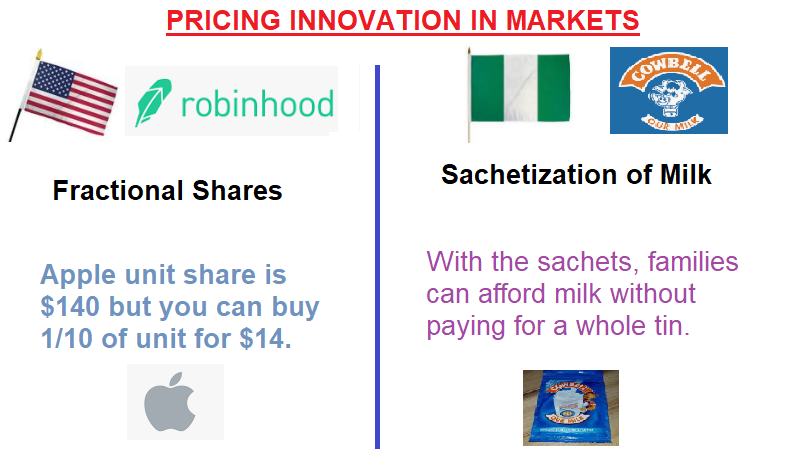
Fractional shares are pieces, or fractions, of whole shares of a company. With fractional shares, you can trade stocks in pieces of shares, in addition to trading in whole share increments. Imagine a scenario where one can buy 1/1000 of a share, and doing that fractional share trading is real-time. Robinhood offers Fractional Shares feature in America, and that is sachetization in Nigeria (packaging products in sachets…Cowbell Milk). Yes, America now sells company shares in sachets! And that innovation has made Robinhood a really great company.  What is your product pricing innovation?

Our mission is to democratize finance for all, and our Fractional Shares feature provides unique investing opportunities to people who might not otherwise be able to participate in the stock market.

With fractional shares, you can invest in stocks and ETFs that cost hundreds or thousands of dollars for a single share with as little as $1. This gives you the flexibility to invest as much as you want in the companies or ETFs you believe in, or get your toes wet without committing to an entire share.

Fractional shares can also help investors manage risk more conveniently. Since you’re not locked into purchasing full shares, you can diversify your portfolio with smaller amounts of money.

The Core Market Segment in Africa – Middle of the Pyramid

African tertiary institutions should develop academic programmes to teach students how to think outside the box and be strategic – Prof. Windapo Abimbola

1

She is the first to become a professor in her discipline both in Nigeria and South Africa. She was recently celebrated for that. She spoke with Rasheed Adebiyi on her career, tertiary education in Africa and other issues.  Here are the excerpts with Prof. Windapo Abimbola…

Tekedia: Could you please tell us about yourself?

Abimbola Windapo: My name is Abimbola Windapo. A Professor of Construction Management at the Department of Construction Economics and Management, University of Cape Town, with more than 30 years of experience in practice, teaching and research. I am a C2 Rated researcher with the National Research Foundation (NRF) and a Professional Construction Project Manager and Mentor registered with the South African Council for the Project and Construction Management Professions (SACPCMP) and Registered with the Council of Registered Builders of Nigeria (CORBON). My research is interdisciplinary and focusses on construction industry development, management of the business of construction and projects from a performance perspective. I am the Editor of the Journal of Construction Business and Management (JCBM)  hosted by the University of Cape Town Libraries and a recipient of several awards including the prestigious NSTF-South32 Engineering Research Capacity Development “Science Oscars” Award.

Tekedia: Your full professorship was announced December 2020 making you the first woman professor in your field in South Africa and Nigeria. As a woman who has been involved in tertiary education on the continent, what does this mean to you?

Abimbola Windapo: I am proud and humbled by my achievement. It means an alteration of my self-image as a leader and role model in construction management. The announcement is a culmination of more than 30 years of work, and it gives me great relief that I made it to the pinnacle of the academic pyramid– an acknowledgement of the years of hard work that it took me to get there. It means recognition, more opportunities to do good things for society, having my voice heard, and creating  conditions for others especially females that are following to thrive.

Tekedia : Building failure and collapse seem to be a recurrent decimal on the continent, especially in Nigeria. What are the factors responsible for this, and how could the menace be tackled?

Abimbola Windapo : Well, there are so many causes of building collapse on the continent. These could be typified into social, technological, environmental and managerial factors. Social factors relate to people, their behaviour and interactions with the building process during its construction and maintenance after its construction. Unethical conducts such as corruption, negligence, bribery and bid cutting fall under this category and all have the tendency to make a building collapse either under construction or after it has been completed.

Keeping to requirements, specifications and methods of construction are all under technological factors. When builders overlook standards or specifications for buildings, there is a higher possibility of building collapse. There are environmental factors too such as abiotic ambient temperature, amount of sunlight and pH of the water in the soil on which the building is constructed and flood.

Then, the managerial factors which cover supervision and coordination efforts in the course of constructing the building are also main factors. Any deficiency or slip in the supervision or even attempts to cut corners could lead to building collapse. When there are improper design, incompetent contractors, faulty construction methodology, poor Town Planning approval and development monitoring process, building collapse occurs.

Prevention of building failure or collapse in Nigeria is largely on the side of the government. There is a lot that governments at the three levels could do to combat this menace. For instance, there is an urgent need to revise the exisiting  building code to incorporate sustainable construction especially for residential buildings. Then, there is a need for adequate monitoring and control of construction work by the three tiers of government through their regulatory agencies. Furthermore, the regulatory professional boides such as the Nigeian Institute of Builders (NIOB); Council of Registered Engineers in Nigeria (COREN) through its Engineering Regulatory and Monitoring (ERM) unit should intensify efforts to enlighten stakeholders, update their knowledge and highlight the dangers and penalties associated with building collapse.

The Government in Nigeria must also be ready to tackle the complicated problem of building neglect by the populace through legislation, enforcement, support and assistance, publicity and public education. Adherence to standards in all facets of building construction by stakeholders and using smart technologies in monitoring and team coordination will go a long way in addressing this menace among other preventive measures.

Tekedia: How do you think the issue of graduate employability problem could be addressed by African tertiary institutions?

Abimbola Windapo: My view is that African tertiary institutions should develop academic programmes to teach students how to think outside the box and be strategic. Employability is about  having the knowledge, skills and behaviour to gain initial employment, maintain employment and obtain new employment if required. Teach students to be job creators and not job seekers.

Our modern learning culture is the scientific method that has value for discovering a known variable and teaches students to think in a certain way with a focus on passing exams using a framework that tests their knowledge of what was taught. Questions are of a known variable and taught in an environment where failure is unacceptable.

A similar process for invention (discovery of the unknown) – ability to frame the same problem in multi-dimensional ways, ask the right questions and challenge assumptions/theories, is not widely taught. Learners are not taught how to frame problems. This will help students graduate with thinking of various ways to solve the world’s problems, including unemployment. African tertiary institutions should strive to build unrestrictive environments that set the stage for creativity; Work towards developing creativity by using the right resources, manpower and space; and Support a culture that rewards an act of courage to challenge assumptions, to try solutions that diverge from conventional wisdom; and embrace failures.

Tekedia: How has it been juggling between building an international career as an academic and raising a family as a woman?

Abimbola Windapo: This has not been easy. However, my children are part of my success story and helped me build my academic career. My daughter – Olukemi prepared the PowerPoint presentation I used to defend my PhD in 2005 (she was just 11 years old). The first time I heard about PowerPoint was the day before my defence. Prior we presented the paper only. My son – Bayonle does a wonderful job preparing all the images I used in my e-books, including the popular e-book “Fundamentals of Construction Management.” While Mobolaji helps me solve difficult mathematical concepts and reviews my papers and notes. I can say my family and I built our careers together.

Tekedia: As a Nigerian academic in South Africa, what are the specific things you have missed about Nigeria?

Windapo Abimbola: Just the feeling of being at home. Missing family, friends, associates, the people and the local food.

Tekedia:What is your advice for women who intend or are aspiring to toe your path? 

Abimbola Windapo : Don’t give up. Have a clear vision of what goals you want to achieve in life—plan towards getting there. You may not see a clear path to your destination because there is no one way to reach the pinnacle of your career or become a professor. The path is not linear. Keep at it, keep moving, continue doing the right thing and what is required of you, and at the right time, the ladder will appear. You will face many detractors on your journey to reach your goals – relatives, pessimists, guilt, society, fear, be courageous and do not give up.


Training on Remote Work Administration At Tekedia Institute

0

Good People, this is an update on the Remote Work Administration training which we have added as part of Tekedia Mini-MBA special live sessions. We will communicate to all members on the protocol via the Board.

But note this: our Institute wants to provide training in an emerging trend of the future where people are expected to develop capabilities to manage projects and people remotely. We are partnering with a  Florida-based company called Krozu to do the training and its staff will handle it. I just spoke with the team yesterday and we are finalizing the process.

Can you work remotely or can you manage remotely, effectively? We hope you can answer YES after this process. We will provide tools for this emerging domain.

Besides the Remote Work Administration, there is also another special session on Blockchain, Cryptocurrency Decentralized Finance to be handled by Lagos-based Bitfxt and BoundlessPay. Then Infoprive, a cybersecurity and digital forensics firm, handles the last on digital security.

We invite you to register and join Tekedia Mini-MBA.

Tekedia Academic Programs

How to Avert the Future Birth of Sunday Igboho in Nigeria

0

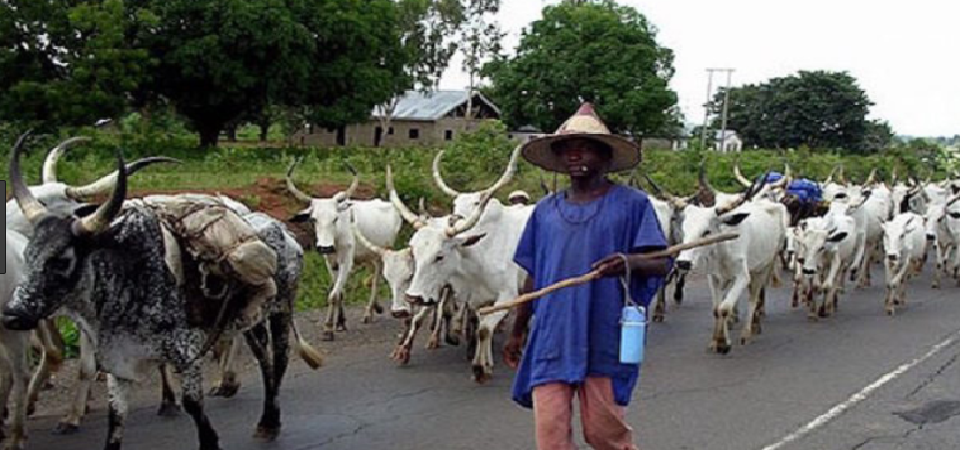
In the last five years, solving herder-farmer crisis and kidnapping remains a huge task for the state and the federal governments. On several occasions, stakeholders meeting and various community conversations have been held. The outcomes have remained mixed. Peace continues to elude people, especially those living in the rural areas across the country. In some locations, peace is being enjoined once a while. In the South region, Oyo, Enugu, Anambra, Ebonyi, Ogun, Ekiti and Ondo States have had the largest share of the outcomes of the crisis and kidnapping. People have been killed and raped, according to a number of sources.

In Oyo state, Oke-Ogun area, especially Ibarapa Local Government, has been the hotbed of the crisis and kidnapping. This is largely due to the agrarian nature of the region, which has huge potential for herdsmen. With the good hospitality usually extends to foreigners by the people of the region, one would expect that both the indigenes and herdsmen live in peace.

Nigerian Government Needs to Pay Attention to These Issues for Sustainable End to Herders-Farmers Conflict

In a recent study, researchers note that the farmers-herdsmen conflict in the region is being stimulated by multi-causal factors which majorly includes limited resources in face of greater need, reprise attack and shortage of pasture lands even climate change among others. In another study “scarce dividends of democracy are distributed to the exclusion of the Fulani due to their status as settlers. The Fulani feel cheated of their rights, even though they vote responsibly during elections. The host communities feel the Fulani are not entitled to the dividends of democracy because they are settlers and thus should return to their homeland. This has promoted division between the settlers and indigenes despite them living side by side.”

In Fashola community, a study indicates that crop-livestock farmers are using tolerance and compensation as coping strategies. The study reveals that when livestock destroyed farms, pastoralists compensate the farmers. This is being done for peaceful co-existence.

Our analyst notes that adoption of these results and others from academic and applied researches conducted in the last five years would have helped the governments and other stakeholders in solving the crisis and end kidnapping. The failure to take decisive actions led to the emergency of a Sunday Igboho, a Yoruba activist recently. Within the few days of his eviction notice to a Fulani community in Igangan [a town in Oke-Ogun region], he became prominent and people see him as the right person who can eliminate the pains and agonies associated with killing and kidnapping in South West region.

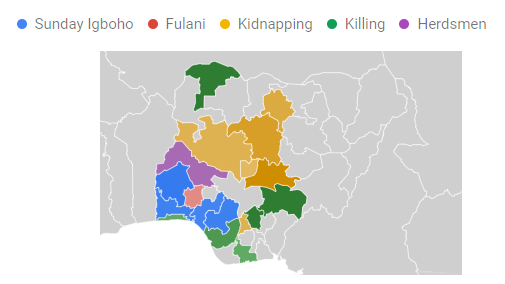
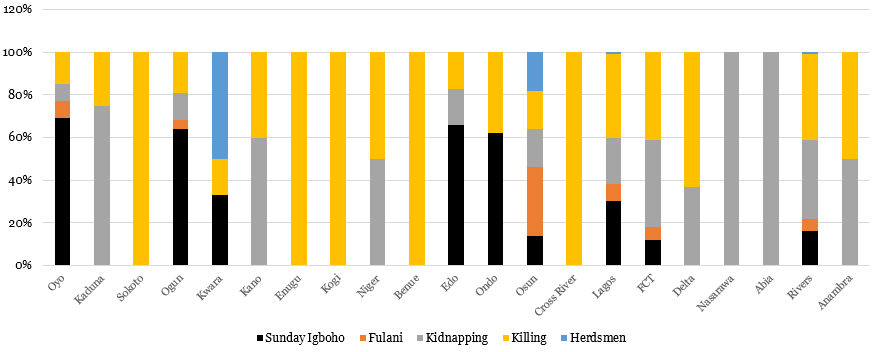
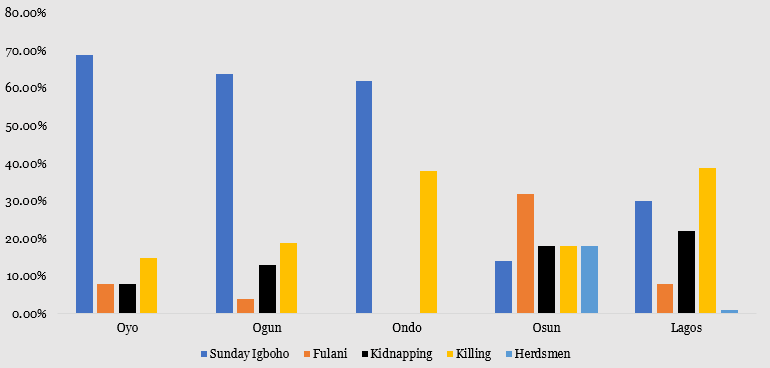
Analysis shows that Sunday Igboho was searched and understood through a number of information on the Internet between January 16 to January 23, 2021. The interest about him was high among the people in the Southern region than other regions in the country. Our analysis reveals that the higher the interest in knowing him, the lower people developed interest in Fulani, kidnapping, killing. This is quite different from their interest in him and herdsmen.

Analysis establishes a 48% interest in herdsmen when they developed interest in him by 1%. Our predictive analysis indicates that 65.8% of the people’s interest in Sunday Igboho could be explained from their interest in Fulani. It was 54.5% in kidnapping, 1.5% in killing and 65.4% in herdsmen.

Exhibit 1: Public Interest in 7 Days

Source: Google Trends, 2021

Exhibit 2: Public Interest per State and Capital Territory in 7 Days

Source: Google Trends, 2021; Infoprations Analysis, 2021

Exhibit 3: Public Interest in South-Western States

Source: Google Trends, 2021; Infoprations Analysis, 2021

Strategic Options

There is no doubt the emergence of Sunday Igboho has added a new basis of resolving the conflict and ending kidnapping in Nigeria. It has shown that people would hardly wait for government security agencies to protect them and their property. It has also indicated that people can voice out when security issues reach a high proportion with the tendency of having severe impacts on socioeconomic activities and development. Despite the relevance of Igboho’s action to the people of Ibarapa and Igangan in particular, government stakeholders need to be assertive and decisive in their approaches to security issues.  Paying lip service to the insecurity would continue to create Igbohos across the country.

Approaches to Sustainable Innovation Financing in Nigerian Facilities Management Industry

0

Like other industries in Nigeria, our analyst has previously noted that the Facilities Management industry cannot grow without constant radical and incremental innovation. This is highly imperative considering the current stage of the industry among others. Apart from the fact that constant innovation would change the face of the industry, making stakeholders to develop more interest in the ability and capability of the players to solve emerging frictions in critical and soft facilities management, it would enhance the industry’s place among other markets in Africa and Asia.

Therefore, both the players and professionals need to be creative and innovate ideas, concepts and products that will effectively deliver facility-related solutions. In our previous analysis, it was noted that employees at business, functional and corporate levels need to work together for innovation to happen. A clear innovation strategic plan must be developed. Innovation vision should be shared among the employees while the business owners and employees at the corporate level should exhibit a clear commitment to the cause.

When these happen, who should finance innovative ideas from the concept to developmental and expansion stages? This is the question this piece intends to answer briefly. Financing innovation is a mechanism that gives room for internal and external support. It also entails personal support or effort towards the successful innovation journey. In our experience, we have discovered that players in the industry can finance their innovation projects using internal and external approaches. Internal approach remains the most appropriate. The appropriateness is hinged on the fact that it gives players opportunity to capture absolute value from the outcomes of the innovation execution.

Using an internal approach means that both the employees and business owners must commit their financial resources to innovation projects. Financing innovation in the industry starts from when an employee or a group of employees [at functional and business levels] developed innovative ideas or concepts and spent their personal money on understanding the nucleus of the ideas or concepts before proposing it to employees at the corporate level. If the ideas or concepts are viable, there is a probability of getting corporate backing. This leads us to the second category of financing innovation.

However, the extent to which corporate financing can happen depend on the financial capacity of the business owners or investors. When it is obvious that the ideas or concepts cannot be financed internally, the needed fund is expected to be sought using external approach. With this approach, both the employees and business owners can discuss the ideas or concepts with a number of external stakeholders. For instance, grants, loans (including convertible debt), and equity investments can be explored. With the external approach, players would have the opportunity of establishing a strong interaction with the key stakeholders towards more recognition of the industry and what it means to the sustainability of public and private facilities.

These approaches must have been employed by Alpha Mead Group, which innovated  Call2Fix [solving perennial friction of having dependable technicians for secure homes and workplaces maintenance], and FilmoRealty that launched its proptech products recently. The company developed Vamp Facilities Intelligence, a software makes planning and execution of facilities projects easier. This software is useful for immersive facilities management practices in a pandemic period suggested by our analyst previously.