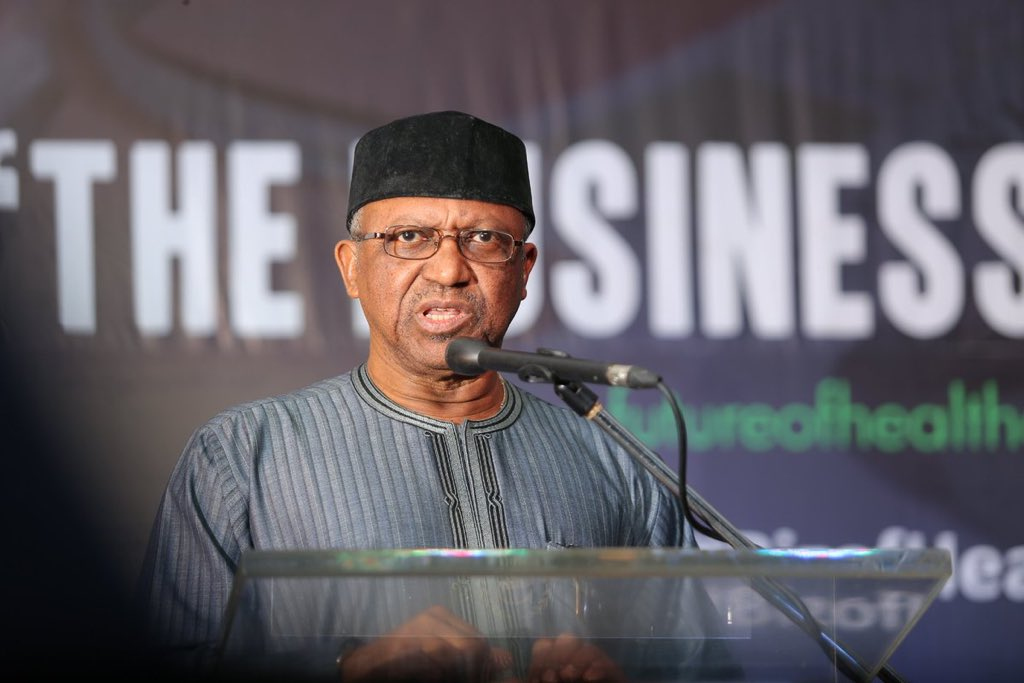
The Presidential Task Force (PTF) on COVID-19 has on Monday announced new measures of restriction to curb the spread of the pandemic. The National coordinator of the PTF, Dr. Sani Aliyu, announced this during the COVID-19 briefing in the Federal Capital Territory (FCT), Abuja.
Dr. Aliyu said there have been adjustments to ease the lockdown by states, while the nationwide restriction remains in place.
“Effective from tomorrow, Tuesday, June 2, 2020, the easing of the lockdown will be characterized by the following: The nationwide curfew will remain in place but the timing of this will be reduced to 10pm-4am.
“And just to clarify, the purpose of the curfew is to limit social interactions and therefore, reduce the risk of transmissions of the virus,” he said.
He explained that, even though inter-state services are still restricted, essential services, which include media activities, food supplies, healthcare services and some other services in the nation’s critical sectors, are exempt.
The Coordinator of the PTF said that businesses in the hospitality sector are free to reopen effective from Tuesday.
“Effective from Tuesday, June 2, the easing of the lockdown will be characterized by the following:
“Hotels may reopen but must observe all mandatory non-pharmaceutical intervention. Restaurants other than those in hotels must remain closed for eating but are allowed to prioritize and continue practicing the take-away system. Bars, gyms, cinemas and night clubs are closed till further evaluation,” he said.
Dr. Aliyu added that the financial sector is free to open to full operation, banks and other institutions in the sector are allowed effective from Tuesday, 2, 2020, to resume normal services.
Among other restrictions, the PTF announced the relaxation of religious activities. The task force recommended that churches and mosques be allowed to open, and the federal and state governments approved the recommendation.
“Relaxation of restriction on places of worship based on guidelines issued by the PTF and protocols agreed by state governments,” it said.
He further added the Presidential Task Force has recommended that aviation activities resume effective from June 21.
“The aviation industry is requested to start developing protocols to allow for domestic flights to resume anytime from the 21st of June onwards.
“Airlines must ensure physical distancing by reducing passenger capacity and ensure the provision of sanitizers and personal protective equipment as well as carrying out temperature checks at the point of entry and departure and ensuring that airports are not congested by either travellers or airport staff,” he said.
The federal and state governments of Nigeria are poised to reopen the economy to save the country from total collapse. The aviation industry is hard hit by the pandemic and has been panting on its last lifeline. The decision of the federal government to allow flight operations to commence has been applauded by stakeholders.
However, governments’ decision to lift the ban on religious gathering has not gone down well with many. Medical experts believe that the move is premature as the number of cases keeps increasing. Moreover, the decision contradicts every other social distancing measure that the governments have put in place.
Part of the protocol adopted by the PTF and approved by the governments is the ban on gatherings of more than 20 people.
“Mobilization of all resources at State and Local Government levels to create public awareness on COVID 19 and improve compliance with non-Pharmaceutical interventions within communities; sustenance of key non-pharmaceutical interventions that would apply nationwide and include: ban of gatherings of more than 20 people outside of a workplace,” the statement said.
There is going to be hundreds of people in places of worship which would make it difficult for social distancing to be observed. The aim of the recommended “gathering of not more than 20 people” has therefore, been defeated, and will lead to the escalation of cases.
It is believed that the governments have given in to the yearnings of religious leaders who are losing economic gains as a result of the ban on religious gathering. And it is because the lockdown initiative has been copy and paste from the onset.
“Nigeria saw the rest of the world enforcing a lockdown and decided to enforce a lockdown with no clear plans. And then when the rest of the world is easing their lockdown, Nigeria also joins to ease the lockdown. Ask the Government the reason for both actions and they don’t know,” Kelvin Odanz wrote on Twitter.
However, the relaxation doesn’t include schools as the governments are still consulting for the best protocol to apply.
Read the full statement below.
REMARKS BY THE CHAIRMAN, PRESIDENTIAL TASK FORCE ON COVID-19 AT THE NATIONAL BRIEFING OF MONDAY, JUNE 1, 2020
PROTOCOLS
I welcome you all to the National Briefing for Monday 1st June, 2020.
- When the PTF briefed the nation on Monday 18th May, 2020, we informed you that Mr. President had approved amongst others, the extension of phase one of the eased lockdown so that the observed gaps in the expected impact of the National Response could be closed and the gains consolidated. That action was based on the Guidelines developed and published by the PTF, working in collaboration with sub-national entities and key stakeholders.
3.The PTF also announced the extension of the lockdown of Kano State due to the need to address the peculiar circumstances that had arisen in that state.
4.During the two weeks extension, the PTF evaluated the COVID-19 situation in the country after which it submitted a Report to Mr. President as promised last week.
5.Ladies and gentlemen, despite partnerships, injection of resources and collaboration, the COVID-19 has continued to ravage the world in very many ways. It has also continued to spread and claim casualties. The global figures recorded as at Sunday, 31st May 2020 had risen to 6,407,451 confirmed cases, 2,862,610 recoveries and 377,834 fatalities across 216 countries and territories of the world.
6.The global epicenter of the pandemic has shifted from China to Europe, then to the United States of America and is now showing significant impact in South and Central America. This shift to South America with virtually similar climatic and demographic similarities with Africa, is a cause for concern when we consider the fact that earlier projections pointed to Africa as likely to be the worst hit continent, by the pandemic.
7.In Africa, confirmed cases stood at 146,568 while 64,080 cases had recovered and 4,222 fatalities were recorded as at Sunday, 31st may, 2020.
8.Reports have shown that there are lesser number of confirmed cases than expected across the African Continent. Countries have continued to record significant daily increases, capable of overwhelming our fragile healthcare systems if there is a consistent surge. This calls for caution, planning, multi-sectoral investment in institutional and human capacity, scientific and methodical approach as well as citizens commitment to the control of the pandemic.
9.As at midnight on the same day (Sunday, 31st May, 2020), Nigeria had recorded 10,162 confirmed cases of COVID-19, 3,007 discharges and 287 deaths. Significantly, Nigeria recorded 553 new cases on Saturday, 30th May, 2020 representing the highest single day numbers, ever.
- Nigeria’s national response has continued to rely on science, data, experiences drawn from other nations and consideration of our peculiar environment to address the pandemic, while observing the guidelines issued by the World Health Organization (WHO).
-
While reviewing the impact of previous measures and the first phase of the eased lockdown, the PTF prioritised the following aims:
i. Ensuring a cohesive, exhaustive and data-driven policy to guide the opening up of the country;
ii. Putting in place procedures for the effective review of the country’s reopening policy;
iii. Mitigating against our health system being overwhelmed by a series of sustained outbreaks;
iv. Maximising the impact of non-pharmaceutical interventions on COVID-19 control; and
v. Minimising the negative and social effects of the non-pharmaceutical interventions.
12.Similarly, the PTF adopted the following guiding principles to ensure that the response is robust and holistic:
i. Utilisation of data systems to assess risk, measure response performance, and evaluate progress;
ii. Application of non-pharmaceutical interventions in a measured and step-wise manner (e.g. using 2-week intervals to identify adverse effects);
iii. Narrowing the focus of non-pharmaceutical interventions with significant side effects (e.g. business closures, stay at home orders) to targeted areas for effectiveness and impact;
iv. Development of systems for the protection of vulnerable groups;
v. Prioritisation of risk communication and community engagement with emphasis on community involvement and ownership; and
vi. Encouraging States to fund activities (contact tracing, sample and data collection, etc.) that support the control of COVID-19 thereby generating data to aid decision-making.
13.The PTF, in reaching its conclusions and making recommendations for next steps of the response, remained mindful of the following important socio-economic issues:
i. impact of COVID-19 on the global economy and all national economies.
ii. pain and hardship brought upon the poor & vulnerable, the aged, the sick, people living with disabilities, and particularly those whose survival depend on their daily earnings;
iii. impact of the closure of schools and tertiary institutions;
iv. avoidable death of citizens occasioned by the decline in the level of availability of medical services to citizens due to closure of medical facilities, rejection of patients by hospitals and fear of stigmatization; and
v. the level of infection of frontline workers and its implications for the national response.
16.From the economic development, security and social cohesiveness perspectives, the PTF also worked closely with:
i. The Economic Sustainability Committee under the Chairmanship of the Vice President;
ii. The Central Bank of Nigeria (CBN) promoting the development of stimulus packages for different categories of SMEs, farmers, businesses, etc;
iii. The Federal Ministry of Humanitarian Affairs, Disaster Management and Social Development working to enlarge the database of some of the Social Intervention Programmes (SIPs) for inclusiveness;
iv. The Federal Ministry of Labour & Employment charged with the mandate to organize the Special Pubic Works Intervention capable of employing one thousand youths from each of the 774 LGAs in the country;
v. The Federal Ministry of Agriculture & Rural Development on the mobilization and technical support to farmers for the planting season as well as unrestricted movement of food and other agricultural produce;
vi. The Federal Ministry of Education for the development of guidelines and protocols for safe reopening of our schools;
vii. The Security Agencies for the enforcement and protection of lives and property;
viii. Professional bodies, Civil Society Organisations, the Labour Sector, trade associations, religious and traditional leaders;
ix. The Nigeria Governors Forum; and
x. The National Assembly.
17.The PTF has taken into consideration the advisory of the World Health Organization on the need to do the following when planning to ease a lockdown:
i. balance lives and livelihoods,
ii. follow a slow and phased approach that is data driven;
iii. apply Public health measures in every community and at every phase of the response (i.e. surveillance, case finding, testing, isolation, tracing and quarantining contacts.); and
iv. evaluating the economic and social aspects of the society, which will play a role in progressing or hindering any efforts for the response.
18.It is the consideration of the PTF that while Nigeria’s confirmed cases have increased in the period under review, the following factors should inspire confidence in the response:
i. Majority of the confirmed cases are in a handful of local governments in the country;
ii. 20 out of the 774 LGAs nationwide account for 60% of the cases (see map below);
iii. There is an opportunity to concentrate efforts in these high-burden areas;
iv. Federal agencies and State Governments are working together on the promotion and utilisation of guidelines on case management (e.g. homecare for relatively well patients);
v. There is increased capacity to detect, test and trace those infected with the virus;
vi. 29 testing laboratories have been activated, with Bauchi being the latest addition while the test count nationwide has exceeded 60,000; and
vii. A shift in focus to community engagement and enhanced risk communication.
NOTE: NCDC to list the names of the 20 LGAs
19.Notwithstanding the foregoing, the PTF considers it necessary to restate to Nigerians that:
i. Nigeria has not reached the peak of confirmed cases;
ii. The battle against COVID-19 is a long term one;
iii. Nigeria should pursue a strategy that will aid the sustainable control of the spread of the disease;
iv. Risk communications and community engagement should remain top priority; and
v. Precision approach to containment and management should be adopted
20.Based on the overall assessment, including available data on the public health considerations and resultant economic impacts, the PTF is of the opinion that Nigeria is ready to allow SCIENCE and DATA determine her cautious advancement into the second phase of the eased lockdown for a period of four (4) weeks.
- After considering all factors mentioned above, the PTF submitted its recommendations and the PRESIDENT has approved the following for implementation over the next four weeks spanning 2nd – 29th June, 2020, subject to review-:
i. Cautious advance into the Second Phase of the national response to COVID-19;
ii. Application of science and data to guide the targeting of areas of on-going high transmission of COVID-19 in the country;
iii. Mobilisation of all resources at State and Local Government levels to create public awareness on COVID 19 and improve compliance with non-pharmaceutical interventions within communities;
iv. Sustenance of key non-pharmaceutical interventions that would apply nationwide and include:
a) Ban of gatherings of more than 20 people outside of a workplace;
b) Relaxation of restriction on places of Worship based on guidelines issued by the PTF and Protocols agreed by State Governments
c) Managed access to markets and locations of economic activity to limit the risk of transmission;
d) Ban on inter-state travels except for movement of agricultural produce, petroleum products, manufactured goods and essential services;
e) Mandatory use of non-medical face masks in public places;
f) Mandatory provision of handwashing facilities/sanitisers in all public places;
g) Extensive temperature checks in public places;
h) Maintaining 2 metres between people in public places;
i) Strengthening infection prevention and control at healthcare facilities;
j) Isolation of vulnerable populations (elderly and those with underlying health conditions)
k) Massive information and education campaigns.?
v. Deepening of collaborative efforts with the community leaders, civil society, faith-based organisations, traditional institutions, etc;
vi. Continuous mobilisation of State governments to take up greater role in the implementation of the guidelines and advisories provided by the PTF;
vii. Continued provision of support by the NCDC to States through guidelines to shape decision-making in responding to high burden LGAs and Wards; and
viii. Easing the total lockdown of Kano State and introduction of Phase One of the Eased Lockdown.
22.Ladies and gentlemen, this is still a fight for life and our advancement to phase two does not mean that COVID-19 has ended. It is still potent and highly wasteful of human lives. I implore all Nigerians and corporate citizens to take responsibility and play the expected role.
-
I will now invite the Hon Minister of Health to provide you with details. The DG – NCDC will elaborate on the technical aspects of the next steps while the National Coordinator will expatiate on the guidelines before it is published.
-
I thank you for listening.
Like this:
Like Loading...