DD
MM
YYYY

PAGES

DD
MM
YYYY

spot_img

PAGES

Home Blog Page 6511

This Week in the Nigerian Capital Market (20-24/1/20): Rates, MPC, CRR

3

It’s no longer news that Guaranty Trust Bank (GTB) crashed interest rates on its Quick Credit loan by 24% from 1.75% to 1.33%. This monthly 1.33% for 12 months will give an annual interest rate of 15.96%, if you factor in inflation at 11.98%; the real return that will go to the bank annually per customer is very thin at 3.98%. That’s too low by Nigerian lending standards; clearly, GTB has more in mind than profit/spread. They have disruption in mind. Now, who is disrupting who?

We will come back to the disruption topic. Currently, banks are battling with two forces, market forces and Central Bank of Nigeria (CBN); market forces led by interest rates and CBN through LDR (loan-to-deposit ratio). While LDR is saying you must lend businesses and consumers money, interest rate is shouting you must lend cheap. The hands of banks are tied, tied by crashing yields across all government securities – what can be likened to a ‘coup of rates’ on the banks by the government.
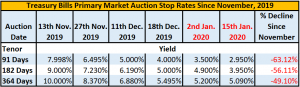
The average decline in treasury bill rates across all tenors in the last six auctions is over 55%.
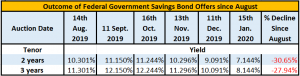
FGN (Federal Government of Nigeria) savings bond yields are down by over 29%.
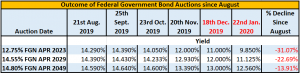
As for FGN Bond, the decline is over 22%. Taking a closer look at the trend (especially from November 2019), clearly, the government has a plan, something like a ‘coup of rates’. Despite these declines, banks, fund managers and PFAs (pension fund administrators) are still desperately after these government securities.

Government is saying we don’t need your cash, invest them in the real sector via loans. For the moralists, it won’t be wrong to ask “Why are we so keen on funding the inefficiencies of government when we complain of the same inefficiencies?”.

The first FGN Bond Auction for the year held on 22nd January 2020 recorded an oversubscription of more than 300%. Subscriptions received through competitive (N624.5b) and Non-competitive bids (N1.83b) totaled N626.33 billion. Following the auction, only N411.822 billion was allotted leaving another N214.508 billion stranded. Already, we have over a trillion stranded from other maturities and more will join them soon.

Conservatively, we can say hundreds of billions are stranded in the system but don’t be surprised when bankers argue in the line of ‘trillions’, anytime these debates take place, expect the CBN.

CBN raise CRR to 27.5%

Yes, CBN turned up. At the first Monetary Policy Committee (MPC) meeting of the year held on 23rd and 24th January 2020, the CBN raised Cash Reserve Ratio (CRR) by 500bps to 27.5% from 22.5%. What’s CRR again?

CRR is a specified minimum percentage of the total deposits of customers, which commercial banks have to hold as reserves in cash with the CBN. The required reserve ratio is sometimes used as a tool in monetary policy, influencing the country’s borrowing and interest rates by changing the amount of funds available for banks to make loans with.

Simply put, CRR is a monetary policy tool of the CBN used to ‘lock up excess cash’. You may want to ask why is CBN locking up cash when I need loans for my business?

“The Committee is confident that increasing the CRR at this time is fortuitous as it will help address monetary-induced inflation whilst retaining the benefits from the Bank’s LDR policy, which has been successful in significantly increasing credit to the private sector as well as pushing market interest rates downwards.” MPC
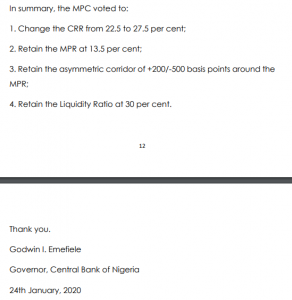
Deposits of customers with banks are currently estimated to be over N16 trillion and growing, a 5% (500bps) increase in CRR will take less than a trillion naira from the system, as a result, we do not expect the increase in CRR to immediately impact the current status-quo.

Expect more insights on the outcome of the MPC during the week.

Selected Tekedia Posts Now Have Audio Play – Listen Without Reading!

0

I am very happy to report that we have successfully integrated a text-to-speech technology on Tekedia. We cannot be going to co-learn and co-share “innovation” without demonstrating that element in the training itself. Simply, when you arrive at the page, you will see an audio link at the top of the page; click that audio button and play the post. 

I just activated a post (click to listen) to give you an idea. With this tool, you can “read” (yes listen) to the contents while driving via your phone, at work with headphones, etc.

(Do not worry how the technology pronounces names!)

My Selected Public Speeches [Videos]

0

We have some of my public speeches together. In 2019, I gave 23 speeches with many in private settings (banks, funds, and investment clubs) and conferences in four continents. The May Platform speech on national TV is included. The FUTO Convocation lecture is already in the university library. This year, I have confirmed speeches in Ottawa Canada (public), Turkey (public), South Korea (private), Osaka Japan (technical), Johannesburg (private) and Lagos (university public lecture).

 You can watch these ones when you have time.


  • The Platform titled “The Growth of Nations” (live national TV)
  • FUTO Biennial Lecture
  • Big Data & Business Analytics Conference
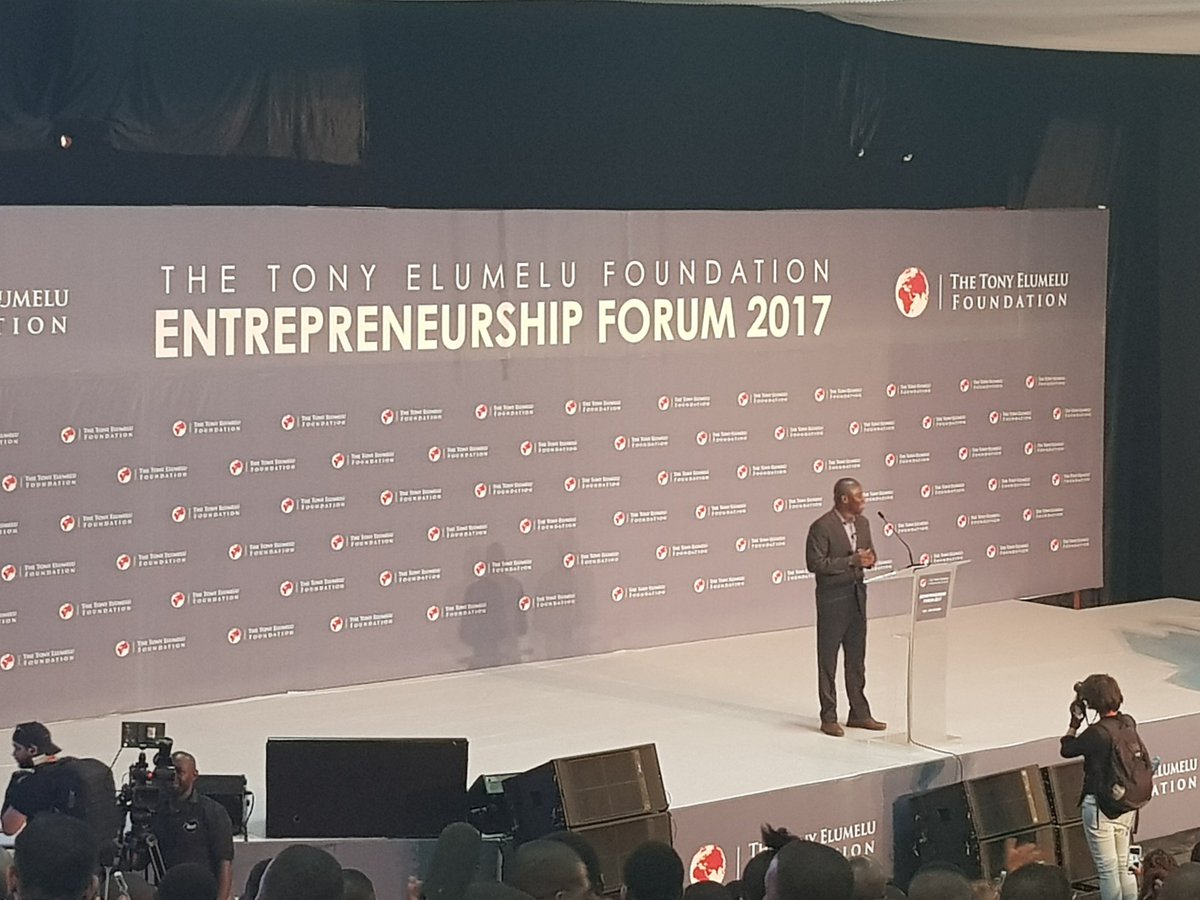
  • Tony Elumelu Foundation Entrepreneurship Forum plenary


I am working on many videos  at the moment for the Tekedia Mini-MBA (register today). You can watch more technical videos here.


The full selected videos

Selected Ndubuisi Ekekwe Public Speeches


Four Short Lessons Learnt from Osun Youth Agenda Campaign

0

Kimpact Development Initiative is a non governmental organisation situated in Osun State, Southwest Nigeria. It is the organisation that was in charge of the Vote not Fight campaign before the gubernatorial election in the state in 2018. Led by Bukola Idowu, the organisation is also in charge of the Osun Youth Agenda, a nine-month, research driven, stakeholder engagement campaign on mainstreaming issues that could lead to sustainable youth development in the policies of the state. In just nine months or thereabout, the campaign has proved very successful.  Instances of the success of the programme were captured in a previous article here. However, the focus of this piece is to examine some key principles that worked for the campaign. Here is highlight of these.

#Multi-layered Bottom Up Approach. The campaign was driven from the bottom up. Youth coordinators were selected from different local government areas in the state. The essence is to keep the engagement robust and make the advocacy neural. As the coordinating hub was consulting at the central level, the coordinators were feeding the secretariat with information from the grassroots level. Political office holders were consulted through the local representatives of the campaign. This made the campaign integrated. This also allowed the campaign to echo same message across different local areas in the state. The resultant effect is the success of the Osun Youth Agenda.

#Multiple Advocacy. The Osun Youth Agenda was a campaign that thrived on multiple advocacy. Stakeholders were properly identified and engaged. Since the campaign was a multi-sectoral engagement, adequate analysis of those who have the stakes in those sectors was done and critical agencies and personnel were involved in the process of developing relevant policy driven proposals and recommendations. From unions to indigenous organisations, the engagement yielded  a buy-in. Apart from the constitution of a board of technical experts for the campaign, the state legislators and members of the executive council equally focused. Recommendations were smartened to make them acceptable and fiscally realistic.    

#Data-Driven  Advocacy. Another factor that assisted the coordination of issues in the campaign was the extensive use of data. Data is the currency of the time. Initially, the campaign coordinating secretariat surveyed youths in the state with the aim of extracting their needs across the various sectors of the society. From Agriculture, education, health to wealth creation and employment opportunities, the demands of the youth were compiled and the implications were visualized. When advocacies are based on data, it gives the advocates a clear picture of the width and breadth of the issues and also attract attention.    

#Creative Programming. The OYA coordinating hub was creative in creating programmes around the campaign. From trainings of the coordinators to the advocacy, elements of creativity stares anyone who cares to look deeper in the face. The two policy dialogues and legislative interaction with the Speaker of the State House of Assembly were the icing on the cake. Arguably, the three programmes were the first in the state to be organized by non state actors in pursuit of campaigns such as this one.

The 9-month programme has come to an end. But, the lessons learnt from pursiung the goals should be warehoused by non-governmental organizations within and outside the state  in pursuing such projects. To pursue the greater good for the greater number, the approach must indeed  be different.


An Investment Option in Nigeria

0

“Gold clingeth to the protection of the cautious owner who invests it under the advice of men wise in its handling.” —The Third Law of Gold

The quote above is culled from The Richest Man in Babylon by George S. Clason. Recently, Prof Ndubuisi Ekekwe expounded it in How You Can Invest N10 Million in Nigeria Right Now. His investment counsel came at the most appropriate time when all interest rates are crashing with the Treasury Bills, TB, leading the pack. Before now TB has been a lucrative and the safest portfolio investment but it has lost its attractiveness and thrown investors into a dilemma.

Investors are having tough times in deciding the next best investment choice to secure and grow their wealth. And, according to the possible alternatives listed by the erudite professor, fixed deposits tops the list. He said,

“If you fix the money for 3 years, in a good bank in Nigeria. The Nigeria Deposit Insurance Corporation (NDIC) insurance will cover a part of the N10 million even in a rare case the bank collapses! So, your risk is fairly managed, broadly, for 10 million, the interest rate cannot be more than 10% looking at some numbers from most Nigerian banks. In short, the average for 10 million fixed deposits, for three years is about 6 – 7%.”

I find his position to be true of commercial banks by my validation. Two months back, I visited the major commercial banks to get their deposits rates and compare with that of AB Microfinance Bank under the guise of an investor. The variance was very significant.

I bet you are trying to retrieve the file of AB Microfinance Bank from your memory bank, just click here to know more. Hold on, before you click, know that AB MfB is one of the few national microfinance banks in Nigeria. It’s the largest German owned firm by number of employees (over 1000). It has been in operation since 2008 with 23 branches in Lagos, Ogun, Oyo, and Ondo states. Five more branches are expected to kick start in the five Southeastern states by the first quarter of 2020.

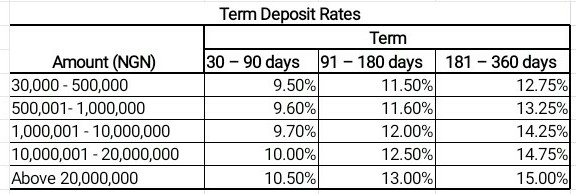
The highest rates on a fixed deposit hitherto offered by other banks is our starting point. How are we able to do this, you ask? Our investment is long term, and our clients are not the few macro borrowers who always fail to pay back their loans. We service the long neglected millions of the micro, small, and medium enterprises whose risk of default is manageable. This guarantees our profitability and continuity. The table below shows our current rates on time/fixed deposits.

Note:

  1. Interest rates are subject to 10% withholding tax (WHT).
  2. Interest rates reduction in case of early withdrawal:
  3. By 50%, if withdrawal is in the first half of the term; and
  4. By 25%, if withdrawal is in the second half of the term.
  5. If interest is paid monthly, the above interest rates are reduced by 0.5%
  6. You can also negotiate for higher rates than 15% for amounts above 20 million.

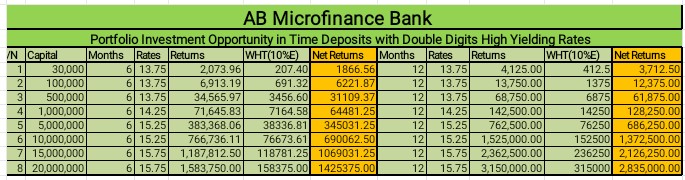
In the second table below, I showed the net earnings on some specific amount of money fixed for 6 months, and 12 months. The net earnings were determined by deducting WHT from the earnings at maturity.

In conclusion, another eternal truth from the Richest Man in Babylon will be helpful.

“Wealth, like a tree grows from a tiny seed. The first copper you save is the seed from which your seed of wealth shall grow. The sooner you plant that seed, the sooner shall the tree grow. And more faithfully you nourish and water that tree with consistent savings, the sooner you may bask in contentment beneath its shade.”

Benefits of Investing in AB MfB Term Deposits

  1. Minimum risk portfolio with predictable yield.
  2. High and stable interest rates above the level of inflation of  11.98%
  3. Flexible amounts and interests determined by clients preferences.
  4. Roll over option.
  5. Easily and readily available when demanded by clients.

Why not invest with AB MfB today? Contact David Gani at David.Gani@ab-mfbnigeria.com or call 0703 744 7482

Mitigate that risk!