DD
MM
YYYY

PAGES

DD
MM
YYYY

spot_img

PAGES

Home Blog Page 6533

Discover The Mines of Knowledge – Join Me On This Excursion

1

Besides the systems and processes, on actualizing accomplished careers, we do know that we need luck (yes, grace). Interestingly, preparing and fertilizing some necessary tools can make that luck work out faster. There is time for accumulation of capabilities, and there is a moment for monetizing those capabilities. Just as nations rise when they generate, accumulate and deploy knowledge (not just find oil wells or gold mines), your 2020 can become great when you acquire some unique capabilities which are evidently non-common. Build mines of knowledge (click and read it) and advance! I will be taking many on excursions on discovering those mines; join me and register.

From the Babylonian Empire to the American empire of today, when you win on Knowledge, you win on economy and human development. Babylon (today’s Iraq) used to be an intellectual domain. When Islam was founded in the 7th century, there were many intellectuals that actually helped. Abu Ja’far al-Khwarizmi, the Father of Algebra, lived in Baghdad and was known to travel to Mecca to help fix mathematical puzzles. He built the foundations of modern Algebra.

[…]

There is hard evidence that when nations build mines of knowledge, they prosper. Over the last 500 years, productivity increase has driven GDP (gross domestic product) growths across nations. When nations improve their productivity capabilities, they always experience expansion in GDPs. And when GDPs expand, the results have correlated with higher standard of living. Higher standard of living is better living welfare for citizens.

Discover the mines…Build the mines..with me.

https://www.tekedia.com/mini-mba/

Mines of Knowledge

Selected Ndubuisi Ekekwe Public Speeches

Three Things Nigerian Youths Need to Know about the Unbundled Mass Communication Curriculum

0

It is no longer news that the Nigerian Universities Commission has unbundled the Mass Communication curriculum into seven different departments each awarding its own degree. The curriculum widely supported by Professors  and Practitioners of Communication in Nigeria first came to lime light sometimes early 2019.

Amidst arguments and counter arguments of the possibility of its implementation, it appeared all was set to launch a new phase in the study of communication in Nigeria.

Recently, words filtered out that the implementation across universities in Nigeria is scheduled to begin this year with fresh admissions of new students. This kernel has given a notice of the regulatory body’s commitment to widen the depth of a course known as communication studies. And the beginning of challenges of sustaining the new unbundled  curriculum. Though the move was not to totally erase the Mass Communication as a course, it has given universities the opportunities to run specialized courses in the areas in which it was split.

People have expressed fears on the new curriculum unbundling the discipline. While some say the fears are unfounded, others argue that any problems emerging from this new move would be resolved along the line. What are the issues that this For the average Nigerian youths, what are the strengths and weaknesses of this new unbundled curriculum? This is what this piece focuses on.

#One Faculty, Seven Programmes. Unlike before, the new system means that communication has become a faculty. This implies that communication has now become an umbrella for seven other programmes. For communication studies, there are varieties of course a prospective student can pick from. From Public Relations, Advertising, Journalism and Media Studies to Multimedia and Media Studies, the coast is now clear.

#Generalist Versus Specialist Education. The unbundling  of the communication has given the opportunity for students to specialize in an area of communication. Unlike the usual practice before now where a student of communication would be struggling to specialize in an area, the new curriculum makes it easy for students to specialize, take courses and earn a degree in their area of specialization.  For instance, any student who is interested in Advertising would take courses in advertising only without  bothering to go to other areas as was the common practice. This allows for deeper knowledge in theory and practice. It could also facilitate easier entry into the professional circle.

#Stiffer Competition. With this new development, there will be tighter competition in the industry. Since we have specialized degrees, it would be difficult to cross the boundary from one aspect of the discipline to the other. For example, when a vacancy exists for a journalist in a media house, only applicants with a degree in Journalism and Media Studies would be considered. If it were before, all graduates of Mass Communication would have had the chance to compete. In a severe economic landscape like what we have in Nigeria, it might be difficult surviving as graduates of Public Relations would have to look for jobs in that segment of the communication studies.

Tekedia Mini-MBA: Edition 1 (Feb 10 – June 10, 2020)

24

Invent, innovate and drive organizational transformation, performance, and growth. Capture emerging opportunities in changing markets while optimizing innovation and profitability. Digitally evolve your business or functional area, turning digital disruption into a competitive capability and advantage. Master the concepts of building category-king companies and thrive.

I am launching a mini-MBA* via my blog, the Tekedia Institute. I invite you to register ($140 or N50,000 naira). This program is a 4-month weekly program, beginning Feb 10, 2020. It will comprise videos, flash cases, written materials and webinars delivered online. When we finish, we will issue a certificate from the Tekedia Institute. 

Register and join us. You will emerge transformed with tools and capabilities that engineer confidence, performance and growth.  Accelerate your leadership ascent with me! .

We have received many emails from the community asking about the mini-MBA program I mentioned here. Certainly, we do not run any formal MBA program. My point is simply that by reading Tekedia, people do develop and accumulate capabilities that could help their careers.

At the moment, I do run a program which is designed for senior executives in companies. It is expensive I must note. The program is structured for these leaders to reach out anytime and discuss business issues. Think of being a professional confidant, assisting them as they work on the mechanics of business systems. It is subscription-based and goes for thousands of dollars yearly. These leaders also receive regular perspectives on what we see in their sectors and on their firms. Through this mini-MBA, I want to share those insights with more people.

How To Register: 

  1. PayPal: follow this link and pay $140 US dollars. It supports most global currencies.
  2. Bank transfer (Nigerian naira): Pay N50,000 into any of GTBank 0114016493, UBA 1019195493. Account owner: First Atlantic Semiconductors & Microelectronics.
  3. Flutterwave: follow this link (naira) or this one (USD) to use your Verve, Visa, Mastercard, Amex, etc cards across Africa and beyond (you can use same links for other currencies, please ask for exchange rate before payment if not on Naira or USD).
  4. Automatic Access: Pay via this Tekedia link for self-automatic enrollment with username.

After payment, email tekedia@fasmicro.com with participant’s name and email to complete the registration.


Theme: Innovation, Growth & Digital Execution – Techniques for Building Category-King Companies

Introduction

Over the last few decades, digital technology has emerged as a very critical element in organizational competitiveness. It has transformed industrial sectors and anchored new business architectures, redesigning markets and facilitating efficiency in the allocation and utilization of factors of production. The impacts have been consequential: nations like Nigeria are moving towards knowledge-based economic structures and information societies, comprising networks of individuals, firms and states that are linked electronically and in interdependent relationships. In this program, we will examine this redesign within the context of fixing market frictions and deploying growth business frameworks in a world of perception demand where meeting needs and expectations of customers are not enough.

Program Time: Feb 10 – June 10, 2020

Venue & Format: Online via videos, articles, webinars, and flash cases. Program is self-paced which means you consume the materials at your own time and pace.It is completely online. You will have something to complete within 7 days. You decide when you do that within the window. Where you live or your time zone would not be an issue as program is not live-delivered.

Cost: US$140 (N50,000 naira) (20% discount for bulk registration of at least four)

Program Structure: The program structure is presented below


Theme: Innovation, Growth & Digital Execution – Techniques for Building Category-King Companies
Week Focus/Faculty
Feb 10 Business Mission, Growth through Innovation – Ndubuisi Ekekwe
Feb 17 The Grand Playbook of Business – Ndubuisi Ekekwe
Feb 24 Evolving Business Models, Digital Frameworks & Strategies, Positioning Strategies – Ndubuisi Ekekwe
Mar 2 New Technologies, Growth, Disruptive Innovation I

–          Blockchain (Uchi Uchibeke, Secure Key Canada)

–          AI (Toyin Arowolo, African Reinsurance Corp, Nigeria)

Mar 9 New Technologies, Growth, Disruptive Innovation II

–          Cloud (Gbolaro Oshun, Oracle Cloud Consultant)

–          Data Management, Big Data & Analytics, Data Systems (Adewole C Ogunyadeka, PhD, esure Group, UK)

Mar 16 Capital Markets, Investing & Fundraising

–          Azeez Lawal (TrustBanc Group, Nigeria)

Mar  23 The Coronavirus Pandemic Economy – Ndubuisi Ekekwe

– Pandemic business continuity policy (Lab)

Mar 30 Innovation, Entrepreneurship, Sustaining Competitive Advantage & Transformation – Gloria Gowal, HEC Paris France
Apr  6 A Playbook for Founders and CEOs During Pandemic, Recession or Market Upheaval

–  Tekedia Institute

Apr 13 New Product/Service Development, Process Improvement and Leadership in Business

–          Dr. Ayodeji Oyebola (Emmright Consulting, USA)

Apr 20 Innovation Lessons: 5in5 (5 Firms in 5 Sectors) – Africa, Global

–Ndubuisi Ekekwe, Douglas O. Chukwuekwe (LargePlaceTech).

The State of the Tech Nation, Emerging Opportunities (Africa, Global)

– Ndubuisi Ekekwe

Apr 27 Market Synthesis, Ecosystem State, Digital Perception Marketing (stimulating new markets) – Ndubuisi Ekekwe
May 4 Winning in Business Special Series – Ndubuisi Ekekwe
May 11 Sales Management, Marketing and Growth

–          Moby Onuoha (Queen’s University, Canada)

May 18 Review of Previous Sessions (Feb 10 to May 17) – Ndubuisi Ekekwe
May 25  Supply Chain Management, Global Partnership & Contracting – Adebayo Adeleke, ex-Chief of Contracting and Deputy Chief, Business Operations Division, US Army
Jun 1 Career and Jobs During Pandemic – Captain Ola Olubawale, CEO, Seamate Australia


Develop a Project Roadmap for company you work (Lab) – Tekedia Institute

Jun 8  

Driving Profitable Growth, Marginal Cost, Scaling – Ndubuisi Ekekwe


Jun 10 The Call to Execution (Summary) – Ndubuisi Ekekwe

Report , Closure – Ndubuisi Ekekwe

*Challenge, no graded . **This is updated to align with the live version here

(All Saturdays have Discussion Webinars of one hour; the contents would be recorded for replay. )

Tekedia Mini-MBA – Overview of Weekly Sessions by Faculty [Video]

Target Audience: This program is designed for professionals across functional areas like sales, marketing, technology, administration, legal, strategy, finance, etc across all business sectors and domains.

Learning ObjectivesTo innovate is to set a new basis of competition in an economy, business sector or market. Most times, it results to disruption. This program is designed for private (large, SMEs, startups) and public institutions. Participants will:

  • Master the mechanics of digital growth – the reward of innovation – through frameworks, cases and evolving strategies.
  • Understand how to undergo digitization journey that is fully aligned with corporate objectives through measurable and realizable benchmarks.
  • Acquire business capability tools that do not just RUN their firms but can TRANSFORM them.
  • Design corporate growth experiments in Lab sessions based on One Oasis Strategy, Aggregation Construct, Double Play Strategy, Accumulation of Capability Construct, and more.

Facilitator:  Prof Ndubuisi Ekekwe invented and patented a robotic system which the United States Government acquired assignee rights. Dr Ekekwe holds two doctoral and four master’s degrees including a PhD in engineering from the Johns Hopkins University, USA. He earned undergraduate degree from FUT Owerri as his class best student. While in Analog Devices Corp, he co-designed an accelerometer for the iPhone. A recipient of IGI Global “Book of the Year” award, a TED Fellow, IBM Global Entrepreneur and World Economic Forum Young Global Leader, Prof. Ekekwe has held professorships in Carnegie Mellon University and Babcock University, and served in the United States National Science Foundation Committee. The South African press called him “a doctor of innovation” for helping organizations on the mechanics of business innovation, strategy and growth. Since 2009, the Chairman of Fasmicro Group which controls many startups and entities has been writing in the Harvard Business Review.

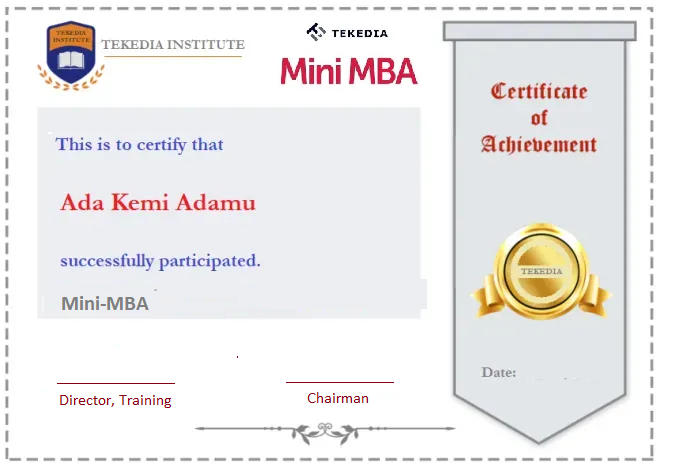
Our sample certificate which will be awarded to participants

Related Contents

Tekedia Mini-MBA: Full Faculty, Weekly Format, NGO Package, Installment Payment, Custom Assignment

Selected Ndubuisi Ekekwe Public Speeches

4-Month Tekedia Mini-MBA by Prof Ndubuisi Ekekwe [REGISTER]

https://www.tekedia.com/seeking-guest-lecturers-for-the-mini-mba-program/

Mini-MBA: Full Program Curriculum with Dates, Video Overview

*the use of *mini-MBA does not make this a degree awarding program. This does not offer any credit by any institution. Tekedia Institute is a learning platform and is not licensed by National Universities Commission or any global equivalent to award any degree, including MBA. 

Onyemelonu Michael Shares His Vision Towards the Safety and Security Awareness in Nigeria

1

Safety at schools, homes, work and social gatherings can never be underestimated. It is important to keep everyone safe. The duty of the government of any country is to ensure that her citizens are safe.

However, despite the importance, many still don’t see the need for it in Africa, Nigeria to be precise. Hence, little or no awareness is raised about it.

Michael has taken it upon himself to make a difference. He has agreed to be an ambassador for safety and awareness in this course. He explained the passion, commitment and as well as challenges in this pursuit in my latest interview with him.

Can you introduce yourself to the audience?

My name is Onyemelonu Michael. I am an advocate for Child safety and awareness mainly targeted at schools, homes and social gatherings.

Thanks for the brief introduction. If I may ask, what led you into being an advocate for child safety and awareness?

I’ve always had a passion for safety cultures. And as regards that safety is always preached about at workplaces neglecting crucial and important people, especially children, teens and parents. I want to make an impact in the lives of these youngsters by helping them understand and imbibe safety as a culture.

Minor and major accidents at school homes and social gatherings really inspired me to be an advocate of child safety

That’s a good course. Do you have your own organization?

Yes, I do. It is known as the Safety Awareness Initiative.

It’s a new (baby) organisation still at an Entry market level.

 It is targeted at educating teachers and students at schools, parents and children at homes, as well as everyone at social gatherings on the importance of safety.

Have you ever carried out any task so far and if yes, what was it?

Yes I have done that several times. In fact, during the Christmas season, last year, I sensitized, and educated people on safety cultures and practices.

At social events, two of them being churches.

What has been your challenge so far with running your organization?

People not seeing the need/importance of safety. (Poor awareness of safety in this part of the globe). 

However, the above is what is fueling my drive to continue with this Safety Awareness Initiative

How do you intend to tackle this?

Amongst my strategic system of tackling this is:

? My interview with you which I believe and know will create an awareness to people especially those that are social media and internet literates

? Volunteering to Educate and propagate SAI at schools homes and social gathering 

?Meet with community heads, School Owners and parents (Families) to discuss how activities and programs can be created so we can reach out to the people

? Use social media platforms

Do you have a team you work with?

Yes, I have a team of 5 persons comprising mainly of my family members for now.

I can imagine. That’s a smart move by the way. Do you have a website or social media page? 

I don’t have one yet. I use my social media platforms to publicize what I do. LinkedIn Facebook and Whatsapp.

Can you share the handles, please?

LinkedIn profile is here.

Where do you see your organization in the next five years?

In the next five years SAI would have become an 89% household name in the HSE Industry. 

In the next five years without limitations, I would have achieved the implementation of safety culture and practices in the homes, schools and public gatherings in my community and neighbouring communities. This would give room for job opportunities or employment to recent graduates and volunteering services for students who are interested. I would have this done through a structured systematic plans of continuous safety culture/practices  taught, measured and evaluated at the above mentioned places.

Social media platforms will be one of the many tools I will use to reach out to the targeted audience in my community and the society at large.

Safety is not just a practice it is a culture.

Thank you, Michael for your time. I wish you a wonderful year ahead.

Thanks Chinedu for making time out of your busy schedules to have this interview with me. I really do appreciate.

Bitcoin, Gold – Gainers from the Middle-East Chaos

0

The events of last Friday in Baghdad have been escalating to the reach of many businesses; from oil to gold, and now Bitcoin. While some markets are feeling the negative impact, some commodities are seeing an opportunity to thrive.

Bitcoin saw a huge leap in the wake of the conflict that started with the killing of Qassem Soleimani, an Irani Army General who represented a key interest between the United States and Iran. The price of Bitcoin hit $8,400 high in the wake of Iran’s retaliation that rained missiles on US military bases in Iraq.

Since 2017, the cryptocurrency has been fighting to maintain the level of performance that attracted the world to it. In mid-2019, the digital currency dropped below $5,000, creating a great loss and despair among its holders. But there was a lift in its performance toward the end of the year, when it rose to $11, 000, but it was not enough to close the gap that exists between its peak periods until now.

The beginning of 2020 also followed the same pattern of dwindling growth but made a surprising turn around which was attributed to the US vs. Iran conflict. In January 7, Bitcoin exerted an upward trend from $8,080 to above $8,400 before topping out at $8, 438, in just over 40 minutes, according to Coindesk.

While this is going on, capital markets are closing trades on losses. Dow Jones Industrial Average was reportedly down 0.41 percent, and S&P index was down by 0.28 percent. A few items of trade beside crude oil have shown defiance to the negative effects of the brewing conflict between the US and Iran – gold, and recently cryptocurrencies.

Gold, inadvertently became the top gainer, jumping above $1, 600 for the first time since 2013. The significant growth has resulted in notable commodity switch, with many traders swapping with the commodity for sustainability.

But Bitcoin seems to be squaring up to gold in growth. After upping its price from about $6,850 low, the cryptocurrency has pulled a leaping gain of more than 20 percent since Friday. And it now looks set to punch a hole through gold’s wall and confirm a falling channel breakout on the weekly Gold/Bitcoin chart.

Coindesk noted Bitcoin’s trading agility in the current chart, above the falling channel resistance of $7, 960. If a break out confirms the week’s closing price at $7, 960, that would imply a continuation of the rally from April 2019’s low of $4, 100, and open doors for a re-test of $13,880.

The weekly chart is suggesting bullish developments on key technical indicators. A bullish divergence happens when an indicator produces higher lows, contradicting lower lows on price and it is considered an advance warning of an impending bullish reversal.

But the daily chart is reporting and inverse head-and-shoulders breakout, which is also a bullish reversal pattern. And that’s among other positive indicators in the weekly chart. According to Coindesk, the odds appear to be in favor of a possibility that the coin will rise to $8,626. So the odds of Bitcoin confirming a channel breakout on Sunday would drop if prices find acceptance below $8,000 with high volumes.

The indicators seem promising to entice more investors to Bitcoin in 2020, especially from Nigeria. 2019 yielded a low Return on Investment to many in the cryptocurrency business, especially those on long term investment. Nevertheless, it was a year of advent awareness of digital currency trading, getting many Nigerians involved. The CEO of the Cryptocurrency trading platform, Luno, Marcus Swanepoel, told BusinessDay that although there was low ROI, in 2019, there was some other gain.

“There is certainly a link with investors, for example, buying gold using digital assets for a small but potentially high return – part of their allocation, but at Luno, we think the price increase in BTC is down to more structural reasons.

“This year, we have seen a steady increase in Bitcoin sentiment which could be linked to the expected halving in May. And we have seen also hash rates, showing the level of mining rise to all-time high.

“In 2019, there was also a 17 percent increase in long positions, which shows that there is a lot of interest in the leading altcon which is helping to bring back buyers into the sector,” Swanepoel said.

However, the sustainability of the recent growth has come under question since it was spurred by the political tension between the US and Iran. What happens to the gains if de-escalation of the conflict is achieved is not certain. But the likelihood that the price would trace its steps backward cannot be overruled.