DD
MM
YYYY

PAGES

DD
MM
YYYY

spot_img

PAGES

Home Blog Page 6875

[Apply] Kobo360 Is Hiring Accountants in Ghana and Togo; Many Fields in Ivory Coast

0

Africa’s leading digital logistics company, Kobo360, is looking for accountants in Ghana and Togo. Backed by some of the most prestigious investors in the world including World Bank IFC, Kobo360 clients include Dangote Group, Olam, Flour Mill, Unilever, etc. Meanwhile, we are still hiring in Ivory Coast for many areas.

Kobo360 is a tech-enabled digital logistics platform that aggregates end-to-end haulage operations to help cargo owners, truck owners and drivers, and cargo recipients to achieve an efficient supply chain framework. Through an all-in-one robust logistics ecosystem, Kobo uses big data and technology to reduce logistics frictions, empowering rural farmers to earn more by reducing farm wastages and helping manufacturers of all sizes to find new markets. Kobo enables unprecedented efficiency and cost reduction in the supply chain, providing 360-visibility while delivering products of all sizes safely, on time and in full. The Kobo mission is to build the Global Logistics Operating System that will power trade and commerce across Africa and Emerging Markets.

Candidate Requirements (Accounting): The candidate should:

  • – be a chartered accountant or equivalent in the country with 4-5 years experience as a financial accountant;
  • – be conversant with IFRS standards and their applications;
  • – be able to process transactions and prepare financial statements in accordance with IFRS standards;
  • – be conversant with relevant national tax laws, be able to compute taxes and file tax returns;
  • – have hands-on experience using accounting software such as sage, quickbooks, etc;
  • -be proficient in the use of Microsoft Office packages, especially Excel.

Applications / submissions can be sent to careers@kobo360.com.
Digital Currency Low Interest Risk

0
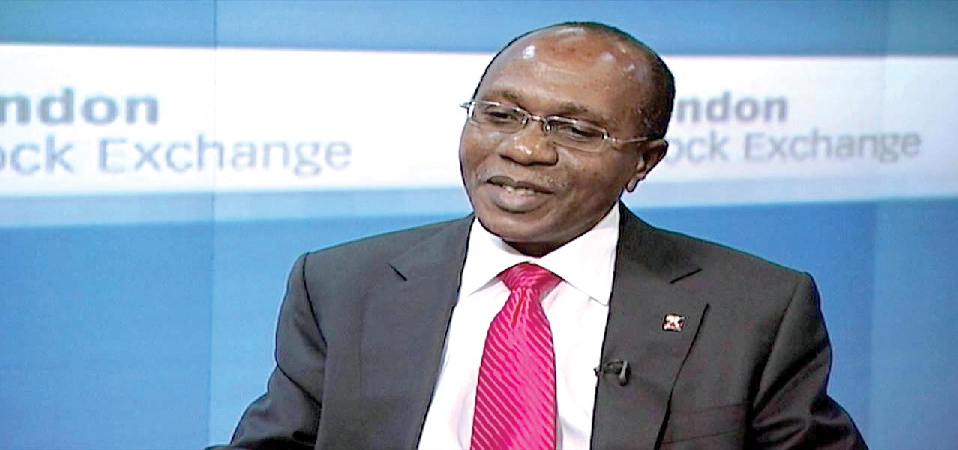
CBN Governor

Central banks such as that of Sweden may be exploring the possibility of issuing official digital money, but Germany’s central bank chief is skeptical. Bundesbank president Jens Weidmann warned that the development could exacerbate bank runs in crisis situations, and introduce volatile demand. After all, if interest rates are low and you have digital money, why keep it in a commercial bank account? (Fortune newsletter)

– Central banks must exercise caution in introducing digital currencies that could potentially destabilize the financial system during times of crisis, Bundesbank President Jens Weidmann said on Wednesday.

Central banks around the globe are examining the benefits of digital money, spearheaded by the Swedish Riksbank with its e-krona pilot scheme, a potential response to the rapid decline in the use of cash.

But Weidmann, an influential voice on the European Central Bank’s Governing Council, warned that widespread use of digital central bank money could have serious consequences.

The digital currency redesign is a huge issue which must be examined. Yet, the blockchain DAPPS remain a promise for commerce – Nigeria should explore how we can deepen capabilities in that space.

Today, I do think Nigeria is at it again. But this time, it is AI and blockchain for Nigeria. But we do not need government as core driver because the (inception) cost here is not as huge as microelectronics. We only need government to help harmonize certain elements. Largely, Nigeria desperately needs an AI and Blockchain Roadmap to ensure we can enjoy synergies across our sectors.

The Destination: One African, One Bank Account, for All African Countries.

0

Preparing for tomorrow’s talk on banking transformation in Africa. I began with perception banking here. I will add a little more context in my thesis below.

How do you do Perception Banking? [Video]

Information Technology delivered Banking 2.0 in Nigeria when new generation banks in early 1990s used IT to bring production efficiencies and productivity in the banking sector, disrupting the incumbents. Internet will deliver Application Banking beginning 2022 by fusion of immersive connectivity and data. Banking 2.0 produced the unification of bank branches where operating account becomes agnostic of the specific branch an account was opened.

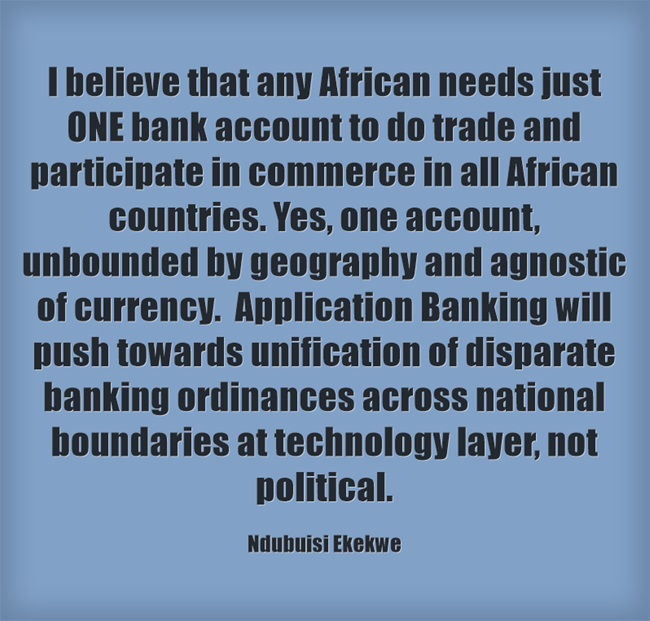
Application Banking will push towards unification of disparate banking ordinances across national boundaries at technology layer, not political. I believe that any African needs just ONE bank account to do trade and participate in commerce in all African countries. Yes, one account, unbounded by geography and agnostic of currency. Making that happen will be perception demand outcome of the application banking.

Application Banking will deliver many elements of Perception demand in banking. It will do to Banking 2.0 what it did to old generation banking institutions: disruption. Sure – those Banking 2.0 are not waiting to be devoured – they are competing.

LinkedIn Comment on Feed

Hmmm… but given the existence of multiple currencies, modeled around national boundaries, how would the settlement of the cross-border flow of funds happen? Tokenisation?

My Response: Application banking era will solve those issues at “technology layer” with no need to have any political harmonization which has been hopeless. Give the compliance book, all elements will be on codes. Today’s rules will stay but technology will hide them out of the views of users.

“Technology Layer”… Prof, are you avoiding using the ‘B’ and ‘C’ words? (lol)

There are many paths to it – this is just starting.  I focus on the core elements without being tied to any brand. But do not think deep into it – WhatsApp could be the largest bank in Africa by 2030. The Application Banking does not mean banks are going to anchor that era. It is a shift and if you see the trajectories,

How do you do Perception Banking? [Video]

0
Ndubuisi Ekekwe with Bill Gates

Tomorrow, I will deliver a Keynote in one of Africa’s largest gathering of bank CEOs [invitation only, unfortunately]. These business heavyweights have put so much to get me here. I hope I will add value in their moments. This is one of the slides which I just started working on. I want to offer something that is fresh, stimulating and actionable. Yes, they will go back to their businesses with something of value. Of course, I will mount the podium with humility knowing that most of them are legends – with deep insights! I hope to add to that knowledge base. How do you do perception banking?

Ndubuisi Ekekwe with Bill Gates (right)

Crowdfunding is now a major vector of African self-empowerment – Naijafund

1

Crowdfunding is a method of raising monetary contributions, typically online, from a large number of individuals, family, friends, customers, individual investors amongst others to fund a venture or project.
Typically, three key agents are involved in crowdfunding:

  • (i) the crowdfunding platforms;
  • (ii) the donors; and
  • (iii) the campaign owners.

The crowdfunding platform is the site on which the campaign is created and the transaction takes place, the donor contributes funds, and the campaign owner receives the funds.

There are four different crowdfunding models. Donation-based (without rewards), reward -based (donors are offered tangible but non-financial rewards or products by campaign owners in exchange for their money), lending model (donors lend money to individuals, businesses or companies in third world countries. The donors usually receive their money back with interest), equity model (donors contribute funds to a private company in return for shares in the company or shares in the company’s profit or voting rights). This form of crowdfunding is illegal in Nigeria. Crowdfunding campaign categories vary from medical expenses, school fees, travel, wedding expenses, business funding, creative projects, political campaigns and much more.

Crowdfunding has grown exponentially worldwide but it is still in a relatively nascent phase in Africa. Africa experiences a slow adoption of online fundraising and financial contributions to African crowdfunding platforms account for less than 0.1% of the global crowdfunding market.
Its expansion as an alternative online funding option is hindered by: low Internet penetration, lack of awareness about crowdfunding among the general public, low social media usage, no legal and regulatory frameworks that define the crowdfunding rules in any African country and limited funds transfer and payments options in most African countries.

In spite of these challenges,the prospects of the African crowdfunding market are bright. The world bank noted that crowdfunding has the potential to create 2.5 billion dollars of investment a year in Africa alone by 2025. Today, crowdfunding is an acceptable source of alternative start-up funding. Entrepreneurs across Africa are now raising capital by crowdfunding and Africa has established many active locally appropriate crowdfunding platforms which collectively raised $32.3 million in 2015.

South Africa has a more mature crowdfunding ecosystem with more home-grown platforms than other African countries although it trails behind Kenya in donations received. Backabuddy platform in South Africa has raised over 100 million Rands from more than 125800 donors. Other African countries are also active in the crowdfunding ecosystem with home-grown platforms like Naijafund in Nigeria, Yomken in Egypt, M-Changa in Kenya,Thundafund in South Africa, Farmableme in Ghana and Akabbo in Uganda.

Crowdfunding is now a major vector of African self-empowerment. Through crowdfunding, Africans have the power to fund projects and causes they care about and drive their own economic agenda.


Naija contributed this to Forum. We liked it and have moved it to the mainboard.